
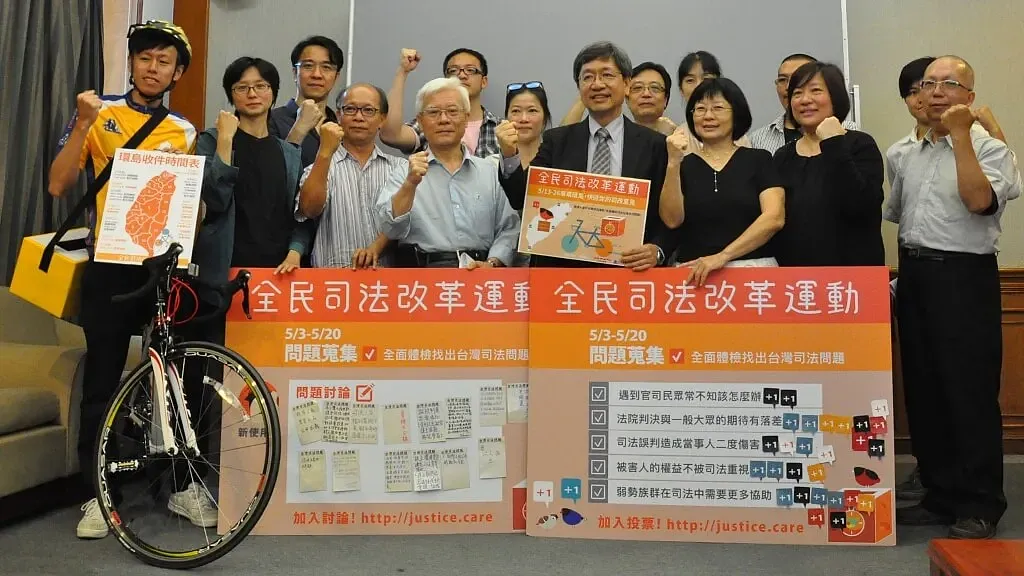
Reforming the Judiciary Starts with Asking the Right Questions: Press Conference on the Launch of the National Judicial Reform Movement
Last edited: 2026-07-27
With the inauguration of the new president on May 20, campaign promises of judicial reform still ring in our ears, but does the new government truly know "what is wrong with the judiciary?" Faced with deeply entrenched and stubborn judicial malpractice, "asking the right questions" is far more important than rushing to propose reform solutions.
"Asking the right questions" is crucially important, yet far from simple. In the past, whenever the government consulted on judicial issues, it invariably targeted judicial elites such as judges, prosecutors, lawyers, and legal scholars, operating under the assumption that only judicial elites understand the law while the general public does not. Little do they realize that judicial elites are precisely the ones who most need to be reformed. No wonder judicial reforms only seem to erode public trust further with each iteration.
Every year, millions of people participate in judicial proceedings. While ordinary citizens may not understand the law, they feel the sting of judicial flaws most profoundly. Orienting reform toward solving people's problems and broadening public participation is the correct direction for judicial reform. To this end, civil society organizations have jointly launched the "National Judicial Reform Movement":
- Goal: Give Me a Healthy Judiciary—A Permanent Judicial Reform Mechanism
- Features: Expanded participation, openness and transparency, legal education
- Three Phases:
-
Health Check Phase (May 3–May 20: Problem Collection)
A comprehensive physical check-up to gather opinions from all sides and understand where people feel the judiciary has problems. -
Fitness Evaluation Phase (May 21–July 1: Preparation; July 2 & July 9: "Evaluation Conferences")
Evaluating the potential structural causes behind the judicial problems identified during the health check. -
Training Program Phase (July 10–Mid-August: "Solution Brainstorming Conferences")
Proposing various judicial reform solutions targeting structural causes, listing their pros, cons, and complementary measures to seek consensus on reform.
-
Health Check Phase (May 3–May 20: Problem Collection)
Today, the National Judicial Reform Movement website (http://justice.care) is officially launched. The first phase, the online "Health Check" for problem collection, will run from May 3 to May 20. We sincerely invite the public to visit the website to submit their questions regarding the judiciary and vote on the judicial issues they resonate with. The judicial issues receiving the most public concern will serve as the primary focus for the second phase of judicial problem evaluation.
To gather grassroots public opinion from across the country, the "Cycling Around Taiwan: Delivering Local Judicial Reform Opinions" campaign will be held concurrently from May 13 to May 25 (click here for dates and locations). Cyclist couriers will personally collect the public's judicial grievances at 19 district courts and summary courts across Taiwan. These will be compiled alongside online submissions and delivered to the Office of the President on May 25.
Participating organizations of the "National Judicial Reform Movement" will also request a meeting with President Tsai Ing-wen, calling on the new government to actively listen to public opinion, gather public feedback on judicial reform, and plan judicial reform policies oriented toward solving the people's problems. To all partners who hold expectations and passion for Taiwan's judiciary, now is the time to step forward. Join us in the "National Judicial Reform Movement"!
For detailed information on the National Judicial Reform Movement, please visit the website: http://justic.care
Post-Event Press Release
Today's press conference launching the "National Judicial Reform Movement" announced the release of the event website (http://justice.care/). Citizens can vote online on judicial issues and submit problems they consider important; public participation is warmly welcomed. Participating organizational representatives voted on judicial reform issues at the press conference, with the results as follows:
- Court judgments disconnect from the expectations of the general public (8 votes)
- Vulnerable groups need more assistance within the judiciary (8 votes)
- Wrongful convictions inflict secondary trauma on the parties involved (4 votes)
- The rights and interests of crime victims are not valued by the judiciary (4 votes)
- Citizens often do not know what to do when facing lawsuits (2 votes)
From May 13 to 25, the "Cycling Around Taiwan: Delivering Local Judicial Reform Opinions" campaign will take place, led by Huang Wei-ting, Director of the Judicial Reform Foundation's Central Office. She will cycle around Taiwan, connecting 19 district courts to personally receive the public's opinions on the judiciary. At the final stop of the cycling tour, the collected opinions will be delivered directly to the Office of the President. The press conference showcased the cycling tour equipment and route map, demonstrating a steadfast commitment to valuing local voices. The main points made by representatives of various organizations are as follows:

JRF CEO KAO Jung-chih stated: 2016 is a critical year for judicial reform. If there is no sound progress within the next year or two after the new government takes office, the judiciary is likely to collapse completely. The newly elected president has promised to convene a national judicial reform conference upon taking office. This conference must not be confined to official figures alone; civil society must also pay close attention. Furthermore, it should not merely be a conference, but a movement. This is the very reason why civil society initiated the "National Judicial Reform Movement."
Association for Judicial Reform (JRF) Chairperson LIN Yung-sung stated: When the National Judicial Reform Conference was organized in 1999, it was predominantly composed of legal professionals. Legal professionals devised the judicial reform issues and carried them out themselves. While judges and prosecutors engaged in practical work certainly understand the law, they do not understand the pain and concerns of ordinary people caught in the judicial system, nor do which problems are more severe or should be prioritized. Judicial reform should focus on enabling the people to raise judicial issues. The civil society organizations participating today promote work across various fields and experience vastly different judicial problems. Ordinary people similarly face a multitude of different issues with the judiciary. With the goals of openness, transparency, and expanded public participation, the Judicial Reform Foundation works alongside other organizations to establish the "National Judicial Reform Movement Website," hoping that the public can ask, "Where is the judiciary flawed?" At the same time, we will embark on a cycling tour around Taiwan to gather local judicial reform opinions. After consolidating the webpage information, we will deliver these judicial reform opinions directly to the President, ensuring the President understands the voice of the people and giving a clear direction to the upcoming judicial reform conference.

Taiwan Association of University Professors (North Taiwan) President CHANG Yeh-sen stated: The judiciary must uphold both procedural justice and substantive justice in order to truly safeguard public safety.

Rule of Law Education Foundation Office Director TSENG Shou-i stated: The judiciary is too distant from the people. To bring people closer to the judiciary, legal popularization education must be promoted. For instance, Judicial Yuan interpretations are written like heavenly books merely to showcase the erudition of the Grand Justices. The Secretariat should translate them into plain language so the public can understand them and have their rights protected.

Awakening Foundation Legal Department Director CH'IN Chi-fang stated: The Awakening Foundation focuses on domestic relations adjudication. Without reasonable judicial judgments, the judiciary will have a severe impact on families. Additionally, vulnerable groups such as foreign spouses and people with disabilities need assistance within the judicial system. Finally, judicial personnel generally lack gender awareness; for instance, Grand Justices have ruled that women cannot become clan members (pai-hsia-yuan), demonstrating deficiencies in the judicial review process regarding the promotion of substantive equality.

Taiwan Association for Assuring Jury Trials Vice Chairperson CHIANG Nien-tsu stated: Over the decades, "dinosaur judges" have handed down many unacceptable judgments that society cannot accept—such as the White Rose movement taking to the streets to push for the Judges Act, and the Hung Chung-chiu incident which consigned military trials to history. Court judgments urgently need massive improvement. The rights of crime victims are disregarded by the judiciary, such as failing to implement confiscation systems to compensate victims. Another judicial problem raised is the lack of institutional separation between the judiciary and the prosecution, which creates formidable obstacles to judicial reform. If the judiciary and prosecution are too cozy, caring only about their own rights and privileges while remaining indifferent to the national system, the rule of law is torn apart and rational discourse becomes impossible.

Yunghe Community College Specialist CHU Chih-hao stated: People all need basic legal knowledge. Everyday law courses offered by community colleges are frequently packed to capacity. When facing lawsuits, students often ask instructors how to handle their cases. The public truly needs assistance with such legal resources, and prison administration reform is another key focus of judicial reform.

Credit Card Debtors' Self-Help Association Representative HSU Tung-jung stated: Judges handling debt relief cases lack professional training sufficient to keep pace with societal developments. Numerous examples show that victim rights are not valued by the judiciary, and some judges even dictate the direction debtors should take, which directly violates the spirit of the Statute for Debt Clearance.

Taiwan Association for Assuring Jury Trials Supervisor TAI Hsiu-fen stated: Non-legal professionals should care even more about the fairness of law enforcement in Taiwan. For instance, the non-prosecution disposition in the Military Police search case showed an immense disconnect from public expectations. Furthermore, because the judiciary lacks independence and acts as a mouthpiece endorsing government policies—such as in the Hsiao Hsiao-ling case—justice for vulnerable groups was not served, and the parties involved received no assistance. This has caused severe public distrust and disappointment in the judiciary, which is precisely where Taiwan's judiciary needs to respond to the people.

Taiwan Association for Human Rights Secretary-General CH'IU I-ling stated: The Cheng Hsing-tse, Su Chien-hsuan, and Chiang Kuo-ching cases demonstrate that wrongful convictions not only harm defendants but also inflict severe trauma on victims' families who cannot obtain the truth. Vulnerable groups, such as foreigners, migrant workers, and refugees, also struggle to obtain necessary assistance within the judiciary. Currently, the judicial system lacks a sufficient understanding of international human rights conventions, and courts apply their own interpretations when dealing with these provisions. For instance, regarding privacy, housing, and the right to freedom of assembly and procession, courts fail to properly apply the conventions, continuing to adjudicate based solely on domestic law. The determination of judges to defend fundamental rights is utterly lacking.

Taiwan Forever Association Executive Secretary HUNG Ts'ung-yen stated: Taiwan Forever Association focuses on discourse and accountability. Many judges, prosecutors, and police officers frequently engage in malicious litigation, abuse of power, and wrongful convictions or investigations. The harm caused by wrongful judicial decisions can even surpass the initial harm itself. It is exceptionally difficult to hold accountable or prosecute judges and prosecutors who make erroneous judgments. Whether it is individuals being prosecuted for street protests or political figures investigated due to political circumstances, achieving corresponding accountability is impossible, which constitutes a severe problem.

Environmental Jurists Association Secretary-General LIN Jen-hui stated: In environmental cases—whether involving pollution or government development projects—court judgments often dismiss public lawsuits on grounds of legal standing. Rights to health or property are only recognized if one resides within 5 kilometers of a development project, ignoring the rights and interests of people downstream who drink or use the water source. Victim rights are disregarded by the judiciary, and we urge the administrative courts to establish specialized environmental divisions.

Association for Work-related Injury Victims Specialist LIU Nien-yun stated: People should be empowered to better master legal tools and discourse. Administrative agencies are sluggish in handling injury issues, leading many occupational accident workers to rely on litigation as their defensive line to protect their rights. With the executive branch doing so little, the judicial system becomes critically important. Facing occupational accident workers who are rapidly thrust into lawsuits, we hope legal professionals within the judicial system clearly understand their roles.

Father Nguyễn Văn Hùng of the Vietnamese Migrant Workers and Brides Office stated: Judges presiding over cases often harbor biases against new immigrants and migrant workers, revealing a presumption of guilt during questioning. Translation training is also inadequate, and vulnerable groups require more assistance. Therefore, migrant worker and immigrant groups are very enthusiastic about participating in the judicial reform movement.
Attendees
Taiwan Association of University Professors (North Taiwan) President / CHANG Yeh-sen
Rule of Law Education Foundation Office Director / TSENG Shou-i
Awakening Foundation Legal Department Director / CH'IN Chi-fang
Taiwan Association for Assuring Jury Trials Vice Chairperson / CHIANG Nien-tsu, TAI Hsiu-fen
Yunghe Community College Specialist / CHU Chih-hao
Credit Card Debtors' Self-Help Association / HSU Tung-jung
Taiwan Association for Human Rights Secretary-General / CH'IU I-ling
Taiwan Forever Association Executive Secretary / HUNG Ts'ung-yen
Association for Work-related Injury Victims Specialist / LIU Nien-yun
Environmental Jurists Association Secretary-General / LIN Jen-hui
Vietnamese Migrant Workers and Brides Office / Nguyễn Văn Hùng
Judicial Reform Foundation CEO / KAO Jung-chih
Judicial Reform Foundation Chairperson / LIN Yung-sung
Press Contact
Judicial Reform Foundation CEO KAO Jung-chih 02-25231178
Appendix

This article is an AI-generated translation of the original Chinese text. In the event of any discrepancy, the Chinese version shall prevail.