
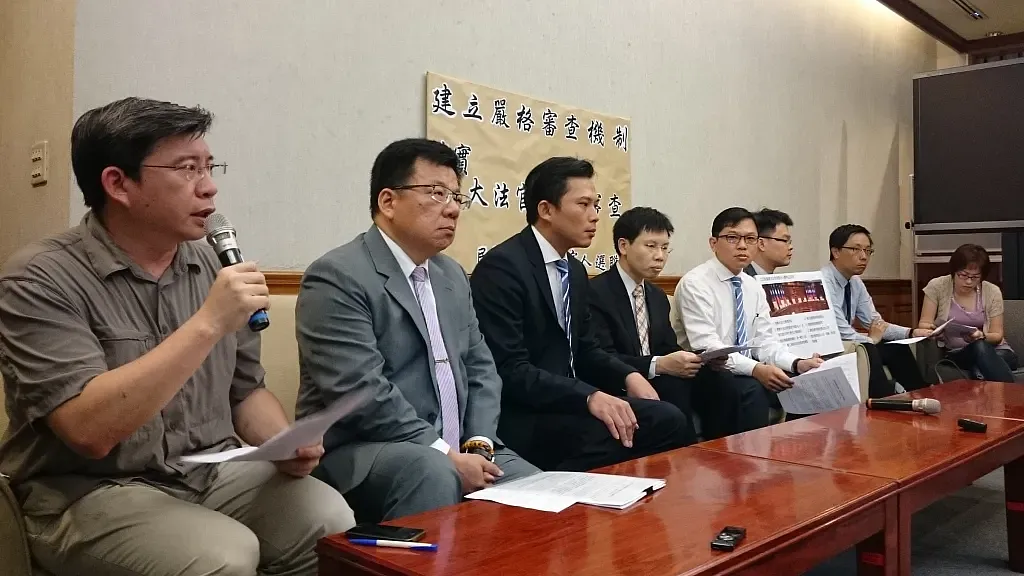
Establishing a Strict Review Mechanism to Implement the Screening of Grand Justice Nominees – Press Conference by the Alliance for Monitoring Grand Justice Nominees
Last edited: 2026-08-31
Since its establishment in 2003, the Alliance for Monitoring Grand Justice Nominees has successively formed six evaluation committees to monitor and evaluate past Grand Justice nominees and has produced evaluation reports; regrettably, current laws and regulations are overly rudimentary, causing the screening of past Grand Justice candidates to often become a mere formality and drawing much criticism from public opinion and society.
Grand Justices are guardians of constitutionalism and hold the ultimate power of constitutional interpretation. The Legislative Yuan naturally has a duty to exercise strict supervision over the quality of Grand Justice nominees to safeguard the well-being of all citizens. However, current laws do not provide detailed review procedures. For the screening of nominees, the Legislative Yuan often arranges schedules hastily. With only a half-day public hearing and a one-day review meeting, each legislator is given a mere 15 minutes for questioning, which is further conducted in a collective Q&A format. If nominees provide evasive answers to run out the clock, personnel appointments ultimately end up being decided perfunctorily.

In response, the Alliance repeatedly calls for: (1) The Legislative Yuan should schedule the review process in advance and must not make hasty and careless decisions; (2) Questionnaires should be distributed to nominees in advance, and they should be required to provide review materials such as representative achievements, publications, and judgments; (3) A two-round review mechanism should be adopted, with the first round in committee review and the second round in plenary review; (4) Multiple nominees should be reviewed individually; (5) Committee reviews should hold hearing procedures; (6) Reports should be produced after reviews; and (7) The exercise of the consent power should take place one week after the report is produced. In addition, after making nominations, the President should explain in detail the nomination criteria for nominees across various fields and promptly submit relevant review materials of the nominees, including educational background, work experience, property, and taxation, to the Legislative Yuan for reference.
Recently, the Democratic Progressive Party (DPP) caucus and the New Power Party (NPP) caucus have successively proposed amendments to the Law Governing the Legislative Yuan's Power concerning the exercise of the consent power: regarding the review schedule, the DPP believes it should not be less than one month, while the NPP believes it should not be less than two months; regarding the review of multiple nominees, both parties believe they should appear and take questions separately, and review reports should be produced. The DPP caucus additionally added the power to hold hearings, while the NPP imposes an obligation on nominees not to make false statements. Although the Alliance believes that the contents of the amendments proposed by both parties this time still have room for improvement, it also hopes that this legislative amendment can be completed as soon as possible. It further hopes that separate regulations for the personnel review of Grand Justices can be enacted to thoroughly implement substantive supervision of Grand Justice nominees.
To take a step back, even if this legislative amendment fails to catch up with the review operations for the new Grand Justice nominees, under the current legal system, the Legislative Yuan should still proactively adopt the strictest review process standards to conduct a substantive review of the upcoming Grand Justice nominees.
Finally, as the new government is about to take office, the controversy over the constitutional roles of the President and Vice President of the Judicial Yuan has resurfaced again. The President and Vice President shoulder the implementation of judicial policies and must be held accountable for the success or failure of judicial policies. Therefore, in the past when a new president assumed office, the President and Vice President of the Judicial Yuan would resign following precedent to demonstrate responsibility for previous judicial policies. However, Grand Justices, as the ultimate guardians of the judicial constitution, should uphold the separation of powers among the executive, legislative, and judicial branches and should not overlap with executive power; the design of judicial power under the current Constitution makes the President and Vice President of the Judicial Yuan policy promoters of judicial administration, which indeed conflicts with the judicial nature of Grand Justices. It is hoped that President Tsai Ing-wen, after taking office, will carefully consider the issue of judicial independence and promptly make the Judicial Yuan an adjudicative organ through constitutional amendment to resolve the existing judicial and constitutional deadlock.
Attachments
- Personal Information Questionnaire for Judicial Yuan Grand Justice Nominees
- Nomination and Review Schedules of Past Grand Justices
- Draft Amendments to the Law Governing the Legislative Yuan's Power by the DPP and NPP
Alliance Attending Representatives
Attorney Cheng Wen-ting / Secretary-General, Taiwan Law Society
Professor Chiu Wen-tsung / President, Taiwan Association for Human Rights (Clarion Society)
Attorney Lin Chun-hung / Director, Taipei Bar Association
Attorney Weng Kuo-yen / Vice Chairperson, Taiwan Association for Human Rights
Attorney Kuo I-ching / Board Member, Awakening Foundation
Professor Tu Yu-yin / Director, Taiwan Forever Association
Secretary-General Chang Hung-lin / Secretary-General, Citizen Congress Watch
Attorney Lo Shih-hsiang / Executive Director, Taiwan Association for Innocent Victims (Association for Wrongful Convictions)
Attorney Kao Jung-chih / Executive Director, Judicial Reform Foundation
Political Party Attending Representatives
Legislator Li Chun-i / Convener, DPP Parliamentary Reform Group
Legislator Lin Wei-chou / Kuomintang
Legislator Huang Kuo-chang / New Power Party
Alliance Members
Taiwan Law Society
Clarion Society
Taipei Bar Association
Taiwan Association for Human Rights
Awakening Foundation
Taiwan Forever Association
Citizen Congress Watch
Taiwan Association for Innocent Victims
Judicial Reform Foundation
Press Contact
Attorney Kao Jung-chih, Executive Director, Judicial Reform Foundation 02-25231178
This article is an AI-generated translation of the original Chinese text. In the event of any discrepancy, the Chinese version shall prevail.