
An Ordinary Life, a Vindicated Injustice: How Difficult Is It? An Interview and Documentary on the Wrongful Conviction of Offense of Undue Enrichment
Last edited: 2026-07-27
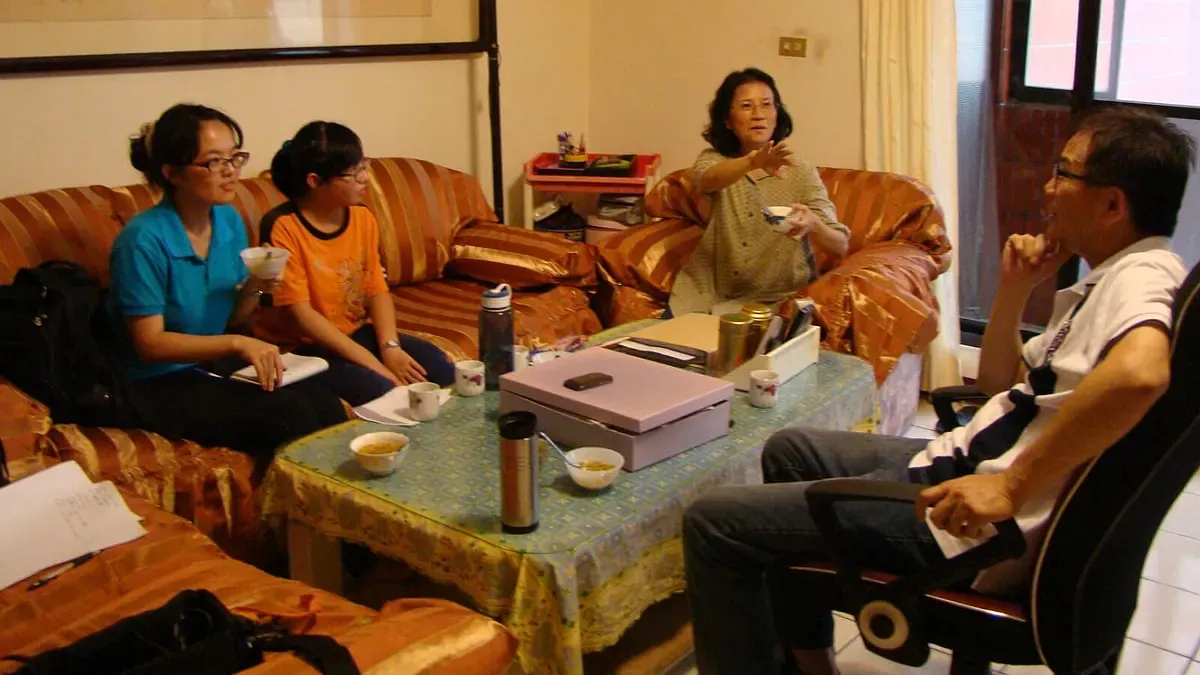
Photo/Mr. Liu Hsiang-heng was wrongfully imprisoned and finally regained his freedom in June 2014. During the interview, we shared a bowl of Aiyu jelly with Mr. Liu and his sister. Such an ordinary life may be taken for granted by us; but for Mr. Liu and his sister, it is a hard-won reunion.
Gray skies carried signs of afternoon thunderstorms, and raindrops occasionally falling during the drive hit the windshield. Today's weather was different from the previous few days, hazy and suffocatingly oppressive. On the afternoon of Wednesday, August 27, I took my sister and JRF full-time staff member Wei-ting to the home of Mr. Liu Hsiang-heng's older sister located in Longtan Township, Taoyuan County. In fact, I had spoken with Mr. Liu on the phone once before. From our conversation, I could perceive his cautious yet friendly speech, as well as his sister's gentle tone, both of which added a bit of curiosity and anticipation to this interview.
An Ordinary Life: Simple yet Flavorful
Mr. Liu Hsiang-heng was born in Taichung, a place where seasons are spring-like year-round, and where his parents settled after following the National Government to Taiwan in 1939. His mother passed away when he was in the second grade of elementary school. From a young age, his father had to raise eight children alone. Although his father tried two or three different jobs during this period, what he yearned for most was a peaceful life of farming and reading. On a piece of land in Takeng, Taichung, he built chicken and duck coops, and read a little poetry and books; this was his father's most comfortable way of supporting his family and living his life.
"Finding joy in poverty and adhering to one's principles" could be said to describe us at that time. We did not pursue fame and fortune; as long as life was comfortable, we were satisfied.
As Mr. Liu Hsiang-heng's older sister—Ms. Liu Hsiang-ling—recounted the past, she added this footnote to the bits and pieces of their old life.
Precisely because they followed the National Government to Taiwan, Mr. Liu Hsiang-heng's parents gave up a comparatively better environment in China. Subsequently, his mother fell ill, and the hefty medical expenses at the time truly brought a heavy financial burden to the family. Over the years, the family's financial situation was no longer what it used to be. Under such realistic pressure, Mr. Liu Hsiang-heng resolutely decided to apply for and enter a military academy.
Mr. Liu Hsiang-heng's go-with-the-flow personality was fully manifested throughout his career, which can be seen in his successive job transitions. After serving in the military for six years, Mr. Liu Hsiang-heng passed the civil service examination for local government personnel, working successively at a township office for three years and the Taoyuan County Government for four years. During this period, he also transferred to different units, conscientiously yet enthusiastically attempting challenges in different fields in accordance with his superiors' assignments. Later, due to understaffing at the county government compounded by improper work allocation, which led to multiplied stress, Mr. Liu Hsiang-heng requested a transfer to the Kueishan Household Registration Office, serving as a section chief. However, Mr. Liu Hsiang-heng's eventful career had not ended here...
During the interview, one could perceive from the speech of the Liu siblings that their outlook on life has always been understated, no different from an ordinary family, with no special demands for success and fame. Perhaps driven by such a personality, in December 2000, the Taoyuan County Government reassigned Mr. Liu Hsiang-heng as the Director of the Taoyuan County Stadium, promising that it was only a temporary three-month assignment after which a new director would assume the post. Since it was a commission from his superiors, given Mr. Liu Hsiang-heng's personality, it was impossible for him to refuse. Although his superior at his original post—the Director of the Kueishan Household Registration Office—strongly opposed him entering such a right-and-wrong-laden place as the Taoyuan Stadium, Mr. Liu Hsiang-heng resolutely took up the post and accepted the assignment from the Taoyuan County Government.
"My thought at the time was that since someone else needed me, I would just help out, that's all. Who would have known... sigh!" Mr. Liu Hsiang-heng did not anticipate at the time that such a temporary job reassignment would drop a bombshell into his peaceful life and profoundly affect the rest of his life.
A Distorted Life: Accidentally Entangled in a Case of Undue Enrichment
Having just taken office as the director, Mr. Liu Hsiang-heng was not yet familiar with all affairs; nevertheless, he still actively promoted activities such as athletic classes and winter/summer recreation camps, bringing new changes to the stadium. Because he was unfamiliar with the stadium's operations, he basically respected the opinions of the handling personnel and would thoroughly consult senior staff in the stadium when encountering issues for discussion. However, all of this completely changed after the "Xi'an Terracotta Warriors Exhibition"...
In mid-May 2001, Hsiu Kang Enterprise Co., Ltd. (hereinafter Hsiu Kang Co.) sent an official letter requesting to lease the gymnasium under the jurisdiction of the stadium to host the "Xi'an Terracotta Warriors Exhibition." Mr. Liu Hsiang-heng and other civil servants handling leasing operations originally approved calculating the venue rent based on a "commercial exhibition" under a "non-ticketed" model, and the exhibition was approved by the Taoyuan County Government on June 6, 2001. Thereafter, citing that the exhibition period was too short to cover costs, Hsiu Kang Co. requested an extension, and the Taoyuan County Government approved the record of the extension on July 10, 2001.
However, Hsiu Kang Co. again requested a city councilor to issue a document on July 13, 2001, hoping to be granted a discount on the venue rent. The Taoyuan County Government forwarded it to the Education Bureau, which in turn forwarded the document to the stadium for handling. The handling personnel stated that this case belonged to a "commercial exhibition" and rent reduction discounts could not be granted. In the end, the Magistrate of Taoyuan County endorsed deferring the matter of rent reduction discounts.
However, during the exhibition period on August 1, 2001, the accounting personnel changed, and Kuo Shu-fang, an accountant from Chianguo Elementary School, took over concurrently. On August 6, 2001, when the exhibition concluded, the handling personnel charged Hsiu Kang Co. using the calculation method of a "commercial exhibition" under the "non-ticketed" model. Nevertheless, the newly appointed accountant Kuo Shu-fang believed that calculation should be based on the "ticketed" model, whereas the handling personnel of the venue section stated in an official memo that the original calculation method should be maintained, and Kuo Shu-fang noted her opinion on the memo. Mr. Liu Hsiang-heng endorsed adopting the original calculation method.
Unexpectedly, on December 12, 2002, the Anti-Corruption Office of the Taoyuan County Government sent a letter to the Anti-Corruption Task Force of the Taoyuan District Prosecutors Office, requesting them to investigate and prosecute this case. Prosecutors directed the Taoyuan County Investigation Station to intervene and investigate the case starting in March 2004. The prosecution determined that if calculated using the "ticketed" model, the amount should be several million NT dollars higher than that calculated using the "non-ticketed" model. Therefore, they concluded that Mr. Liu Hsiang-heng and other civil servants had unduly enriched Hsiu Kang Co., and prosecuted them for the offense of undue enrichment. Throughout the successive trials, Mr. Liu Hsiang-heng and four other accused civil servants were found guilty in some judgments and not guilty in others; there was also a High Court judgment dismissing the prosecution, and the Supreme Court revoked and remanded the case three times. However, among the five civil servants prosecuted together, the other four were successively acquitted with finality. Ultimately, during the retrial (third remanding), the court convicted only Mr. Liu Hsiang-heng of the offense of undue enrichment, sentencing him to 5 years and 6 months of imprisonment, which finally became final in 2011, and he was sent to prison to serve his sentence.
The Long Road to Vindication: When Will It End?
In this case, we believe there are many unreasonable aspects. As Mr. Liu Hsiang-heng said, because he was unfamiliar with the stadium's operations, and according to standard procedures, vendors negotiating leasing operations dealt directly with the handling personnel; Mr. Liu Hsiang-heng, serving as the stadium director, would not directly face vendors but rather oversaw the stadium's overall operations, and naturally had no way to unduly enrich the vendor. Furthermore, Mr. Liu Hsiang-heng did not even know the personnel from Hsiu Kang Co., let alone harbor any intent to unduly enrich the vendor. In addition, the calculation method for venue rent was not clearly explained in the stadium's relevant regulations, leading civil servants to be unable to clearly distinguish it. However, after Mr. Liu Hsiang-heng made detailed inquiries to the Taoyuan County Government, the conclusion he obtained was no different from the original handling of Hsiu Kang Co., which was obviously favorable to Mr. Liu Hsiang-heng. However, this only occurred after the criminal judgment became final. According to the law, the county government's official document belonged to newly discovered facts arising after the fact, so a retrial could not be initiated. Mr. Liu Hsiang-heng's case had reached an impasse at this point.
"I consider myself innocent, so I don't read the judgment very much, because reading it only makes me angrier," Mr. Liu Hsiang-heng said calmly. Although in June of this year he was released on parole due to good behavior in prison, it still haunts the Liu siblings like a nightmare, and the ruthless court judgment baffles them. Even his former colleagues took the initiative to extend a helping hand, showing how difficult it is to associate Mr. Liu Hsiang-heng's conduct with a criminal offense of undue enrichment.
The doubts and grievances of the siblings regarding the judgment are not without reason. In the court's judgment, the judge merely used deduction to pin the offense of undue enrichment on Mr. Liu Hsiang-heng, devoid of direct and powerful evidentiary derivation, and even less capable of effectively explaining whence Mr. Liu Hsiang-heng's intent to unduly enrich others came. Such a shoddy judgment is naturally difficult to convince the public!
From here, one can glimpse a corrupt corner of the legal system. Prosecutors failed to ascertain the facts and indiscriminately prosecuted under conditions of insufficient evidence. Although shouting slogans of cracking down on crime, rash prosecution is like merely accumulating performance metrics, yet it inflicts lifelong, irreparable harm upon the people! Meanwhile, under circumstances where judges handle excessive cases, facing a controversial case like undue enrichment, it ultimately took on the implication of perfunctory dismissal, leaving stadium director Mr. Liu Hsiang-heng to shoulder this charge entirely alone—which is astounding! The Liu siblings actively sought assistance from government units, but constrained by formal conditions, they were often turned away. Can the truth of facts and the grievances of the people really fail to break through these man-made formal conditions? When the state grants people avenues for remedy, it simultaneously imposes numerous conditions, leaving people at a loss and helpless when facing predicaments, which is truly extremely unfair to the people!
During the interview, we could feel Mr. Liu Hsiang-heng's sense of injustice regarding the judgment. He considered his actions upright, having never embezzled a single cent from the state, let alone engaged in underhanded acts. Although indignant, he still calmly detailed the cause and effect of the incident to us. Although the days of serving time in prison have passed, in the future he still has to face the cold remarks of outsiders. What he hopes for is to wash away his wrongful grievance as soon as possible and return to his original smooth and stable days.
Can the state admit its mistakes and discern the truth with absolute clarity? As a legal professional, I should optimistically believe that the grievances of the people will eventually be vindicated. But for Mr. Liu Hsiang-heng? This will be yet another long road, and when the end will be reached remains unknown.
This article is an AI-generated translation of the original Chinese text. In the event of any discrepancy, the Chinese version shall prevail.
