
Cycling Around Taiwan: Starting from the Justice Problems of the Most Vulnerable! - Press Release on the Taoyuan District Court Event
Last edited: 2026-07-27
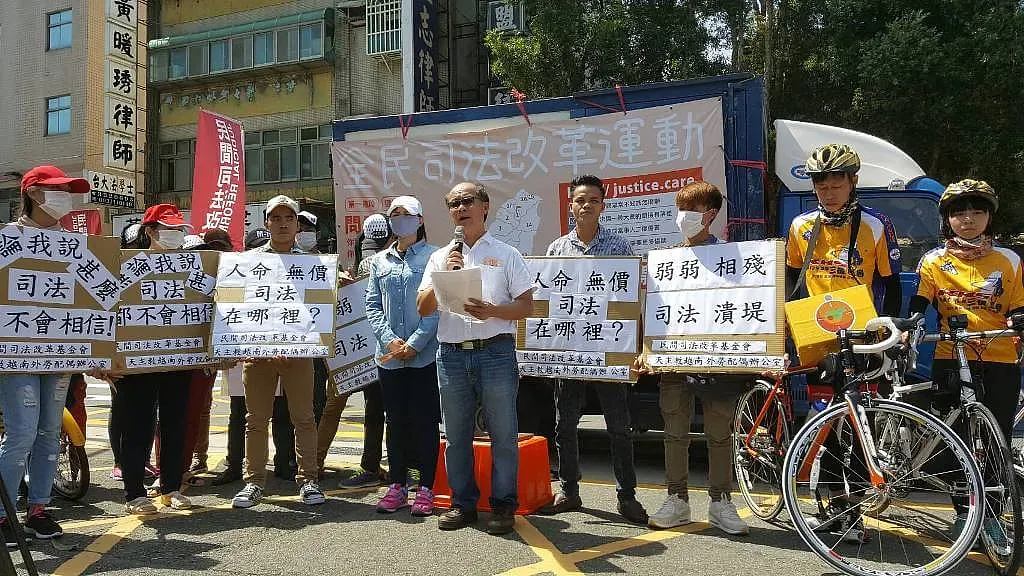
The Judicial Reform Foundation invites the public to join the judicial reform movement! On May 4, the Public Judicial Reform Movement Website was officially launched to collect the public's opinions on the judiciary. In addition, the "Cycling Around Taiwan: Delivering Local Judicial Reform Opinions" event kicked off today (May 13). From May 13 to May 25, three riders from the JRF Taoyuan/Taichung Office—Director Huang Wei-ting, Executive Secretary Ch'en I-chen, and volunteer student Ch'en Hsin-i—will visit every district court across Taiwan to gather the public's views on the judiciary and hold the "Cycling to Deliver the Judicial Reform Dream" forums to talk about justice with everyone.
As the first stop of the cycling tour around Taiwan, the team departed from the Taoyuan District Court on May 13 at 09:30. Father Peter Nguyen Van Hung of the Catholic Diocese of Hsinchu - Migrants and Immigrants Service Center (co-organizer) released three cases today to analyze the predicaments faced by migrant workers in judicial trials. Deputy Director Cheng Chen-chen of the Taoyuan Servants Association Migrant Worker Shelter also spoke about common judicial problems encountered by migrant workers, jointly advocating that judicial reform must begin with safeguarding the rights of the most vulnerable. Other citizens coming forward to voice their grievances included former Director Liu Hsiang-heng of the Taoyuan County Stadium, who maintained he never took a cent from the state but was sentenced to 5 years and 6 months in prison for malfeasance; and the mother of Yang Shih-chun, a petitioner for the individual evaluation of a prosecutor from the Taoyuan District Prosecutors Office, who complained that her son was handed a life sentence based on an identification from a single photograph, yet the Prosecutor Evaluation Commission refused to penalize the prosecutors office for violating procedural rules on the grounds that the two-year statute of limitations for evaluation had expired. Details of the cases can be found in the following attachments:
-
Nursing Home Exploitation of Migrant Workers Case
"We are a newly established nursing home currently with 48 beds, thousands of pings of green space, and a pleasant, comfortable environment. An Chia's management philosophy is to ensure that residents' physical, mental, and spiritual well-being receive comprehensive care, and we look forward to like-minded partners joining us in our common endeavor." This was a recruitment ad published by a nursing home in Taoyuan; however, the actual working environment was akin to a slave factory.
The seven migrant workers employed by the nursing home had their cell phones, passports, and alien resident certificates confiscated by their employer. They had no independent rooms to rest in, with their beds separated only by cloth curtains, and surveillance cameras recorded them 24 hours a day. They worked up to 18 hours a day without days off or overtime pay. If an electric mosquito repellent plug was left unplugged, garbage uncollected, if they dozed off, or if they conversed in Vietnamese or Tagalog, their wages would be docked. They were also arbitrarily assigned duties outside of caregiving, such as mowing grass across thousands of pings of green space.
Unable to bear the exploitation, the migrant workers sought help externally through relatives, friends, and the 1955 hotline. After the Hsinchu City Investigation Station verified that the situation met the criteria for human trafficking, they were sheltered, and the case was referred to the Taoyuan District Prosecutors Office. Unexpectedly, the prosecutor held that since the migrant workers were able to seek help externally, the situation did not meet the requirement under Article 34 of the Human Trafficking Prevention Act of being in "a situation where one cannot, does not know how to, or finds it difficult to seek help," and thus issued a non-prosecution disposition in favor of the person in charge of the nursing home. Organizations assisting migrant workers stated that Taiwan's prosecution and conviction rates for Human Trafficking Prevention Act cases have been chronically low, offering severely insufficient protection to migrant workers.
Case Profile
Parties 7 migrant workers Case Type Human Trafficking Prevention Act Judicial Problem Chronically low prosecution and conviction rates in labor exploitation cases under the Human Trafficking Prevention Act. Relevant Judgments Taoyuan District Prosecutors Office 104-Year-Su-Chen-No. 14610 and No. 19290 Non-Prosecution Disposition A Word to the Judiciary The vulnerable prey on the vulnerable, and the dike of justice collapses.
Catholic Diocese of Hsinchu - Migrants and Immigrants Service Center / Supervisor Li Hui-ling -
Mysterious Death of a Welder Case
"Other people's lives are framed in gold and wrapped in silver; our lives are worth nothing." These are lyrics from *Gold and Silver*, and they also portray the reality of migrant workers in Taiwan.
In 2004, Hualien Tzu Chi Hospital received a patient suffering from severe electrical burns who could not regain consciousness despite emergency treatment. Pham Ngoc Hung was found at the construction site of Hsiulin Elementary School's school buildings, lying near a leaking school building water pipe with an electric welding machine beside him. The worker and construction contractor who voluntarily took Pham Ngoc Hung to the hospital unanimously stated that they did not know Pham Ngoc Hung, that no one had employed him, and that no one knew why he mysteriously appeared at the school construction site. Upon reviewing records of Pham Ngoc Hung remitting money to Vietnam, the prosecutor discovered that the contractor's ex-wife had twice helped Pham Ngoc Hung remit money. However, the ex-wife claimed she happened to be running errands at the bank when an unfamiliar woman whom she had only seen at the market asked her to help remit the money, so she helped out of kindness and did not know Pham Ngoc Hung at all. Nevertheless, shortly after the incident, Pham Ngoc Hung's family members quickly received notification, and days after taking him back to Vietnam, he died from his severe injuries.
For 12 years, assisted by Father Peter Nguyen Van Hung and the Legal Aid Foundation, the family exhausted all judicial procedures, only to find no one held accountable for Pham Ngoc Hung's death and not a cent of compensation awarded. The impression Taiwan's judiciary left on the family is that a migrant worker's life is indeed worthless.
Case Profile
Parties Pham Ngoc Hung (Vietnamese migrant worker) Case Type Professional Negligence Resulting in Death Judicial Problem The judiciary handles cases involving migrant workers perfunctorily and with prolonged delays, exhibiting clear bias and discrimination. Relevant Judgments Supreme Court 103-Year-Tai-Shang-No. 2173 Criminal Case Successive Instance Judgments, Taiwan High Court Hualien Branch Court 97-Year-Lao-Shang-Yi-No. 3 Civil Case Successive Instance Judgments A Word to the Judiciary Human life is priceless; where is the defense line of justice?
Catholic Diocese of Hsinchu - Migrants and Immigrants Service Center / Supervisor Li Hui-ling -
Distorted Judicial Interpretation Case
The police asked: "When woman A was kissed by you, she screamed, bit your shoulder with her mouth, and shouted loudly that the boss was coming, whereupon you let go. Did this happen?" A-yung answered: "Yes!" The police asked: "Why did you intend to sexually assault woman A?" A-yung answered: "Because I like her." The police interrogation record documented the confession of A-yung, a Vietnamese migrant worker, in black and white.
What the social worker from the Catholic Diocese of Hsinchu - Migrants and Immigrants Service Center heard from A-yung was a completely different story. He said that on that morning, due to an electrical malfunction in the factory dormitory, he notified woman A, the factory accountant, to find someone for repairs. When woman A opened the door to check, a fruit knife on the door lintel was dislodged. A-yung pulled woman A away to dodge it, and because the room was cramped, the two lost their balance and fell onto the bed. A-yung stated that he indeed kissed woman A's cheek at the time, but had absolutely no intention of sexual assault. A-yung said he told the police this, but did not know why the record was written that way.
The Catholic Diocese of Hsinchu - Migrants and Immigrants Service Center helped A-yung find a legal aid lawyer and retrieve the audio recording disk of the police and prosecutorial interrogation. Only then was it discovered that the problem lay with the interpreter. Whether translating questions or answers, this interpreter—who apparently understood neither Chinese nor Vietnamese properly—seriously distorted the meaning, resulting in completely irrelevant dialogue. Later, during the prosecutor's re-interrogation, when A-yung wanted to explain that he had no intention of sexual assault at the time and tried to prove his innocence by showing there were no bite marks on his shoulder, the interpreter said, "Whatever you said over there at the police station, you must say the exact same thing here," refusing to translate according to his statement. Following the interrogation, the prosecutor indicted A-yung for the crime of妨害性自主 (offenses against sexual autonomy).
After being indicted, A-yung could neither work nor leave the country to return to Vietnam. With parents and two younger sisters at home, and as the economic pillar of his family, he repeatedly expressed how distressing it was not to be able to make money. Shortly afterward, he fled the shelter, presumably to take up odd jobs, and lost contact ever since. Taiwan's judiciary has long failed to value translation professionalism, and instances like A-yung's are numerous.
Case Profile
Parties A-yung (Vietnamese migrant worker) Case Type Offenses against Sexual Autonomy Judicial Problem Severe shortage and poor quality of judicial interpretation personnel. Relevant Materials Taoyuan District Prosecutors Office 104-Year-Su-Chen-No. 5032 Indictment and Police/Prosecutorial Interrogation Audio Transcripts. A Word to the Judiciary A-yung: No matter what I say, the judiciary will not believe it. -
Taoyuan Stadium Director Malfeasance Case
Ambiguous administrative practices may saddle a civil servant with a lifetime of integrity with the crime of profiteering for contractors.
In 2001, the Taoyuan Stadium had a standard for maintenance fee collection that looked fine at first glance, but felt rather odd upon closer inspection. Maintenance fees were divided into two billing modes: "ticketed" and "unticketed." Under the "unticketed" mode, it was prescribed that an additional venue fee be charged for "commercial exhibitions." The fee schedule did not specify how "ticketed" and "unticketed" were to be distinguished. Previously, selling individual seat tickets—like selling seat tickets for a basketball game—constituted ticketed; whereas commercial exhibitions charging an admission fee were unticketed.
That year, the "Xi'an Terracotta Warriors Exhibition" rented the stadium. Part of the exhibition area was free to visit, while another part charged an admission fee, so it adopted the unticketed mode but with an additional venue fee charged. The exhibition ran from July 12 to August 7. However, an accounting staff handover took place on August 1, and the newly appointed accountant took the view that the "Xi'an Terracotta Warriors Exhibition" should be billed under the ticketed mode, demanding that the exhibition contractor pay an additional NT$4 million plus in maintenance fees, leading to a serious conflict with the original handling personnel. In the end, Stadium Director Liu Hsiang-heng endorsed: "1. Temporarily continue to handle according to the current method. 2. Please expeditiously formulate a fee schedule and report it to the city government." However, rather than resolving the dispute, this invited intervention and investigation by the政風室 (Department of Government Ethics) and the Investigation Bureau.
The key basis upon which the prosecutor determined civil servant malfeasance was an official letter from a county councilor requesting favorable calculation of maintenance fees, and on this basis indicted five civil servants. After the indictment, the draft of the official document was located, confirming that the defendants had not accepted lobbying from the councilor; nevertheless, the wheels of justice did not stop. Following a protracted litigation lasting 10 years with alternating guilty verdicts, not guilty verdicts, and even dismissals, four defendants were acquitted with finality, but Stadium Director Liu Hsiang-heng was still sentenced to 5 years and 6 months in prison for malfeasance with finality. Director Liu maintained that he never took a cent from the state and had a clear conscience in handling this case; the real problem lay with the judiciary that sentenced him.
Case Profile
Parties Liu Hsiang-heng and 4 others Case Type Civil Servant Malfeasance (Profiteering) Judicial Problem - Overzealous indictments by prosecutors lacking evidence.
- Overly lenient elements of the crime of malfeasance, lacking clarity.
Relevant Judgments Supreme Court 100-Year-Tai-Shang-No. 3007 Criminal Case Successive Instance Judgments. A Word to the Judiciary Liu Hsiang-heng: Justice may be delayed, but making justice arrive is the mission of the judiciary. Learn More
-
Single Photograph Identification Case
Among 250 wrongful conviction cases in the United States exonerated through DNA evidence, 76% involved erroneous witness identifications, making it the primary cause of wrongful convictions. Taiwan's laws also have detailed regulations on how the police and prosecutors should conduct witness identifications, prohibiting suggestion, especially identification using a single photograph.
In 2006, Taoyuan Airport searched A-te's suitcase and seized over 4 kilograms of heroin. He stated that the two men who gave him the heroin containers in Thailand were "one tall, one short" and "one robust, one thin," and that they had met only once and did not know each other. Two years later, A-te, who was detained in a correctional facility, was brought to a video room where a prosecutor displayed a photograph on a remote communication screen and asked A-te if this was the person who gave him the heroin two years ago. Subsequently, the record stated: "A-te answered: Yang Shih-chun is the person who gave him the drugs."}p>
After being indicted by the prosecutor, Yang Shih-chun continually proclaimed his innocence and demanded a face-to-face confrontation with A-te. On November 30, 2011, the judge summoned A-te to testify. The prosecutor first conducted direct examination: "Do you know Yang Shih-chun?" A-te answered: "I don't know him." The prosecutor then asked why A-te had previously identified Yang Shih-chun as the person who gave him the drugs. A-te answered: "The photo does not look like the person." Disappointingly, the judge did not acquit Yang Shih-chun based on A-te's testimony in court, but instead sentenced Yang Shih-chun to life imprisonment with finality.
Facing a protracted wait with no end in sight as to when her son could return home, Yang's mother, heartbroken and distressed, decided to file a petition for individual prosecutorial evaluation, demanding disciplinary action against the prosecutor who handled the case in violation of identification regulations. However, Article 36 of the Judges Act stipulates that the statute of limitations for requesting a prosecutorial evaluation is only two years, starting from the time of indictment. Consequently, by the time a lawsuit concludes with a final judgment, it usually exceeds the two-year time limit for requesting an evaluation. Yang's mother's complaint was thus dismissed on procedural grounds for exceeding the time limit. She could not accept that the judiciary used a single-photograph identification made after two years to sentence Yang Shih-chun to life imprisonment, yet denied the public the right to request an individual evaluation of the prosecutor after two years.
Case Profile
Parties Yang Shih-chun Case Type Narcotics Hazard Control Act Judicial Problem - Single-photograph identification by the prosecutor, violating procedural rules of case handling.
- The two-year statute of limitations for individual prosecutorial evaluation is too short.
Relevant Judgments Supreme Court 102-Year-Tai-Shang-No. 1125 Criminal Case Successive Instance Judgments. Prosecutor Evaluation Commission 104-Year-Jian-Ping-Zi-No. 3 Evaluation Resolution A Word to the Judiciary Yang's Mother: I hope the judiciary returns justice to my son. -
Four Major Judicial Problems Frequently Encountered by Migrant Workers - Statement by the Taoyuan Servants Association
Spokesperson Deputy Director Cheng Chen-chen
Today, alongside two victimized migrant workers, we are attending the press conference held at the Taoyuan District Court for "Cycling Around Taiwan: Delivering Local Judicial Reform Opinions" to voice some of the problems migrant workers frequently encounter in the judiciary. The cases of migrant workers are all harrowing, and these workers have suffered massive losses due to flaws in our domestic system. Time is limited, so I have compiled them below rather crudely, but discussions and supplements from everyone are welcome.
- Service of Documents Issue:
The most severe problem is the service of documents. Migrant workers are often unable to obtain documents intended for them by judicial authorities. Whether enforcement orders or subpoenas, they are all mailed to the registered address of the employment agency or employer, and migrant workers frequently have no opportunity to receive them. For example, Arnold, an Indonesian factory worker, was suddenly scheduled for deportation one day without knowing what on earth had happened. When he later sought help from us, we discovered that the agency had failed to find him a new job or process his extension. Yet had he been given the opportunity to respond, he could have changed agencies and applied for an extension. As for why his agency neither helped convey the message nor assisted with translation, it was out of fear that the migrant worker would run away upon learning the bad news.
- Translation Issue:
Subpoenas, administrative dispositions, and enforcement orders are all in Chinese, as are orders for payment based on promissory notes. Even if migrant workers are fortunate enough to receive court official documents, they cannot understand the contents. Francis, a Filipino caregiver, once found out through a roundabout way after changing jobs that her former employer had received an official document concerning her. She asked a friend to retrieve it, but still could not understand the information inside. It wasn't until her day off the following month that she could take it to a friend who knew Chinese, only to find out it was an order for payment—specifically for a loan she had already finished paying off. She thus missed the deadline to file an objection, and as a result, the court assisted the loan company in forcibly deducting tens of thousands of NT dollars in excess from her wages. She is not alone; many caregivers have encountered the exact same situation, and we are currently researching how to help them reclaim this money.
- Unfriendly Judicial Authorities:
The police often refuse to accept crime reports filed by migrant workers, or fail to issue crime report receipt slips, nor do they invite judicial interpreters to the scene. Previously in Keelung, a migrant worker was accused of theft by her employer. During police interrogation, she did not know how to admit to something she hadn't done. Later, the police notified the agency's interpreter to attend, and the interpreter told her: "You have to confess so you can change jobs quickly." Under duress, she signed a confession, and only when she was about to be deported did she realize she had been misled by the interpreter's statements.
- Weak Social Support System:
Many migrant workers have no days off, and even when their legal rights are infringed, they lack the conditions to seek channels of relief. For instance, Ms. Nancy was falsely accused of fraud by her agency, and the address on the prosecutor's subpoena was also wrong, sent entirely to a place where she was not. When her friend managed to retrieve it for her, she discovered the hearing date had already passed. Wanting to take Nancy to apply with the Legal Aid Foundation, she found out that as a caregiver, Nancy only had Sunday off, yet the Legal Aid Foundation is closed on Sundays, and volunteer lawyer consultations are only held on weekdays.
Indonesian Caregiver Sexual Harassment by Care Recipient Case
Lili (pseudonym) is a caregiver responsible for taking care of an elderly man. Unexpectedly, about a week into her job, she was sexually harassed by the care recipient, and Lili subsequently reported the case to the police. According to Social Worker Wu from the Social Welfare Bureau's Domestic Violence Prevention Center, the treatment Lili suffered from the care recipient constituted forcible indecency.
Lili stated that during her first police report, although she provided video evidence of the sexual harassment, the police were reluctant to believe her. Afterward, she visited the Labor Department and went to report the case to the police station a second time; only then were the police willing to pay attention, yet that officer failed to issue a three-part crime report receipt slip. During the reporting process, she did not feel she was treated with the protection due to a victim.
Our center repeatedly requested the document from the relevant precinct but was refused. The handler stated that the migrant worker had to appear in person to sign and stamp her fingerprint before a three-part crime report receipt slip could be issued, and it could not be mailed via double-registered mail. Even after intervention by the Ministry of Labor and the Labor Department, the document still could not be obtained, and in the end Lili had to travel there in person by herself to collect the three-part crime report receipt slip.
When the police refuse to accept crime reports from migrant workers, fail to issue crime report receipt slips, or fail to bring a judicial interpreter to the scene, many cases are treated perfunctorily or delayed, severely impairing the rights and interests of migrant workers.
Case Profile
Parties Lili (pseudonym, Indonesian migrant worker) Case Type Sexual Harassment / Forcible Indecency Judicial Problem Perfunctory judicial attitude, delayed processing Relevant Judgments Still awaiting the Kaohsiung District Prosecutors Office to convene an investigation; processing is extremely slow. A Word to the Judiciary Taoyuan Servants Association Migrant Worker Shelter: Migrant workers are also human beings and deserve to be valued and treated fairly. Indonesian Factory Worker Facing Malicious Deportation Case
Arnold, an Indonesian factory worker, was suddenly scheduled for deportation one day without knowing what on earth had happened. When he later sought help from our center, we discovered that during his employer transition period, the agency had failed to find him a new job or process his extension. From beginning to end, the agency never delivered the official document issued by the Labor Department into his hands, nor would the agency convey the message or assist with translation, presumably out of fear that the migrant worker would run away.
Yet today, if Arnold had the opportunity to receive the official document or if the document had bilingual translation and he could understand the content, he could have made alternative arrangements, changed agencies, and applied for an extension, avoiding the plight of facing deportation.
Migrant workers are frequently unable to obtain documents intended for them by judicial authorities. Whether enforcement orders or subpoenas, they are mailed to the registered address of the employment agency or employer, and migrant workers often have no opportunity to receive them. The link of failure to serve official documents can be described as the most severe problem; this has deeply endangered migrant workers' right to work, and the issue demands attention.
Case Profile
Parties Arnold (pseudonym, Indonesian migrant worker) Case Type Malicious Deportation Judicial Problem Issue of service of documents by judicial authorities, lack of bilingual translation. Relevant Judgments Still under administrative appeal A Word to the Judiciary Taoyuan Servants Association Migrant Worker Shelter: If documents are not served to the individual resulting in the deprivation of their rights, channels of relief should be provided. - Service of Documents Issue:
Are you dissatisfied with the judiciary? Do you feel the judiciary is unjust? Do you have opinions about the judiciary you wish to express but lack the channel to do so? Welcome everyone to tell us "where you think the problem lies with the judiciary." The public's judicial problems will be delivered by courier to the Presidential Office on May 25, conveying the people's aspirations for judicial reform to the new president.
- Public Judicial Reform Movement http://justice.care/
- Cycling Tour FB Event Page https://goo.gl/P0oKXR
- Event Website http://goo.gl/0XozK6
Press Contacts
Catholic Diocese of Hsinchu - Migrants and Immigrants Service Center Supervisor Li Hui-ling 03-2170468
JRF Deputy Executive Secretary Attorney Ch'en Yu-fan 02-25231178
JRF Regional Coordinator Specialist Hsiao I-min 02-25231178
This article is an AI-generated translation of the original Chinese text. In the event of any discrepancy, the Chinese version shall prevail.