
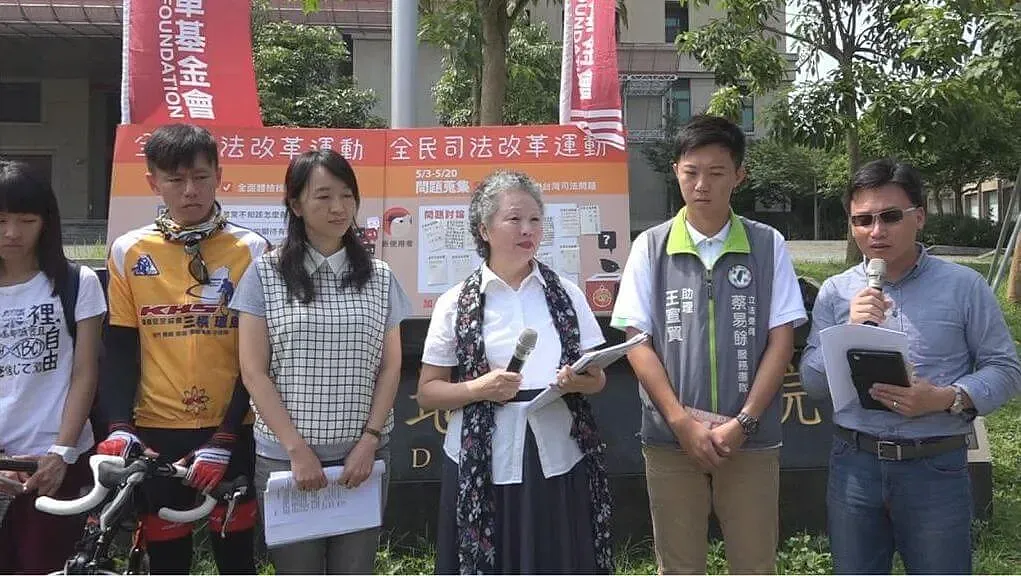
The Family Members Toiling on the Path to Vindication: Cycling Around Taiwan - Chiayi District Court Event
Last edited: 2026-08-31
On its 5th day, the "Cycling Around Taiwan: Delivering Local Judicial Reform Opinions" campaign arrived at the Chiayi District Court. Two women concerned about judicial reform came out to show their support. Originally ordinary housewives, both were forced to run around seeking rescue due to their husbands' wrongful imprisonment, experiencing firsthand the darkest, most hidden sides of the justice system. "When one person is detained, a hundred are on the road." When the judiciary makes a mistake, the damage extends far before the wrongfully accused; their families suffer right along with them. Their stories are detailed in the following attachments:
-
Taekwondo Instructor Corruption Case
During high school, Chiu Hsuan-ching served as the president of the Taekwondo Club. One day, his coach encouraged him to take the police examination so that he could continue practicing taekwondo. After successfully becoming a police officer, Ch'iu served as the police force's taekwondo instructor, in charge of routine training and 2 to 3 months of intensive training every year to participate in taekwondo competitions, meaning he was rarely stationed at his assigned Highway Police squad.
In 1995, a collective corruption scandal broke out within the Highway Police Corps. During the interrogation transcripts by prosecutors and investigators, a colleague stated that Chiu Hsuan-ching was also on the bribery list. However, immediately after being released on bail, that same colleague went to the hospital for a medical examination and accused the Investigation Bureau of extorting a confession through torture. Because the evidence of torture was clear and there was no corroborating evidence other than the single witness's accusation, Ch'iu was acquitted in both the first and second instances and was reinstated to his police position. During the period from March to June 1994 prosecuted by the prosecutor, Ch'iu was in Taishan for intensive training and competitions in April and May, took compensatory leave in June, and was transferred away from that squad in July. Believing in his own innocence, he always trusted that the judiciary would clear his name. Unexpectedly, because the case involved a large number of people, the legal battle dragged on for 17 years. The judges of the Fourth Remand Instance changed their legal evaluation, holding that even if the Investigation Bureau's transcript was not given voluntarily, the state of psychological compulsion did not carry over to the prosecutor's re-interrogation stage, thereby determining that the prosecutor's interrogation transcript possessed admissibility. Ch'iu was sentenced to 10 years and 2 months of imprisonment, which was ultimately commuted to 5 years and 1 month under the Criminal Speedy Trial Act.
Following 17 years of protracted litigation and over 3 years of wrongful imprisonment, Ts'ai Fang-man persevered in seeking vindication for her husband. She stated that Chiu Hsuan-ching believed in the sportsmanship spirit, never took advantage of others, and performed his duties with reckless disregard for his own safety. After being released from prison, he did not give up sports and still runs marathons. Relying merely on an extremely unreliable witness transcript while ignoring other evidence favorable to Ch'iu, the judiciary handed down a guilty verdict. The judiciary must strictly adhere to procedural justice, especially during the initial investigative stage; otherwise, the occurrence of wrongful imprisonment cannot be prevented.
Case Profile
Defendant
Chiu Hsuan-ching
Case Type
Violation of the Anti-Corruption Act
Judicial Issues
- Extortion of confessions through torture and improper interrogation during the prosecution and investigation stage.
- Accusation by a single witness lacking evidentiary support.
Related Judgments
Supreme Court Judgment 101-Tai-Shang-3320 (2012)
A Word to the Judiciary
Ts'ai Fang-man: "We followed the law; Judge, have you followed the law?"
(Wife of Chiu Hsuan-ching)
-
Wrongful Case of Former Eighth River Basin Management Office Director Lai Ting-fu
Case Profile
Defendant
Lai Ting-fu
Case Type
Violation of the Anti-Corruption Act
Judicial Issues
- Investigators destroyed and concealed evidence.
- Judges made errors in fact-finding, violating the rules of evidence.
Related Judgments
Supreme Court Judgment 101-Tai-Shang-3320 (2012)
A Word to the Judiciary
Lai Chun-yeh: "Judicial democratization: Establish a universal jury system"
(Wife of Lai Ting-fu)
Related Reports
Last night, after returning home, death row inmate Cheng Hsing-tse, who suffered 14 years of wrongful imprisonment, made his first trip away from home to Chiayi. He visited family and friends he had not seen in 14 years and attended the Chiayi session of the "Cycling to Deliver the Dream of Judicial Reform" symposium. Lo Ping-ch'eng, a pro bono lawyer for the Cheng case, stated that he hopes Taiwan's prosecutorial system can establish a conviction review panel to jointly shoulder the responsibility of rectifying wrongful convictions. Drawing from the experience of the prosecutor initiating a retrial in the Cheng Hsing-tse case, we can more clearly feel that those best equipped to shoulder this heavy responsibility are definitely prosecutors with resources. Let us no longer leave lawyers and defendants to fight a lonely battle; hopefully, both sides can work together for Taiwan's path toward exonerating the wrongfully convicted!

A standard without a standard is not a standard.
This is "A Word for Taiwan's Judicial Reform" written by Cheng Hsing-tse. Drawing on his own judicial experience, he hopes the judiciary can handle every case using more standardized standards. He dropped the postcard bearing these words into the suggestion box, to be delivered by the cycling round-island riders to the Presidential Office, demanding that the new president immediately promote judicial reform.
- National Judicial Reform Movement, voting website: http://justice.care/
- Cycling Around Taiwan FB Event Page: https://goo.gl/P0oKXR
- Event Website: http://goo.gl/0XozK6
Press Contact
Hsiao I-min, Regional Coordinator, Judicial Reform Foundation
This article is an AI-generated translation of the original Chinese text. In the event of any discrepancy, the Chinese version shall prevail.