

The Unfinished Road: The Case of Police Officer Chen at the Port of Kaohsiung
Last edited: 2026-08-31
Photo: On the day of the interview, JRF staff and volunteers went to Kaohsiung. As the interview concluded, a rainbow appeared over the harbor, and we hope this case, too, will clear up after the rain.
You are an ordinary port police officer working at the Kaohsiung Port Police Station. Today, you put on your uniform, take a bite of your breakfast, and enthusiastically head out for your shift.
As an ordinary person with innate civil-servant traits, you meticulously lay out the rhythm of your life, never allowing yourself a single moment of tardiness. It was April then, and walking to work early in the morning, you faced the warm sunshine, trying to use its lukewarm warmth to fight off your shivering. Even though the weather outside bothered you, your mind immediately turned to work: arranging shift schedules, organizing training for the fish market, promoting government policies to fishermen, picking up items at the employee store, planning prize-winning activities, inspecting ships... As you walked, you guessed what tasks your supervisor might assign to you today.
However, when you opened the office door, the first thing you heard was not the usual routine work, but an unexpected piece of news.
"Hey, did you know something happened at our station?" As soon as your colleague saw you, he poked his head out eagerly and said bluntly.
"Something happened? What is it?" you frowned while taking off your belongings and jacket.
"I heard Kuo Kuei-ch'in was detained, seemingly on suspicion of taking bribes."
Hearing this, you thought to yourself that the port police station deals with all sorts of people, so such matters are bound to pop up. But being upright as always, you didn't think too much of it. You shrugged and immediately threw yourself into your busy work.
A few days passed, and your colleague Kuo Kuei-ch'in's matter had long been forgotten at the back of your mind.
One day, the ringing of the telephone pierced the silence of the office.
"Cheng Li-ming!" Your colleague's shout made you look up from the official documents you were buried in.
"The Inspectorate Office just called to say the prosecutor has issued a subpoena requiring you to report to the District Prosecutors Office to help clarify a case."
You were puzzled as to how you, always upright, could run into such a thing—and apparently a serious matter at that. But you immediately put on a calm appearance, cast aside your swirling suspicions along with your uniform, stepped out of the port police station, and got into the supervisor's pick-up vehicle.
Little did you know that this single departure would span a lifetime.
It'll be fine, you thought to yourself. Although it was an investigation unlike anything you had ever encountered in your life, as long as you explained clearly that you were misunderstood, even if you unfortunately ended up in judicial proceedings, as long as you said everything that needed to be said and stated what you didn't do, the court... is a place that establishes justice and uncovers the innocent. Everything would be fine.
You arrived at the District Prosecutors Office.
Inside, you first explained to the prosecutor that you had never colluded with others to take bribes. Yet the prosecutor's sharp, suspicious gaze probed you, continually questioning you about the details of that day. While being interrogated, you desperately tried to piece together the fragments of that day. "March 12, 1984. March 12. March 12..." You struggled to recall what had actually happened. But as time slipped away, you were merely chewing on a mouthful of panic. March 12, 1984—you had not the slightest shred of memory of it. You could only do your best, repeatedly offering clarifications to the prosecutor over and over again.
However, the prosecutor did not simply treat this as a mere misunderstanding.
Subsequently, relying on Kuo Kuei-ch'in's confession and scattered pieces of evidence, the prosecutor indicted you for allegedly taking bribes in breach of your official duties.
You didn't have much time to process the sudden shock of bad news. You hurriedly found a lawyer and fumbled through complex procedures with only a hazy understanding. Your lawyer was quite amiable and willing to provide a great deal of professional assistance, which made you feel quite grounded in this unfamiliar battlefield.
Inside your heart, you repeated the phrase you started with: "It'll be fine."
The day of the court hearing arrived.
This was the first time in your life stepping into a court, the first time seeing the sternly seated judges everyone talked about. It felt as though you had stepped into an unfamiliar dimension.
You struggled to overcome the tension in the courtroom, laboriously trying to understand the complicated procedures and abstruse legal terms, and bravely stating your opinions clearly in court. After a period of busyness, you anxiously awaited the court's judgment.
The first and second instance judgments came out one after another. Defeat.
I Became a Victim of 'Batch' Indictment
You walked out of the courtroom and witnessed two completely different scenes.
At the time, Kuo Kuei-ch'in had pointed the finger at quite a number of people, among whom were many civil servants just like you.
First, you saw Lo Sheng-ch'üan and Huang Ch'ing-hsing, who were acquitted, happily and excitedly shaking hands with their lawyer, grateful that a massive disaster had come to an end. Then you glanced sideways at Wang Shun-feng and Yang Chung-jung, who were similarly dragged into the bribery case by Kuo Kuei-ch'in's statements; the two of them were dejectedly discussing their next move with their lawyer.
To you, facing the court's stereotyped argumentation, trial after trial of debates and arguments had inexplicably become the most impotent voices.
On one side was a narrow escape to safety; on the other, listless sighs.
When counting up the entire case, more than ten people were implicated, yet as many as six were acquitted in the first instance due to insufficient evidence. On one hand, you questioned the prosecutor's carelessness when drafting the indictment; on the other hand, you regretted why such good fortune had not fallen upon you. The nightmare of the judiciary still bared its fangs and held on to you tightly.
You leaned against the wall and let out a long sigh of exhaustion.
Then the case was appealed to the Supreme Court.
The result came out: the Supreme Court held that the High Court's judgment was unlawful, and thus revoked the original judgment and remanded the case.
Your lawyer smiled at you: "Let's give it another try! Being revoked and remanded means there might still be many flaws in the case. After all, it's a chance."
You nodded, moved, but immediately faced massive financial problems: litigation fees, lawyer fees, plus the family's living expenses after you were suspended from work due to the case. Your wife gave up her role as a housewife and became a department store counter clerk; your child started working part-time at a gas station right after graduating from junior high and entering high school; you yourself took on three jobs—driving a taxi at night, working as a security guard at a shopping mall in the morning, delivering vegetables, and doing odd jobs in the remaining time. Sleeping less than five hours a day, you fought day and night against economic hardship. The family muddled through those bitter days of litigation without a single word of complaint.
Unlike the courtroom where you were constantly treated as a criminal, home was the only place where you were treated fairly, the only place that preserved a shred of your dignity.
Thus, supported by your family and through repeated revocations and remands, the case drifted through retrials, yet the results remained disappointing, ending in defeat in both instances.
I Want Objective, Solid Right and Wrong, Not Ambiguous Compromises
Although people say that once a case enters a court, winning or losing is hard to predict, setback after setback in litigation always gave you the vague feeling of wanting to get to the bottom of the matter. So you began reading through the retrial judgments. What caught your eye was a passage like this:
Letter No. Kao-Hai-Yuan-Yü-Tzu-9005433 of the National Kaohsiung Institute of Marine Technology dated September 14, 2001: "...3. According to the attached fishing license, the total tonnage of said fishing vessel (Feng-Shou-I No. 1) is 127.18 tons. When leaving port, aside from necessary equipment such as crew, fuel, and water, its ultimate loading capacity should be 50.06 tons (including the weight of fishing gear). That is to say, when the cargo carried by the vessel exceeds 50 tons, it is deemed overloaded. Navigation at sea with overloading is an extremely dangerous act; if struck by larger winds and waves, there is a risk of capsizing."
The court decided not to adopt this piece of evidence, but its reasoning was:
To seek maximum profit, the overloading condition of the Feng-Shou-I No. 1 fishing vessel was not impossible. Moreover, the fish holds were in fixed positions, and all the catch was concealed within the holds. The stable center of gravity would instead serve as ballast, favoring the stability of the vessel's navigation amidst winds and waves, and capsizing would not necessarily occur merely upon being overloaded...
Yet when you checked the attached table following the judgment regarding your cargo volume, the judge clearly failed to incorporate the 50-ton overloading limit into consideration at all, still recording five prominent digits: 76.564 tons.
You felt deeply indignant. Vessel overloading was clearly a matter of life and death; yet caught between human life and profit, the court chose to deviate from general perception, putting on an act of guessing the defendant's mindset.
In the courtroom—in this courtroom where subjective conviction was infinitely expanded—there is no dialogue between experts. With everything driven by human manipulation, only a hollow shadow remains.
We chose to forsake the ideal of thoroughness, only to bring about wishful thinking-induced harm.
You felt as though you were peeling away the sacred candy-coating of subjective conviction layer by layer, moving toward the naked truth.
Amidst your sighs, you flipped to the second retrial judgment, and an unbelievable thing happened.
When you checked the table section, you discovered that these figures had abruptly been altered from the original 76,564 kilograms (first retrial)—which severely contradicted professional judgment—down to over 1,000 kilograms (second retrial)!
In that instant, you understood everything: behind this seemingly clear-cut facade lurked a guilty conscience of self-deception.
I Want an Account of How I Am Guiltless, Not Groundless Harm
Next, you caught a glimpse of the charge section.
Cheng Li-ming, as a person performing public duties pursuant to laws, jointly accepted bribes for acts in breach of official duties...
"I breached my official duties? What official duties did I breach?" Looking at the unexpected charge, you intuitively asked yourself.
You cross-referenced the facts:
Kuo Kuei-ch'in... jointly acting on generalized criminal intent, or having a concurrent criminal intent with Lin Ying-chih... and Cheng Li-ming, from the times shown in Attached Tables 2 to 8, well knowing that the fish cargo... loaded by the 'Feng-Shou-I No. 1' fishing vessel upon entering and leaving port exceeded the announced limit of 1,000 kilograms, and constituted contraband imported/exported clandestinely from Taiwan to the Mainland Area... still breached his official duties which originally required him to execute safety inspections and crack down on smuggling...
Then came the reasoning section:
The criminal act of defendant Cheng Li-ming listed in Attached Table Item 7 has been vividly testified to by co-defendant Kuo Kuei-ch'in... In addition, witness Hsieh Jung-fu stated that during inspection, he once saw a large amount of fish cargo about to leave port, but defendant Cheng Li-ming thought it was fine... and upon being asked, Cheng Li-ming replied that it was fish bait and the like... Co-defendant Hung Te-ch'ing stated at the Kaohsiung City Investigation Division on April 7, 1995, that the 40 or 50 tons of fish cargo carried by his vessel were to be transported to the Mainland for sale or processing... Furthermore, the clandestine export of fish cargo to coastal areas of the Mainland for delivery to consigning Taiwanese businesspeople by the Feng-Shou-I No. 1 fishing vessel at the time listed in Attached Table Item 7 is also supported by Ch'en Yung-chien's statement on record, and there are two detailed sheets recorded by Ch'en Yung-chien at the Kaohsiung City Investigation Division itemizing the names, quantities, and prices of fish cargo loaded per incoming and outgoing voyage according to the seized account books. Thus, the fish cargo loaded on that voyage was transported to the Mainland for sale or processing, not as fish bait. It is evident that defendant Cheng Li-ming knew this yet knowingly condoned it and accepted bribe money...
The court merely glossed over the fact that you breached your official duties, but were all fish cargo transported to the Mainland considered a breach of official duties? What kind of fish cargo constituted contraband? None of this was written above. The only place where one could barely glimpse some clues was the table attached at the very end of the judgment. Reading down line by line, you matched your shift date:
Departed port on March 12, 1984, clandestinely exporting sand worms, large head hairtail, and miscellaneous fish exceeding 1,000 kilograms.
As far as the work of port police is concerned, you vaguely remembered your superior constantly hammering into you that for "fish cargo suspected of smuggling," remember to avoid handling it; if you want to catch smuggling fishing vessels, do it only when you have evidence. He always gave such earnest instructions: as a port police officer, just do your own job well; remember that those other things are not what you should touch.
Your superior's words were still ringing in your ears. Yet right at this moment, the charge of "breaching official duties" was tightly fastened onto you—someone who treated "following superiors' orders as your golden rule"—turning into a monumental blow and irony.
Next, you pulled out the "Items and Control Methods of Contraband Goods" revised in 1990 to take a look.
You opened your eyes wide, matching word by word. The court's table stated that on the day of your shift, the Feng-Shou-I No. 1 transported sand worms, large head hairtail, and miscellaneous fish out of the port. But when you checked the "Items and Control Methods of Contraband Goods", you frowned, repeatedly reading items A through D over and over, the unfamiliarity of statutory text still lingering on your lips. Weapons, books, securities, drugs, gold, videotapes, cigarettes... are items prohibited from import/export (Items A to C). Smuggling goods from the fallen zone into the free territory of this country, or smuggling goods from the free territory of this country to the fallen zone, shall be deemed contraband goods... Those exceeding NT$100,000 in value or reaching 1,000 kilograms in weight shall be deemed prohibited import/export items. (Item D).
You felt extremely aggrieved. Putting aside the fact that the fish cargo deemed by the judge to be a breach of official duty didn't even cast a shadow on the statutory control list, even if Item D applied, how could a port police officer, facing such ordinary fish cargo as sand worms, large head hairtail, and miscellaneous fish, instantly know at a glance that it must be related to clandestine smuggling with the Mainland Area?
Even from a standpoint of common sense, the situation of fishermen smuggling these three types of fish cargo was highly unreasonable. Take sand worms for instance; you vaguely remembered when you were young, you once curiously asked a turtle-farming family what they bought sand worms for.
You only saw that family smile, take a basket full of sand worms by their feet, and dump it with a splash into the turtle-farming pond.
In the water, the reflection showed swarms of turtles scrambling to feed.
"Young man, nobody eats sand worms! We buy these simply to feed the turtles. Sand worms have zero value; at most, they're just used as feed!"
Large head hairtail followed a similar logic.
According to what Military Police officer Hsieh Jung-fu said in court, the large head hairtail he had inspected on ships thus far, when measured, were merely...
30 centimeters!
30-centimeter large head hairtail could never grace the markets of mainstream commerce.
Extrapolating from this, if vessel expenses were further deducted, where on earth would the 300,000 to 400,000 NTD in smuggling income stated in the judgment come from?
Looking at the judgment crumpled into a ball by your agitation, you seemed to remember once again that day you saw the turtle-farming family. What stuck most in your memory was the ripples wrinkling across that pond.
You were furious. Not to mention being muddled into this in the first place, even the final charge used to convict you was a total miscarriage of justice!
Conclusive Evidence or Illusory False Testimony?
Among the evidence used to convict you was also a record from inspecting military policeman Hsieh Jung-fu:
I once saw a large amount of fish cargo about to leave port (about 7 or 8 tenths full). At the time, I was assigned to inspect the ship's engine room and unintentionally discovered it.
To be honest, you didn't remember at all what you did that day. Not to mention that months had already passed, just considering ship inspections alone, dozens of fishing vessels entered and left the port each day, each carrying varied types of fish cargo. The task of inspecting ships alone was exhausting enough; asking someone to recall how full the fish holds inspected three months ago were was already demanding the impossible, let alone inspecting up to 50 fishing vessels in a single day—who would have the mind to remember such things?
You muttered, feeling that this whole thing was bizarre. At the same time, you looked at the testimony of other military police officers regarding co-defendants Wang Shun-feng and Yang Chung-jung who were also implicated in this bribery case:
Regarding Wang Shun-feng (testimony of military policeman Yang Ch'ing-chung): Unintentionally discovered that within the fish hold inspected by Wang Shun-feng, there was a large amount of fish cargo (about 8 tenths full), but Wang Shun-feng told me that this section of the ship's hold was his responsibility, so I found it inconvenient to inquire further.
Regarding Yang Chung-jung (testimony of military policeman Yang Ch'ing-chung): Once unintentionally discovered that the fish hold section inspected by Yang Chung-jung was loaded with a large amount of fish cargo (about 8 tenths full), but Yang Chung-jung told me he bore full responsibility for it, so I found it inconvenient to inquire further.
After making this comparison, you felt even weirder. Weird because everything was just too coincidental: not only did everyone have great memories, but the words they spoke were actually cut from the exact same mold!
Furthermore, when compared with the statement of Feng-Shou-I No. 1 captain Hung Te-ch'ing, Hsieh Jung-fu's statement was even more unreasonable:
Hung Te-ch'ing (testified under oath on April 25, 2006): The fish hold of the Feng-Shou-I No. 1 fishing vessel was about up to my chest in height, which is considered low; some are taller than a person. The fish hold cover is double-layered. Once the fish hold cover is opened, you can see the bottom of the cover, and a person has to go down inside to see what's below.
Hsieh Jung-fu's record: I once saw a large amount of fish cargo about to leave port (about 7 or 8 tenths full). At the time, I was assigned to inspect the ship's engine room and unintentionally discovered it.
According to captain Hung Te-ch'ing's statement, a person had to enter the fish hold to possibly see the fish cargo carried by the vessel. Since military policeman Hsieh Jung-fu was not inspecting the fish hold at the time, how could he have unintentionally discovered a large amount of fish cargo inside?
Moreover, according to the customary practice of ship inspections, once aboard, police officers begin inspecting from the fish holds, while military police begin inspecting from the engine rooms; police officers inspect from the outside in and top to bottom, whereas military police inspect from the inside out and bottom to top. Both would eventually inspect the same things, just starting differently. They only divided labor, not responsibility. Military police and port police bore joint and several responsibility; under such institutional pressure, which military policeman would abandon investigation simply based on a port police officer's one-sided assurance, risking the chance of being investigated themselves?
This is too exaggerated! Too absurd! You told your lawyer you planned to fight this to the end.
Please Treat Me the Way You Wish to Be Treated
In the blink of an eye, bypassing the third retrial, it was time for the court hearing of the fourth retrial.
"Your Honor, our side has a question regarding the income and expenditure account books of the Feng-Shou-I No. 1 fishing vessel recorded in successive judgments as evidence to convict the defendant. There is an entry of 'harbor clearance fee' of NT$30,000 for the departure on March 12, 1984, but looking at the photocopy of the account book our side obtained right after the account book was seized, there is no such related record of departure."
A rustling sound of flipping pages instantly echoed through the courtroom. Three judges whispered to each other, peering across the case files. Your lawyer sniffed the air with professional instinct, then quickly replied: "Page... of the case file."
Only then did the three judges truly focus, unanimously flipping to the place mentioned by the lawyer.
"The entry for March 12... This must be what you're talking about, Defendant!" The presiding judge wore a skeptical expression, appearing somewhat baffled by the question just raised by your lawyer.
Your lawyer leaned forward, eyes drifting back and forth between the judge and the case file in his own hands. Within moments, your lawyer's gaze paused at a certain spot, and together you discovered an astonishing secret...
"Your Honor, our side has discovered a new flaw in the evidence! Page 8 of the seized account book produced by Ch'en Yung-chien, which points to defendant Cheng Li-ming as being involved in bribery, has traces of alteration!" your lawyer said with spirited vigor, his ringing voice stirring every shred of air in the courtroom.
"I've checked it. The characters 'departed port on March 12' on page 8 of the original seized income and expenditure account book of the Feng-Shou-I No. 1 fishing vessel provided by the Investigation Bureau to the court are written in thinner strokes than other characters in the account book, obviously written with a different pen. Furthermore, the characters 'depart port' clearly differ in handwriting from 'depart port' elsewhere on the same page!" the lawyer continued.
Here it comes again! For the sake of evidentiary consistency, the Investigation Bureau had actually secretly altered the original documents—they truly stopped at nothing! Behind evidence that seemed seamless lay sickening calculations and setups.
Having presented such obvious evidence, you thought winning the lawsuit was already a foregone conclusion. However, the verdict of the trial was...
Defeat.
Just like that, the third, fourth, fifth, sixth retrials... your youth quietly dripped away down the long river of lawsuits.
You bitterly discussed this inescapable entanglement with your lawyer, talking about the lawsuits fought over the past decade or so—from initially being dragged into it, to appeal after appeal, revocation and remand...
Throughout these legal battles, the evidence used to convict you—especially Kuo Kuei-ch'in's testimony—was found, after successive examinations of optical discs, to be tainted by improper methods used by investigators on three days of testimony, rendering it inadmissible. All those once seemingly ironclad pieces of evidence were continually washing away through the changes of trial instances, yet the judges still tightly pinched your neck. You had not yet obtained the longed-for innocence and remained a person under judgment in the judge's writings.
And the seventh retrial was the turning point of the entire lawsuit.
What I Felt Was Not Conviction by Conclusive Evidence, But Appalling Patchwork
Actually, you and your lawyer had always cared about one thing: whenever you asked the judge to examine Kuo Kuei-ch'in's investigative optical discs, the judge always refused under the pretext of necessity being lacking or failure to meet the required conditions. You often complained that the court's approach seemed to pull a veil over the truth, attempting to push everyone away from it. Yet your lawyer remained undeterred, trying to grasp the dawn of truth within this erratic gray zone, insisting on this demand in every trial. And this time, the court granted your request.
Your heart tightened, and a contradictory emotion surged within you. You felt joy because your case might achieve a new breakthrough; you felt fear because of the horrifying methods the Investigation Bureau must have used to drag so many people down. Holding your breath, you ventured alone into this enclosed, dark, and unbelievable secret:
Investigator: "We'll look out for you too. As long as this part is settled first and the prosecutor has no other opinions, you can be released. What do you say? You help me, I can help you."
Kuo Kuei-ch'in: "I'm writing it."
Investigator: "A ratio like two-thirds, one-third—forty percent, you split it with him. One third is only NT$20,000 anyway, it doesn't even exceed NT$50,000, what are you worrying about, what are you afraid of?"
Kuo Kuei-ch'in: "How should I write forty percent?"
Investigator: "I'll write it for you."
Investigator: "I'm telling you, I'll write it for you: I received it 5 times, 40 percent kept for me and the supervisor to split, with the ratio being two-thirds for the supervisor and one-third for me. As for the remaining 60 percent, right, I distributed it to the police officers on duty, and kept a portion for... but you should mention the ratio roughly."
"This... why is it only being discovered now? Didn't the judges always say the confessions were fine and examining the optical discs was unnecessary?" you unconsciously asked yourself.
At this very moment, the surrounding air seemed to freeze because of these few sentences.
"You help me, I can help you..."
"I'll write it for you..."
"What are you afraid of..."
You saw the judge subsequently play another segment of wiretapped audio requested by your lawyer for examination, attempting to stem the restless commotion bubbling up in the courtroom...
An Accidental Fabrication Led to Years of Inevitable Protracted Litigation
Regarding another piece of evidence pointing to bribery—the wiretapped telephone recordings of purchasing plane tickets—investigators had previously mentioned that Kuo Kuei-ch'in and the captain's father, Hung Chien-chü, used the purchase of plane tickets to confirm port entry and exit matters. Hung Chien-chü would inform Kuo Kuei-ch'in over the phone of the dates and times of plane tickets for going abroad (leaving port) or returning (entering port), hoping Kuo Kuei-ch'in would grant clearance at the designated time.
The court played this tape over and over again, but the content regarding purchasing plane tickets alleged by the investigators was nowhere to be found.
The court subsequently summoned the investigators.
"The content shown in the above wiretap report does indeed exist. It's possible that the recording tapes manufactured by various tape companies varied in length, and shorter tapes were used during copying, causing the tail end of the dialogue to be unrecorded and preventing that segment of dialogue from appearing during examination," the investigators explained.
"Can you provide the original tapes then?" the judge asked.
"That might..." The investigator's face sank, as if concealing an unspeakable secret.
"Can you?"
"Probably not," the investigator said timidly, accidentally making eye contact with you, but he immediately averted his gaze elsewhere, staring blankly at the thing he found most difficult to face.
You harbored resentment; all these fabrications had materialized precisely as you anticipated.
Synthesizing all the flawed evidence mentioned above, you obtained an acquittal in the seventh retrial.
Bearing the victory of the seventh retrial, you felt this was at least justice delayed. Even if late, it was still innocence after all. Not thinking too much, you optimistically returned to work as you wished, becoming a police officer once again. You helped organize data for your unit's traffic equipment and even won third place for it. Beaming with radiant smiles, you felt everything was back to the way it used to be.
However, peaceful days did not last long.
The prosecutor refused to accept the outcome of the seventh retrial and appealed. Subsequently, the Supreme Court issued a ruling revoking the seventh retrial judgment and remanding the case.
You shook your head, lamenting this unfinished nightmare.
Everything had to start all over again.
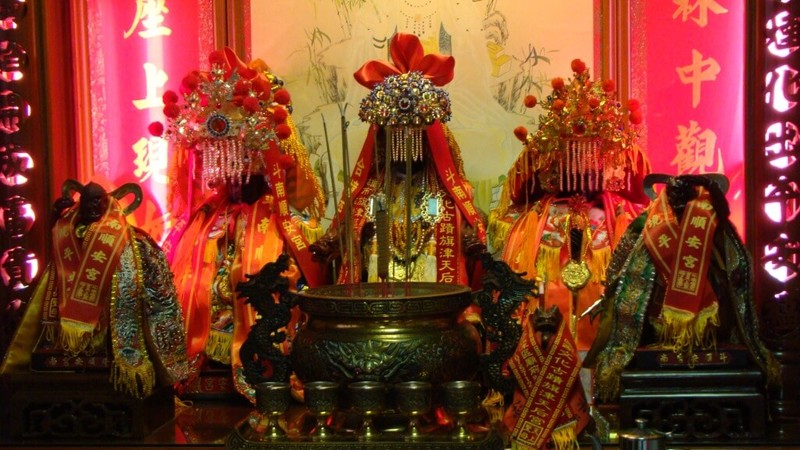 Photo: This temple is located inside the Kaohsiung First Port Branch Police Station and is locally reputed to be very efficacious. On the day of the interview, JRF staff and volunteers prayed together for the case to be exonerated soon.
The Unfinished Road
The eighth retrial.
Dressed neatly, you and your lawyer stood upright on the familiar battlefield.
"What on earth are you lawyers playing at?"
Faced with such remarks from the judge of the eighth retrial, you felt as if you had been ambushed. The surrounding atmosphere felt unfamiliar all over again...
"What are you doubting? Isn't it because the Bar Association always rates me last? I'm a very serious judge, you know. Why are you treating me this way?"
"The court has problems, the judge evaluation has problems, lawyers have problems—everything has problems..."
Time slipped away amidst the complaints of that judge.
Suddenly, the judge began asking the prosecutor to read the gist of the indictment.
You straightened your back, originally thinking the formal proceedings were finally about to begin, but unexpectedly, after simply asking about the intent of the appeal and the defendants' opinions regarding related statements and evidence, the judge hastily adjourned the session.
You saw your lawyer holding a thick stack of case files, standing dejectedly at the defense podium.
This situation did not happen just once.
So many living, breathing lives beneath the bench utterly failed to stir a shred of his passion or enthusiasm for earnest adjudication.
Beyond your shock, you had actually predicted the outcome of the trial long ago.
Two years and seven months of imprisonment, a fine of NT$10,000.
Carrying the defeat of the eighth retrial, you petitioned the Judicial Yuan in grievance, denouncing the eighth retrial judge for dereliction of duty. The Judicial Yuan subsequently forwarded your petition to the Taiwan High Court Kaohsiung Branch Court. At that point, you had no time to weigh your own predicament of fighting a David-and-Goliath battle; you only hoped to bring a turning point to the case, even if it were just a sliver.
The result brought in return was merely a breezy sentence: He has been informed, and is instructed to take note...
You grew anxious. If petitions could not bring a turning point, you simply dared not imagine the transformations and hardships you would have to endure hereafter.
You felt as though a prankster had set fire to you, and that child had already scampered away in a flash. You cried out for help to the child's parents, but they merely stood there, coldly and faintly watching the fire continue to burn on you.
Following the defeat in the eighth retrial, your lawyer hurriedly assisted you in filing an appeal to the Supreme Court. However, this time, the Supreme Court's conclusion was "appeal dismissed."
To you, everything was over, and everything was ruined.
With a sudden turn of your head, resentfully and bitterly, you recalled that judge in the courtroom, loathing the contemptuous expression with which he smugly delivered the end of your hope and the beginning of your nightmare.
You stepped down from your position, stripped off your uniform, and now you became a prisoner deprived of liberty.
You looked back once more at your children who had cried their eyes out, glanced at the sunshine and blue sky that used to be everywhere, and then jerked your head around, walking into the deepest darkness of your life, letting the clinking sound of handcuffs weigh down the prison corridor.
On the way to being led into the prison cell, you thought about the lawsuits time and time again, puzzling over this elusive subjective conviction. You felt as though you had been ruthlessly butchered under the games of a group of elites. It turned out this was never a game ordinary citizens could afford to play. Once trapped, you were trapped for a full 17 years; yet the payment of all these prices still failed entirely to buy back that fragile, seemingly within-reach truth.
At the same time, you were irritated—irritated that it was a mistake right from the start, a total farce from beginning to end. How effortless it was for an investigator to drag an innocent person into a case, yet how grueling and stumbling the ordeal it caused for the person trapped inside.
As for the court, you will never forget the disappointment brought by every single word and sentence in the judgments. That subjective conviction once deemed so sacred by everyone—now, as you finally understood today, beneath the shiny facade of independent adjudication lay tens of thousands of crooked instances of trampling and sacrifice.
And until you hunched over, truly feeling every single stomp stepped upon your back by the judge, did you finally see through those conventional matters taken for granted.
Seeing sacrifice and experiencing sacrifice are what truly allow people to see problems and step into them.
In this lawsuit, you felt as if you were standing on a judicial stage, like a play where the endings of all defendants are pre-arranged. You truly felt you were just standing there, cast in the mold of a criminal, and what the judge was doing perhaps was merely deciding how long you would be locked away. The script written here was not one of the presumption of innocence; the more the judges worried about being deceived by lies, the more they deepened the shadows of fear with the spotlight of subjective conviction.
And you bore a puppet's destiny: under a predetermined script, you could only ever do your best. If the play succeeded, you naturally escaped unscathed; if it flopped, you alone shouldered all the success or failure.
And what you paid—the part you could never let go of—was 17 years of your youth, which to the judge was merely a casual shadow in their eyes. Your figure arguing with reason, as staff members tightly bound the case files together, would ultimately become nothing more than a routine administrative record.
Yes, your 17 years—to others, it was nothing more than that.
Facing the judicial circle, facing the "justice" brought by the courts, throughout these nearly six thousand days, you seemed a bit tongue-tied, because you understood—you understood the unique taste of it all that only those who have been inside can truly comprehend.
During your time in prison, fortunately accompanied by your family through quite a few visits and letters, you did not sink into excessive depression and despair.
You calmly served out your sentence, and the day of your release finally arrived.
Absent-mindedly, you walked down the dusk-lit street, listening to the soul-lost footsteps ground out by the soles of your shoes.
Lowering your head, trying to grope your way home, you suddenly heard a familiar voice.
"Dad! Over here!"
You raised your head and saw your son. You were about to call out to him, but in a split second, a piercing memory choked your throat: you saw your son wearing that familiar Coast Guard uniform, waving at you with a smile.
"Dad, you're back! Mom and Grandpa prepared a lot of dishes and are waiting for you!"
"This uniform of yours?"
"Oh! I passed the exams! Just like Dad, I entered the Coast Guard too!"
Video: "...Where has the time gone? Grown old before fully experiencing youth..." This is a song given to his father by Cheng Li-ming's son.
You looked at your son, looking at that simple-hearted, almost goofy smile. You thought of someone—that port police officer wearing a uniform, standing firmly at his post, relying on proud experience and intuition during inspections to bust valuable cigarettes, illegal smuggled laborers... That unforgettable, high-spirited self of yours.
You desperately tried to squeeze out some congratulatory, encouraging words, but before these words could be spoken, they stopped short, because you were afraid—afraid that on your son's body, everything would start all over again.
Yet before this spirited young man, you couldn't bear to shatter his dream with a single blow. You said nothing, but patted him on the shoulder, burying all your heartache and fear deep inside your heart.
You had not yet reached an age where you could gracefully savor tragedy, but the unpredictability of worldly affairs forced you to strip away the brilliance of your peak, bringing a cruel pause to that brilliant movement of life.
Until now, you could not stop asking yourself: Who on earth should be held responsible for these 17 years of mine?
Should you blame Kuo Kuei-ch'in? The Investigation Bureau? Military policeman Hsieh Jung-fu? Or should you blame the judge?
As you watched your life, like the sunset before your eyes, gradually sinking westward amidst sighs—this world, a judicial world that essentially had never changed, had nevertheless become entirely different to you.
Having exited the career of a civil servant, you started working as a taxi driver, beginning a life of dispatching shifts and picking up passengers. Day after day, you threw yourself into the diligence of work, wanting to wash away the gloom of the past seventeen years with bright yellow...
You actually wanted to forget—truly, very, very much so. How much you hoped you could march forward fearlessly from then on, how much you hoped these invisible burdens could be cast off forever, returning a clean life to you. But you knew none of this was useful, because nightmares in the dead of night always haunted you: the cold, damp, dark space of prison, waiting for the torture of time, the repetitive routine day after day, until walking on the street, facing the strange glances and pointing of neighbors—you simply could not breathe air as free as before.
Therefore, you decided. You decided to break all silence; you decided to leap up from the churning and tossing of the judiciary, because you thought of how each rash lawsuit had ruthlessly crushed your high spirits and shattered your life into pieces. You could not convince yourself to become a deserter of the truth.
Thus, you stepped into a small office.
"Hello, my name is Cheng Li-ming, and I'm here to file a grievance..."
This article is an AI-generated translation of the original Chinese text. In the event of any discrepancy, the Chinese version shall prevail.