
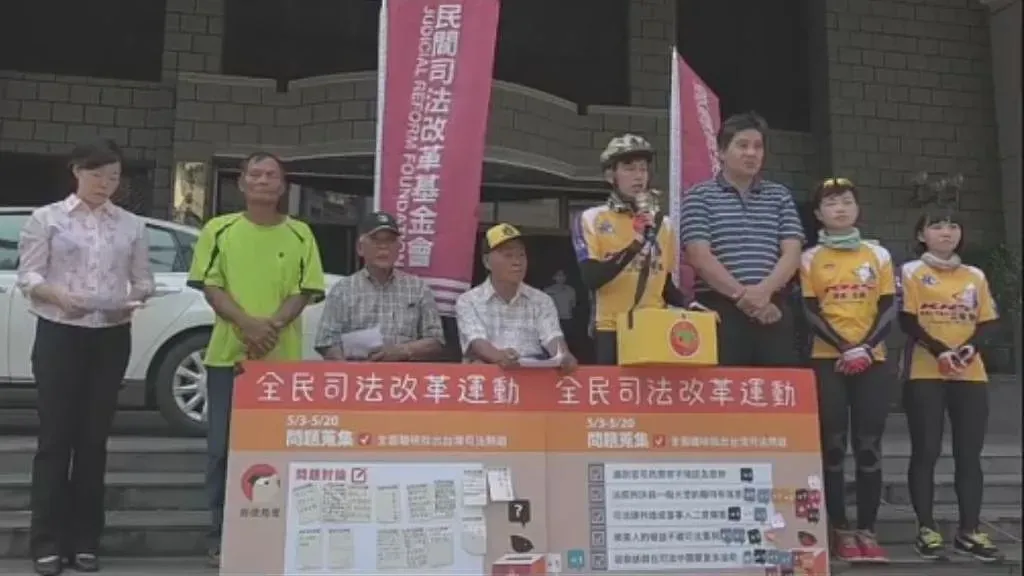
Out-of-Control Land, Out-of-Control Judiciary: May 19 Pingtung District Court Event
Last edited: 2026-08-31
“Cycling around Taiwan: Delivering Local Judicial Reform Opinions” campaign has reached Taiwan's southernmost point, setting off today from the Pingtung District Court toward eastern Taiwan. Viewed from Taipei, Pingtung appears to be a stable agricultural county; however, standing on the ground in Pingtung reveals that changes are underway. Social problems stemming from land speculation are steadily increasing. As shown in the following statistical table, civil, criminal, and protection order cases at the Pingtung District Court have surged dramatically over the past decade. This has flooded the court with a massive volume of complex litigation, challenging the quality and capability of existing judges, prosecutors, and attorneys. This is reflected in the unprecedented rise of registered practicing attorneys in the Pingtung Bar Association to over 700, alongside a growing number of complaints against judges and prosecutors.
Pingtung District Court Case Statistics Over the Years
| Year | Civil | Criminal | Protection Order |
| 2015 | 98,819 cases | 19,021 cases | 1,701 cases |
| 2014 | 105,632 cases | 18,265 cases | 1,812 cases |
| 2013 | 101,062 cases | 19,323 cases | 1,845 cases |
| 2012 | 100,361 cases | 21,972 cases | 1,806 cases |
| 2005 | 79,383 cases | 12,172 cases | 1,028 cases |
| 2004 | 77,537 cases | 12,046 cases | 1,043 cases |
Taking as an example the Disciplinary Court of the Judicial Yuan's 2014 Disciplinary Decision No. 8, which issued a reprimand against former Pingtung District Prosecutors Office Prosecutor Wu Wen-cheng: Prosecutor Wu exceeded his authority by demanding that all management and supervisory committee members of the Xishih Chueh-shan Temple convene a joint meeting of management and supervisory committee members at the Chaochou Precinct. He exercised investigative powers by presiding over the meeting as chairperson to elect the temple's chairperson and standing supervisor, thereby directly intervening in civil matters. Furthermore, he searched and seized items held by the temple's former chairperson, Lin Hai-jung, general affairs staff member Chen Wen-kung, and others. On the very day of the seizure, while private rights remained in dispute, he handed over items from the seized goods&mdashincluding disputed gold medals, gold rings, silver medals, and cash&mdashto the newly appointed management committee members, including Liu Jen-fang, for safekeeping. In addition to violating regulations regarding the return of seized items and directly intervening in the determination of private rights, this was suspected of substituting for the new management committee members in exercising civil rights to deliver items and request compulsory execution. Moreover, he indicted Lin Hai-jung, Chen Wen-kung, and others for the crime of embezzlement; however, due to insufficient evidence and erroneous legal interpretation, they were acquitted with finality by the Pingtung District Court and the Kaohsiung High Branch Court. Prosecutor Wu's acts of exceeding prosecutorial authority and making abusive indictments caused grave damage to the fair image of the judiciary. The background of this unfit prosecutor case was precisely the social problems triggered when predatory and unlawful speculators cast their sights on traditional local temples sitting on vast tracts of land.
Problems within the courts have also emerged endlessly. A court clerk resent a payment order after the statutory deadline had passed. A conciliation proceeding record stated that the conciliation commissioner was female, but the commissioner who actually attended was male. A Family Court judge used God, the Bible, and emotional language to coerce and deceive citizens into settling, yet the settlement record was erroneous and impossible to execute. A judge even crumpled up a citizen's written submission and referred the citizen to the district prosecutor's office for investigation under the offense of insulting a public office. These problems all highlight that if judicial personnel lack legal literacy, moral integrity, and sufficient competence, they will not only fail to resolve disputes through the law when facing a massive volume of complex cases, but will instead make matters more tangled and complicate simple disputes.
Judicial reform cannot rely solely on a Taipei perspective; localities have their own perspectives. Compared to relatively progressive Taipei, local areas are in even greater need of attention from reform forces. The judiciary is a mechanism for resolving social problems; facing out-of-control social problems, the judiciary must become a stabilizing force. The cycling team will convey the voices of local residents to the new president to demand judicial reform.
Attendees
Lin Hai-jung and 4 others / Complainants regarding Prosecutor Wu Wen-cheng
Dr. Tsai Te-chin / Professor of Civic Courses, Fooyin University
Chang Ching-ling, Assistant / Service Office of Legislator Chou Chun-mi
Press Contact
Regional Coordinator, Specialist Hsiao I-min
This article is an AI-generated translation of the original Chinese text. In the event of any discrepancy, the Chinese version shall prevail.