
Do Not Forget Those Still Suffering in Wrongful Imprisonment! ~Keelung and Shilin Events on May 24
Last edited: 2026-08-31
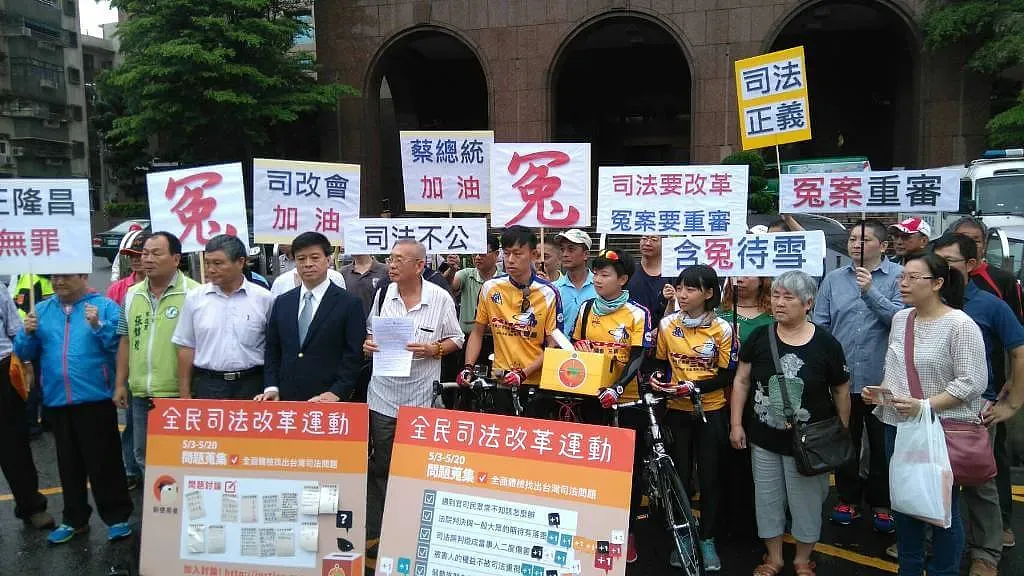
On the 12th day of the "Cycling Around Taiwan: Delivering Local Judicial Reform Opinions" campaign, the cycling team traveled from the Keelung District Court, passed through the Shilin District Court, and arrived at the New Taipei District Court. They are expected to reach the Taipei District Court at 09:30 the next day, May 25, completing their island-wide journey. Reflecting on the Hsuchien-ho Case—which occurred in the Hsichih and Keelung areas in 1991, endured 21 years of judicial litigation, and finally resulted in an acquittal—the defendants stated that being vindicated from a wrongful conviction was their good fortune, and they called on the public to "do not forget those still suffering in wrongful imprisonment!"
Throughout this island-wide journey, diverse public opinions on the judiciary were collected. Among them, the most severe and urgent issue to resolve is saving the innocent who are still suffering in wrongful imprisonment. This cannot be understood by those sitting high in official temples, wearied by case files and documents. Only by personally visiting grassroots communities can one realize just how many wrongful convictions exist in Taiwan! Today, at the Keelung and Shilin District Courts, defendants or family members from five wrongful conviction cases came to voice their opinions. Their stories are as follows:
-
Nangang Exhibition Center Bidding Evaluation Committee Corruption Case
Wang Lung-chang (王隆昌) is a second-generation mainland mainlander born in Keelung City. Coming from an impoverished family, he once worked part-time peddling a tricycle at the docks and studied diligently to become a university professor. He was dedicated to teaching, particularly cared for underprivileged students, and long served as a volunteer traveling to indigenous townships to organize various educational and training programs for indigenous peoples as a way of giving back to society.
In 2003, Wang Lung-chang was invited to serve as an evaluation committee member for the Nangang Exhibition Center bidding project. The entire evaluation process concluded in 2004 without controversy. It was not until 2008, when the Special Investigation Division was investigating Chen Shui-bian's money-laundering case, that it accidentally discovered a list of evaluation committee members for the Nangang Exhibition Center bidding project on a computer at Ruentex Engineering Construction. Prosecutors then listed the Nangang Exhibition Center bidding project as a corruption case for investigation. At the beginning of the investigation, the contractors denied offering bribes; however, after being detained for 35 days, they "suddenly saw the light," confessed to the "truth," turned state's evidence, and admitted to sending money to Chen Shui-bian's wife, Wu Shu-chen, while also bribing evaluation committee members through a middleman. Consequently, they received a lenient sentence of six months. The middleman also cooperated with the prosecution's investigation, pointing out that several evaluation committee members had accepted bribes, whereupon these cooperative middlemen were granted "non-prosecution." The contractors and middlemen willingly cooperated because prosecutors held a sharp weapon for handling corruption cases: the provision under Article 11, Paragraph 5 of the Anti-Corruption Act, which reduces or exempts the punishment for those who confess to offering bribes. By detaining them first to let them taste the bitterness of incarceration and then using this provision to lure them into cooperating with the investigation, the prosecution secured testimony unfavorable to the recipients of bribes. Relying solely on the testimony of the contractors and middlemen, prosecutors indicted Professor Wang Lung-chang, one of the evaluation committee members. Aside from human testimony, this case seized no accounting books, contained no wiretap transcripts, found no objectively verifiable contact records, and detected no abnormal fund flows in the accounts of Wang Lung-chang and his family. The middleman often could not clearly articulate the details of the bribe-giving and required repeated "reminders" from prosecutors before "explaining things more and more clearly." Although physical evidence was lacking, the court held that corruption is a covert act and inherently difficult to substantiate with physical evidence, meaning a lack of physical evidence does not prove Wang Lung-chang did not accept bribes. Furthermore, although errors frequently appeared in the details of the bribe-giving, the court maintained that because a long time had elapsed, it was natural for the bribe-giver not to remember clearly. Without obtaining and reviewing interrogation recordings to carefully examine how the relevant details of the bribe-giving were gradually established during the investigation, the court flatly concluded that Wang Lung-chang committed the crime of accepting bribes in breach of official duties, sentencing him to 7 years and 8 months of imprisonment.
Wang Lung-chang could not accept this judgment, and his colleagues, students, and family members refused to believe he would commit such an act, tirelessly running about on his behalf. After the judgment in this case became final, the Control Yuan issued an investigative report stating that the evidence in this case was thin, and the Prosecutor-General also filed an extraordinary appeal for this case, yet neither yielded results. Nevertheless, Wang Lung-chang and his family have not given up, persisting in their efforts to clear his name...
Case Profile
Defendant
Wang Lung-chang
Case Type
Accepting bribes in breach of official duties
Judicial Issues
- Using detention to achieve the substantive effect of extracting a confession.
- Article 11, Paragraph 5 of the Anti-Corruption Act was improperly used to lure bribe-givers into cooperating with the investigation.
- Over-reliance on witness testimony to convict in corruption crimes.
Relevant Ruling
Supreme Court 101 Tai-Shang-Tzu No. 6510
A Message to the Judiciary
Wang Lung-chang's brother: Please have judicial adjudications adopt strict evidence and refrain from using conjectural inferences and free proof to cause wrongful convictions!
-
The Mei Fu-an Case: "Micron" and "Macro" within the Judicial System
Case Profile
Defendant
Mei Fu-an
Case Type
Crime of misappropriation
Judicial Issues
The judiciary ignores the human rights protections of new immigrants
Relevant Ruling
Keelung District Court 100年度簡上字第1號
A Message to the Judiciary
Mei Fu-an: Bungling judges get out of the court
-
A Certain Elementary School Playground Renovation Project Corruption Case
Principal Chang has served in the education sector for forty years, neither smoking, drinking, nor engaging in social networking and banquets. He does not abandon any student, especially those from impoverished families or with poor grades, presenting them with prizes to encourage their academic pursuits. Every graduation ceremony, he insists on personally handing out diplomas to every single student to show respect. In the 1960s, he taught at a certain elementary school, and twenty years later returned as its principal. Seeing that the school buildings and playground had not been renovated in twenty years, improving the school's hardware facilities to provide students with a high-quality environment became his primary goal in school administration.
In 2002, the school playground surface cracked, frequently causing students to get injured, and Principal Chang decided to renovate it. Due to limited funding, the renovation was planned to repair only the playground surface layer without redoing the foundation layer to save money; however, considering future durability and stability, he additionally required that if the foundation layer was found to be damaged after scraping off the surface layer, the damaged area should be excavated, the foundation layer in that section redone, and then a new surface layer applied. This cost-saving approach was reported as shoddy work and corruption benefitting a contractor. The prosecutor and judge, lacking engineering practical experience yet refusing Principal Chang's application to send the design drawings to a professional institution for appraisal, found Principal Chang guilty in his indictment, first instance, and second instance. Upon appeal to the Supreme Court, the case was remanded, and it entered the retrial stage. During the retrial, Principal Chang requested that the scope of the project work be submitted to the Taipei Architects Association for appraisal, but the court simply refused to send it. Principal Chang had no choice but to officially request an appraisal from the New Construction Division of the Public Works Department of the Taipei City Government. The appraisal opinion stated: "It is determined that the scope of work did not entail excavating the entire foundation to rebuild it before applying the surface layer." However, the retrial judge handed down a hasty judgment without waiting for this appraisal conclusion to be produced, and the Supreme Court dismissed the appeal based on its role as a law review court rather than a fact-finding court. Principal Chang suffered a wrongful conviction resulting in 3 years and 6 months of imprisonment.
When prosecutors and judges lack engineering practice, are incapable of reading blueprints, and refuse to submit matters to professional institutions for determination while expanding their discretionary power infinitely—is this the ignorance of judicial officers, or their arrogance...?
Case Profile
Defendant
Principal Chang
Case Type
Crime of public officials gaining illicit benefits
Judicial Issues
- Judicial personnel lack expertise in other fields yet refuse to submit matters to professional institutions for appraisal.
- The elements of the crime of gaining illicit benefits penalize result crimes; attempted crimes are not punishable.
Relevant Ruling
Supreme Court 102 Tai-Shang-Tzu No. 4334
A Message to the Judiciary
Principal Chang: When judges adjudicate, their discretionary power is infinitely expanded; subjectivity leads easily to misjudgment.
-
Air Force Captain Spy Case
 Statement by Chiang Fu-chung (Click image to enlarge)
Chiang Fu-chung is a young Air Force captain. After graduating from the Air Force Academy, he served as an Air Force interception control officer, training officer, and other roles starting in 2008, with duties involving considerable Air Force secrets. Hoping to transfer to a unit with relatively fixed working hours, the young man asked people everywhere to help him arrange a transfer.
His uncle, who did business in China, said he had connections to help him transfer, but needed to know his status in the military and information related to his intended transfer. Because his duties involved military secrets, Chiang Fu-chung was only willing to provide his military ID to his uncle. However, the transfer did not go smoothly, so in 2011, he downloaded and printed some exam materials inside the camp, intending to use his spare time to prepare for transfer-related exams. He did not consider those exam materials to be overly important secrets, and when leaving the camp, he left the materials beside the driver's seat, where they were discovered by the squadron leader in charge of security inspections at the camp gate. He was disciplined for allegedly carrying military secrets out of the camp. Chiang Fu-chung complained about this to his uncle, who said that a well-connected "Manager Chen" in China could help him. The uncle connected Chiang Fu-chung with "Manager Chen" via Skype, and Chiang Fu-chung wrote an essay complaining about his work conditions to "Manager Chen" via email.
Unexpectedly, shortly after writing the complaint, Chiang Fu-chung was arrested for the crime of being a spy, and his uncle was arrested for the crime of leaking secrets. Unable to endure the Bureau of Investigation's fatigue interrogation, his uncle confessed and admitted to the crime. Eager to distance himself as quickly as possible from the harrowing litigation process, the uncle pleaded guilty all the way and received a lenient sentence, but in doing so, he implicated Chiang Fu-chung. Meanwhile, because Chiang Fu-chung had stored teaching materials from his previous officer training class on a flash drive, and his uncle had previously taken his laptop to China, Chiang Fu-chung was suspected of smuggling electronic files of training materials to China via the laptop with his uncle, thereby leaking military secret information to Chinese intelligence personnel (yet restoration and appraisal of the laptop revealed no military secret information). Chiang Fu-chung admitted to lacking sufficient security awareness regarding certain military information he considered less important, but strongly denied being a spy. Nevertheless, the court did not accept this and sentenced him to life imprisonment with finality.
Chiang Fu-chung's relatives firmly believe in his innocence, running about for him every step of the way and seeking help from the JRF. The JRF also desperately hopes to restore the truth of the case, but under the grand pretext of military secrets, many critical materials cannot be obtained—such as the video discs of the Bureau of Investigation's interrogation or the audio recordings of wiretaps. Furthermore, the defense has no way of confirming whether providing these materials to defense counsel would genuinely jeopardize national security; whether something counts as a "secret" is entirely up to the Ministry of National Defense and the court to decide.
Recently, several more "spy cases" have erupted one after another. Which of these are genuine spies, and which are accidental products of poor security habits in the military? The courts need to examine this carefully and must not arbitrarily use the grand pretext of military secrets to restrict document reviewing. Otherwise, a modern-day version of the White Terror wrongful convictions is likely to play out once again...
Case Profile
Defendant
Chiang Fu-chung
Case Type
Crime of engaging in espionage activities for the enemy
Judicial Issues
Excessive restriction on access to litigation materials in the name of military secrets
Relevant Ruling
Supreme Court 104 Tai-Shang-Tzu No. 1699
A Message to the Judiciary
Chiang Fu-chung: My future may not necessarily arrive.
-
The Case of the Disappeared Polygraph Disc
Lo Ming-tsun (羅明村) was the head of the Criminal Investigation Division of the Xinzhuang Precinct and handled countless major cases, such as the Pai Hsiao-yen murder case and the Lin Ch'ing-yü parricide case, both of which he handled. In 1997, a shooting occurred in Xinzhuang. Someone provided a tip-off leading to the apprehension of a juvenile suspect, who also confessed to the shooting and led police to recover the firearm. Originally thought to be a swift and brilliant solution to the case, the juvenile unexpectedly retracted his confession during detention, stating that someone else had actually committed the shooting, which drew the attention of prosecutors and investigators and raised suspicions that corrupt police officers were involved in shielding and taking the rap.
When the other four suspects in the shooting were arrested and interrogated at the police station and prosecutor's office, none of them stated who had accepted bribes for protection; however, once sent to the Bureau of Investigation, they successively "saw the light," confessed to the "truth," and accused the criminal division squad leader who led the team to apprehend the juvenile and firearms of being the mastermind behind the bribery and protection. Lo Ming-tsun was then indicted for accepting bribes in breach of official duties. All those who implicated Lo Ming-tsun retracted their statements upon reaching court, accusing investigators of improper interrogation, yet judges in the first and second instances failed to investigate. It was not until the retrial court examined the video footage that it discovered threats, inducements, and transcript contents fabricated by the investigators themselves. Even more seriously, upon examining the video of Lo Ming-tsun's polygraph test, it was discovered that Lo Ming-tsun was physically unwell during the test, causing the testing to be suspended; yet the Bureau of Investigation still produced a polygraph report concluding that he failed the polygraph. Having discovered this favorable evidence, the retrial court overturned the ruling and acquitted Lo Ming-tsun. Unexpectedly, in order to investigate the flaws in the polygraph process during the second retrial, the court requested the polygraph video footage once again, but the Bureau of Investigation claimed that the retention period had been exceeded and it could no longer be provided. The second retrial court simply concluded that it was impossible to confirm whether flaws existed in the polygraph, sentenced Lo Ming-tsun to 13 years of imprisonment, and the Supreme Court dismissed the appeal, finalizing the judgment.
Law enforcement officers extract confessions through improper methods in the first place, and subsequently conceal evidence; judges and prosecutors ignore and condone these various flaws, leading to obscured truths or wrongful convictions. Such a judiciary truly must change.
Case Profile
Defendant
Lo Ming-tsun
Case Type
Accepting bribes in breach of official duties
Judicial Issues
Improper interrogation, presumption of guilt
Relevant Ruling
98 Tai-Shang-Tzu No. 1893
A Message to the Judiciary
Ms. Lo: Hoping for the early realization of a fair and just trial
The generation of wrongful convictions involves individual issues as well as systemic ones. Beyond individual case rescue, how to proceed from the overall system to rationalize the mechanism for redressing wrongful convictions and establish dedicated organizational agencies for the prevention and redress of wrongful convictions are all the most urgent issues for judicial reform research. The cycling team will deliver these cries for justice to the Presidential Office, demanding that the new president immediately assist these innocent individuals.
Attendees
Mr. Wang Tai-chang / Older brother of Professor Wang Lung-chang, wrongful conviction defendant
Mei Fu-an / Wrongful conviction defendant
Liu Wen-hsiung / Former Legislator
Chen Tung-tsai / Keelung City Councilor
Chang Chin-huang / Keelung City Councilor
Principal Chang / Wrongful conviction defendant in a certain elementary school playground engineering corruption case
Mother Chiang / Mother of Chiang Fu-chung, spy wrongful conviction defendant
Teacher Ho / Supporting pastor for Chiang Fu-chung's spy wrongful conviction case
Shen Yuan-kai / Member of the Executive Committee of the JRF
Lin Chun-hung / Pro bono defense attorney for the Lo Ming-tsun case
Ms. Lo / Daughter of Lo Ming-tsun, wrongful conviction defendant
Press Contacts
Regional Coordinator, Specialist Hsiao I-min
This article is an AI-generated translation of the original Chinese text. In the event of any discrepancy, the Chinese version shall prevail.