
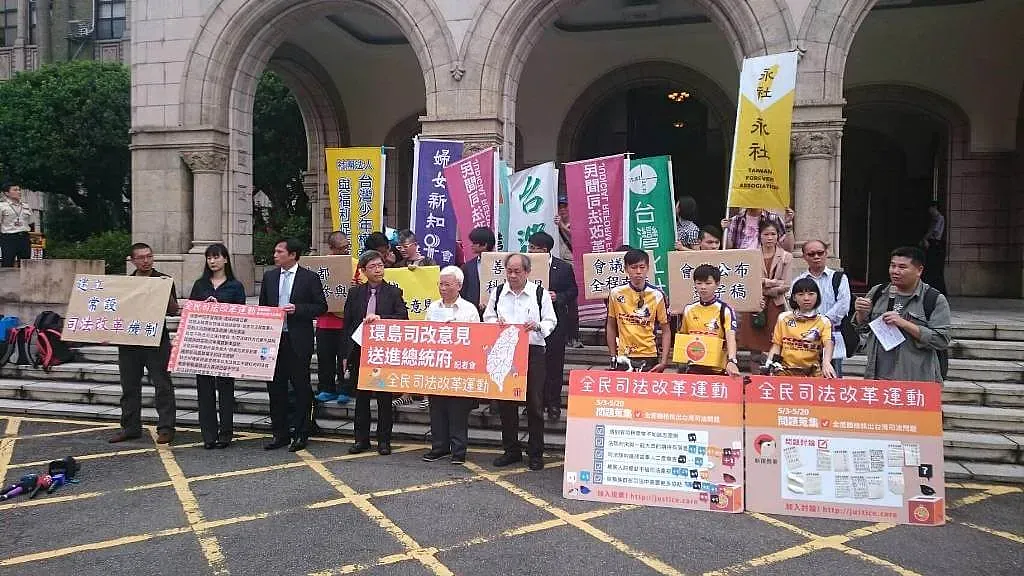
Cycling Around Taiwan to Deliver Judicial Reform Opinions to the Presidential Office – Citizens' Judicial Reform Movement Press Conference
Last edited: 2026-08-31
The "Citizens' Judicial Reform Movement," organized by the Judicial Reform Foundation, officially kicked off on May 4. On one hand, it collected public opinions on "what is wrong with the judiciary" via an online platform (http://justice.care/); on the other hand, it launched a cycling tour around Taiwan, visiting 19 courts across the island over 13 days to talk face-to-face with citizens about the judiciary and provide different channels for giving voice. After compiling online and physical feedback, the JRF and civil society organizations jointly announced the judicial issues of public concern today, and launched the second phase of the Citizens' Judicial Reform Movement.
Media and Correctional Institutions Rank as Primary Concerns
Regarding the online voting results on "what is wrong with the judiciary," tabulated from May 4 to May 20, a total of 1,856 netizens registered and voted. The top ten judicial issues cover a wide range of aspects (see Appendix I: Statistical Results of Online Voting for the Citizens' Judicial Reform Movement). Notably, the top two issues both relate to media coverage of judicial affairs. Citizens also paid close attention to the plight of rehabilitated persons and disadvantaged groups, which ranked third and fourth, respectively. Furthermore, citizens believe that a lack of understanding regarding judicial operations generates judicial problems. Regarding judges and prosecutors, in addition to inadequate elimination mechanisms, heavy workloads also sparked public concern. Finally, illegal police execution of duties and the harm caused by wrongful convictions left a deep impression on the public.
How the Online Platform Crystallized into Concrete Issues
Synthesizing the experience of collecting opinions online, in addition to the initial voting options, the online platform of the Citizens' Judicial Reform Movement also established a "discussion forum" for netizens to report new issues. After thorough discussions between board moderators and netizens, these were designed into new options open for everyone to vote on. At the same time, a "discussion thread" was established for each issue to allow netizens to share experiences. Through this, several issues were successfully consolidated into options. For example, many netizens left messages pointing out that the public's legal literacy has room for improvement; such opinions were consolidated into the issue of "the general public being unfamiliar with judicial operation practices." In this way, duplication can be avoided, issues can be more focused, and discussions can be more concrete. Many issues discussed through the online platform this time did not exist in past National Judicial Reform Conferences. Through appropriate mechanisms, online discussions can help focus issues, and netizens' specific opinions prevent the process from degenerating into populism.
Cycling Tour Opinion Collection Delivered to the Presidential Office
Meanwhile, the 13-day cycling tour around Taiwan undertaken by three riders from the JRF Taichung Office—Huang Wei-ting (黃暐庭), Ch'en I-chen (陳怡真), and Ch'en Hsin-i (陳芯儀)—started from the Taoyuan District Court, where migrant worker cases are numerous. Along the way, they gave a speech at the entrance of the Hsinchu City God Temple, paraded through downtown Taichung, and stopped for bike maintenance in Yunlin. People from all walks of life along the route had insightful views on the judiciary. The team also exchanged views with legal practitioners across various regions. One judge expressed a wish that the public could trust judges before their own retirement. Court and prosecutors' office representatives responded that the judicial hardware environment must be improved before carrying out corresponding reforms such as public participation in trials or technological courtrooms. Citizens wrote sentences "in one word/phrase about Taiwan's judiciary" on event postcards: "I like this island of Taiwan, I hope you keep it up," "We don't want the judiciary to become a TV drama," "Judges should not be bound by performance evaluations," and "I hope trusting the judiciary becomes a way of life." These sincere opinions will be delivered to the Presidential Office by rider representatives. (See Appendix II: A Word/Phrase for Taiwan's Judiciary)
Phase Two: Transforming Issues into Policy Topics
After gathering the public's opinions on the judiciary, the Citizens' Judicial Reform Movement will enter its second phase: holding evaluation meetings on July 2 and July 9 to have experts help analyze the potential causes behind the issues. The panel of experts will include judges, prosecutors, defense lawyers, legal and non-legal scholars, and representatives of civil groups, with non-legal background participants making up more than half of the total. In addition, members of the public who actively participated in online discussions and consistently published high-quality comments will be invited to participate. (See Appendix III: Description of Phase Two of the Citizens' Judicial Reform Movement)
Meetings and Materials Fully Online and Interactive
Written materials related to the evaluation meetings will be published online in advance for easy review. On the day of the meetings, live webcasts and real-time text broadcasting will also be adopted. Meeting recordings, verbatim transcripts of meeting minutes, meeting minutes, online chat room interaction records, and other materials will also be published online after the meetings. This is a concrete implementation of broadened participation, openness, and transparency.
Allowing True Public Participation
President Tsai Ing-wen announced in her May 20 inaugural address that a National Judicial Reform Conference will be convened in October, emphasizing the need for actual public participation and the entry of social forces, so that judicial reform is no longer solely the judiciary's or legal professionals' judiciary, but a reform with universal public participation. The National Judicial Reform Conference should abandon grand, two-to-three-day ceremonial meetings and instead take solid steps to hold sessions across various regions. At the same time, it should make good use of internet and technology assistance to truly maximize actual public participation. Moreover, the process of deliberating judicial policies must be completely transparent and open to genuinely involve the people, rather than relying solely on the opinions of legal professionals. Only in this way can judicial reform truly earn the public's trust.
Attendees
Father Peter Nguyen Van Hung, Catholic Diocese of Hsinchu - Migrants' Service Center (Vn-Office)
Lin Jen-hui (林仁惠), Secretary-General, Environmental Jurists Association
Li Hui-jen (李惠仁), Executive Director, News Hazards Prevention Foundation
Lin Wen-wei (林文蔚), Correctional Officer
Lo Shih-hsiang (羅士翔), Attorney & Executive Director, Taiwan Association for Innocence
Chu Chih-hao (朱智豪), Specialist, Yonghe Community College
Professor Chang Yeh-sen (張葉森), President, Taiwan North Society
Wu Cheng-che (吳政哲), Supervisor, Taiwan Association for Truth and Reconciliation / Taiwan Association for Children's Rights and Welfare Promotion (Note: adjusted to official name if known, keeping original translated context)
Professor Chien Wen-nan (錢文南), Board Member, Taiwan Jury Association
Ch'in Chi-fang (秦季芳), Director of the Legal Department, Awakening Foundation
Huang Ti-ying (黃帝穎), Board Member, Judicial Reform Foundation / Taiwan Forever Association
Chang Hong-lin (張宏林), Executive Director, Citizen Congress Watch
Ku Li-hsiung (顧立雄), Legislator
Huang Kuo-chang (黃國昌), Legislator
Kao Jung-chih (高榮志), Attorney & Executive Director, Judicial Reform Foundation
Lin Yung-sung (林永頌), Attorney & Chairperson, Judicial Reform Foundation
Huang Wei-ting (Director), Ch'en I-chen (Specialist), and Ch'en Hsin-i (Volunteer), Taichung Office (Cycling Riders), Judicial Reform Foundation
Press Contacts
Kao Jung-chih, Executive Director, Judicial Reform Foundation 02-2523-1178
Attachments
Appendix I Statistical Results of Online Voting for the Citizens' Judicial Reform Movement
Statistics from May 4, 2016 to May 20, with a total of 1,856 participants voting, listed by vote count from highest to lowest as follows:
- Improper reporting during investigations, causing trial by public opinion. Votes: 1288
- Media publishing erroneous reports without factual verification, harming the judiciary and parties involved. Votes: 1281
- Difficulty making a living for released inmates, leading to high recidivism rates. Votes: 1073
- The public's unfamiliarity with judicial operation practices, leading to misunderstandings about how the judiciary works. Votes: 1056
- Disadvantaged groups need more assistance in the judicial system. Votes: 1027
- Judges and prosecutors bear heavy caseloads, affecting the quality of case handling. Votes: 979
- Citizens often do not know what to do when facing lawsuits. Votes: 827
- Lack of clear and objective review standards to weed out truly incompetent judicial officers. Votes: 800
- Some police officers are law enforcement personnel themselves yet do not abide by the law. Votes: 798
- Judicial miscarriages of justice cause secondary harm to the parties involved. Votes: 767
- Legal education produces legal professionals who only know how to take exams. Votes: 702
- Some laws are unjust, and some Supreme Court precedents and resolutions are out of touch with society. Votes: 672
- Lawsuits drag on too long, and litigating is very expensive. Votes: 662
- Victims' rights are not valued by the judiciary. Votes: 645
- Judicial units should strengthen communication with the people and enhance transparency. Votes: 630
- Prosecutors' indictments, non-prosecution dispositions, and other documents should be made public. Votes: 545
- Some judges and prosecutors have poor attitudes during court sessions. Votes: 515
- Judicial procedures are not rigorous, infringing upon the rights and interests of the parties involved. Votes: 509
- Some court judgments diverge from the expectations of the general public. Votes: 429
- The efficiency of Grand Justices' constitutional interpretation should be enhanced. Votes: 352
- Reasonable appeal and relief periods should be guaranteed after a death sentence is finalized. Votes: 316
- Drug policies should be comprehensively reviewed to properly handle drug-related crime issues. Votes: 265
- Legal documents should use clear and easy-to-understand formats and writing styles as much as possible. Votes: 246
- Some lawyers take money but do not handle matters properly. Votes: 237
- Some judicial cases pander to political manipulations. Votes: 202
- Judicial officers, judgments, and improper actions during the authoritarian and dictatorial period should be comprehensively reviewed. Votes: 199
- Some forensic personnel lack professional competence, indirectly causing miscarriages of justice or wrongful convictions. Votes: 78
- The purpose of disclosing private data of parties involved in judicial procedures should be explained. Votes: 33
- Judges and prosecutors should have channels to request reviews of inappropriate laws. Votes: 4
- Prison administration must be transparent, and a third-party oversight mechanism should be established. Votes: 3
To check the latest results, please visit the Citizens' Judicial Reform Movement website: http://justice.care/step1
Appendix II A Word/Phrase for Taiwan's Judiciary
- The vulnerable prey on the vulnerable; the judiciary collapses. (Li Hui-ling, Supervisor, Catholic Diocese of Hsinchu - Migrants' Service Center)
- No matter what I say, the judiciary will not believe it. (A-yung, Vietnamese migrant worker)
- Justice may be delayed, but making justice arrive is the mission of the judiciary. (Liu Hsiang-heng, Wrongful conviction case party)
- Migrant workers are also human beings and should be valued and treated fairly. (Taoyuan Service Center for Masses, Migrant Worker Shelter)
- Please have judges examine cases based on their conscience and judge fairly. (Police officer with the surname Cheng, Wrongful conviction case party)
- We have all acted according to the law; Judge, have you acted according to the law? (Tsai Fang-man, Wife of a wrongful conviction case party)
- Judicial democratization, establishing a universal citizen jury. (Lai Ch'en Chun-yeh, Wife of a wrongful conviction case party)
- A standard without a standard is not a standard. (Cheng Hsing-tse, Wrongful conviction case party)
- Please have judicial trials adopt strict evidence rules, and do not cause wrongful convictions through conjectural inferences and free proof of evidence! (Elder brother of Wang Lung-chang, Wrongful conviction case party)
- When judges conduct trials, judicial discretion is stretched infinitely, leading to subjectivity and easy misjudgments. (Principal Chang, Wrongful conviction case party)
- My future may not necessarily come. (Chiang Fu-chung, Wrongful conviction case party)
- Hoping for the early realization of fair and just trials. (Miss Lo, Daughter of a wrongful conviction case party)
- A judiciary with the capacity for self-reflection is a great judiciary.
- Universal participation and judicial transparency.
- Judges should not be bound by performance evaluations.
- Support lawyers' right to review case files.
- Prosecutorial and court reforms should be promoted with the mindset of transitional justice.
- Support the Grand Justices in confronting equality rights and issuing constitutional interpretations immediately. r
- Implement rule-of-law education more thoroughly.
- Victims' rights must be valued.
- Allow the most vulnerable people to receive the best protection.
- Hoping the judiciary can protect me to grow up safely.
- Eliminate dinosaur judges.
- Open and transparent judiciary.
- Implement rule-of-law education.
- Marriage equality and diverse families.
- I like this island of Taiwan; I hope you keep it up.
- We don't want the judiciary to become a TV drama.
- Judges should not be bound by performance evaluations.
- I hope trusting the judiciary becomes a way of life.
- Killing is not allowed; the state must not kill either.
- What happens to oneself is an accident; what happens to others is a story. May there be fewer wrongful cases, keep it up!
Appendix III Description of Phase Two of the Citizens' Judicial Reform Movement
I. Schedule
- Phase One: 05/04-05/20 Health Check / Problem Collection (Completed)
- Phase Two: 05/21-07/09 Physical Fitness Evaluation / Evaluation Meetings (In Progress)
- Phase Three: 07/10-Mid-August Training Items / Solution Brainstorming Meetings
II. Description of Phase Two
After completing the first phase of collecting judicial problems, in order to uncover the causes behind the problems and transform them into policy topics, experts will be brought in during this stage to assist with cause analysis. The panel of experts includes judges, prosecutors, defense lawyers, legal and non-legal scholars, and representatives of civil groups. To prevent overly professionalized discussions by legal professionals that create a barrier to participation, and to prevent legal professionals from falling into their own professional blind spots, non-legal background participants will make up more than half of the experts assisting with cause analysis. In addition, members of the public who actively participated in online discussions and consistently published high-quality comments will be invited to participate in the evaluation meetings on July 2 and July 9.
[Pre-meeting Preparations]
(1) Purpose of preparation: List the "list of judicial problems and their potentially related underlying causes" for confirmation by the evaluation meeting, so as to facilitate efficient meeting proceedings.
(2) Information disclosure before/after the preparation period:
- In principle, materials related to the meetings will be made public online, including meeting recordings, meeting minutes (including verbatim transcripts), and responses to public comments.
- Materials posted online need to be plain and easy to understand.
(3) Timing: Estimated 2-3 preparatory meetings before July 2; time and location will be announced on the website, and meeting notices will be issued.
[Evaluation Meetings]
(1) Purpose of the meetings:
- Confirm the "list of judicial problems and their potentially related underlying causes."
- If necessary, also jointly confirm which causes of judicial problems urgently require priority discussion for solutions.
(2) Information disclosure before/after the meetings:
- These meetings will be live-streamed and text-broadcasted in real-time.
- Pre-meeting written materials, meeting recordings, verbatim transcripts of meeting minutes, compiled meeting minutes, and online chat room interaction records.
(3) Timing: July 2 and July 9, morning or afternoon
This article is an AI-generated translation of the original Chinese text. In the event of any discrepancy, the Chinese version shall prevail.