

Judicial Reform Involving Non-Lawyers is Quite Different
Last edited: 2026-07-27
In recent years, public satisfaction with the judiciary has been low, and there is a widespread awareness that "Taiwan's judiciary needs reform." However, because members of the public may lack specialized legal skills, they are often only able to express negative feelings about a specific case or judicial practitioner, finding it difficult to pinpoint the exact crux of what the judiciary needs to improve. On the other hand, while the professional legal community—such as judges, prosecutors, and attorneys—can propose professional solutions to certain judicial problems, their habitual ways of thinking about judicial issues easily create blind spots, preventing them from perceiving the everyday judicial sentiments commonly held by ordinary people.
To ensure that these negative public sentiments toward the judiciary can be accurately communicated to the legal community, leading to the formulation of correct remedies and making judicial reform truly resonate with the public, the JRF set up a website to hold a voting campaign in May of this year. Members of the public proposed and voted on the "judicial problems" they felt most needed to be resolved in Taiwan. The top three voted results were:
- Improper reporting during investigations, leading to public trial by media.
- Media publishing erroneous reports without proper verification, harming the judiciary and the parties involved.
- Difficulty in making a living for released prisoners, resulting in high recidivism rates.
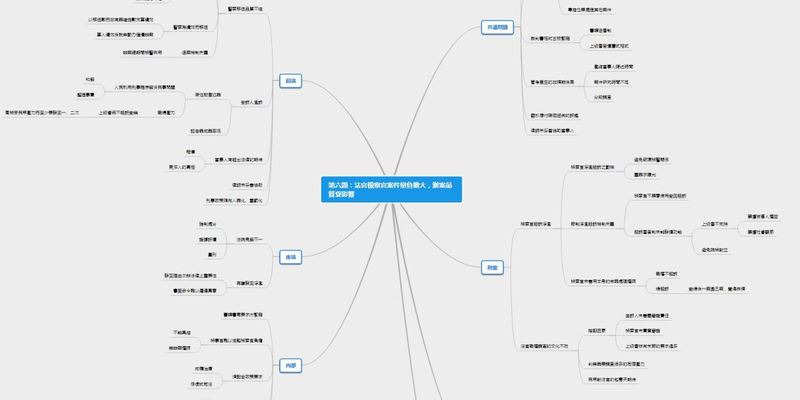
Following the announcement of the first-stage voting results, the JRF commissioned suitable analysts in the second stage to analyze and interview the top 12 judicial problems. For each judicial problem, an analytical report of significant reference value was written. At the same time, the analysis results were compiled into mind maps that could be easily read by non-legal professionals.
After completing the analytical reports and mind maps, the JRF convened a working group comprising scholars, experts in related fields, judicial practitioners, and NGO representatives to hold three working meetings and two expanded evaluation meetings. The purpose was to discuss and confirm the analytical reports and mind maps more meticulously, crystallizing them into judicial issues to be used in the third stage to generate solutions for judicial reform.

Past judicial reforms were usually initiated by judicial practitioners proposing the difficulties they encountered in the judiciary, followed by legislative amendments or oversight. But as mentioned earlier, because judicial practitioners have habitual stances on specific issues and even suffer from parochialism, their imagination of judicial problems is far removed from the actual experiences of the public who are the "users" of the judiciary.
Compared to the past, the reform approach experimented with by the JRF attempts to "reform" the "method" of judicial reform. Starting from the perspective of the users, it collects the judicial problems they care about most. Because judicial problems are multifaceted, the dimensions involved in a single judicial problem can be all-encompassing. Therefore, we do not rush to immediately seek solutions for a judicial problem; instead, we first analyze the causes of the problem, attempting to understand why the public has such feelings toward the judiciary. Only after dissecting and analyzing the problem into issues do we begin to seek solutions.
When discussing judicial reform, legal professionals have traditionally believed it to be a specialized domain that laymen should not meddle in. However, throughout this experimental process, the participation of non-lawyers has emerged as a major highlight. Thanks to the multifaceted involvement of non-lawyers, problems can sometimes be targeted directly at their essence while expanding infinitely.
Taking the number-one voted judicial problem—"Improper reporting during investigations, leading to public trial by media"—as an example, a legal professional like the author would instinctively react by applying a formula, immediately categorizing this as a typical issue involving "侦查不公開" (the principle of non-disclosure of investigations). The solution would have long been proposed: imposing a corresponding confidentiality obligation on prosecutors and police, and prohibiting police from taking the media along to handle cases.
However, the analyst for this judicial problem, who included a media professional, offered a more multidimensional analysis. He argued that the rise of social media and the survival predicament encountered by traditional media might be the real reasons why the principle of non-disclosure of investigations has consistently failed to be implemented. He further mentioned that the principle of non-disclosure of investigations may need to be reconstructed and elevated; legal professionals should consider whether the principle of non-disclosure of investigations, as operated under the current status quo, needs adjustment. Furthermore, when the public raises doubts about a case, should the judiciary make appropriate disclosures to account to the public, or even proactively reveal and inform them—including what parts cannot be discussed—through proactive and active explanations, facing the situation with a candid attitude to break away from the feeling of concealment? He believes that the judiciary's proactive attitude in facing problems will be the key to whether the public trusts the judiciary.
The journey of the JRF and the working group is far from over. After producing the analytical reports and mind maps, groups of experts will be invited to discuss and critique these outcomes, all to ensure that the judicial problems existing in the public mind can be communicated and analyzed with the utmost precision. We believe that only through grounded, contextualized analysis can judicial problems be connected to the most nearly correct solutions. Only thus can judicial reform truly respond to the aspirations of the people.
This article is an AI-generated translation of the original Chinese text. In the event of any discrepancy, the Chinese version shall prevail.