
Before Transitional Justice is Achieved, Do Not Use the Chiou Ho-shun Case to Quell Public Outrage
Last edited: 2026-08-27
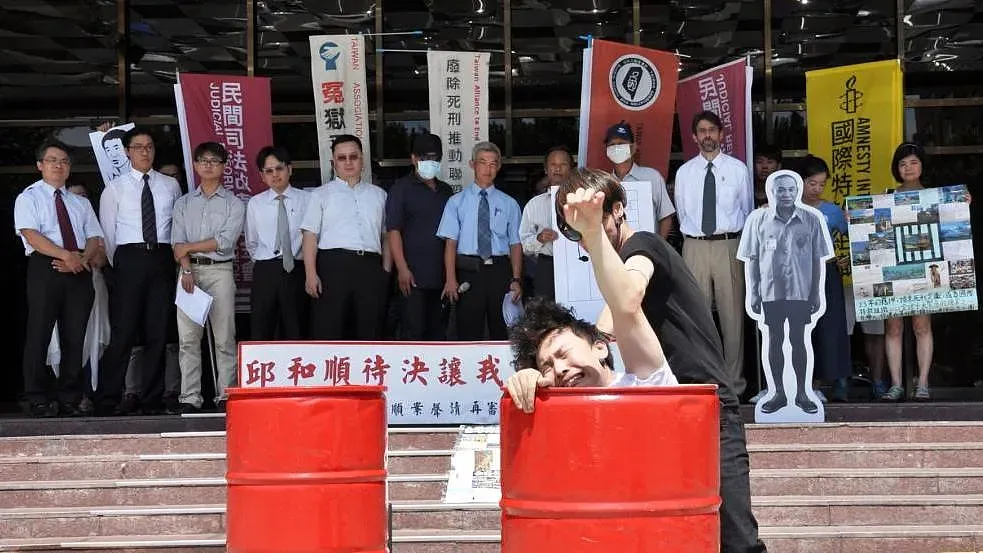
Last Friday, amidst public uproar, the Minister of Justice signed an execution order, and six death-row inmates whose judgments had been finalized were executed that very night. Subsequently, the media reported with the headline 'Detained for 27 Years, Control Yuan Borrows Case Files: Lu Cheng Case's Chiou Ho-shun Escapes Firing Squad Death Penalty,' indicating that Chiou Ho-shun was likely originally on the execution list.
In fact, with just a little time spent checking and understanding, this case has not only been listed by Amnesty International as one of the top ten wrongful convictions of the year, but the Control Yuan has also issued a report strongly condemning prosecutors and police for subjecting the involved parties to 'violence and coercion' during the handling process, and impeached the police officers and prosecutors involved at the time, making it a clear miscarriage of justice. At this very moment, such a narrative makes it difficult not to suspect that the Ministry of Justice intended to use the Chiou Ho-shun case to quell public outrage and appease the inflamed sentiments of the crowd.
Retired Police Officer's Confession from the Conscience
During the investigation, the interrogation tape—in which a co-defendant was wearing only underwear, and voices could be heard saying 'Bring the pepper spray in here, Chuan-tan-i' and 'I hit him once, he changes another,' mixed with cursing and the sound of beating—is still circulating in courts and the media. Yesterday (June 9), a frontline police officer who assisted in handling the case back then spoke from the heart in front of the Ministry of Justice, recounting how the Taipei City Police Department's Criminal Investigation Division, which led the operation, used torture during custody; how the defendants took advantage of gaps during custody to plead for mercy; and the dilemma they faced when reporting upward only to be punished and their helplessness under the system. Until the calls for execution grew ceaseless, leaving them no longer able to ignore their consciences, they stepped forward to clarify: 'What was done was done, and if it wasn't done, innocence must be returned to the people,' words still ringing in their ears, hoping the judiciary would stay the execution and clear away the unjust accusations against them.
Transitional Justice Awaiting Implementation
During the period of martial law in Taiwan, the judiciary under the authoritarian regime was not an independent institution; the scales tilted not toward fairness and justice, but toward political correctness. Torture, coerced confessions, and arbitrary detention were commonplace. To resolve the social pressure of failing to solve cases for a long time, judicial authorities ignored evidence favorable to the defendants and convicted them based solely on confessions obtained through torture, unjustly imposing two cases upon Chiou Ho-shun and others, wronging them for nearly thirty years.
To this day, martial law has been lifted in Taiwan for decades, but the people remain shrouded in the lingering echoes of state violence and the lament of the party-state authoritarianism, which has not been alleviated by the ratification of the two Covenants since 2009. The hot-button issue of transitional justice is still viewed as a remedy for past illegalities and injustices and carries great expectations. The people hope to bid farewell to the lingering poison of authoritarianism through transitional justice and consolidate the protection of basic human rights for the future.
The Chiou case, which occurred the year after the lifting of martial law and brought together torture, authoritarianism, and backroom dealings, is a precise example of how deeply the authoritarian legacy had penetrated judicial organs at the time. This case is the benchmark and the crux of whether social justice can be realized and public trust in the judiciary restored. At this juncture, what is being tested is not only whether the judiciary can comprehend that 'life and death, entry and exit are the origin, and rectifying the crooked and straightening the bent are the pivotal mechanisms,' and recognize the profound impact of judgments on human lives, but even more so, whether the government can respond to the aspirations of the people, demonstrate the height and perspective of checking public opinion and embodying judicial justice in individual cases, and impact the nation's resolve to implement transitional justice policies.
This article is an AI-generated translation of the original Chinese text. In the event of any discrepancy, the Chinese version shall prevail.
