
Reflections on Chief Prosecutors' Reassignments, Taking Yang Chih-yu as an Example
Last edited: 2026-07-27
In early May, the Ministry of Justice held a handover ceremony for chief prosecutors, with outgoing Taipei District Prosecutors' Office (TDPO) Chief Prosecutor Yang Chih-yu drawing the most attention. In his speech, he expressed gratitude for the recognition and support shown to him by former Minister of Justice Tseng Yung-fu, and thanked Minister Lo Ying-shej for her magnanimity and steadfast support. This was a relatively relaxed occasion; perhaps Yang's remarks were merely intended to show humor, or perhaps they truly came from the bottom of his heart. After all, the TDPO has long been known as the "Number One Office in the Realm." With high-ranking officials and dignitaries swarming Taipei, making a living there is no easy task—nor is it something one can achieve simply by wanting to; it takes the right time, favorable geographic conditions, and harmonious human relations, along with one's own efforts and the blessing of superiors.
As events subsequently proved, Tseng Yung-fu was brought down by the political struggles orchestrated by President Ma, who was deeply favored by Lo Ying-shej. Naturally, the media loves to report on such flashpoints. Yet, this speech "thanking superiors" still left people feeling saddened and emotional, with a heavily pervasive undertone of having "eyes only for superiors, and nothing else."
Contrasting this with around this time last year, when Yang Chih-yu threatened to resign, creating a dilemma for Lo Ying-shej—who had just taken office six months prior—and sparking widespread discussion. Some analyzed that he was truly a "grand master of inner court politics," and his resignation was extremely "savvy." It signified his willingness to advance and retreat together with his old superior "Uncle Yung," while also testing whether Lo Ying-shej "truly loved him." As he simultaneously mentioned in his speech, having stayed at the TDPO for nearly five years and experienced two Taipei mayoral elections, "the fires of war raged incessantly, resembling two World Wars," and he managed to "survive it through." However, what he failed to mention was that when he tendered his resignation at the end of April last year, it coincided precisely with the conclusion of the Sunflower Student Movement; how to handle the "Sunflower Movement" would determine a chief prosecutor's historical positioning. When Hau Lung-bin ran for re-election, the campaign was much milder and could hardly compare to the showdown between Ko Wen-je and Sean Lien.
By staying another year, what did Yang Chih-yu choose?
Yang Chih-yu is smart, which is why his attempt to resign at the end of April last year was an effort to protect himself and preserve his reputation. He was strongly urged to stay, and staying meant agreeing to help "steady the ship" for the Ma regime, represented by Lo Ying-shej. During the Sunflower Movement last year, the Ma administration suffered a heavy blow, and in the November 29 elections at the end of the year, the Kuomintang suffered an unprecedented defeat. Looking back, what did the TDPO led by Yang Chih-yu do?
It prosecuted students and crowds participating in the movement on a massive scale. Furthermore, right before stepping down, it additionally prosecuted citizens who had filed charges against Ma Ying-jeou and Chiang Yi-huah—specifically those individuals who had their heads beaten and bloodied. What is even more outrageous is that some people were prosecuted simply for stepping forward as witnesses to testify against the violent beatings by police, and were consequently "reverse-implicated" as having charged into the Executive Yuan and deemed accomplices. Their testimonies accusing the police were twisted by the TDPO into confessions of guilt.
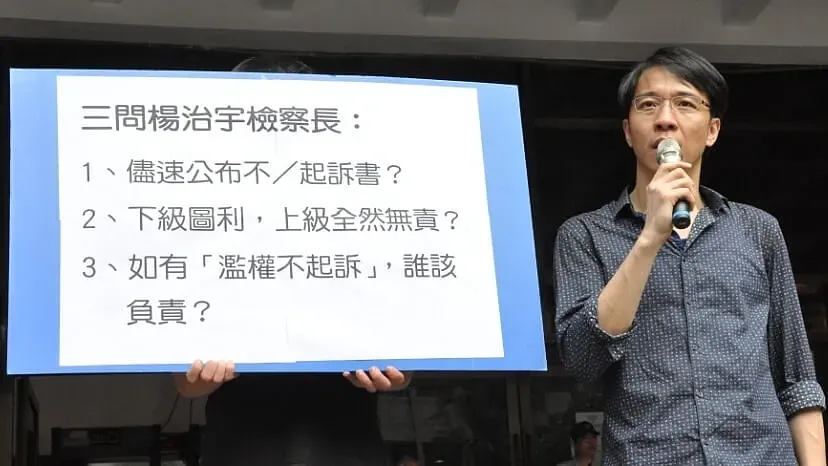
Of course, the Executive Yuan was unwilling to let go, insisting on filing charges against students and the public. If the TDPO wants to prosecute, we have no objection, provided the prosecutors make the facts and evidence clear and distinct, and avoid "retaliatory prosecutions" cast like a "drift net." However, in stark contrast, while police officers who beat people until their heads were cracked and bleeding faced zero investigative progress from the TDPO, this is the textbook definition of a "double standard." Based on this point alone, Yang Chih-yu's value choice is crystal clear: he "servilely submitted to and defended the regime."
Let us also recall how the TDPO initially investigated the wiretapping scandal surrounding Ko Wen-je's campaign office with lightning speed. Staff members of Ko's office were handcuffed and subjected to requests for detention, and two detective agency operators were likewise detained. Setting aside the fact that these actions were later slapped down by the courts—which could be considered a reflection of prosecutors having lower human rights standards compared to judges—
yet, in the end, two of these three individuals were completely unindicted, and the TDPO once again buried its own reputation with its own hands. This indicates that when requesting detention, the TDPO had virtually no evidence on hand at all. Therefore, who could still believe that those high-profile requests for detention at the time were entirely necessary? And what does this represent? Was there simply no objective standard for handling cases, or was it merely doing another favor for Ko Wen-je's new regime?
If these cases are deemed too "politically sensitive" (not to mention the non-prosecution of high-ranking officials in the Meihwa township case, and the deferred prosecution of Lien Hui-hsin!), let us discuss a case that is completely "insensitive" yet completely "perished" at the hands of Yang Chih-yu: the Chiang Kuo-ching case! On July 27, 2010, Yang Chih-yu took office as Chief Prosecutor of the Taipei District Prosecutors' Office. On August 3 of the same year, Chiang Kuo-ching's mother filed a complaint with the TDPO against military officers including Chen Chao-min for offenses including suspected homicide, abuse of authority causing death through prosecution, and unlawful detention resulting in death.
After waiting for nearly a year, in May 2011, Yang Chih-yu issued a non-prosecution disposition for Chen Chao-min and his associates. The Taiwan High Prosecutors Office swiftly remanded the case for reinvestigation on July 13. Sitting on it for another year, the TDPO still issued a non-prosecution disposition in August 2012. The High Prosecutors Office remanded it once more, and from December 2012 onward, it has been left sitting until now. Clearly, Yang Chih-yu simply wanted to shelve it, leaving the messy situation for others to deal with, regardless of whether anyone cleans it up.
Had he applied the same spirit of "pursuing/hunting down" the Sunflower students and crowd to Chen Chao-min and others, Chen and his associates would have been indicted hundreds of times over by now. Moreover, the Control Yuan's investigation had uncovered even more concrete evidence proving that Chen Chao-min had indeed used notes and issued directives, exercising control over Chiang Kuo-ching's death from beginning to end. For the TDPO to still refuse prosecution and continuously shelve the matter clearly demonstrates an intent to handle it with a "cold shoulder."
The Selection of Chief Prosecutors is Unlawful and a Black Box
A strong critique is leveled against Yang Chih-yu for no other reason than that the Chief Prosecutor of the Taipei District Prosecutors' Office wields one of the greatest prosecutorial powers. The greater the power, the stricter the supervision it must face. Consequently, a stern reminder must be given to all 16 newly reassigned chief prosecutors: every decision and choice made after assuming power will be subjected to even more rigorous scrutiny.
Furthermore, during the selection process, we have never heard what criteria were actually based upon, or what conditions were required. Why were some eliminated and others chosen, and on the basis of what qualifications? Aside from "seniority ethics" being the supreme standard, everything else seems to be an unspoken "black box" understood by all.
Since everyone keeps it "unspoken," no one truly takes the relevant laws seriously. Article 90, Paragraph 4 of the Judges Act stipulates that when the Minister of Justice selects chief prosecutors, they must make their choices from a list of "twice the number of candidates" proposed by the Prosecutor Personnel Review Committee.
According to media reports, the Ministry of Justice initially announced to the outside world that there would be "10" chief prosecutor reassignments, and consequently, the Prosecutor Personnel Review Committee only submitted a list of "20" candidates. However, in the end, as many as "16" chief prosecutors were selected.
Pursuant to Article 90, Paragraph 4 of the Judges Act, the Minister's selection this time around may be unlawful. Yet, shockingly, not a single law-savvy prosecutor noticed this? Or did they simply not care? Or perhaps there is yet another "divine logic" behind the explanation?
This article is an AI-generated translation of the original Chinese text. In the event of any discrepancy, the Chinese version shall prevail.