
The Ministry of Justice Chokes Its Own Child
Last edited: 2026-07-27
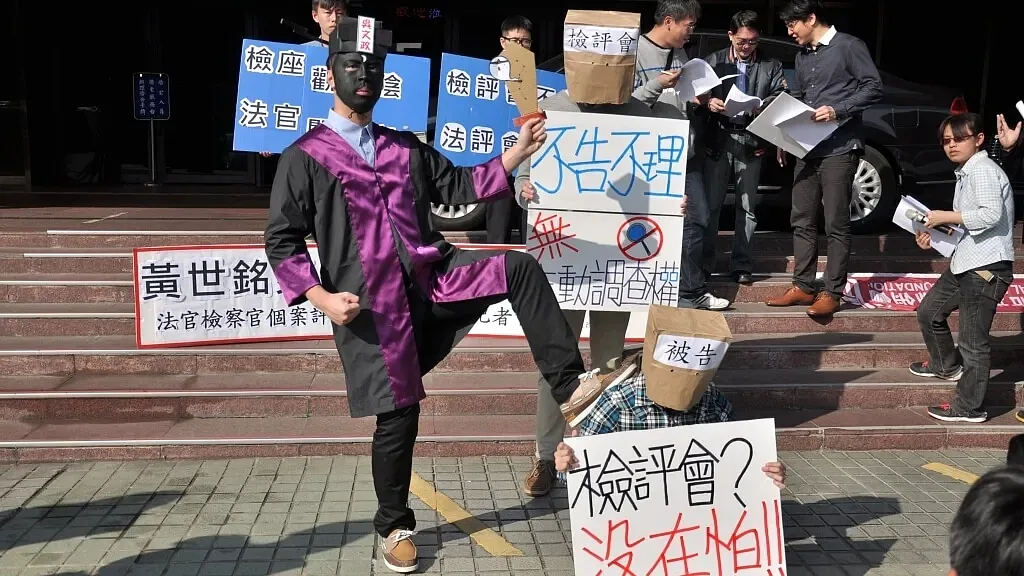
Choking is the act of applying pressure to the neck, which induces a sustained state of cerebral hypoxia and ultimately leads to coma or death. Such is the explanation on Wikipedia. The neck is a vital part of the human body, through which the trachea and blood vessels pass. The brain is the most crucial human organ, requiring blood to transport oxygen and supply nutrients. Brain decay leads at best to a vegetative state and at worst to brain death, a defined state of death. Normal parents do not want to choke their own child to death. Those who wish to choke their own child are usually somewhat abnormal, or perhaps the child is unlovable and constantly provokes the parents. Especially when the child threatens the parents' survival, such tragedies are prone to occur.
Who threatens the survival of the Ministry of Justice? Who is that unloved child? It is presumably the "Prosecutor Evaluation Commission" established and put into operation on January 6, 2012. The Prosecutor Evaluation Commission "parasitizes" within the Ministry of Justice, just as prosecutors "parasitize" within the Judges Act. Unlovable, yet it must barely survive. Yet the Prosecutor Evaluation Commission shares the power of the Ministry of Justice, possessing the ability to discipline prosecutors. It can prevent someone from remaining a prosecutor, and at most, strip them of their civil servant status at the root.
The Prosecutor Evaluation Commission is an Alien
Out of the eleven members on the Prosecutor Evaluation Commission, only three are prosecutors themselves, while the other eight are outsiders. In the eyes of the Ministry of Justice, this is essentially an "alien." Conceived inexplicably in outer space and smuggled to Earth to wreak havoc, for over two years, the Ministry has continuously staged a movie about "eradicating the alien," trying every possible means to find its fatal flaw and incapacitate it permanently.
Denying dedicated manpower and depriving it of nutrients. The members of the Prosecutor Evaluation Commission are all part-time, with an attendance fee of two thousand per session, offering low incentive. Meetings are typically held once a month, making it easy to become disengaged. Without strong staff support, anyone with discerning eyes can see that its combat capability is weak and it simply cannot grow. Gasping for breath and nearly asphyxiated, the Ministry of Justice simply does not care.
It even kicks them while they are down, promulgating internal regulations on its own to lock the throat, tie the hands, and bind the feet, leaving them completely immobile. The chairperson is appointed by the Minister and can only be held by a prosecutor (it is rumored that the next term will be amended). Is a chairperson monopolized by one's own people not precisely intended to lower firepower and facilitate "damage control"? Furthermore, the Prosecutor Evaluation Commission has been reduced to a body that "does not act unless petitioned," while severely restricting the scope of investigation—submissive to an absurd degree, timid and shrinking.
Even more absurdly, it blinds its eyes and deafens its ears. During an investigation, if it "inadvertently" sees a part not mentioned by the whistleblower, no matter how obvious the prosecutor's violation is, it must be skipped, bypassed, and let pass entirely. This is blindingly ridiculous; how can a whistleblower investigate, and how can they possibly know where all the evidence is? Since the whistleblower does not know, naturally they do not mention it, and the Prosecutor Evaluation Commission deceives itself, closing its eyes, walking blindly past, and making a mockery of itself.
Consequently, under circumstances where it is unloved by anyone and forced to live under another's roof, the Prosecutor Evaluation Commission is on the verge of becoming a "child that fails to grow up." The proportion of prosecutors referred after review has plummeted straight down, hitting a mere 6% last year. This year, it even refuses any assistance and gives up on treatment.
Regulating the external bodies that request evaluations, their qualifications automatically expire every three years and must be re-verified if they wish to continue. As if that were not enough, things have now escalated: refusing to help transcribe audio recordings? Refused. Requesting to review the case files? Disallowed. Requesting to attend and provide explanations? Objected. It is entirely a case of handling matters behind closed doors, carrying a strong flavor of secret investigations by prosecutorial agencies. Complete lack of transparency—it is a black box.
The Ministry of Justice intentionally and deliberately aims to darken it, deprive it of oxygen, strip it of nutrients, rob it of mobility, prevent it from amounting to anything, and ensure it poses no threat. Even if it is still allowed to breathe, it is in a defined state of death.
It Was Not Supposed to Look Like This
This current spectacle reaffirms that had it not been for the White Rose Movement and collective judicial corruption back then, the Ministry of Justice would have fought to the death to avoid giving birth to this child. When it was initially passed into legislation, it looked like this, already congenitally deficient. The original expectation of the civil society's draft version was to hope that the people themselves could directly file complaints against problematic prosecutors, without having to take convoluted detours through bar associations or civil groups.
If it had been opened to the public, it could not possibly operate on such a small scale as it does now. Given the degree of public "trust" in our judiciary, it is believed that complaint cases would roll in endlessly like the surging river. It had to be of a considerable scale to withstand wave after wave of public grievances against the judiciary. Only then would the Ministry of Justice have been unable to pull the wool over everyone's eyes and so easily choke its own child.
Of course, after so much criticism, the Ministry of Justice will surely feel deeply aggrieved. But let us not forget that the Prosecutor Evaluation Commission has a twin brother called the Judges Evaluation Commission, which is nurtured by the Judicial Yuan. Although they share the same origin and are both congenitally deficient, the Judicial Yuan at least puts in genuine effort, providing some nutrients and striving for self-improvement.
If you want to talk big, wait until your conditions match theirs before coming back.
This article is an AI-generated translation of the original Chinese text. In the event of any discrepancy, the Chinese version shall prevail.