
Stop Making Grand Justices Appointments Based on Spoils Systems
Last edited: 2026-07-27
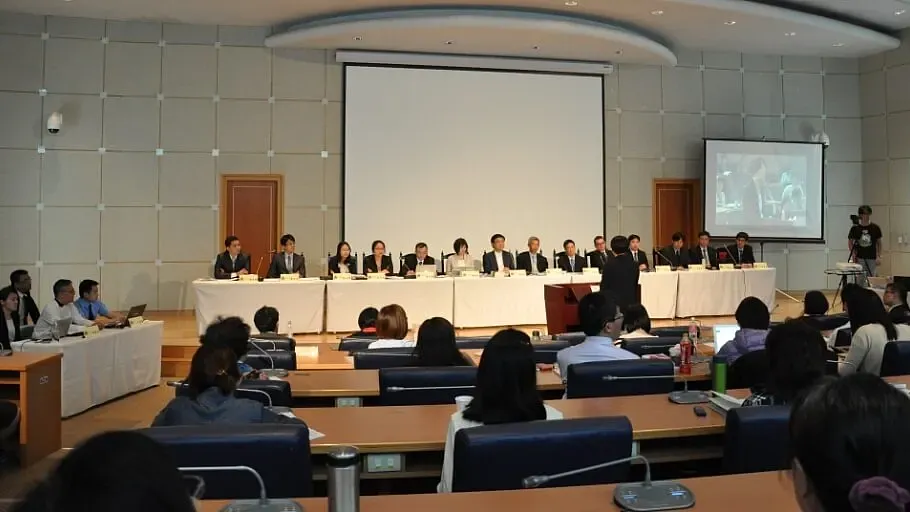
Photo / Photo of the first Mock Constitutional Court event
"Since when did the Judicial Yuan, tasked with constitutional interpretation, become a tax court?" This was stated by Grand Justice T'ang Te-tsung in his dissenting opinion on J.Y. Interpretation No. 713. What Grand Justice T'ang left unsaid undoubtedly reflected his deep frustration with the severe atrophy of the current Grand Justices' functions. With the terms of four Grand Justices soon expiring, as the President initiates the nomination process for new candidates, we must concern ourselves with the suitability of the Grand Justices.
The primary duty of the Grand Justices is to protect the constitutional rights of the people and prevent the various branches of government from colluding. Today, as social systems in Taiwan remain unreasonable in every aspect, and the legislative, executive, and judicial branches continue to disregard public sentiment, the Grand Justices have failed to fully perform their function as "guardians of the Constitution" due to flaws in the constitutional review system and the conservative character of most Grand Justices. Especially when the U.S. Supreme Court, composed of nine Grand Justices, still hears seventy or eighty cases a year, the Judicial Yuan, composed of fifteen Grand Justices, hears only a dozen or so cases annually. In terms of work performance, the Grand Justices ought to be ashamed.
Is it because Taiwan's legal system is relatively sound, resulting in fewer cases worthy of adjudication by the Grand Justices? As anyone can guess, that is impossible. Is it because Taiwanese society is relatively reluctant to litigate, resulting in fewer cases applying for constitutional interpretation? Anyone who understands constitutional review practice knows that the Grand Justices reject the procedural aspects of the vast majority of cases. Let alone ordinary citizens, even when lower-court judges write elaborate legal arguments spanning seventy or eighty pages to apply for constitutional interpretation, the Grand Justices dismiss them on the grounds that: "The petitioner relies on subjective views, making generalized accusations; it can hardly be said that specific reasons have been presented to objectively establish a definitive conviction that the law is unconstitutional."
The crux of the issue lies in the character, values, and scholarship of the Grand Justices. In the past, the selection and appointment of our Grand Justices—euphemistically called diverse recruitment—was actually closer to spoils-system appointments. In addition to balancing the number of those originating from academia and the practical sector, attention had to be paid to balancing the countries where they studied abroad, accommodating studies in public law, civil law, and criminal law, and—more importantly—political correctness and gender balance. With so many factors considered, character, values, and scholarship ceased to be the primary focus. Taking Grand Justices from the practical sector as an example, most display only a conservative and authoritarian character; not only do they rarely write persuasive opinion briefs, but they also frequently take defending Supreme Court precedents or dismissing parties' petitions as their mission.
Take Grand Justice T'ang as an example. He was not President Ma's initial choice; it was because a previously nominated female nominee faced high legal applicability controversies regarding a specific judgment. Amid public uproar, President Ma held a press conference to apologize and re-nominated Grand Justice T'ang to quell the anger. However, even then, President Ma solemnly designated the Vice President to form a "Grand Justices Nomination Advisory Committee," which accepted recommendations from all sectors and reviewed them before submitting recommended candidates to President Ma. Yet, such a controversy still occurred, showing that appointment-spoils are the root of the problem. Today, President Ma has once again instructed the Vice President to serve as the convener and formed an advisory committee with mostly the same members. If their mindset does not change, there is no guarantee they will not repeat past mistakes.
On the other hand, in the United States—the birthplace of the constitutional review system—because federal Supreme Court justices serve for life and number only nine, combined with a legal-supremacy rule-of-law culture, successive presidents have regarded the nomination of Grand Justice candidates as the most important act of governance during their term. Therefore, when a nomination opportunity arises, Department of Justice officials and White House staff begin searching far and wide for articles, speeches, and legal documents previously published by potential candidates, conduct on-site interviews with candidates and their surrounding colleagues, and are then personally received by the President to ensure the nominee's will and values are close to their own. During this process, by convention, the bar association also assists in screening promising candidates, issuing evaluation opinions regarding their reputation, judicial competence, and judicial impartiality. Once the nomination is confirmed, the Presidential Office actively assists the nominee in visiting members of Congress and preparing for the hearing process.
As demonstrated by the U.S. experience, nominating Grand Justices must be treated with utmost seriousness. The candidate's character, values, and scholarship should be the core considerations, and diverse recruitment must never be turned into appointment-spoils. Rather than being reviewed by a small oligarchy (these former presidents of the Judicial Yuan and former Grand Justices also carry personal relational baggage), it is better to listen more to diverse opinions from bar associations and public interest groups, pooling the wisdom of the masses, combined with strict review by the Legislative Yuan review committee. Only in this way can Grand Justices who truly defend the Constitution and protect human rights be selected.
※ This article was published in the Apple Daily on March 16, 2015. This is the original full text.
This article is an AI-generated translation of the original Chinese text. In the event of any discrepancy, the Chinese version shall prevail.