
Truth, Confrontation, and Beheading Chickens
Last edited: 2026-08-31
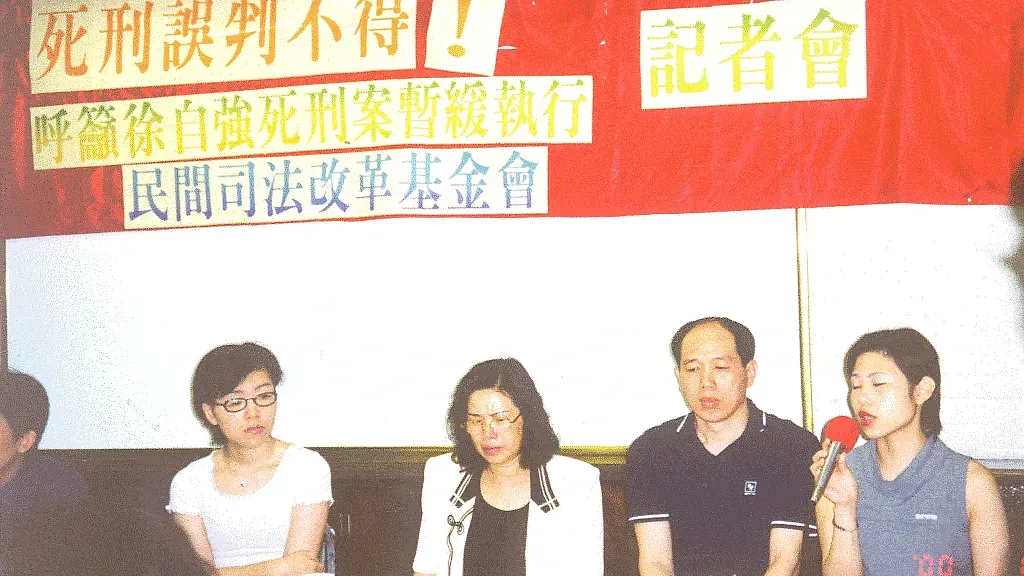
Photo / Press conference on the HSU Tzu-chiang case in 2000
After beheading a chicken, burning yellow paper, and drinking blood in a pact of brotherhood, Wei Hsiao-pao, you are now my brother in the Heaven and Earth Society, temporarily assigned to the Azure Wood Hall. We have ten major society rules, twenty major precepts, thirty major commandments, and eighty minor commandments. If you violate even one of them, even though you are my disciple, you shall die by ninety-nine and eighty-one knife cuts.
Mortals are dishonest in their speech and need oaths for assurance. When disputes arise and we need to uncover the truth, we hope someone can speak the truth. There are many ways to provide a guarantee; in ancient times, before the deities, chickens were beheaded and toxic oaths were sworn. This was once beloved by politicians and citizens alike in early Taiwan, though it has gradually fallen into obscurity.
Curious as to why it had to be beheading a chicken, and why the chicken had to be so unlucky? Historical records can be traced back to the Spring and Autumn and Warring States periods. The Records of the Grand Historian, in the biographies of Lord Pingyuan and Yu Qing, notes that Lord Pingyuan wanted to form an alliance with the State of Chu, "telling the attendants of the King of Chu to bring the blood of pigs, horses, and dogs," and "drinking blood in a covenant." The commentary Suoyin explains: "As for the sacrificial animals used in covenants, the high and low rank differ. The Son of Heaven uses oxen and horses, feudal lords use dogs and boars, and officials of the rank of Ta-fu and below use chickens." This passage explains the use of chicken blood for sacrifice, as we are "Ta-fu and below," meaning ordinary commoners.
Is a Formal Pledge Inferior to Beheading a Chicken?
Blood sacrifices and blood oaths are solemn and serious, and thus valued by people. The culture of beheading chickens is said to be a custom of the Miao people, where before a shaman, toxic oaths are sworn to deities and a chicken is beheaded. Observing which way the chicken's head points determines right and wrong. This custom spread to Fujian, Zhejiang, and Guangdong, and then came to Taiwan with Koxinga.
With deities within, oaths without, public opinion, and fresh blood, this makes for a very strong "guarantee." What the oath-taker says ought to be the truth. However, why does the Code of Criminal Procedure only use a "limp" "formal pledge (具結)" and refuse to introduce this method which "has both spectacular visuals and rich effects"?
Making a formal pledge yet lying is merely the offense of perjury under the Criminal Code, carrying a sentence of imprisonment for under seven years. While the penalty may not seem light, in practical operation, those who get punished either have exceptionally clumsy lying skills or retracted their testimony, leading to retaliatory prosecution by prosecutors. Furthermore, there are various exclusionary provisions allowing certain specific individuals to remain silent and keep secrets locked in their hearts.
This shows that modern justice has discarded (or left unaddressed) tales of ghosts and gods, while acknowledging its own limited capabilities and inability to be omniscient and omnipotent. Due to certain practical difficulties, or to uphold higher values (such as physicians, accountants, and clergy being allowed to refuse to testify), it stops investigating the full truth. It ceases its relentless pursuit. This is the difference between modern justice and Judge Pao, and an inevitable result of the disenchantment of modern society.
While American courts certainly mention God when swearing in witnesses, it is merely a formality. Puritans no longer practice Old Testament-style sheep sacrifices and know that even before God, someone might still lie. The values represented by God were long ago nailed to the cross by Nietzsche, not to mention the unrestrained atheists.
The American legal system believes that to ensure witnesses tell the truth and better discover the true facts, prosecutors and defense attorneys must engage in fierce adversarial combat and conduct cross-examination. Anyone daring to step onto the witness stand is guaranteed to be put through the wringer by the prosecutor or defense counsel. Unless they tell a solid truth, inconsistencies will eventually emerge from contradictory statements, or flaws will appear where testimony conflicts with evidence.
Close cross-examination paired with meticulous rules of evidence, along with clearly defined burdens of proof, makes court proceedings appear more rational and serves as a hallmark of modernization. It is no longer merely pre-modern bloodshed and heart-pounding tension, posturing, or spiteful bickering. But looking back at our country's courts, they seem still lost/puzzled between the modern and the pre-modern.
Regardless of whether witnesses are friendly or hostile, regardless of the order of questioning, and regardless of how heavy or light the burden of proof is, judges jump into an already chaotic battle, asking questions on the spot, haphazardly, and casually. Completely devoid of method, it is practically a judicial farce. Without prior preparation, witnesses blurt out a mess; friendly witnesses get set up, and hostile witnesses might flip.
When everyone has questioned to their heart's content, the judge conveniently begins cutting and pasting. Thus, witnesses may subsequently regret their testimony, feeling that it was not what they originally meant at all. The prosecution, defense, and judges will also nitpick over every word, bickering and stamping their feet when amending transcripts. While we certainly do not behead chickens, there are chicken heads scattered all over the floor. The direction they point depends entirely on how the judge chooses to pick them up and use them. Judicial discretionary power.
Is Cross-Examination Inferior to Confrontation?
Paragraph 2, Article 184 of the Code of Criminal Procedure stipulates: "When necessary for discovering the truth, [the court] may order a witness to confront another witness or the defendant, and may also, upon the application of the defendant, order confrontation with a witness." The meaning of this statutory provision is that in order to clarify the facts, the judge may require a witness to "confront" other witnesses or the defendant.
This provision existed even before our country implemented cross-examination. One interpretation is to construe "confrontation" as "cross-examination." Then, naturally, it must follow the rules of cross-examination. Both the prosecution and defense can cross-examine/confront the witness, rather than having professional prosecutors and defense attorneys stand idly by and watch ordinary laypeople battle it out head-to-head.
Another interpretation is essentially the defendant's right to be present, enabling them to see and hear the witness's testimony with their own eyes and ears to enrich their right to defense. In the early days without cross-examination, written transcripts were supreme and could substitute for everything. If the court was too lazy to summon them, defendants sometimes were convicted without even seeing the witness or asking any questions. The law therefore protects the defendant's "right of confrontation."
Admittedly, our country's cross-examination still has great room for improvement, but in any case, there is little reason to revert to the pre-modern practices of swearing toxic oaths and beheading chickens. This would mean tossing aside all the constitutional litigation rights represented by the Code of Criminal Procedure, such as the presumption of guilt, the principle of resolving doubts in favor of the defendant (in dubio pro reo), the privilege against self-incrimination, the prosecutor's burden of proof, and the strict rules of evidence.
"Raising a chopper is your right; refusing to raise the chopper to behead a chicken means you are guilty." Beyond being a classic case of presumption of guilt and requiring the defendant to prove their innocence, when facing an opponent where you are doomed either way, what is the big deal about beheading a chicken? Politicians who swear oaths about being struck by lightning, having their entire family wiped out, or getting hit by a car upon stepping outside are all still living just fine.
What is saddening is the court. Even with earnest sincerity, in pursuit of discovering an illusory truth, it sacrifices rules of litigation and gambles away modern justice, unconsciously lowering itself to the status of an ancient shaman. Perhaps codes and institutions are always superficial, while cultural heritage is what truly matters!
This article is an AI-generated translation of the original Chinese text. In the event of any discrepancy, the Chinese version shall prevail.