
Perhaps We Should All Learn Humility in the Face of Truth: Post-Script on Court Observation of the Hsuch'en Case
Last edited: 2026-08-31
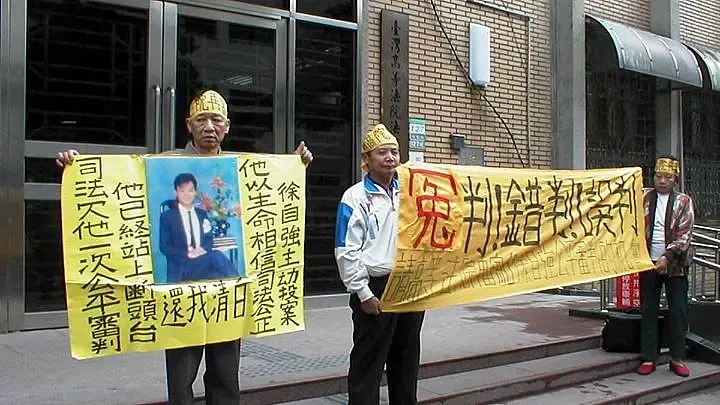
Photo / In 2002, Hsu's father demanded a retrial for the Hsu Tzu-chiang case in front of the court.
Yesterday (March 4) was my first time attending a court hearing as an observer, specifically the trial of the Hsu Tzu-chiang case. The main proceeding this time was the cross-examination of the witness, Hsu Tzu-chiang's father.
Quick Notes on Court Observation
At the beginning, defense attorney Lin Yung-sung questioned first. Since Hsu's father primarily speaks Taiwanese, Lin asked questions using both Taiwanese and Mandarin to accommodate the court clerk's record-keeping.
Although the atmosphere during this process was somewhat akin to a casual chat, one could still sense how nervous Hsu's father was while answering. Sometimes his answers were overly brief, prompting the attorney to ask him to explain clearly to avoid misunderstandings. Notably, the attorney specifically added in his questioning, "This matter happened twenty years ago, why do you still remember?"—perhaps a preemptive rehearsal for the witness so he would not panic when facing the prosecutor's questions.
Following the attorney's questioning, the prosecutor took over. Unsurprisingly, the prosecutor focused on "completeness of memory," asking the witness about events surrounding the date of the incident. Since the incident occurred on September 1st, the prosecutor asked about the grandson's school registration two days prior, or why the witness remembered his itinerary for September 1st. Given how long ago it was and how old Hsu's father is, listening to it live really felt like an oral examination by a prosecutor.
Moreover, the prosecutor seemed unable to question in Taiwanese, requiring translation by the on-site interpreter. The interpreter even made a translation error in court, which the attorney fortunately spotted and pointed out immediately to prevent any misunderstanding.
Finally, after the attorney and prosecutor finished questioning the witness, the commissioned judge asked several questions in Taiwanese, and a supplementary examination by the attorney concluded today's trial session.
Attorney Lin Yung-sung's Explanation
After the observation ended, defense attorney Lin Yung-sung came over to point out a few interesting takeaways.
He explained that the method of examining witnesses seen today is called cross-examination. The party who requested the witness questions first—for instance, if requested by the defense attorney, the defense asks first, followed by the prosecutor. Then comes supplementary questioning by the defense attorney, followed by the prosecutor's supplementary questioning.
Next, the judge questions the witness, followed once more by questions from the attorney and prosecutor, concluding the entire cross-examination process. Through cross-examination, those present are better able to piece together the full picture.
Lin explained that prior to 2003 (the 92nd year of the Republic), Taiwanese law did not mandate the format of cross-examination. Judges often took the lead in questioning witnesses, and only allowed attorneys to ask questions after the judge was finished. By that point, however, the judge had lost interest in hearing further questioning; some judges even prohibited attorneys from continuing. Because the judge had already obtained the answer they wanted, they usually formed a conclusion right then, and subsequent questioning held little interest or power to influence the judge's preconceived notions.
Taiwan has never adopted the "single copy of indictment" principle (Dossier-Überweisung/principle of a single indictment file); judges almost always read the massive amount of materials provided by the prosecutor prior to questioning, making them prone to preconceived notions and making it even harder for defense attorneys to overturn situations unfair to the defendant.
For example, the prosecutor asked today whether Hsu's family had requested Hsu's father to act as a witness after finding a defense attorney a month after the incident. Hsu's father answered "no." Anyone present hearing this answer could easily assume that Hsu's father only came forward to testify later to help his son escape punishment.
However, during the defense attorney's supplementary questioning, he asked Hsu's father whether the defense attorney had requested other witnesses. Hsu's father then replied that Hung Pei-shan, an apprentice at the beauty salon run by the Hsu family, had lunch with Hsu Tzu-chiang on the noon of September 1st, and Hung was requested as a witness. The attorney had stated at the time that because parents are relatives, it was inappropriate to request them as witnesses, and thus only the apprentice was requested, not the parents.
Through this mutual cross-examination, the full picture of the event could be pieced together, and what actually happened back then could be understood.
In addition to cross-examination, Lin also explained the trial procedure in criminal courts. Criminal trials begin with preliminary proceedings to determine whether the defendant pleads guilty; if not, the case proceeds to the subsequent trial hearings. During preliminary proceedings, only a single judge (the commissioned judge) is present, whereas all three judges (the commissioned judge, the presiding judge, and the associate judge) are present during the trial hearings. However, some judges do not follow this procedure. Lin noted that in courts outside Taipei, some judges question defendants during preliminary proceedings. Because the other judges are not present, they can only understand the defendant's responses through written reports. Without observing the defendant's demeanor during questioning firsthand, it becomes even harder for these judges to grasp the nuances of the responses, significantly increasing the likelihood of misjudgment.
Language proficiency also dictates whether judges misunderstand a witness's testimony. Because Hsu's father primarily uses Taiwanese, communication gaps and talking at cross-purposes easily occurred between him, the prosecutor, and the judges. Fortunately, the defense attorney was sharp and formulated complete questions during supplementary questioning to prevent misunderstandings. Throughout the questioning process, such situations were commonplace, leaving observers on site with their hearts in their mouths.
Finally, Lin added that although the Hsu family requested Hung Pei-shan as a witness from the very beginning, the court repeatedly failed to summon her, sentencing Hsu Tzu-chiang to death five times based solely on the co-defendant's confession. This point alone highlights the court's disregard for the truth of the Hsu case.
Conclusion
Before attending court hearings as an observer, my imagination of witness examination came mostly from movies. Films typically adopt an "omniscient" perspective where the audience knows everything that happened, making it easy to tell if a witness is lying. However, attending in person made me realize that truth is pieced together bit by bit through questioning, relying on memory and logic. Cross-examination is like a group of people feeling an elephant in the dark; even when finished, one always worries there might be discrepancies from the facts. Clarifying the truth in a real courtroom is by no means as effortless as Conan declaring that "there is only one truth." And a flawed system will only drive us further away from the truth.
The Goddess of Justice, who represents the judiciary, is often depicted as a blindfolded goddess holding scales. Many say the blindfold represents freedom from bias, but to me now, it seems more like an attitude of humility—"knowing that we can only ever approximate the truth."
Perhaps, in the face of truth, we should all learn humility.
This article is an AI-generated translation of the original Chinese text. In the event of any discrepancy, the Chinese version shall prevail.
