
A Judicial Yuan That Protects Corporations and Judges?
Last edited: 2026-08-31
"According to Article 16 of the Constitution, the people shall have the right of litigation. To safeguard the people's right to judicial benefits, and to make the case-assignment operations of the Supreme Court and the Supreme Administrative Court more transparent so as to eliminate disputes, the Judicial Yuan, after deliberation, considered that there is no need for confidentiality after cases are assigned... and deleted the provisions on confidentiality procedures." This was the press release issued by the Judicial Yuan in March 2012 when it resolutely abolished the Supreme Court's confidential case-assignment system. The President of the Judicial Yuan even stated that this was an indispensable process for realizing "transparency" (crystal) in his "4C Policy."
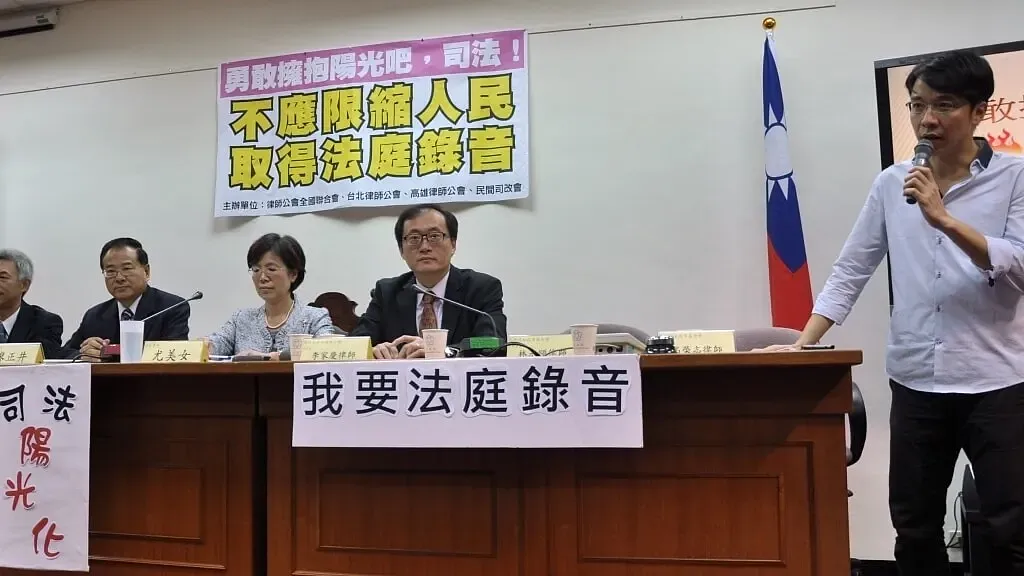
Those words were still ringing in our ears when, in October of the following year, the Judicial Yuan quietly and substantially amended the "Regulations on Court Recordings," renaming it the "Regulations on Court Recordings and Their Utilization and Preservation." It deleted the provision that had been in effect for nearly ten years allowing parties, based on their right to review case files, to request the delivery of court recording discs, changing it to the prerequisite that "written consent must be obtained from persons making statements present at the court session" (see Article 8).
The rationale for the amendment argued that court recording contents are not limited to the recording data of the parties involved, but also include the recordings of other persons making statements present at the scene. Furthermore, technically it is still impossible to separate the recording data of the parties from those of other persons present. Providing copied recording data constitutes the utilization of personal data held by public agencies. Consequently, the Judicial Yuan invoked the proviso of Article 16 of the Personal Data Protection Act, arguing that if recordings are used for purposes other than the specific purpose, the consent of the persons making statements present at the court session must be obtained.
The purpose for which a party applies for a recording disc is usually to check its accuracy against the court transcript, which naturally complies with the use for the purpose of the recording. However, while the aforementioned amendment also explicitly stipulates that recordings shall not be used for improper purposes, it requires parties to obtain the "written" consent of other persons making statements present in order to obtain the recording disc. Leaving aside the fact that after a court session concludes, it is completely impossible for a party to track down hostile witnesses and obtain written consent, the opposing party in the litigation will create as many difficulties as possible—how can one hope for their consent? Not to mention if a group of students happens to be visiting the courtroom and asking questions that day, where in the world is a party supposed to find them afterwards to get their consent? No wonder this amendment has been criticized as "under the false guise of protecting third parties, actually acting to conceal the live proceedings of judges' court sessions."
Another Egregious Example of Abusing the Personal Data Protection Act
This is, of course, yet another instance of the state abusing the Personal Data Protection Act to conceal the fact that public authority actions should be open and transparent. Yet the protagonist has changed to the Judicial Yuan? The highest judicial administrative organ and the final line of defense for human rights protection. To make matters worse, ignoring protests from parties, the legal profession, and legislators against this absurd amendment, the Judicial Yuan "doubled down" late last year by intending to add the draft Article 90-4 of the Court Organization Act, which would impose criminal penalties—up to three months of imprisonment—for disseminating, publicly broadcasting, or using for purposes other than other legal interests the acquired court recording contents. Struck from both front and back, the sole objective is to obstruct the openness and transparency of court sessions.
As a judge, I can understand the pressure that the public release of court recordings places on judges when adjudicating cases, and even more so the anxiety of judges and prosecutors that court recording discs might be "taken out of context" and used as evidence for evaluation or even disciplinary action. In particular, several recent successful cases of evaluating judges and prosecutors have invariably relied on court recordings as the basis.
However, an "open court" is one of the essential elements of the principle of a fair trial, part of the principle of due process of law, and a basic procedural right explicitly protected by the International Covenant on Civil and Political Rights. Many judges take great exception to the phenomenon of entire court sessions being recorded and every party holding a copy. In the past, instances of openly defying the "Regulations on Court Recordings" by simply refusing parties' applications to copy court recordings were numerous, with this phenomenon being most severe among civil court judges. In fact, it is not difficult to discern the clues as to why the Judicial Yuan dared to blatantly take a backward step and obstruct court transparency, given the frequent maneuvers from within the judicial system.
Stop the Amendments of Mutual Collusion from Top to Bottom
As early as November 2012, the Civil Department of the Judicial Yuan utilized a routine legal symposium of the Taiwan High Court and its subordinate courts to abnormally propose a discussion on the provisions of the "Regulations on Court Recordings," which had no ambiguities in wording and stipulated that court recording discs should be delivered simply upon payment of fees by the parties. This was deliberately engineered to pitch a soft ball to the civil court judges in attendance. Following the review opinions of the senior judges of the High Court, a resolution was passed concluding that this ran counter to the Personal Data Protection Act and should not be permitted; the reasoning of this resolution later became the structural rationale for the Judicial Yuan's aforementioned amendments. Next came the launch by the Supreme Court, when Yang Ting-chang, the president well-versed in civil affairs, abruptly proposed in July 2013: Should parties be permitted to apply for the delivery of court recording discs or digital recording contents in order to verify whether the transcript records are accurate? (Strange, haven't things been done this way for the past ten years?)
The Civil Divisions of the Supreme Court rendered the 10th Resolution of 2013, asserting unexpectedly that court recordings contain the voiceprints and emotional activities of persons participating in court activities, and that the delivery of court recording discs or digital recordings involves the protection of fundamental rights such as personality rights. It claimed that the provisions of the "Regulations on Court Recordings" concerning the delivery of recording discs exceeded the authorization of the Court Organization Act and the Code of Civil Procedure, and courts could choose not to apply them. Three months later, the Judicial Yuan smoothly cooperated by amending the regulations, deleting the provision allowing parties to request the delivery of court recording discs, and changing it to the current requirement of "obtaining written consent from persons making statements present at the court session."
Was this a combination of Supreme Court judges (via resolution) and High Court presiding judges and senior judges (via review opinions at the High Court symposium) exerting "pressure" on the Judicial Yuan through institutionalized internal judicial administrative resolutions, or was it a "coordinated performance" of mutual collusion from top to bottom, initiated at the behest of the Judicial Yuan? Readers can draw their own conclusions. Even more outrageous are these erroneous views cooked up behind closed doors by judicial administrative high officials and civil court judges, or even expressed in individual judgments, such as: stubbornly twisting the voices of speakers in an open court into "voiceprints" protected as personal data (along with emotional activities?); misunderstandings of the principle of legal reservation and the scope of application for authorized orders; the abuse of the proportionality principle's weighing process; and ignoring the provisions of Article 44-1 of the Code of Criminal Procedure applied in criminal courts that permit parties and interested persons to utilize court recordings. All of these make one unable to hold in high regard the constitutional literacy and human rights protection concepts of judicial officials and civil judges.
In fact, what the Judicial Yuan and senior judges mean beyond what they actually say is that preventing outsiders from obtaining court recordings to monitor judges' court proceedings, questioning attitudes, and procedural legality is the true intention behind this amendment and the criminal penalties to be listed under the future Court Organization Act!
Not limited to the aforementioned amendments to the recording regulations or the Court Organization Act, recently—including the criminal confiscation under the Act Governing Food Safety and Sanitation , or the institutional review and amendment controversies regarding civil payment orders—the supreme guiding principle of the Judicial Yuan has long shifted from "justice for the people" to "justice only for judges," and it even vigorously protects those antiquated systems that benefit corporations and banks. With a Judicial Yuan and a Supreme Court that are enemies of the people, why would grassroots judges ever need enemies?
This article is an AI-generated translation of the original Chinese text. In the event of any discrepancy, the Chinese version shall prevail.