
Wiretapping, Exploitation, and K'o P'u
Last edited: 2026-09-01
Mayor K'o is the new darling of public opinion, and both his witty remarks and slips of the tongue are media favorites. A continuous wave of gaffes has gradually produced a backlash. Public opinion is like flowing water; no matter how high one's popularity, there will always come a time when it declines. Reckless speaking, "jumping into every trap," talking nonsense on a whim, and failing to withstand scrutiny mean that even a vast fortune will eventually be squandered away.
Regarding the shooting at the Emei Parking Lot, after reading the police review report, Mayor K'o had a gut reaction that taking two days to pull telephone records and wiretap "when the suspect is already known" is simply too long. He argued for efficiency, suggesting a "shoot first, report later" registration system and that "issues can be retroactively checked later"; after receiving criticism, he changed his tune to advocate for "grading and categorization."
This is a great example that can be used to interpret the dynamic relationship between the media, the K'o Wen-je phenomenon, and major public issues.
Not the Smartest, Only Smarter
To some extent, the media deliberately intensified or amplified Mayor K'o's remarks. In fact, his statements had a "premise": that under the condition where the "suspect is already known," taking two days to pull call logs and wiretap for similar major cases (of course, he didn't explicitly say this, but it is added through a charitable interpretation) is simply too long.
Under this premise, there is the problem of delayed relief. Therefore, he proposed a solution—the "shoot first, report later" registration system. His revised statement of "grading and categorization" merely placed greater emphasis on the importance of "priority and urgency." Mayor K'o's statements made a few mistakes, thus drawing criticism. However, it is not that the statements themselves were wrong.
In fact, the newly amended The Communication Security and Surveillance Act sets out exceptional provisions in Article 6 (regarding wiretapping) and Article 11-1 (regarding the retrieval of communication records). For major and urgent cases like murder or kidnapping (grading and categorization), the police only need to make an oral report before they can proceed with wiretapping or retrieving call records ("shoot first, report later").
The law dictates that an oral report is sufficient, which is even more lenient and more "shoot first, report later" than the registration system Mayor K'o came up with. Interpreted charitably, Mayor K'o was speaking in response to "exceptional circumstances." Feeling instinctively that something was amiss, he presumed the law was unreasonable and thus proposed amendments. However, the legal provisions are actually quite close to what he had in mind.
According to the law, applying for a wiretap warrant in advance is the rule, while emergency situations of shooting first and reporting later are the exceptions. The initial criticisms leveled against him all assumed he wanted to "turn the exception into the rule." Members of the Democratic Progressive Party criticized him while thinking of Huang Shih-ming in their hearts, and members of the Kuomintang were even more fascinating: having previously fought desperately against any amendments to the Communication Security and Surveillance Act, they suddenly turned around and, with a sanctimonious air, criticized him for not understanding human rights protection and for being authoritarian and arbitrary, acting as if it were a serious matter.
r
To borrow one of Mayor K'o's favorite phrases: "There is no smartest, only smarter." He is truly smart, but he should not be too clever by half. The places where he should be criticized lie not in his reaction being wrong (on the contrary, his gut reaction aligned with the law), but in his speaking without understanding the Communication Security and Surveillance Act—speaking first to win, and revising only after being criticized. Judging from the content of his revisions, he fundamentally did not know whether what he was talking about was right or wrong. Being right was a blind guess, being wrong meant he didn't know, and getting criticized was just what he deserved.
Something that can be known simply by flipping through the legal provisions was not helped by any of his staff members. The mayor seemed to be "fighting a solo battle," which is somewhat terrifying. What is even more terrifying is that the police officers who wrote the report were either ignorant and genuinely believed they were bound by the law and thus complaining, or they intentionally deceived their superiors and concealed the truth for ulterior motives. Both are terrible: the former shows poor legal literacy among the police, while the latter attempts to use Mayor K'o's mouth to issue orders to the realm. All of this is far more terrifying than Mayor K'o's simple slip of the tongue.
Exploiting Every Opening
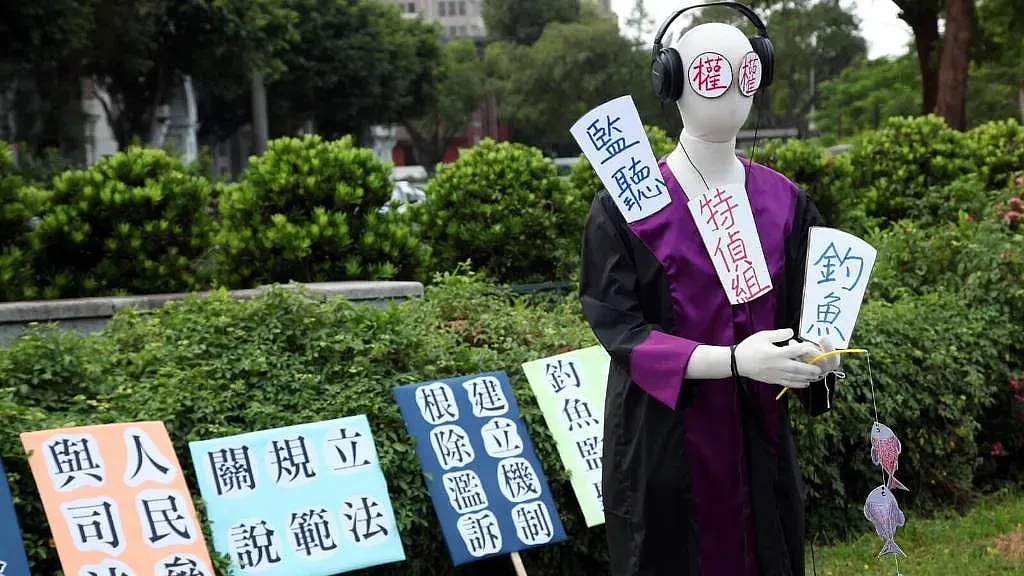
Mayor K'o is the rising star of the moment, and many people want to exploit every opening to criticize or praise him in order to secure their own interests. By intercepting fragments of Mayor K'o's remarks, the media can report on them for three consecutive days, generating both high topicality and viewership. Prosecutors and police also hope to use him to seek opportunities to amend the Communication Security and Surveillance Act.
Before the legal amendments, the police could pull anyone's call logs as they pleased, without restriction. Prosecutors could "listen all they want on a single case," extending wiretaps however they pleased without any boundaries. After the amendments, they faced heavy restrictions, and the Ministry of Justice and the National Police Agency are plotting a comeback every single moment, attempting to reclaim these convenient powers. Especially the police: it was clearly the Prosecutor-General who abused wiretapping power, yet the result of the legal amendments was that the police system suffered heavy damage, losing the power to "pull call records anytime and anywhere."
Police officers everywhere complain that "the black dog steals the food while the white dog takes the blame," completely unaware of how "retrieving communication records" infringes upon the people's rights and interests, feeling that "what's the big deal?"
Consequently, whenever someone goes missing, the police will threaten that they cannot provide assistance because they cannot pull call records, completely ignoring the possibility of amending other laws or changing practical operations, just wanting to continuously accumulate public grievance. Whenever a major case is solved or a great merit is achieved, they demand rewards while intimidating: "If we had been able to pull call records sooner, we could have solved the case sooner."
The Ministry of Justice pushes the National Police Agency, and the National Police Agency speaks through Mayor K'o's mouth. Everyone is led by the nose by Mayor K'o's dazzling words, and no one is seriously thinking about whether pulling call records is the only factor in solving this case? Whether wiretapping is a critical method? Whether the necessity is high? And as long as necessity is established, the law is not set in stone. Lenient yet wanting even more leniency? Simply to allow even more abuse of power?
In fact, we do not care much about a mayor who speaks recklessly; what we care more about is that a highly popular mayor has opened a pointless battlefield. In order to support (or oppose) him, the people are trapped in debates over fake issues, thereby causing matters that deserve more attention to lose focus, or even escalating into regressive legislative amendments.
In a country where roads are filled with surveillance cameras, where entering a highway immediately triggers eTag, and where household registration, taxation, health insurance, and financial information are highly integrated and readily accessible, to insist that call records are extraordinary and sacred privacy gives one a profound sense of extreme disorientation. However, this does not mean that police retrieval of call records should return to the unrestrained state of the past.
The Core Problem of Wiretapping
What must be emphasized is that the aforementioned controversies have not even touched upon the core issue of wiretapping.
The real problem in Taiwan is: Why can the state establish a "wiretapping center"? Why must all telecommunications and network systems run lines to the "wiretapping center," placing the state in a condition where it can wiretap and access any of our communication data at any time (in fact, telecommunications operators cannot even obtain a license before laying lines for the state)? Why can our prosecutors and police record "everything" during wiretaps instead of acting proportionally and only dispatching personnel to monitor online and record relevant portions?
What is most terrifying is that, in reality, apart from the wiretapping center itself, no one can inspect whether the actual number of wiretapped targets and phone numbers matches the numbers and numbers approved by the court? If our Constitution stipulates that the people's freedom of secret communication is inviolable, how could there possibly be so many strange "exceptional states"?
Thus, Mayor K'o guessed right: the world of wiretapping has long been operating just as he imagined. It's just that he does not know—and it seems he has never even considered—that the Constitution's guarantee of the freedom of secret communication is the rule, while Taiwan treats the exception as the rule. If one were to say he was innocently "exploited," it seems he is not quite that innocent after all.
This article is an AI-generated translation of the original Chinese text. In the event of any discrepancy, the Chinese version shall prevail.