
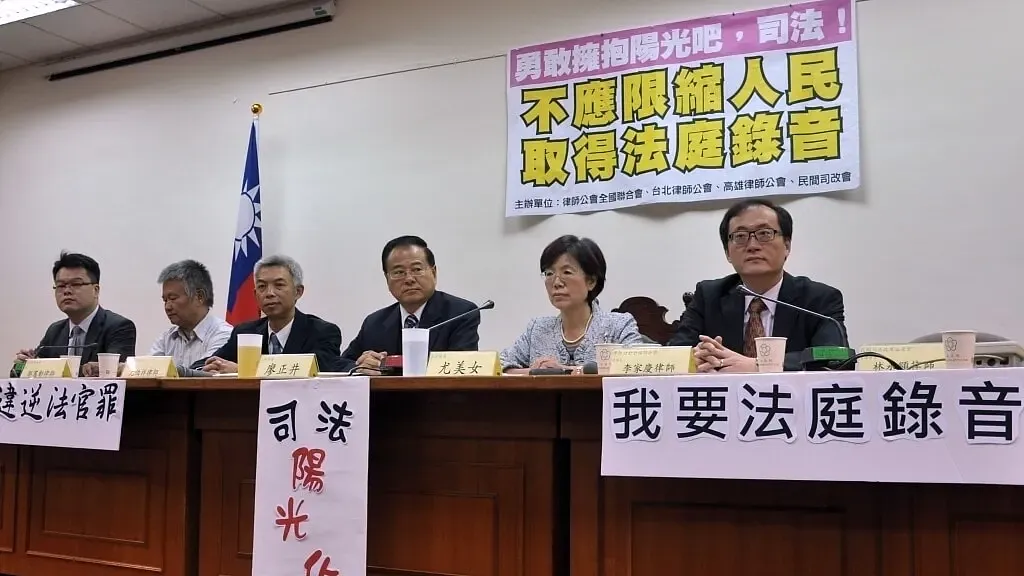
In My Courtroom…
Last edited: 2026-07-27
Recently, the JRF filed a complaint with the Judges Evaluation Commission of the Judicial Yuan regarding Judge Tseng of the Taoyuan District Court for poor courtroom demeanor, while the court recording evidence from the incident mysteriously vanished. Following the JRF's disclosure, members of the public came forward to report further unlawful acts by this judge. These allegations include threatening a defendant by saying, "If you say another word, I will detain you"; ordering defendants to stand and forbidding them from sitting during proceedings; and even declaring, "In my courtroom, only legal professionals are allowed to sit."
Just as the Evaluation Commission might find its hands tied against Judge Tseng due to the sole piece of evidence vanishing into thin air, the Judicial Yuan's draft amendment to Article 90-4 of the Court Organization Act is scheduled to be legislated before the Legislative Yuan session ends on January 23, adding insult to injury in the path of weeding out incompetent judges.
This problematic provision states: "A person who has been permitted to independently record or videotape, or who holds the contents of courtroom audio or video recordings, shall not distribute, publicly broadcast, or use the obtained audio or video contents for any purpose other than asserting or protecting their legal interests. Anyone who violates the provisions of the preceding paragraph shall be sentenced to imprisonment for not more than one year, short-term detention, or a fine of not more than NT$100,000." In other words, "anyone" who makes courtroom audio or video recordings public will face criminal penalties of up to one year in prison.
Once this regulation takes effect, criminal liability will apply across the board when news outlets broadcast the audio and video of judges roaring and scolding people in court; when legislators use them for public interpellation; when teachers play them in classrooms for educational purposes; or when non-profit civic groups, lawyers, and legal professionals use them for public reporting and advocacy. Ironically, these are the most legitimate uses imaginable!
The cornerstone of fair judicial trials is "public trial." Only by being subject to supervision can the general public trust that the courts are impartial and selfless. The draft proposed by the Judicial Yuan turns the very monitors most likely to act for the public interest into targets for punishment. This mindset—which ignores the suffering of the people and blindly shields judges—deserves severe condemnation.
While laws can appropriately restrict the arbitrary distribution or public broadcasting of courtroom recordings, imposing unmitigated, indiscriminate, and exceptionless bans on making courtroom recordings public through harsh penal laws will lead to the grave consequence of the judiciary remaining completely unchecked. We earnestly appeal to legislators not to pass this bill, which sets the rule of law into a severe regression.
This article is an AI-generated translation of the original Chinese text. In the event of any discrepancy, the Chinese version shall prevail.