
Facing Up to the Crisis of Prosecutor Hierarchy
Last edited: 2026-07-27
Judicial Day has just passed, which should be a time for reflection rather than mere celebration. Although our country has adopted Western legal systems for over a century, under the past authoritarian regime, the rule of law ideals such as the supremacy of law, freedom, and equality were never internalized into the professional creed of legal practitioners. Instead, they remained indifferent to the people's hardships, timid, and lethargic, naturally failing to gain the people's trust. After the lifting of martial law, although legal professionals introspectively promoted many reforms, transitional justice was never truly implemented. Coupled with the fact that universal legal education emphasizing reasoning, critical thinking, and human rights protection as its core values has never been realized, judicial credibility remains low.
Today, a new generation growing up after democratic transition has successively entered the legal profession, and reform-minded judges and attorneys have completed generational turnovers, continuously driving waves of reforms that give people a glimpse of the judiciary's future. Only within the prosecutorial system has reform completely stalled. Ever since the reform bills advocated by the Prosecutors Reform Association were passed around 2006—stipulating that the appointment of the Prosecutor-General requires congressional consent, and establishing the Special Investigation Division along with the Prosecutor Review Committee responsible for prosecutorial personnel deliberation—reform activities within the prosecutorial system have completely died out. Even with its internal problems multiplying, it remains like a pressure cooker with no prospect in sight.
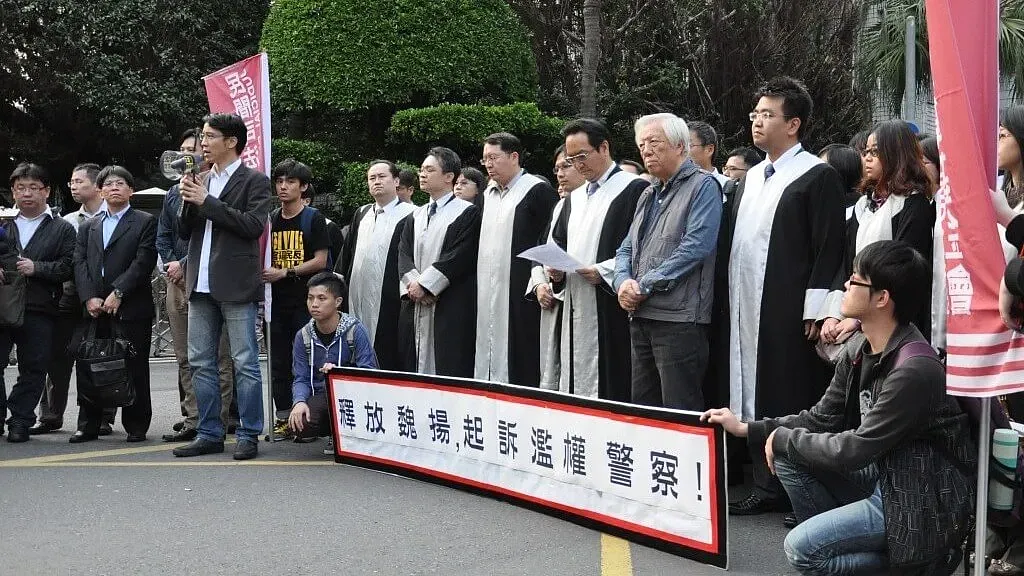
Last year, the most closely watched event in Taiwanese society was undoubtedly the Sunflower Student Movement. In expanding the effects of this event, the prosecutorial system made its "contribution"—requesting the detention of student Wei Yang. If you had known that as soon as this news broke, many prosecutors immediately left messages on the Judges Forum hoping that the presiding judge would exercise moral courage, withstand government tyranny, and dismiss the detention request, you would understand how absurd this request was, to the point that even the prosecutors' peers could not stomach it. Fortunately, the judges of the Taipei District Court held their ground. Nevertheless, the handling prosecutor was still promoted to head prosecutor as a reward for catering to the higher-ups' wishes.
Catering to whose wishes? Currently, the Ting Hsin political donations scandal is making headlines, and President Ma has even filed a lawsuit. In fact, when the Taipei District Prosecutor's Office investigated the Ting Hsin TDR case in 2013 (102), it had already discovered that Wei Ying-chung, upon the request of Legislative Yuan President Wang Jin-pyng, took NT$5.25 million from the commissions refunded by SinoPac Holdings to sponsor the Kuomintang's Kaohsiung mayoral candidate election. This money did not appear in Ting Hsin's accounting records, nor was it ever declared as a political donation. If this money belonged to Ting Hsin, Wei Ying-chung's misappropriation constituted breach of trust; if the use was legal, it still exceeded the limit for political donations.
According to Huang Shih-ming's statement during the September Political Struggle that prosecutors should report administrative illegality, prosecutors ought to investigate this case. Did the handling prosecutor investigate? No! Given the long-standing power struggle between Ma and Wang, coupled with the subsequent September Political Struggle and the Ting Hsin tainted oil scandal, shouldn't a prosecutorial system that caters to higher authorities have investigated even more? As it turned out, still no. Yet that same prosecutor was promoted to head prosecutor anyway. This shows that the prosecutorial system does not merely cater to the higher-ups' wishes. The crux of the matter is that after years of operation, the Prosecutor Review Committee, coordinated with the hierarchical system of the prosecutorial agency, has created problems of prosecutor stratification, disciplinary control, and domestication.
How so? The members of the Prosecutor Review Committee are appointed by the Minister of Justice, recommended by the Prosecutor-General, and elected by prosecutors, with the original intention of allowing the three forces to check and balance one another. However, because all members are prosecutors, decision-making only considers the institutional self-interest of prosecutors; prosecutors who abuse their power in prosecution still have a better chance of promotion as long as they are "heroes" in handling cases and have shining records. Furthermore, because elected representatives have one more vote than politically appointed members, the elected representatives hold the power to decide the shortlist. How is the shortlist decided? Through local spoils-sharing! That is, allocated according to the proportion of personnel in each prosecutor's office. How is the spoils divided? Usually by respecting the decisions of the chief prosecutors and head prosecutors.
Major cases are assigned at the discretion of the chief prosecutor, and who gets to be appointed head prosecutor is also decided by the chief prosecutor. Coupled with the prestige and the generous "benefits" of having a lighter caseload after being promoted to head prosecutor or the Taiwan High Prosecutors Office, driven by human nature to seek gain and avoid harm, who would want to be the "prophet of doom" of the prosecutorial system, an unlikable internal reformer? This tells us that if the prosecutorial system fails to carry out institutional reforms that align responsibility with authority and democratic accountability, it will not only continue to act as a tool for the rulers, but will also become a runaway cannon of power. It is hoped that all sectors of society will face up to the reform of the prosecutorial system.
※ This article was published on January 13, 2015, in Apple Daily "The Prosecutor Who Detained Wei Yang Has Been Promoted". This is the author's original text.
This article is an AI-generated translation of the original Chinese text. In the event of any discrepancy, the Chinese version shall prevail.