
I Still Can't See a Judge
Last edited: 2026-07-27
Late one night in mid-December last year, police in Hsinchu arrested a man on the grounds of allegedly violating the Narcotics Hazard Prevention Act. After the man applied for a writ of habeas corpus, the Hsinchu District Court issued Ruling No. 8 (Criminal Habeas Corpus) the following day, concluding that the police had violated the Police Powers Exercise Act by arbitrarily searching the personal belongings of an individual without concrete evidence to substantiate the police's claims, and ordered the man's release. This is merely one of the few release cases since the Habeas Corpus Act officially took effect in early July of last year. However, by exercising the power of the judiciary to check and balance the abuse of power by the administrative branch—reviewing the substantive elements of arrest and detention and implementing the protection of personal liberty—the judge in this case is fully capable of guiding us toward the correct operational direction of the habeas corpus system.
Writs of Habeas Corpus Should Be Issued Whenever Possible
Personal liberty is the starting point of all freedoms for every single one of us. The newly amended Habeas Corpus Act implements the basic spirit of the "writ of habeas corpus," which is actually a long-overdue and inevitable corollary of a democratic society governed by the rule of law. Under the framework of the new law, judicial officers naturally bear the obligation to promptly review both substantive and procedural aspects of every case, based on principles such as the facts of detention, legal basis, necessity, and proportionality. However, when the Judicial Yuan promoted the content of the law to grassroots judges, it emphasized that upon receiving an application for habeas corpus, judges should only review formal requirements and not the legality and necessity of the substantive detention. The Judicial Yuan's stance not only effectively imposes restrictive conditions not provided for in the Habeas Corpus Act, but also risks conflicting with the Constitution and the International Covenant on Civil and Political Rights, which will result in the complete forfeiture of the habeas corpus system's functions.
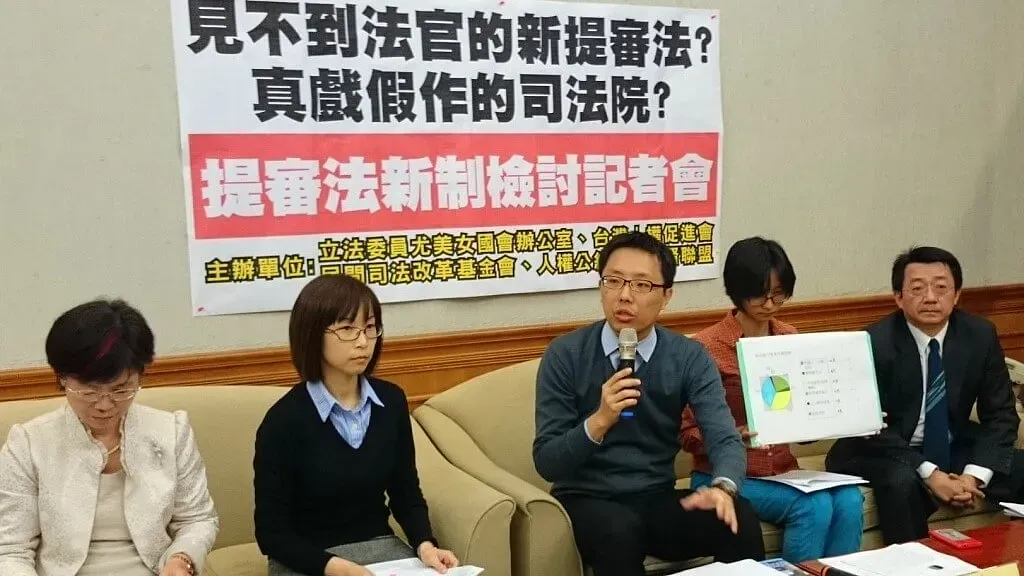
Regrettably, an examination of over one hundred rulings since the implementation of the new law reveals that nearly one-quarter of applicants still "cannot see a judge" in practice. In over twenty percent of the cases, no hearing was held and only a formal review was conducted, continuing to afford the administrative authority considerable "convenience" in restricting personal liberty. Since the Habeas Corpus Act pursues the realization of the protection of personal liberty, judges should naturally issue writs of habeas corpus to bring applicants to court to "see a judge" whenever possible, and should also review the substantive elements of their arrest and detention. There is absolutely no reason to conduct only a formal requirements review.
Judging from international human rights documents such as Article 9 of the International Covenant on Civil and Political Rights and General Comment No. 35 of the Human Rights Committee, persons arrested or detained have always had the right to petition a court to review the legality of the decision to arrest or detain them. In particular, issues concerning substantive elements—such as whether there is a necessity for arrest or detention, whether there are other alternative means, and whether the arrest or detention amounts to arbitrariness—should be the focus of the review scope. Otherwise, not only is there a risk of hollowing out the core values of the habeas corpus system, but it is also easy for the court itself to fall into the ignominious position of acting as an escort for arresting and detaining authorities, thereby damaging the judicial image.
Following the implementation of the new Habeas Corpus Act, a small number of judges still conduct substantive reviews regarding the necessity of arrest and detention by administrative authorities. For instance, in several habeas corpus cases involving the release of detained foreigners, courts have generally been willing to actively intervene and review substantive elements concerning whether there is a necessity to detain the applicants and whether detention can be replaced by less intrusive means such as release into the custody of a responsible person.
Fulfilling the Function of Timely Relief
Conversely, regarding other dismissed foreign detention cases, judges mostly failed to carefully weigh the necessity of detention or the possibility of alternatives. Since "detention of foreigners" is a temporary measure prior to forced deportation, if unnecessary, it can certainly be replaced by other methods. This is the very reason why Article 38 of the Immigration Act stipulates that "provisional detention" may be ordered when "it is manifestly difficult to effect forced deportation without detention." Therefore, in practical operations, some judges have shockingly ignored the reality that our detention system completely deprives detainees of their personal liberty, concluding that detention does not constitute a "status of being arrested or detained." If they further ignore the immediate relief function of the habeas corpus system and compel detained foreigners to resort to administrative litigation—a judicial remedy too slow to meet urgent needs—it fundamentally violates the intent of Judicial Yuan Interpretation No. 708 and represents a blind spot in habeas corpus practice that urgently needs improvement.
"I want to see a judge" should not be merely a promotional slogan. The immediate protection and relief functions regarding personal liberty played by the habeas corpus system must not be reduced to a dead letter. Since the issue of "being unable to see a judge" must be thoroughly resolved, isn't it crystal clear what obligations judges should fulfill when facing habeas corpus cases?
This article is an AI-generated translation of the original Chinese text. In the event of any discrepancy, the Chinese version shall prevail.