
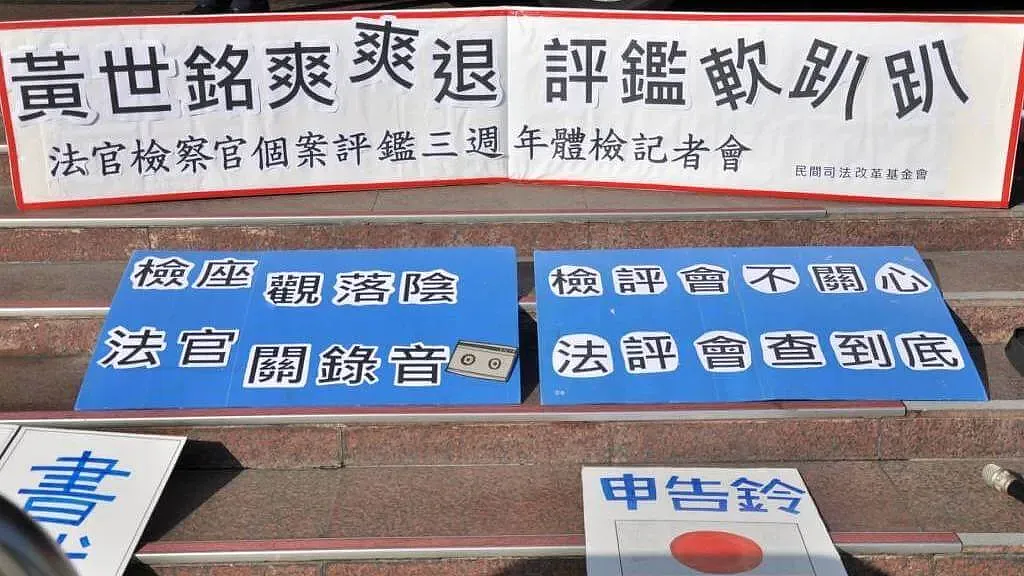
A-bian Released, Huang Shih-ming Retires?
Last edited: 2026-07-27
A-bian is released, and Huang Shih-ming retires. At first glance, the two seem to have nothing to do with each other. Yet their common threads are: first, both involve the imprisonment of a president; second, the competent authority in both cases is the Ministry of Justice. Ultimately, the injustice within the prosecutorial system severely undermines the rule of law and the legal system.
We do not object to Minister Lo Ying-sheng thoroughly executing the will of the Ma administration. After all, when responsible politics does not fail, if a minister's governance severely loses popular support, stepping down not only affects oneself but also implicates the entire administrative team. If a minister blatantly lacks a sense of proportion, oversteps the legal system, and yet clings to power, they should face harsher oversight and criticism. Lo is conservative, reactionary, and unconcerned with human rights covenants. Furthermore, she repeatedly makes remarks directing prosecutors on how to handle cases—for instance, vowing to severely punish the Sunflower Student Movement, concluding that Huang Shih-ming bore no responsibility or guilt before any investigative procedures had even been initiated. She crossed the red line of non-interference in individual cases long ago.
We also respect the decision regarding whether to approve medical parole, as this falls within the authority of the competent agency. However, we must first ask clearly: whose authority is it precisely? The Agency of Corrections is an independent agency; decisions on medical parole should rest with the medical team, the warden, and the director-general. What is absurd is that the person who jumped out first to test the waters was once again the minister, making it clear that the Ministry of Justice orchestrated the whole affair. What ought to have been a grand production by the Agency of Corrections turned out to be merely shadow puppetry manipulated by the Ministry of Justice. The heavy-handed interference from higher-ups is unmistakable. How can they still brazenly insist this is "administration in accordance with the law" without feeling even a shred of shame?
We do not object to Huang Shih-ming collecting his pension. Some kindly remark that after a lifetime of "hard work," it is what he "deserves." But Huang Shih-ming rose to prominence under an authoritarian system, which cannot be compared to the hardships faced by contemporary grassroots prosecutors who must balance case handling with rigorous procedures. The Directorate-General of Personnel Administration has already launched a dedicated review of the Judges Act's extraordinarily high pension replacement rate of up to 98%. Such rates drag down national finances and represent generational injustice; amending the law to lower them in the future is imperative. Should prosecutors who lorded it over others during the early authoritarian era—having left office without undergoing transitional justice—still be allowed to collect high pensions (which they might not be able to in the future)? Is this truly what young prosecutors "deserve"?
The legislative protection of generous pensions in the Judges Act was predicated upon being paired with a robust evaluation committee capable of weeding out incompetent prosecutors. Today, the second-term Prosecutors Evaluation Commission has been lackluster. Although the previous term's resolution was to remove Huang Shih-ming from office, the Control Yuan's two attempts at impeachment ultimately failed. This once again proves that the evaluation system under the Judges Act is spineless, and the "resolutions" of the evaluation committee are merely feeble "recommendations" that can be overturned at any time by the subsequent Control Yuan or the Disciplinary Court of Judges. For the public to evaluate incompetent prosecutors is practically like "passing through five passes and slaying six generals." The Judges Act has been distorted into a "protection act" rather than the "elimination act" that the public so eagerly anticipates.
Compared to the swift disciplinary actions taken against Chen Shou-huang and Lin Hsiu-tao, Lo Ying-sheng has shielded Huang Shih-ming every step of the way, imposing zero administrative penalties. She could not even bear to temporarily suspend him from office while awaiting a finalized criminal judgment. She would rather let him spark controversy by rushing to secure his pension at the very first moment, pocketing the money safely. Bearing the infamy seems motivated by a fear that Huang might turn tables out of discontent and bite back, exposing President Ma as an accomplice in wiretapping and leaking secrets, only to end up investigated and prosecuted the moment he leaves office just like A-bian.
The entire upper echelon of the prosecutors' office has been reduced to looking like a gang organization: I back you, you cover me, all tied together in a web of mutual interests. This inevitably brings to mind the earlier whistleblowing against prosecutor Wu Wen-cheng for abuse of power, whereupon the Pingtung District Prosecutors Office even issued a statement in the agency's name emphasizing that the entire district office "strongly backed" Prosecutor Wu. Now that Prosecutor Wu has been implicated in multiple scandals and impeached by the Control Yuan, I wonder if the chief prosecutor who decided to "show support" back then should also resign and step down to take responsibility?
Prosecutors wield immense power, yet accountability mechanisms for abuse of power are lacking. If political parties across the spectrum have the will, they should face this issue and resolve it through legislation—whether for their own sake (think of Ma and A-bian) or for the public at large.
This article is an AI-generated translation of the original Chinese text. In the event of any discrepancy, the Chinese version shall prevail.