
When Injustice Takes Shape
Last edited: 2026-07-27
When I was young and did well in school, I would be made class monitor, acting as a good student in the eyes of the teacher. In rural elementary schools, teachers exercised authoritarian disciplinary methods and would empower the class monitor to maintain order, which meant telling classmates to study quietly and not make noise. There were always mischievous kids, whom teachers would beat; the class monitor couldn't beat them and could only record demerits, which slightly diluted this authoritarianism. Sometimes, I would even be deliberately challenged: kids who couldn't match the teacher would talk back to the monitor, settling for second best when the fish wasn't available. One day, a lively and active classmate of mine made noise during self-study and was corrected by me, leading to a few back-and-forth remarks. Perhaps my words were too unpleasant to hear, so we started arguing. In the end, I couldn't help but throw the first punch, and the one keeping order ended up brawling with the one being managed. My classmate was horrified and hurriedly reported the incident. Before long, the teacher's "imperial edict" arrived, ordering both of us to report to the Office of Student Discipline.
That was surely the longest walk of my life. Walking merely from the second floor to the first, it genuinely felt like riding a free-fall drop tower; my heart felt as though it were stopping, and I didn't want to go down. Along the way, that classmate also started "peace talks" with me. "Class monitor, let's tell the teacher we only argued and didn't fight, okay?" I was completely rattled; fighting was much more serious than arguing. Having never been punished by a teacher since childhood, I couldn't even imagine it. My intuition was to dodge it however I could. I agreed.
That Look of Grievance
As soon as the teacher saw the two of us, without asking any reason, he barked an order for the classmate to kneel. I was terrified, standing there blankly, thinking to myself: "Wasn't I the one who threw the punch first?" Then, the teacher began a string of scoldings: he always liked to play around, had poor grades, and even hit the class monitor—he was just thoroughly rotten. Kneeling on the ground with his head lowered, he glanced sideways at me, giving me a look of desperate appeal. It meant: "What happened to the agreement we just made?"
I didn't dare to speak up much. In a scenario I had never imagined for myself, this conflict came to an end. Without even needing to open my mouth, I was shown favoritism. As for him, he didn't even have the chance to open his mouth in defense. That wronged look, accompanied by the shame of breaking a promise, has remained branded in my mind to this day.
The next day, he acted as if nothing had happened, frolicking with classmates and laughing with me just the same. Being reprimanded by the teacher was something he was used to. Sometimes it was deserved, sometimes it went too far. But no one could ever argue with a teacher and win; at such a young age, he understood that, and he was used to it.
Swallowing It Whole
A friend who had once been wronged told me that no one understands the feeling of not being trusted and being doubted. No one can understand, and no one wants to understand. They don't want to understand because it is too heavy; everyone hopes their own life is light and soaring, and they don't want to sink down along with it.
They cannot understand because no voice can be uttered. Just like my classmate, without even the chance to speak, one has to swallow the whole thing down. Friends might pat you on the back, but they keep their distance. Family members will choose to believe you, but they still interrogate you. People who have suffered injustice understand this feeling: swallowing it whole.
Compared to teachers, the justice system holds far more power. When we were young, teachers could only beat and scold us, but a twelve-year-old juvenile offender could be locked up. Those locked up in their teens—they must be bad, truly bad. But these were also just things reported in newspapers and told by teachers, and so we believed them. They were given no opportunity to voice a defense. The media had no interest, so they were silenced.
Adults are even harder to believe; very often, they simply do not look innocent. By contrast, those who manage to pass the exams to become judges and prosecutors are all exceptionally accomplished—at the very least, they were good students who knew how to study. The vast majority of them must have been class monitors, and they certainly never had the experience of being ordered to kneel down without any explanation whatsoever. They haven't even witnessed it.
When Injustice Takes Shape
I merely witnessed injustice with my own eyes, an insignificant injustice. But because it connected with my own life, it began to take shape. Once it has shape, it has distance and depth, physical force and a sense of space. It occupies a position. Otherwise, one remains unaffected, merely a bystander to someone else's story.
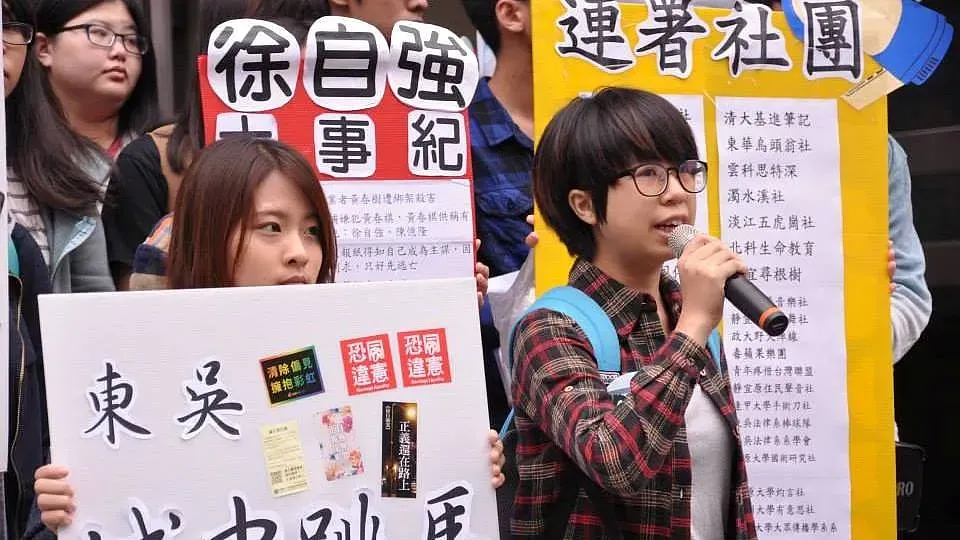
Today (11/12), something happened: the Hsu Tzu-chiang (徐自強) case, which has been in trial for nearly 20 years, held a court hearing, and 120 people came to observe in the gallery. In two dimensions, 120 is just a number; it's no big deal. Even though the largest courtroom was packed, the court merely treated it with indifference, casually letting those who couldn't fit in spill over into the hallways. Public trials are nothing special, and observing court hearings is unimportant. Adjudication has never taken the people as its core, nor does it seem to be news. It's no big deal.
With a sense of depth, however, you come to realize how many brilliant students, amidst the agonizing stress of midterm exam week, braved their test-taking anxiety and traveled from northern, central, southern, and eastern Taiwan to come here, wanting to get inside and forge a living connection with this case. These young people had spoken with him longer than the judges had. They had questioned him more sharply than the judges did.
They might not be able to tell you whether he was truly wronged. But they knew that if he had suffered an injustice, all of this was simply going too far. They are young and fortunate, yet in Hsu Tzu-chiang, they touched upon that feeling of having to swallow everything whole—silently, quietly swallowing it down. This far exceeded their imagination.
There is no need to bring up the presumption of innocence, Judicial Yuan Interpretation No. 582, a myriad of absurd and conflicting pieces of evidence, or alibis. Judges are too smart, too capable, and far too aware of why this case warrants an acquittal. The judges aren't being malicious; it's simply that they are much more frequently teachers and class monitors who never needed to swallow anything. The sense of injustice lacks dimensionality.

This article is an AI-generated translation of the original Chinese text. In the event of any discrepancy, the Chinese version shall prevail.