
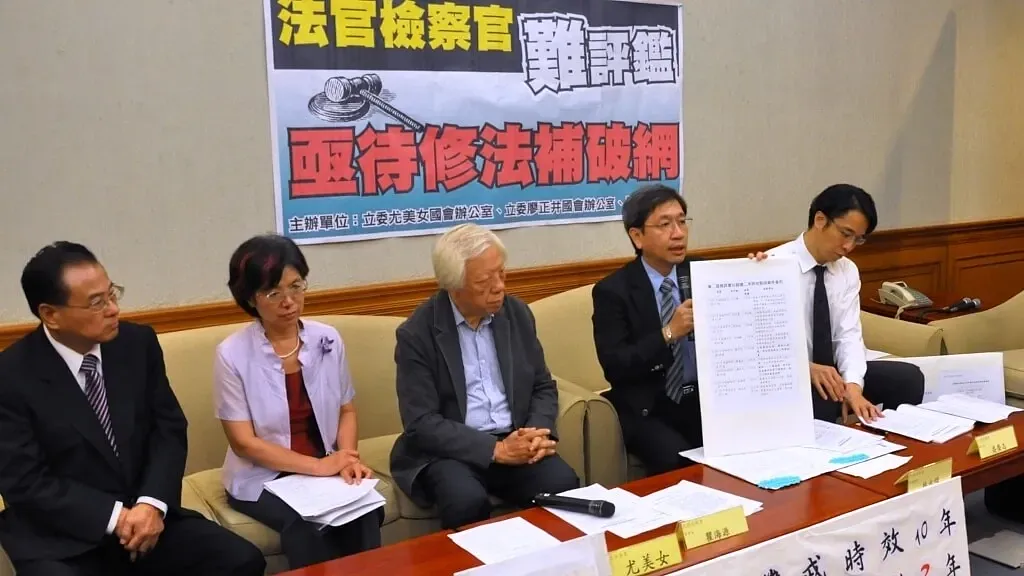
Support Amendments to the Judges Act to Weed Out Bad Prosecutors
Last edited: 2026-07-27
Legislation to remove incompetent judges and prosecutors is a crucial bill concerning the success or failure of judicial reform. In the past, due to strong boycotts from the judicial system targeted for reform, legislation proceeded with difficulty. It was not until around 2010, when successive controversial rulings and major corruption cases erupted in the legal sector, that public dissatisfaction with the judiciary surged rapidly, eventually triggering the so-called "White Rose" protest march. Pressured by both soaring public grievance and the continuation of the regime, the Ma administration finally allowed the Judges Act, which had been delayed for over twenty years, to pass smoothly in June 2011. In addition to introducing a judicial evaluation system, it also incorporated prosecutors into the regulations.
As representatives of the state's public interest, prosecutors exercise the power of punishment and prosecute crimes on behalf of the state. While their duty certainly lies in prosecuting criminal defendants to realize the state's penal power, more importantly, as guardians of the law, prosecutors must not only oversee court judgments to protect defendants from arbitrary judicial acts, but also protect criminal suspects from infringements upon their fundamental rights by police authorities. Therefore, the importance of the prosecutor's role goes without saying. Consequently, the urgency of operating a prosecutorial evaluation and removal mechanism should take precedence over that of judges. To put it more plainly, constrained by their own limitations and bound by the principle of "no action without a complaint," judges occupy a passive position. Relevant cases must be referred from prosecutorial agencies; hence, only prosecutors can decide whether or not to prosecute criminals. Prosecutors stand on the front line of criminal cases—as long as a prosecutor decides not to prosecute a case, no criminal case will ever enter a courtroom. Secondly, even if a prosecuted individual is later acquitted by the court and their innocence restored, the party concerned will have suffered tremendous destruction in terms of physical and mental health, family, and employment under the long-term torture of the "judicial meat grinder." In short, given the public's uncompromising demand that prosecutors exercise their powers impartially, society eagerly anticipates whether the evaluation mechanism, which officially went into effect in January 2012, can timely fulfill its function of disciplining and removing incompetent prosecutors.
The individual case evaluation system has been implemented for nearly three years now. However, following the formation of the second Prosecutor Evaluation Commission in January this year, according to statistics from the Judicial Reform Foundation, only 16 evaluation cases have been initiated, and among them, only two were accepted and referred to the Control Yuan for investigation—an acceptance rate of a mere 12.5 percent. As for the remaining 14 unaccepted cases, an astonishing nine were dismissed on the grounds of having "exceeded the two-year request period." The absurdity of these cases lies in the fact that bad prosecutors cannot be disciplined simply because the "starting point of the statute of limitations" requiring an individual case evaluation to be "made within two years" is calculated from the time the prosecutor "concludes the case processing"—that is, the evaluation request must be filed within two years after the prosecutor prosecutes the case. Yet, looking at court trial practices in Taiwan, sluggishness and inefficiency have long been the norm in court operations, and defendants face protracted trials after a case is indicted. While the case is ongoing, who would dare to provoke trouble and request an evaluation of the prosecutor? By the time the defendant is finally acquitted, however, the time elapsed from the indictment is often more than two years, exceeding the statute of limitations for reporting the prosecutor. Viewed in this light, this determination method causes individual case evaluations of prosecutors to "self-castrate," allowing bad prosecutors to easily remain at large. That officials shield one another to this extent is truly sigh-inducing.
To remedy the aforementioned loophole of an obviously excessively short limitation period for evaluation requests and various other legislative defects, the amendment draft for the Judges Act has been jointly proposed by 21 legislators, including Legislators Yu Mei-chu and Liao Cheng-ching, and is currently submitted to the Judiciary and Organic Laws and Statutes Committee for review. Only by allowing that minority of bad prosecutors who have indiscriminately prosecuted, disregarded human rights, ravaged people, and intentionally framed others to genuinely face legal sanctions can the credibility of the judiciary revive from decline, and judicial justice truly find redemption.
This article is an AI-generated translation of the original Chinese text. In the event of any discrepancy, the Chinese version shall prevail.