
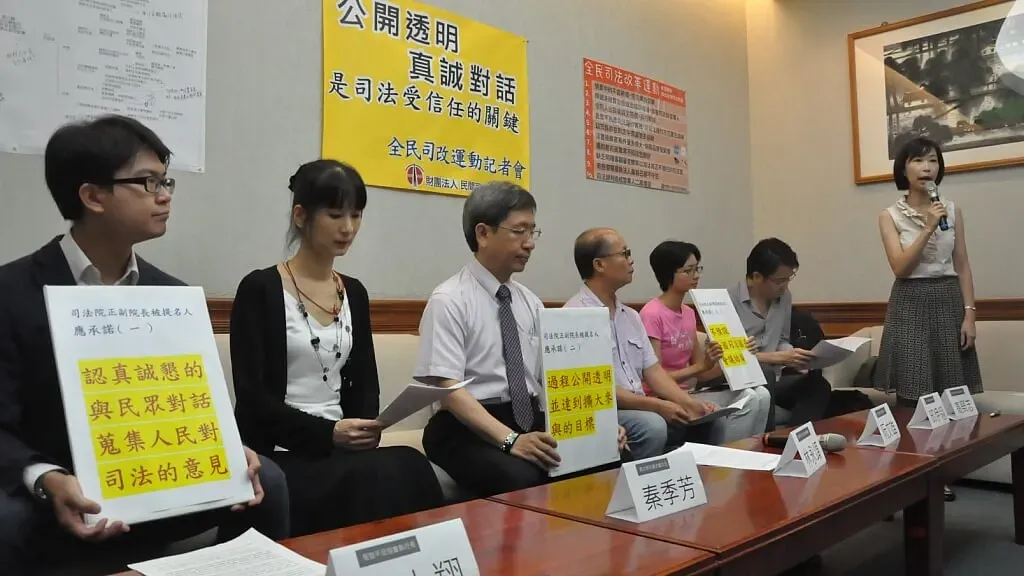
Openness, Transparency, and Sincere Dialogue Are Key to Trust in the Judiciary ~ Press Conference on the National Judicial Reform Movement
Last edited: 2026-07-27
To pursue a healthy judiciary with the goal of establishing a permanent judicial reform mechanism, the JRF launched the 'National Judicial Reform Movement' in May of this year. In the first phase, through online voting and collecting public opinions physically at 19 courts across Taiwan, with input from numerous civil society groups and the participation of nearly 1,800 citizens, 33 judicial issues 'most felt by the people' were selected.
Following the announcement of the first-phase voting results, we entered the second phase: 'Analyzing the Root Causes of Judicial Issues.' With the joint participation of NGO representatives, judges, prosecutors, lawyers, scholars, police officers, and media workers, multiple interviews were conducted, reports were drafted, and three working meetings were held. Furthermore, two expert evaluation meetings were held on 07/02 and 07/09. Both meetings maintained a composition where legal professionals made up less than half of the participants for discussions, ultimately completing highly reference-worthy analysis reports and mind maps on the top 12 judicial issues. (Full texts of the analysis reports are available online)
As we gradually clarified numerous judicial issues, we found that many possible common root causes are challenges that must be faced in order to resolve the complex judicial dilemma, including: issues of civic education and a judicial culture that values peers and superiors' intentions. More importantly, throughout the analysis process, all information—including interviews, meeting minutes, and analysis reports—was made publicly available online for the public to read and discuss. Furthermore, the meeting proceedings were fully recorded and made public (both expert evaluation meetings were livestreamed in their entirety), and netizens' opinions were brought into the meetings to allow netizens to participate in the discussion as well. Through open, transparent, and broadened participation, we discussed judicial issues earnestly and sincerely.
Next, we will move toward the third phase: seeking consensus on solutions to judicial issues. Since discussions in this phase involve potential difficulties encountered in implementation, in addition to the general public and experts, we also plan to invite relevant 'stakeholders,' including frontline staff and official representatives, to exchange views on potential difficulties that may be encountered during implementation.
In the process of organizing the National Judicial Reform Movement, we also discovered that the mindset of meeting organizers must be corrected. If the organizers have already presupposed the conclusions of the meeting, no matter how the meeting is held, it will instead make participants feel disrespected and lose confidence in discussion. Only by holding meetings without predetermined positions, bringing together various stakeholders—including frontline judicial personnel, police officers, correctional staff, and media workers—truly listening to their hardships and needs, and inviting scholars and experts from various fields such as sociology and journalism to analyze the issues, can these judicial issues truly be seen and resolved.
President Tsai Ing-wen stated in her May 20 inaugural speech that 'the judiciary must respond to the needs of the people, and no longer be a judiciary of legal professionals alone, but a judiciary of all citizens,' and expressed her commitment to carrying out 'citizen-participatory judicial reform.' These words still ring in our ears; yet recently (07/11), she nominated Hsieh Wen-ting (谢文定) and Lin Chin-fang (林锦芳) as President and Vice President of the Judicial Yuan, and submitted a memorial to the Legislative Yuan for consent. The past 'conservative working styles' of these two nominees for President and Vice President, and even their staunch opposition to judicial reform demands, have sparked continuous questioning from civil society organizations regarding their suitability. How judicial reform can be implemented remains deeply questionable. Moreover, the 'Directions for the Establishment of the Preparatory Committee for the National Conference on Judicial Reform' published by the Office of the President contains no regulations on information openness and transparency, and citizen participation risks becoming an empty shell.
Therefore, the organizations and the JRF participating in this joint press conference jointly urge that the nominees for President and Vice President of the Judicial Yuan (as well as the Office of the President and the Ministry of Justice, of course) should commit to the following matters, and we call upon the legislature to conduct a rigorous review procedure. If the nominees for President and Vice President of the Judicial Yuan cannot make clear commitments, their nominations should be vetoed.
- Engage in earnest and sincere dialogue with the public to gather people's opinions on the judiciary.
- Ensure the process is open and transparent, and achieves the goal of broadened participation.
- Do not presuppose the conclusions of the National Judicial Reform Conference.
Table of Appendices
- Improper reporting during investigations leading to trial by media - Votes: 1288
- Media publishing erroneous reports without factual verification, harming the judiciary and parties involved - Votes: 1281
- Difficulty making a living and high recidivism rates among released prisoners - Votes: 1073
- The public's unfamiliarity with judicial operation practices, leading to misunderstandings about how the judiciary operates - Votes: 1056
- Vulnerable groups need more assistance within the judiciary - Votes: 1027
- Heavy caseload burdens on judges and prosecutors affecting case-handling quality - Votes: 979
- Citizens often not knowing what to do when facing lawsuits - Votes: 827
- Lack of clear and objective review standards to weed out truly unsuitable judicial officers - Votes: 800
- Some police officers are law enforcement personnel themselves yet fail to abide by the law - Votes: 818 (Note: 798 in source)
- Judicial miscarriages of justice causing secondary harm to parties involved - Votes: 767
- Legal education cultivates legal professionals who only know how to take tests - Votes: 702
- Some laws are unjust, and some Supreme Court precedents and resolutions are out of touch with society - Votes: 672
- Lawsuits taking too long and litigation being very costly - Votes: 662
- Rights of victims not valued by the judiciary - Votes: 645
- Judicial units should strengthen communication with the people and enhance transparency - Votes: 630
- Prosecutors' indictments, non-prosecution dispositions, and other documents should be made public - Votes: 545
- Poor courtroom demeanor of some judges and prosecutors - Votes: 515
- Non-rigorous judicial procedures infringing upon the rights and interests of parties involved - Votes: 509
- Some court judgments falling short of the general public's expectations - Votes: 429
- Efficiency of constitutional interpretations by Grand Justices should be enhanced - Votes: 352
- Reasonable periods for appeal and relief should be guaranteed after the finalization of the death penalty - Votes: 316
- Drug policies should be comprehensively reviewed to properly handle drug-related crimes - Votes: 265
- Legal documents should use clear and easy-to-understand formats and writing styles as much as possible - Votes: 246
- Some lawyers take money but fail to handle cases properly - Votes: 237
- Some judicial cases comply with political motives - Votes: 202
- Judicial officers, judgments, and improper actions during the authoritarian dictatorship era should be comprehensively reviewed - Votes: 199
- Inadequate professional competence of some forensic personnel, indirectly causing miscarriages of justice or wrongful convictions - Votes: 78
- The purpose of disclosing private data of parties involved in judicial procedures should be explained - Votes: 33
- Judges and prosecutors should have channels to request reviews of inappropriate laws - Votes: 4
- Prison administration must be transparent, and a third-party oversight mechanism should be established - Votes: 3
Press Conference Representatives
Judicial Reform Foundation / Chairman Lin Yung-sung
Association for Women's Rights Promotion / Director Ch'in Chi-fang
Taiwan Association for Innocence / Executive Director Attorney Lo Shih-hsiang
Taiwan Association for Human Rights / Secretary-General Chiu I-ling
Ty. Catholic Diocese - Migrant Workers and Brides Service Center / Father Nguyễn Văn Hùng
Judicial Reform Foundation / Executive Director Attorney Kao Jung-chih
Press Contacts
Executive Director Attorney Kao Jung-chih 02-2523-1178
This article is an AI-generated translation of the original Chinese text. In the event of any discrepancy, the Chinese version shall prevail.