
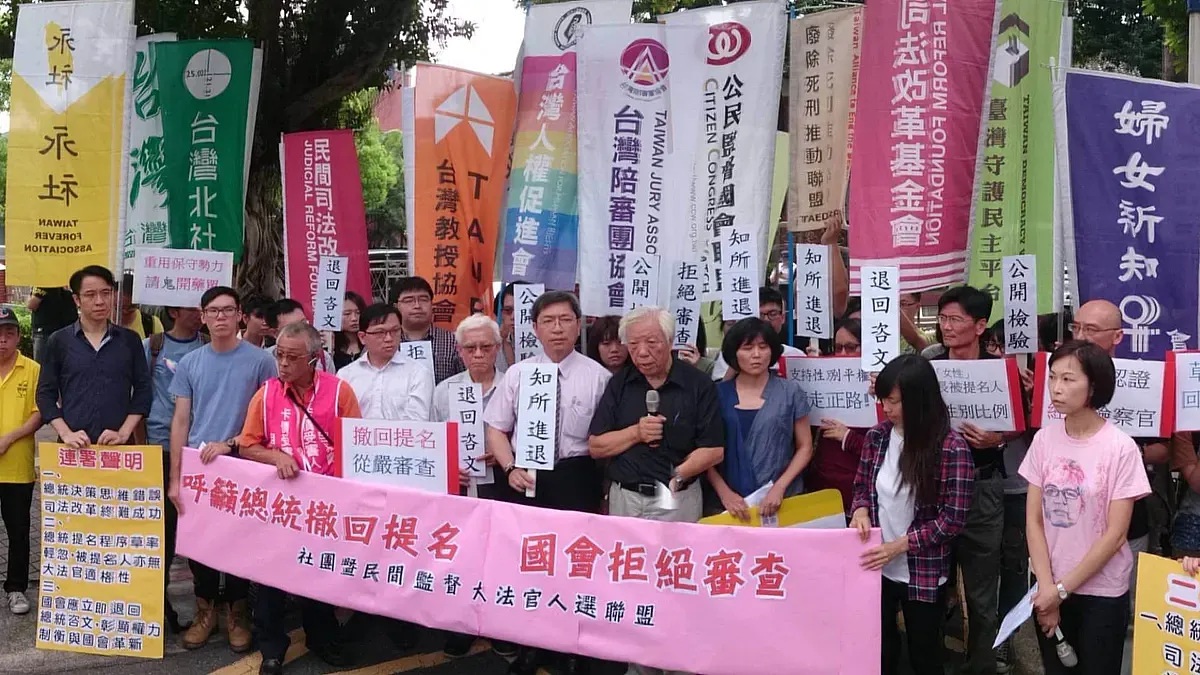
[Petition] Urging the President to Withdraw the Nominations and the Legislature to Refuse Review ~ Joint Statement by the Civil Alliance for the Monitoring of Grand Justice Candidates
Last edited: 2026-11-03
Regarding President Tsai Ing-wen's recent nomination of Hsieh Wen-ting and Lin Chin-fang as Grand Justices and respectively as President and Vice President of the Judicial Yuan, and submitting the official documents to the legislature, civic organizations and the Civil Alliance for the Monitoring of Grand Justice Candidates consider the President's decision-making mindset to be flawed and the nominations inappropriate, which will ultimately lead to the failure of judicial reform. Their joint statement and demands are as follows:
Petition Demands
- The President must immediately withdraw the nominations for Grand Justices and the President and Vice President of the Judicial Yuan!
- The legislature must return the official documents and refuse review! Do not hastily pass major judicial personnel cases through an extraordinary session!
Joint Statement
-
The President's Decision-Making Mindset is Flawed, and Judicial Reform Will Ultimately Struggle to Succeed
In order to catch up with the Judicial National Affairs Conference to be promoted in October, President Tsai Ing-wen hastily and carelessly nominated candidates for the President and Vice President of the Judicial Yuan, firmly believing and claiming that reform can only succeed if led by senior administrative bureaucrats within the system. However, the deep-seated malaise of the judiciary requires the vision of a radical break from the past to develop. Administrative bureaucrats have always been set in their ways and lacking in fresh thinking; how can they change overnight? This raises serious doubts. The two nominees have served as high-ranking officials in the prosecutorial and judicial systems for many years and have successively served as Secretary-General of the Judicial Yuan for many years, during which time they have not lacked specific remarks and actions resisting reform, repeatedly triggering public grievance. Yet, they can be promoted to President and Vice President—on what grounds? Such an outdated past leaves people utterly unable to expect innovation! Seeing that reform may be postponed for at least another four years, the public harbors deep grievances against the judiciary and likely has no more four years to waste! The public holds deep expectations for President Tsai. If flawed thinking in the President's personnel selection model leads to an inability to advance judicial reform, it will ultimately face a backlash from the public's strongly disappointed sentiment!
- During his tenure as Secretary-General of the Judicial Yuan, Hsieh Wen-ting stepped down from his position as Secretary-General due to a corruption case involving judges of the High Court, only to be promoted instead as President of the Commission on the Disciplinary Sanctions of Functionaries. During his tenure, his handling of the sexual assault case at a special education school in southern China (Taiwan) was suspected of being overly lenient.
- During her tenure as Secretary-General of the Judicial Yuan, besides vigorously promoting the "lay participation system" (Guan-Shen system), Lin Chin-fang argued in 2012 for strict restrictions on lawyers and parties obtaining court audio and video recordings, and even advocated during the 2014 amendment to the Court Organization Act that "publicly disclosing court audio recordings shall be unconditionally regarded as a criminal offense." In the Meihwa SHI Constitutional Interpretation case, she publicly defended Vice President Su's unconstitutional commentary and publicly opposed legislation on gender ratios.
-
The President's Nomination Procedure was Hasty and Careless, and the Nominees Lack the Qualifications for Grand Justices
When nominating candidates for the new President and Vice President, the President completely failed to listen to public opinions and recommendations, nor did she go through meticulous screening. To ensure utmost caution, nominations for Grand Justices have traditionally first established a screening committee to accept recommendations from all sectors in order to broadly incorporate public views. The nominations are then submitted to the screening committee for review before being recommended to the President. For Grand Justices who are also the President and Vice President of the Judicial Yuan, how could the nomination process be even more casual? Exactly what recommendations or self-nominations were involved? Were they recommended after review by a screening committee? The process was entirely non-transparent and completely defeats the purpose of the President establishing a screening committee in the first place! Furthermore, examining the past words and deeds of the two nominees, they have neither demonstrated concrete actions in defending the Constitution and human rights, nor put forward concrete propositions possessing constitutional stature and human rights awareness, nor do they have any publications related to constitutionalism and human rights! Instead, they are not short of remarks lacking human rights protections! They are unqualified even to serve as Grand Justices, let alone as the President and Vice President of Grand Justices. The President's nomination procedure is evidently hasty and careless, and the public cannot expect the nominees to fulfill their duties of defending the constitutional order and protecting human rights!
-
The Legislature Should Immediately Return the President's Documents to Manifest Checks and Balances and Congressional Reform
Since the new legislature takes reform as its focus, the Democratic Progressive Party (DPP) caucus has even proposed amending the law, arguing that major personnel cases should have a review period of at least one month, and demanding that the nominating authority attach detailed review materials; otherwise, the nominations will be returned and review refused. According to the Gazette of the Legislative Yuan, the materials on the nominees attached to the presidential nomination documents are extremely rudimentary, failing to show the concrete arguments and discourses of the two individuals regarding judicial reform. The personnel case of the President and Vice President of the Judicial Yuan is undoubtedly a touchstone for congressional reform. Faced with such crude and sloppy nominations, the legislature should decisively return the documents and refuse review to exercise the functions of separation of powers and checks and balances between the legislative and executive branches! If the DPP, after attaining full governance, insists on setting a bad precedent of "express-lane clearance," directly violating the DPP caucus's demand for at least one month of congressional review for Grand Justices, blindly endorsing them by leveraging its numerical advantage, and treating the legislature as the President's rubber stamp, how does it differ from the old government? Since the legislature has resolved to reform, it should take concrete action to manifest its determination, firmly oppose the hasty review and passage in an extraordinary session, and immediately return the documents!
President Tsai Ing-wen put forward nine major judicial reform policies before the election, and the determination she displayed in her inaugural address still rings in our ears. However, the public's ardent expectations for judicial reform make the President's very first step of nomination terribly disappointing! We hereby loudly call upon the President to immediately withdraw the personnel nomination case for the President and Vice President of the Judicial Yuan, listen to civic advice, transparently select the decision-making process, and prudently nominate appropriate candidates! Should the President refuse to withdraw, the legislature must also exercise its function of separation of powers and checks and balances by returning the documents and refusing review! If, in order to accommodate the political agenda of the National Judicial Reform Conference in October, the nomination and review of the President and Vice President of the Judicial Yuan—which are extremely important within the constitutional system—are rushed and put the cart before the horse, such a starting move for judicial reform will doom a reform originally intended to pursue greater fairness, transparency, and due process to failure!
Sign the Petition Now
※ After filling out and clicking "Submit," please wait a moment; the page will automatically redirect to the thank-you page to complete the signing.
Petition Signatories
※ This form updates automatically. If your signature does not appear yet after submitting, please wait a few minutes and refresh this page by pressing "F5". To view the list of individual signatories, please click the Individual Petition tab at the bottom of the window.
Initiating Organizations
Civil Alliance for the Monitoring of Grand Justice Candidates
Citizen's Congress Watch
Taiwan Association for Human Rights
Taiwan Forever Association
Taiwan Law Society
Taiwan Supporting Democracy Platform
Citizen Constitutional Promotion Alliance
Alliance for Human Rights Conventions Implementation
Association for Wrongful Convictions
Environmental Jurists Association
Roots Taiwan Association
Wild Green Taiwan Association
Jury System Association of Taiwan
Catholic Diocese of Hsinchu Migrants' Service Center (Vitenamese Migrant Workers and Spouses Office)
Awakening Foundation
Judicial Reform Foundation
This article is an AI-generated translation of the original Chinese text. In the event of any discrepancy, the Chinese version shall prevail.