
The Legislative Yuan Should Swiftly Pass the Amendment to the "Consent Appointment" to Implement a Rigorous Review Mechanism for Grand Justices
Last edited: 2026-07-27
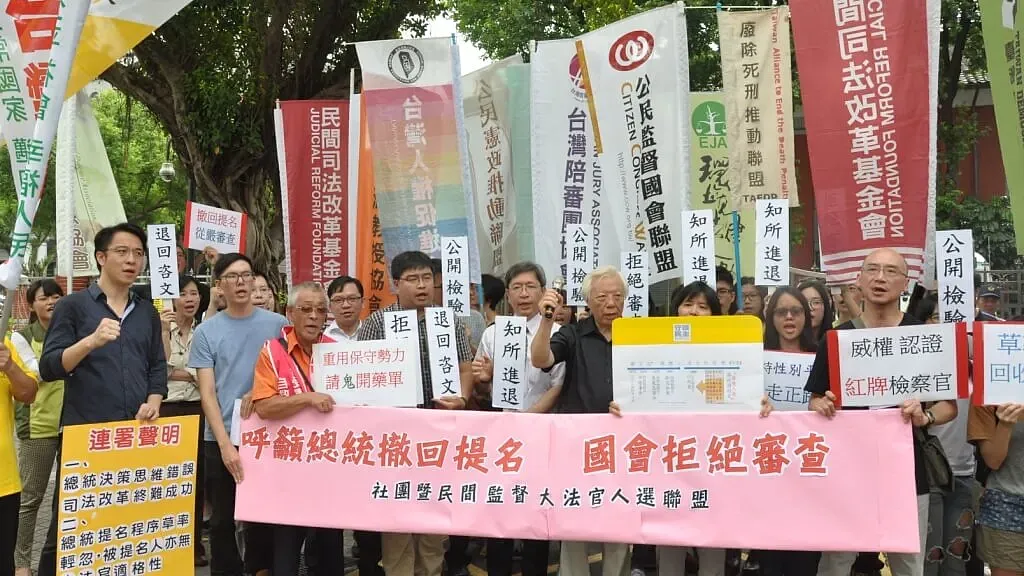
The Civil Alliance for the Monitoring of Grand Justices Nominees held a press conference today at the Legislative Yuan alongside multiple civil society organizations, calling on the President to withdraw the nominations for Grand Justices and the President and Vice President of the Judicial Yuan. They also urged the parliament to return the nomination message and refuse to conduct the review! Following the press conference, they visited the President of the Legislative Yuan and various caucus groups to seek their support.
Following these visits, the Democratic Progressive Party (DPP) caucus stated that the President's nomination message had already been submitted to the plenary session last week and could not be returned under current procedures. Nevertheless, the caucus acknowledged the public's dissatisfaction with the nominees and would not rush to schedule the review timeline. Meanwhile, the New Power Party and People First Party caucuses both pledged to adopt a rigorous review process for the nominees proposed by the President for Grand Justices and concurrently as President and Vice President of the Judicial Yuan. The New Power Party further stated that a consensus has already been reached in committee regarding the draft amendments to the Organic Law of the Legislative Yuan concerning the review of personnel appointments. If this amendment can be passed during the extraordinary session, it can be applied immediately to the current personnel appointments of the President and Vice President of the Judicial Yuan, thereby implementing a rigorous review.
Therefore, the Alliance and various organizations issue this statement and call upon the following:
- The provisions regarding the power of personnel consent in the current Organic Law of the Legislative Yuan are overly rudimentary, leading to superficial and perfunctory personnel reviews in the past.
- The Legislative Yuan will hold a "Caucus Consultation Meeting" tomorrow morning (July 20) and should include the draft amendments to the Organic Law of the Legislative Yuan concerning the power of personnel consent in the agenda of the extraordinary session.
- The Legislative Yuan should also swiftly pass the aforementioned draft amendments during the extraordinary session to facilitate a rigorous review.
- Even if the full version cannot be passed, non-controversial parts within the committee (such as Article 29) should be passed first.
Only by swiftly passing the amendment to the power of personnel consent can legislators have new, rigorous review regulations and requirements when exercising their consent power, preventing the Legislative Yuan from following old precedents and hastily passing candidates nominated by the President without strict scrutiny.
In addition, a spokesperson for the Office of the President responded today, pointing out that the President is aware of the role Hsieh Wen-ting played at the time and understands these past cases. Regarding this, the Alliance feels deeply regretful! The foremost task of transitional justice is to disclose past historical documents and restore the truth. The Office of the President and the nominee for President of the Judicial Yuan clearly knew of this history's existence yet chose to downplay it in an attempt to conceal it. For a political party that claims transitional justice as its governance objective, this is undoubtedly the greatest insult to the people!
The Alliance once again calls upon the President to withdraw the nominations and the Legislative Yuan to swiftly pass the draft amendments to the Organic Law of the Legislative Yuan! Furthermore, they must strictly review the suitability of the President and Vice President of the Judicial Yuan!
Attachments
Invitation to Endorse
Regarding President Tsai Ing-wen's recent nomination of Hsieh Wen-ting and Lin Chin-fang as Grand Justices and respectively as President and Vice President of the Judicial Yuan, and the submission of the nomination message to the parliament, civil society organizations and the Civil Alliance for the Monitoring of Grand Justices Nominees believe that the President's decision-making mindset is flawed and that inappropriate candidates have been nominated, which will ultimately lead to the failure of judicial reform. They have thus issued a joint endorsement statement and demands.
Return the Presidential Nomination Message to Manifest Checks and Balances and Congressional Reform
Statement by Civil Society Organizations and the Civil Alliance for the Monitoring of Grand Justices Nominees on Visiting the President and Caucus Groups of the Legislative Yuan
Since its establishment in 2003, the Civil Alliance for the Monitoring of Grand Justices Nominees has successively formed six evaluation committees to supervise and evaluate the review of Grand Justice nominees. However, whether due to conflicts between the ruling and opposition parties or legislative inertia, past reviews of Grand Justice candidates have largely been reduced to mere formalities, triggering widespread criticism in public opinion.
At the beginning of their term, the legislators of this current session prided themselves on congressional reform and successively introduced numerous congressional reform bills. In his inaugural speech, President Su Jia-chyuan declared that the new parliament of the future would be a new parliament of the people, an open parliament, and a professional parliament. He stated it would proceed from the interests of the people, transcend partisanship, strictly observe procedural neutrality, and return the parliament to the people. Various political parties have also successively proclaimed the spirit of congressional reform, with the DPP and the New Power Party each introducing draft amendments to the Organic Law of the Legislative Yuan.
Grand Justices are originally the guardians of the constitutional order, possessing the ultimate power of constitutional interpretation. Those serving as the President and Vice President among the Grand Justices are pivotal figures determining whether the judiciary can respond to the expectations of the people! Before the election, President Tsai Ing-wen published a blueprint for judicial reform, and after taking office, she actively mapped out the process of judicial reform, recently announcing the "Directions for the Establishment of the Preparatory Committee for the National Congress on Judicial Reform," demonstrating her ambition for judicial reform. However, the President's nomination of candidates for Grand Justices and concurrently as President and Vice President of the Judicial Yuan this time was not only perfunctory and hasty, but her decision-making mindset was also fundamentally flawed. She mistakenly believed that senior bureaucrats within the administrative system were sufficient to execute the goals of judicial reform, while ignoring the independent and transcendent nature of Grand Justices! The appointment of political appointees in the administrative system cannot be mentioned in the same breath as the nomination of Grand Justices concurrently as President and Vice President of the Judicial Yuan.
The personnel review case of the Grand Justices is the most crucial personnel review case since the legislators of this term took office, and it is also a touchstone testing the new parliament's determination for reform. In the past, the exercise of the consent power often degenerated into hasty superficiality and hollow review, and the Legislative Yuan was frequently mocked by public opinion as the President's rubber stamp. Consequently, the DPP and the New Power Party proposed draft amendments to the Organic Law of the Legislative Yuan, advocating that major personnel cases should have a review period of at least one or two months, and that a review report should be produced prior to voting to serve as a reference for legislators when casting their ballots. Utilizing an extraordinary session to review major personnel cases already involves significant controversy, yet rushing the review process—how can we repeat past mistakes?
To manifest the values of power oversight and checks and balances, and to echo the goal of congressional reform, the Legislative Yuan should immediately return the President's nomination message and request that the President earnestly heed advice from all sides, deliberate carefully, and re-submit qualified and appropriate candidates. Furthermore, the Alliance also calls for abandoning complacency and perfunctoriness in the review of Grand Justice personnel. Priding itself on being an open and professional parliament, the new legislature should establish standards for the review process.
The Alliance suggests:
- The Legislative Yuan should pre-schedule the review timeline and must not make hasty and rushed decisions.
- Questionnaires should be distributed to nominees in advance, and they should be required to provide review materials such as representative deeds, publications, and judgments.
- A two-round review mechanism should be adopted: the first round through committee review, and the second round through a full-house review.
- Multiple nominees should be reviewed individually.
- Committee reviews should include hearing procedures.
- Reports should be produced following the reviews.
- The exercise of the consent power should take place one week after the production of the report.
In addition, the President should also be required to detail the criteria used for nominating the candidates following the nominations, and swiftly submit the relevant review materials of the nominees—including education background, work experience, property, and taxation—to the Legislative Yuan for record. If the President fails to meet the parliament's demands, the nomination message must be returned immediately and the review refused!
The errors in the President's current nomination decision are not entirely irremediable. If the parliament insists on acting as the President's rubber stamp, what will be lost is not only the opportunity for judicial reform over the next four years, but also the people's total distrust of both the executive and legislative branches! Standing at the crossroads of reform, how should the people's parliament make its choice? Please think twice!
Visiting Representatives of the Civil Alliance for the Monitoring of Grand Justices Nominees
Ch'ü Hai-yüan, Professor / Convener, Civil Alliance for the Monitoring of Grand Justices Nominees
Lin Yung-sung, Attorney / Chairperson, Judicial Reform Foundation
Ch'en Chao-ju, Professor / Chairperson, Taiwan Association for Human Rights (Taiwan Supporting Democracy Platform)
Yen Chüeh-an, Professor / Supervisor, Taiwan Supporting Democracy Platform
Li Yüeh-hui, Secretary-General, Taiwan Supporting Democracy Platform
Ch'iu Wen-ts'ung, Professor / President, The Society of Constitutional and Civil Jurisprudence (Hsueh She)
Hsü Wei-ch'ün, Professor / Executive Member, Citizens' Constitutional Promotion Alliance
Hsü Shih-jung, Professor / Chairperson, Protect Taiwan's Land Association
T'u Yü-yin, Professor / Executive Member, Taiwan Association for Human Rights, and Ch'iu I-ling, Secretary-General, Taiwan Association for Human Rights
Chang Yeh-sen, Physician / President, North Taiwan Society
Chang Hung-lin, Executive Director, Citizen Congress Watch
Ch'in Yü-jung, Secretary-General, Awakening Foundation
Ch'in Chi-fang, Director, Awakening Foundation
Lin Chia-ho, Professor, Taiwan Professors' Association
Lo Wu-lung, Executive Member, Debt Slaves Self-Help Association
Kao Jung-chih, Attorney / Spokesperson, Civil Alliance for the Monitoring of Grand Justices Nominees
Participating Organizations
Civil Alliance for the Monitoring of Grand Justices Nominees
The Society of Constitutional and Civil Jurisprudence (Hsueh She)
Taiwan Law Society
Taiwan Association for Human Rights
Taiwan Supporting Democracy Platform
Citizens' Constitutional Promotion Alliance
Citizen Congress Watch
Taiwan Alliance to Promote Civil Rights Conventions
Association for Innocence Project Taiwan
Environmental Jurists Association
Protect Taiwan's Land Association
Taiwan Wild Bird Federation (WildisGreen Association)
Taiwan Jury Association
Catholic Diocese of Hsinchu - Migrants and Immigrants Service Center (Catholic Vietnam Migrant Workers and Spouses Office)
Taiwan Forever Society, Awakening Foundation
Taiwan Alliance to End the Death Penalty
North Taiwan Society
Economic Democracy Union
Debt Slaves Self-Help Association
Judicial Reform Foundation
This article is an AI-generated translation of the original Chinese text. In the event of any discrepancy, the Chinese version shall prevail.