
Do Not Let Political Rhetoric Drown Out Chiang Yi-hua's Judicial Trial
Last edited: 2026-07-27
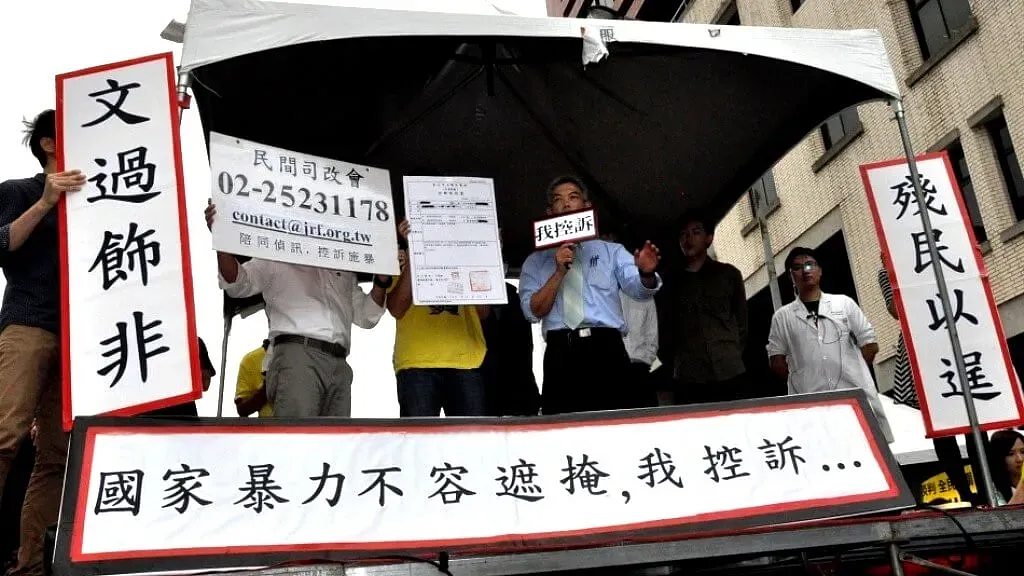
On March 24, 2014, when unarmed citizens were beaten and groaning on the ground in front of the Executive Yuan, the high-ranking officials who ordered the eviction of the Sunflower Movement protesters were sleeping soundly at home. Today, when victims attempt to seek the remaining vestiges of justice in Taiwan through the judiciary, they are subjected to relentless attacks and political scheming.
First, an article published in the United Daily News pointed out that since Chiang Yi-hua and others are accused of attempted murder, the Kaohsiung gas explosion incident, which caused far more deaths and injuries, should be grounds to prosecute Ch'en Chu for related crimes. The article argued that the Kaohsiung City Government caused major casualties through "omission," whereas the Executive Yuan engaged in "active commission" "in accordance with the law" to maintain order, representing a clear distinction in merit; how can the judiciary prosecute Chiang Yi-hua and others?
While such tactics of deliberately misinterpreting criminal law explanations and framing the matter as a Blue-Green partisan feud are quite common, using the tragedy of the gas explosion to shirk the Executive Yuan's responsibility for violence has become intolerable.
In criminal law, crimes involving first "commission" (creating a danger) followed by "omission" (failing to eliminate that danger) are quite common. For example, starting a fire and then failing to extinguish it, thereby causing a fire disaster, is a classic crime of "commission" (starting the fire) followed by "omission" (failing to extinguish it). Chiang Yi-hua and others first ordered the "time-limited" eviction of a large crowd (commission), but failed to control the violence (omission)—this is fundamentally a textbook case in criminal law. What about Ch'en Chu? Did Ch'en Chu first go and detonate the pipelines (commission) and then do nothing (omission), or did she order a petrochemical company to manufacture defective pipelines back then (commission) and then go home and kick back with her feet up (omission)? These two fundamentally incomparable cases have been used as excuses to cover up the Executive Yuan's violence, ultimately only highlighting the outrageous conduct of Chiang Yi-hua and others all the more.
In fact, within the apparatus of power, those behind the scenes can often evade responsibility. For example, in organized crime, prosecutions are frequently limited to the crimes of the underlings (the executors), while the crime bosses (those at the top) cannot be held accountable as accomplices under the law, especially in situations where underlings guess at superiors' unstated wishes with bosses maintaining plausible deniability, or where bosses give orders that remain ambiguous.
To address such deficiencies, advanced nations' criminal laws have long possessed a complete set of discourses concerning the responsibility of superiors within power apparatuses, which are widely applied to military officers, state actors, and even corporate executives, and have long been recognized and utilized by international criminal tribunals. The key to whether their guilt is established lies in whether corporate or state superiors had a certain understanding of the conditions within the organization and acted accordingly, or whether they created a danger yet failed to control it. The Executive Yuan and the National Police Agency are classic examples of power-apparatus organizations. Whether applying a modified concept of indirect perpetration or the normative combination theory of organizational dominion, current evidence can easily establish the normative position of Chiang Yi-hua and others. Therefore, the ultimate question is not whether Chiang Yi-hua and others are accomplices, but whether they were indispensable figures within the organizational dominion structure, and whether their acts and omissions led to the outbreak of violence.
In the Chiang Kuo-ch'ing case, the judicial sector's attitude toward Ch'en Chao-min clearly demonstrates our judiciary's conservatism in applying the theory of organizational dominion and the modified theory of indirect perpetration, yet whether these theories can be applied to transitional justice is of critical importance. In the attempted murder case against Chiang Yi-hua and others, whether judges choose to apply sophisticated theories already developed across various nations or adhere to the Supreme Court's traditionally conservative stance is a matter of judicial independence and philosophical belief, and furthermore tests whether judges are willing to place long-standing state violence into a historical context to deliver a revolutionary interpretation of criminal law.
However, several recent media op-eds have deliberately portrayed this case as one of "insufficient evidence" and "presumption of innocence." An issue that ought to be one of high-level criminal law theory application—an issue that has already sparked widespread discussion within Taiwan's criminal law academia—has been distorted by months of continuous op-eds and editorials into a case of Blue-Green partisan wrangling, abusive private prosecutions, and judicial degradation.
Under the current criminal justice system, when corporate bosses can be held accountable for customary violence within organizational structures, it is difficult for the Executive Yuan, as a tightly organized institution, to shirk responsibility. However, based on the principle of criminal law as a last resort (ultima ratio), how this theory should be narrowly applied is also highly controversial. Nevertheless, even if judges ultimately follow the Supreme Court's traditionally conservative stance to reject organized crime theories, it could still possess a high degree of innovation: because based on the history and culture of implicit state violence in Taiwan, judges might develop perspectives on transitional justice that are even more fitting than those of advanced nations. Yet these are all matters of applying legal theory, not some partisan brawl.
Certainly, when we use the judiciary to heal the wounds caused by state violence, we must face the social costs that new legal perspectives may entail. Nevertheless, there are some things we must reject: op-eds that misinterpret the law, editorials that deliberately distort the facts, and analogies that exploit Taiwan's trauma!
This article is an AI-generated translation of the original Chinese text. In the event of any discrepancy, the Chinese version shall prevail.