
An Account of the Executive Yuan's Dark Suppression on the Night Of
Last edited: 2026-07-27
This is in front of the Executive Yuan in the early morning hours, at the end of the crackdown.
The sky is bright, but this country is shrouded in darkness. I urge every friend at the scene, regardless of your role,
to use all possible forms to faithfully record everything you saw this night.
I was still in Kaohsiung when I learned yesterday about students occupying the Executive Yuan.
Judging that trouble might break out at night, everyone rushed back to Taipei from various places.
Because people had varying levels of acceptance regarding the occupation of the Executive Yuan,
the volunteer lawyers' group chat once discussed whether the students inside the Executive Yuan also fell within the scope of volunteer accompaniment during interrogation.
What was moving was that most lawyers agreed that due process remains unchanged,
reaching a consensus that assignments would still be uniformly coordinated by the JRF, while whether to accept a case would be decided based on individual willingness.
Around 8:00 p.m., nearly 20 lawyers had already gathered beside the Miramar Hotel.
They were also the first batch of lawyers led in by Attorney Ku Li-hsiung.
The purpose was to assist more than 10 students who had already been detained with interrogations.
However, at the beginning, they faced layer after layer of obstruction and could not see the students.
I heard from Meng-hsiu that even lawyers were treated unfavorably inside, with restrictions on going to the restroom and no freedom to enter or exit at will.
The lawyers were virtually subjected to disguised detention.
The remaining lawyers who could not rush there immediately gathered at the McDonald's on Linsen South Road to stand by.
When I arrived at McDonald's a little after 11:00, nearly ten companions were already waiting there.
Everyone directly started a strategy meeting at the long table on the second floor.
Around 12:00, half of the first batch of lawyers who went in returned, and Yu-hsiu and Meng-hsiu reported on the situation inside.
Shortly after, news continuously came over the internet that the clearance had begun and students were injured.
Everyone was very anxious, but to avoid getting trapped again and exhausting manpower for legal accompaniment, they had no choice but to wait idly there.
Around 1:00, while helping Yu-hsiu draft a statement and watching Facebook post after post about students getting injured,
I couldn't stand it anymore, and Yen-chun and I decided to go directly to the scene to see the situation.
The legal team would contact us by phone once their next step was determined.
At that moment, we really didn't know what we could do, but many citizens saw us wearing lawyer robes
and kept coming up to tell us where police were beating people, where someone was being carried out, and where was best to call.
They showed us photos and videos taken on their mobile phones, asked us if these could be used as evidence, and asked us to ferret out the perpetrators.
People were beaten, yet we had no way to have them report it to the police, because the ones doing the beating were precisely the brute police.
So we borrowed loudspeakers at various exits to broadcast, asking everyone to mind their safety and avoid conflicts,
giving people the JRF phone number, reminding them of their rights when arrested, and teaching ways to watch out for shield and baton attacks.
Personally, I really hoped everyone would leave quickly when the police started the violent dispersal.
Yet those who stayed at the scene despite such circumstances were impossible to persuade to leave.
You could only tell them how to protect themselves.
We walked around the Executive Yuan and saw military police and riot squads with various equipment all along the way.
Many officers' gazes were filled with exhaustion and even anger.
This bastard government had cornered them to the verge of a psychological breakdown, waiting to unleash them against unarmed citizens.
Many student leaders and speakers at the scene were still using passionate tones to escalate the confrontation with the police.
I felt this was not the way.
So as I patrolled the perimeter, passing in front of every police officer waiting for orders,
I kept telling them, "Thank you for your hard work, please show mercy; thank you for your hard work, please show mercy; thank you for your hard work, please show mercy."
Yen-chun followed me and repeated those exact words.
We both naively hoped that this could cause some police officers who still had reason and judgment
to truly show mercy.
We were all too naive.
Past 2:00, Te-tian called to say they were moving to the side gate on the north side of Peiping East and Chungshan North, to go inside and join the first batch of lawyers, Hsien-chang and Hsiao-pa.
Yen-chun and I rushed over from the east side. The crowd was massive, and citizens along the way kept coming over to report various news.
When we arrived, half an hour had passed, and unexpectedly Te-tian and the others were still being blocked by police at the entrance, unable to enter after a prolonged standoff.
We produced the power of attorney signed by the families of the injured students inside, but were still refused entry.
We questioned under which provision the authority of lawyers to accompany clients undergoing interrogation was being restricted.
The crowd at the scene demanded that the media present film the police obstructing lawyers' right to defense.
It wasn't until Attorney Ku successfully negotiated inside that about ten of us external lawyers were let in.
The number of riot police inside the Executive Yuan was unimaginable upon seeing it with one's own eyes.
They did not let us go to the front lines to rescue people.
Instead, they formed two long human walls on either side with police riot shields and long batons, extending all the way to the Peiping main gate to create a safe passage.
Lawyers stood along this passage, helping injured citizens or those carried out by the police out of the main gate one by one.
Yet we could only ensure that citizens entering the passage reached a safe state. Every student placed into the passage had a panicked expression, having no idea how many batons they had endured inside.
Moreover, the police consciously prioritized driving away the media; the reporters with camera equipment were the ones sent out in the first half hour.
They thought that by covering everyone's eyes, nothing would be seen afterwards.
You definitely would not dare to believe what I saw
in Taiwan, when people step foot into what the Constitution calls the highest executive organ,
what they look like when they come back out.
With cracked heads, bleeding chins, covering their ears, being choked, attacked in the groin, broken hands, limping, weak-kneed, fainting, staring blankly, hysterical; stretchers and oxygen cylinders went in and out multiple times, along with cases of epilepsy, and even a pregnant woman. A man was separated out by the police, continuously shouting that his wife was still inside and that she was pregnant. We kept begging the police to let us go find the people first, intimidating the police to let us find them, gather evidence, and take photos, but they still refused to let us in.
We could only escort people out one by one, supporting each other, saving as many as possible to prevent them from being dragged back, arrested, and dumped onto police wagons.
When you saw more and more injured people, with riot police and the Special Police Corps constantly changing formations, powerful and vigorous military chants drifted from afar: "One, two, three, four~~ One, two, three, four, one, two, three~~ four." Right as the chants ended, they were followed by screams and cries. At that moment I really felt nothing else mattered, and even hoped the people inside would not hold on, giving up and just walking out safely.
Thus it went until around 4:00 in the morning. Hundreds must have gone out by then. For a moment the cries of the crowd inside were still there, but no one had been carried out or walked out of the safe passage for a long time. We noticed the police quietly beginning to change formations, isolating the lawyers and the passage. They had long since surrounded the protesters who had held out this far in another area, intending to use even greater force against this group of so-called rioters who remained stubborn to this end.
Upon discovering this, we rushed toward the front lines. The riot unit seemed fully prepared, quickly surrounding any spot where a lawyer intended to enter.
I was once surrounded tightly within three seconds by over a hundred riot police using shields, along with three other lawyers—just like that scene in the Young and Dangerous movie where Chen Xiao-chun is surrounded by a crowd on a basketball court.
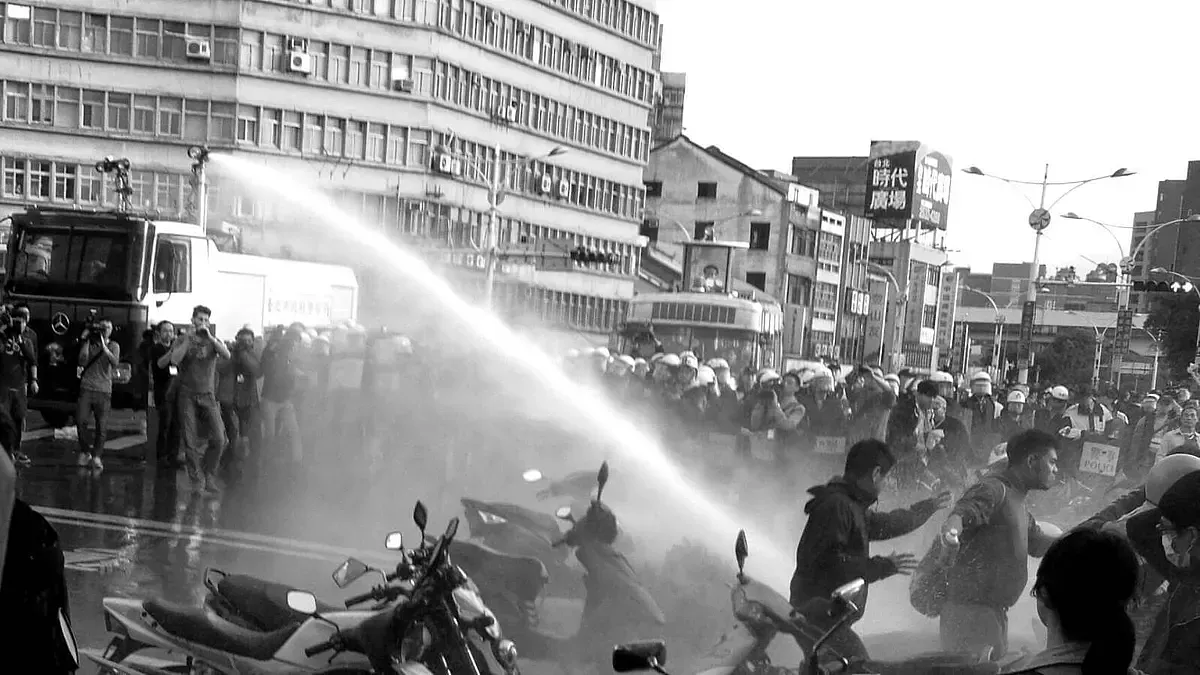
We stood in a standoff with the commander. I shouted that your superiors said we could enter, we have people detained inside, we must proceed for legal accompaniment, let us through! But the commander insisted on not letting us move toward the Security Police Corps management office, even softly persuading us to enter through some other door because this area was blocked off (we later learned around the same time the front gate was already spraying water cannons). Naturally, the door he mentioned was already sealed shut, and the police surrounding us told us to leave the way we came, while not far away a voice came from behind the shields: "Bastard lawyers~~ get out~~".
The scene was noisy, but I heard it very clearly.
So we returned to the Executive Yuan cafeteria, which was our temporary liaison post. P'ei-shan was in charge of online communication, manpower deployment, and message transmission there. Police officers were also resting here, and students arrested as flagrante delicto offenders were detained here as well. Knowing that lawyers inside the Executive Yuan had been isolated from the crowd, we sent out messages for help while drafting powers of attorney for the students inside, continuing this way until dawn.
I could not stop a single swing of a baton, nor the spray of any water cannon.
The white robe of the lawyer beside me was stained with the blood of the crowd.
We didn't know whose blood was shed, but we were all crystal clear about who did the beating.
Ma Ying-jeou, you made everyone here bleed, cry, get soaked, feel aggrieved and furious, and then despair because of you.
The lawyers inside the Executive Yuan were physically exhausted, yet at the same time many other lawyers were running around everywhere. Some were protecting the crowd on the perimeter, some went to National Taiwan University Hospital and Mackay Memorial Hospital to take statements from the injured, some stayed up all night at headquarters assigning tasks, some went to the Zhongzheng First Precinct or Security Police Corps for detained interrogations, and some stayed at the Legislative Yuan for over ten hours without anyone coming to relieve them. I truly admire everyone's stamina.
Stepping out of the Executive Yuan a little after 6:00, I took this photo in the distant breaking dawn. The clashes at the main gate in the photo had still not stopped at that time.
This familiar intersection, which I had passed through countless times from childhood to adulthood, suddenly became so unfamiliar and absurd.
Did you fall asleep last night?
"You go to sleep first. When you wake up from sleep, Taiwan will be different."
This article is an AI-generated translation of the original Chinese text. In the event of any discrepancy, the Chinese version shall prevail.