
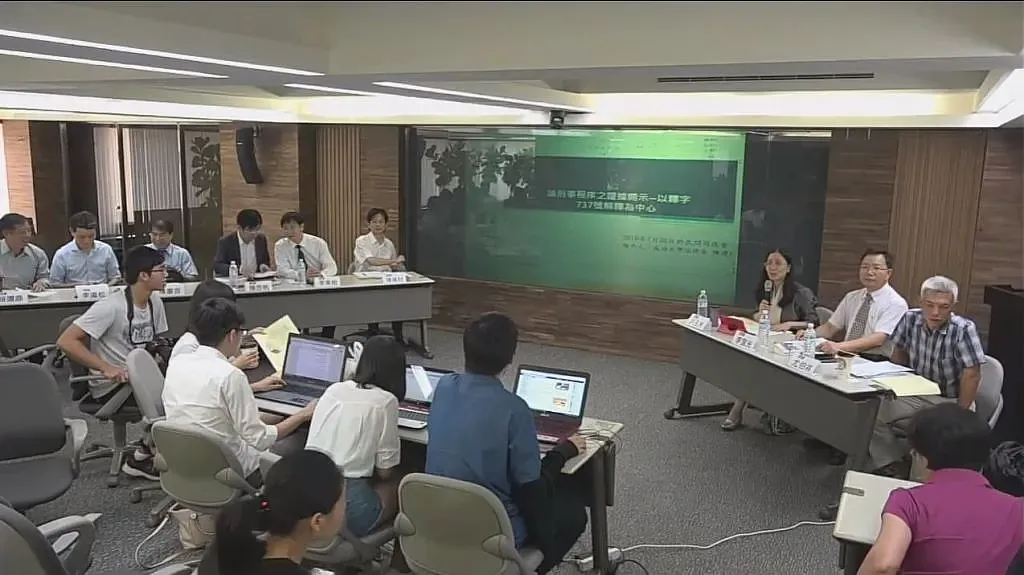
Event Record | Seminar on the File-Review System during Investigation
Last edited: 2026-11-03
Although Interpretation No. 737 opened the door to reforming the file-review system during investigation, the implementation of system design still relies on legislative reinforcement. The author emphasizes the substantive subjective status of the right to counsel, gradually safeguarding discovery, dividing mandatory and discretionary disclosure, and integrating the design of other defense procedures to genuinely guarantee suspects reasonable and balanced opportunities for defense during the investigation process.
Conference Materials
- Reporter / Prof. Ch'en Yün-ts'ai
- Discussant / Judge Li Tung-po
- Discussant / Prosecutor Li Hao-sung
- Discussant / Attorney Yu Po-hsiang
- Teacher Hsu Yü-hsiu
- I am sorry, no one told me it was time to start. I am very glad that everyone with strong opinions has come today. Representatives from both the Ministry of Justice and the Judicial Yuan are also in attendance, and I thank them very much. This era can no longer be avoided; we must go to the front lines to dialogue with the people no matter what. I hope that the more intensely contested an area is, the more we must speak out. Ideally, there should be a thorough dialogue that allows us to clarify some or all of the issues. I would like to seek everyone's opinions: it is very likely today will run about half an hour over the scheduled time. Do you all agree? Because this will allow for two rounds of dialogue, with twenty minutes for each speaker. Twenty minutes is enough to say a lot. In the first round, everyone has fifteen minutes, and in the second round, five minutes to respond to each other. My opening is complete. Please let Professor Ch'en Yün-ts'ai begin his speech immediately. Let's give him a round of applause.
(Applause)
- Professor Ch'en Yün-ts'ai
-
Grand Justice Hsu, senior practitioners here, and all the seniors and those interested in this issue who have come to attend this seminar on a weekend. From the perspective of academic research, I personally see this as an important milestone for judicial reform. Echoing what Grand Justice Hsu said, Interpretation No. 737 opened an important window regarding the issue of file review during investigation. As we move forward on this grand path of protecting human rights—especially protecting the suspect's right of defense during investigation—the focus is actually no longer at the theoretical level, but rather how defense counsel, prosecutors, and the court standing as an objective and neutral third party maintain the suspect's exercise of the right of defense through evidence disclosure and the scope and method of file review. This should be an even more important issue. It is rare, as Grand Justice Hsu just mentioned, for a prosecutor to play the defendant—though I suppose it should be scholars playing the defendant—for defense counsel and prosecutors to examine whether this theory can operate in practice and how it should be applied.
In my report today, the written materials are already available. Before the report, I want to thank Senior Attorney Li I-kuang for pointing out two typographical errors to me. One is on page 9, line 1, where it says "suspect or defendant"; please change "defendant" to "defense counsel." Page 9, line 1 emphasizes the difference in subjective status between the suspect and defense counsel who are both exercising the right of defense, allowing for a certain distinction in the scope and manner of file review. That is the first point: change the word "defendant" to "defense counsel." The other place is page 14, line 8, regarding a typographical error in the text: it is Article 8 of the Constitution, not paragraph 9.
In our country, as early as 1982, due to the Wang Ying-hsien homicide case, our country established the defense system during investigation, which has now been 33 years. Although defense counsel obtained an admission ticket into the investigation, there is no stage for them inside. I can describe it this way. Why? Because after the defense system during investigation was established, the things our defense counsel can do during investigation are, first, under Article 245, Paragraph 2 of the Code of Criminal Procedure, accompany suspects during interrogation. However, although the provisions allow for stating opinions, the actual room to state opinions is very limited, and some defense counsel even self-deprecatingly call themselves... using the word "mute" is not entirely appropriate, but they self-deprecatingly call themselves "mute defense counsel" because they cannot express opinions. Next is today's topic: being unable to access the dossier materials during investigation. Senior Attorney Yu Po-hsiang described himself as a blind swordsman, unable to see. Dragging on until 2009, the Grand Justices rendered Interpretation No. 503; otherwise, when lawyers met with detained suspects in detention centers, they were subjected to monitoring, recording, and even videotaping, and those could be used as evidence against the defendant. I particularly emphasized in my article that although we established defense during investigation 30 years ago, the entire content of the right has long remained in a dark tunnel, and the right of defense that defense counsel can truly exercise for defendants during investigation is very limited. In fact, in 2014, before Interpretation No. 737, I happened to have the opportunity to participate in a legal symposium of the High Court to provide opinions from a scholar's perspective. There was such a question at the 2014 legal symposium: when a prosecutor applies to the court for detention, can defense counsel request access to the prosecutor's written application for detention? As a teacher, I provided my doctrinal view that of course there should be no problem. However, the majority opinion resulting from the vote was that, based on the principle of non-public investigation, defense counsel may not access the detention application even during the detention review process. To realize a right that originally belonged under the Constitution takes 30-odd years, so engaging in judicial reform is not an easy task. Later we will have the opportunity, and we are very honored to invite Senior Attorney Li I-kuang, the petitioner of Interpretation No. 737, to give a more profound description.
Well, let's look at what Interpretation No. 737 says. First, regarding the basis for the protection of this right, I basically interpret it as continuing the spirit of Interpretation No. 654. Therefore, it likewise starts from the perspective of Article 8 and Article 16 of the Constitution, because this application involves detention dispositions restricting personal liberty, thus emphasizing the need to grant suspects and their defense counsel the right to obtain knowledge of the reasons and evidence related to the application during the detention review process. This is to safeguard due process of law under Article 8 of the Constitution, and of course it is also the protection of the people's right of litigation under Article 16. Now, regarding the content of this right protection, it emphasizes that appropriate and timely methods must be used to let criminal suspects and their defense counsel know the reasons for detention and related evidence. As just mentioned, I feel that the important issue left behind by Interpretation No. 737 is what is discussed here: how to subsequently enable suspects and defense counsel to obtain relevant evidence in an appropriate and timely manner during the detention review process. However, looking at these two points, we might think whether the density of protection should move toward an unrestricted direction, or a direction of broader contact with relevant dossier materials, to reach a conclusion. What I personally find more regrettable is regarding the method of obtaining knowledge; it emphasizes that file review and transcription are not strictly necessary, meaning this part is left to legislative discretion. I think this is the crucial issue just mentioned left behind by Interpretation No. 737. How the legislature handles obtaining information from dossiers during investigation is a very important issue. As I will mention later, this is generally handled using the concept of evidence discovery in Anglo-American law and Japanese law. Evidence discovery, viewed from the regulations of Japanese law, is a very major issue—I see nearly 20 related provisions regulating evidence discovery. Should we spend the relatively necessary costs to deal with the problem of accessing dossiers during the detention review process?
Based on the perspective of safeguarding the correct exercise of the state's penal power, Interpretation No. 737 sets forth exceptional grounds. That is, if there are factual grounds to recognize that there is a risk of destroying, forging, or altering evidence, colluding with accomplices or witnesses, or otherwise obstructing the purpose of investigation, or endangering the life or bodily safety of others, the aforementioned right to access dossier materials guaranteed by Articles 8 and 16 of the Constitution may be restricted or prohibited. I mentioned in my article: why did Interpretation No. 737 derive this exception? How did these exceptional grounds come about? The reasoning opinion does not further explain, which is also an issue worthy of discussion. In its reasoning opinion and the main text of the interpretation, Interpretation No. 737 mentions a holistic observation. This interpretation targeted two provisions of the Code of Criminal Procedure: one is Article 101, Paragraph 3, concerning the notification of reasons constituting the cause for detention, and the other is Article 33, concerning file review during trial. Through holistic observation, it declared that these two provisions do not comply with the opportunities guaranteed to interested parties to access dossiers under Articles 8 and 16 of the Constitution. Regarding such a constitutional review method of holistic observation, quite a few concurring opinions and dissenting opinions were raised in Interpretation No. 737. I will briefly explain this to everyone later; these are several issues derived from this interpretation. Finally, the reasoning opinion mentions the principle of non-public investigation and the principle of equality of arms: non-public investigation is a principle of the Code of Criminal Procedure, but it possesses important constitutional value because non-public investigation maintains the correct exercise of the state's penal power and protects the constitutional rights of suspects or interested parties—though this right is not described in detail. For suspects and defendants, the most important distinction for privacy and reputation protection is the right to a fair trial. It particularly emphasizes that non-public investigation is not sufficient to serve as a basis for restricting due process of law guaranteed by the Constitution—it emphasizes this sentence in the reasoning opinion. However, it also mentions at the same time that because the current pre-trial detention review procedure in the Code of Criminal Procedure does not adopt an adversarial structure, the principle of equality of arms does not apply. These two issues were also points where some Grand Justices expressed different thoughts in their concurring and dissenting opinions. Due to time constraints, those interested can read the relevant concurring and dissenting opinions in detail.
My article explains the concept of evidence discovery and proposes ten argumentative viewpoints.
First, our handling of the right of defense in criminal proceedings should return to the standpoint of suspects and defendants, viewing them from the perspective of being subjects of the procedure. I also hope to break away from the concepts of non-public investigation and equality of arms; in the article, I repeatedly emphasize that these two concepts are more instrumental concepts rather than substantive rights. Regarding substantive rights themselves, we must still return to the viewpoint of suspects and defendants as rights subjects.
Second, defense counsel—this is very interesting. In Interpretation No. 737, some Grand Justices mentioned that Interpretation No. 737 itself views problems from the perspective of the suspect, yet seems not to highlight the independence of defense counsel's authority. I personally believe that under the premise that the suspect/defendant is a procedural subject, defense counsel, as part of the defense system and as a provider of legal aid to the defendant, can independently enjoy the right to defense based on the constitutional defense system, and the two do not conflict.
Third: The concept of the right to defense in litigation is actually not easy to grasp because it is diverse, abstract, and different in nature from the freedom rights we have long advocated. My article hopes to point out the difficulties we face, meaning that currently within judicial proceedings—including Article 95 notifying the suspect of the charge, granting them the opportunity to defend themselves, the opportunity to receive assistance of counsel, the right to remain silent, and the right to request the investigation of evidence—these are basically what litigation calls the right of defense in litigation. The question is, at what stage this right of defense in litigation should be protected, to what extent it should be protected, and what its specific contents are, are actually closely and highly correlated with the litigation structure or the judicial review structure we adopt. We just mentioned whether the principle of equality of arms should apply during investigation; this issue appears right here. We want to protect personal liberty and adopt the pleading principle—no one would object to this. But we share a consensus when thinking about the extent to which file review should be protected, just as Interpretation No. 737 has many different views. Points four and five I have already mentioned: in the pre-trial detention stage, I agree with the argumentative result of Interpretation No. 737 that it is not necessary to handle it using equality of arms. Returning to the first point, viewing it from the standpoint of the suspect/defendant as a subject is sufficient. Conversely, non-public investigation is not sufficient to serve as an excuse to obstruct the right of defense from entering the investigation stage.
Sixth: As I just mentioned, in Interpretation No. 737, the holistic observation result of Article 101, Paragraph 3 and Article 33 is deemed not to conform to the requirements of constitutional due process of law. However, I believe that the regulatory purposes and the nature of right protection of these two provisions are different. Article 101, Paragraph 3, notifying the reasons for detention, responds to concepts like notification, the opportunity to be heard, and the right to a hearing. This notification and the granting of an opportunity to defend oneself are prerequisites for exercising the right of defense. By contrast, further accessing relevant dossier materials, file review, or evidence discovery is also a necessary right for exercising defense. However, the regulatory purposes and spirit of these two norms still differ. When a prosecutor applies for detention, a suspect whose personal liberty is restricted should know the reasons why he is applied for detention beforehand, rather than being told afterwards for what reason you are to be detained, and only then having his defense heard.
Seventh: The right to request evidence discovery should run through the entire criminal procedure. Once a suspect's status is formed during investigation—in the investigation stage, upon the conclusion of investigation, prosecution, trial stage, and even applying for a retrial after the final judgment—the suspect, defendant, or convicted person should enjoy the basic right to evidence discovery. Of course, the scope of this evidence discovery is closely related to the progress of the litigation. The article mentions that it should be a progressive and linked proportional relationship. The further along the stages go, first, the danger of evidence destruction decreases, and second, the importance of defense increases, so the scope that should be opened up must be broader. This is the argumentative viewpoint I mentioned in the seventh point.
Eighth: Aiming at the pre-trial detention stage during investigation, I believe we should distinguish between two stages: the detention application procedure and the appeal procedure after the court decides to detain the defendant. The scope and manner of evidence discovery should be differentiated between these two stages. This is the eighth argumentative basis I mentioned in the article.
Ninth: Regarding how to define the scope and manner of evidence discovery during the pre-trial detention stage in an investigation, I believe future legislative policy should distinguish between mandatory disclosure and discretionary disclosure. We should sit down—especially as I mentioned at the beginning—our defense counsel, prosecutors, or the Judicial Yuan drafting the legislative provisions should try to think about which evidence is critical and important for a suspect whose personal liberty may be restricted and for the defense counsel exercising defense for him, and grant them the opportunity to obtain knowledge, setting the scope of mandatory disclosure. Conversely, outside of mandatory disclosure, other evidence should be disclosed at discretion based on individual cases if it does not obstruct the investigation order, unless there are exceptional grounds under Interpretation No. 737, which are exceptionally restricted. This is my personal argumentative viewpoint in the ninth point.
Tenth: Evidence discovery during the pre-trial detention stage in an investigation must also be organically linked with other rights of defense. If a prosecutor applies for detention during investigation, and the suspect retains a lawyer as defense counsel, the very first thing to do upon arriving at court is of course a meeting, through which to understand the progress of the case and, as just mentioned, access necessary related application dossier materials, allowing them sufficient time and opportunity to prepare for the subsequent detention during investigation and exercise necessary defense. Of course, this is also related to the concept of the right to remain silent. The right to meetings and communication, the right to remain silent, and these several rights should be observed together. This is the relevant argument mentioned in my written materials today, and I will make this opening report first.
Next, regarding several more important parts of the article, due to limited time, I will further supplement them. The first point to supplement: why do we need to establish the litigation subjectivity of suspects and defendants in criminal proceedings? This viewpoint, as just mentioned, has established indisputable arguments through the amendment of the Code of Criminal Procedure, especially through Interpretation No. 654 and this Interpretation No. 737. Once the status of a suspect or defendant is formed in our criminal proceedings, they are a litigation subject and a rights subject, and should be granted necessary and reasonable opportunities to exercise defense. Why establish this concept of a rights subject? I think there are three important significances:
First, they can also exercise self-defense. That is to say, even if a suspect or defendant fully possesses sufficient legal knowledge themselves, can they claim self-defense? Yes. This is the first thing that must appear here after establishing litigation subjectivity: the right to self-defense.
Second, emphasizing internal relations. Under the premise of establishing the litigation subjectivity of the defense rights of defendants and suspects, we can examine from the perspective of the defendant/suspect whether the defense provided by the lawyer/defense counsel is sufficient and adequate. If the defense provided by the lawyer/defense counsel is insufficient and inadequate, then the defendant/suspect can claim ineffective assistance of counsel, which may affect the outcome of the judgment and can serve as a reason to apply for appeal. This is the second point.
Third, establishing that both are subjects who can independently claim constitutional defense rights—on one hand the suspect, on the other hand defense counsel. At this time, a distinction can be made, and I believe the scope of exercising the defense rights for both can be differentiated. The reason is the personal interest of the suspect/defendant in the litigation itself. As we know, based on the perspective of the lack of expectation of a different lawful course of conduct, criminal law does not pursue a defendant destroying evidence, committing perjury, or making false statements on their own. By contrast, defense counsel, based on the requirements of the Attorney Regulation Act and attorney ethics, if they are involved in instigating perjury, destroying evidence, or colluding in the defense process, must bear certain criminal liabilities. Therefore, when thinking about the issue of evidence discovery during investigation, I believe it is naturally necessary to distinguish based on this foundation. Certain distinctions can be made in the scope of exercising defense rights between a suspect who has not retained a lawyer and one who has engaged a lawyer.Next, my article also spends quite a bit of space dealing with whether the principle of equality of arms mentioned earlier can be applied during investigation. Please refer to the written materials for comparative law discussions. My personal thought is that if we move in the direction where the principle of equality of arms can thoroughly implement a fair trial and protect the exercise of defense rights by suspects and defendants, I am affirmative. However, what is the content of equality of arms? If it is believed that when a prosecutor applies for detention during investigation, equality of arms applies, how should it be done? For example, must the prosecutor appear in court? What should the prosecutor do if they appear in court? Should the records constituting the grounds for detention in the investigative dossier be read aloud by the prosecutor? Can the physical evidence constituting the grounds for detention be presented by the prosecutor? Conversely, should the suspect and defense counsel raise different opinions regarding the evidence presented by the prosecutor, conducted in such a manner? If so, this should be the so-called adversarial structure. But if so, it actually returns to the starting point: before this adversarial structure, must the opportunity for suspects and defense counsel to access dossiers be provided? Therefore, I believe that even if we emphasize that the pre-trial detention review procedure during investigation adopts an adversarial structure and has the application of equality of arms, it actually has no substantive impact on the concept of accessing dossiers that we just established. Therefore, whether equality of arms should be applied to investigation is substantively a question of whether we want to adopt an adversarial structure, not because we want equality of arms that we must adopt an adversarial structure. This is something that must be clarified logically. Whether our criminal procedure should shift the adversarial structure currently in trial earlier into the investigation stage—do we want this? In my written materials, I briefly mentioned my personal concerns, actually two points. Modern criminal trials are conceived as trial-centered; investigation should be a procedure for both parties to prepare for trial, and investigation is a preparatory stage. If adversarial investigation is adopted, I fear it will hollow out the trial. That is my first concern. My second concern is whether overemphasizing confrontation during investigation will instead result in an early trial by investigative agencies, making prosecutors' evidence-gathering passive—especially passive regarding evidence favorable to the defendant. This is my second concern, and we can listen to the views of practitioners shortly. Under this understanding, I personally believe we should separately review Article 33 and Article 101, Paragraph 3 of the Code of Criminal Procedure, and more directly target Article 101, Paragraph 3. This process can be viewed from the perspective of the right to notification and defense; I believe it should fall within the scope of due process of law under Article 8 of the Constitution, and should not be restricted by any exceptional grounds. In practical operation, regarding the protection of the opportunity for notification and defense, I suggest that when applying for detention, the prosecutor should simultaneously deliver a copy of the detention application to the suspect or defendant. I believe there should be no reason to exclude or restrict this. As for how to specifically, timely, and appropriately let suspects and defense counsel know the evidence related to detention, I believe the scope of evidence discovery should set mandatory disclosure and discretionary disclosure. The so-called mandatory disclosure means that among the prosecutor's investigative dossiers, relevant evidence should be presented to the suspect or defendant:
First, favorable evidence. This is very necessary for exercising the right of defense. If the prosecutor gathers favorable evidence during investigation based on the duty of objectivity, the prosecutor must disclose it without awaiting a request from the suspect or defense counsel.
Second, investigative information previously publicly disclosed by investigative agencies. We can imagine that in this process, there is no danger of destruction, and this part should also be within the scope of disclosure.
Third, to point out the illegality and impropriety of investigative methods violating statutory procedures. If there is relevant evidence within this scope in the prosecutor's dossier materials, it should also be within the scope of disclosure, mainly because information concerning illegal investigation actually has no need for protection, is not worth protecting, and should be disclosed to the suspect and defendant.
Fourth and fifth, including appraisal reports and records produced during the interrogation of the suspect in the investigation. These two parts are also within the scope of mandatory disclosure under German criminal procedure regulations, which can be referenced.
Finally, regarding the reasons constituting the grounds for detaining the suspect, but evidence unfavorable to the suspect: if this process has no risk of interfering with the correct exercise of justice, it should also be within the scope of mandatory disclosure, unless there are exceptional grounds set by Interpretation No. 737; otherwise, it should in principle be within the scope of accessible materials.It is specifically mentioned here that to balance the maintenance of the right to remain silent, suspects and defense counsel claiming to access dossiers for detention applications should not be burdened with the obligation to state specific reasons, as this would conflict with the basic spirit of the right to remain silent.
As I mentioned to you at the beginning, the right to request evidence discovery must be organically linked with the protection of other defense rights. If a suspect has not retained defense counsel, based on the viewpoint of distinguishing the right to request evidence discovery from that of defense counsel, the court may, if it deems appropriate, not directly provide dossier materials for the suspect to review, but at this time the court should mutatis mutandis apply the methods of Articles 164 and 165 of the Code of Criminal Procedure, notifying the suspect of the contents of the evidence in an appropriate manner.
Finally, the seventh point mentions that regarding the request by suspects and defense counsel to access dossier materials, I believe this should be done between defense counsel and the prosecutor through evidence discovery before the prosecutor applies for detention and before the court interrogates the defendant. If the prosecutor refuses, defense counsel should be granted the opportunity to appeal to the court, with the court making the final discretion. Through such relief against refusal, the constitutional operation of evidence discovery in the future can be established. Due to my limited time, regarding the non-public nature of investigation, please refer to the written materials.I mentioned in my article that I personally believe non-public investigation is not sufficient to serve as a basis for restricting or prohibiting suspects or defense counsel from exercising their right of defense during investigation. What are the interests protected by non-public investigation? In fact, the interests protected by non-public investigation, besides the realm of relations, most importantly include the defendant's interest in receiving a fair trial. This should be an even more important and superior interest. For a defendant protected by receiving a fair trial who attempts to access dossier materials during investigation, only for state organs to use non-public investigation as a reason to restrict his access to dossier materials—non-public investigation itself is contradictory. Therefore, non-public investigation is not sufficient to prohibit the exercise of the right of defense during investigation; not only accessing dossiers, but also inclusion in presence. Next, many issues may derive, as I mentioned in my final conclusion: regarding the right to presence, currently you can be present during interrogation, but can you be present during search and seizure? No. Because search and seizure currently, according to Article 150, is considered to have the right to presence only during trial. These are all issues we must consider and study for how the overall defense system can be implemented in investigation in the future.
I think a very important basic idea behind this is the relationship of trust. I was very honored to serve as an expert witness for Grand Justice Interpretation No. 737. During the debate that day, one could perceive that the representatives of the petitioner side for constitutional interpretation and the Ministry of Justice on the defense side were very close in physical position, but the chasm between them was very deep. Because in the past, as I said at the beginning, one side held non-public investigation as a shield, and the other held equality of arms as a spear, and both sides had some emotions and somewhat lapsed into assimilation. Therefore, we still need to return to the essence of the problem. After establishing the subjectivity of defendants and suspects, how many opportunities for defense should we grant? Returning to this viewpoint, after opening this window through the interpretation, today's seminar has its important significance. The organizers and academic units can invite senior prosecutors and senior attorneys to sit down on such an occasion to discuss this issue, which I think has important significance for our future implementation of the defense rights of suspects and defense counsel. I will make my report above. Thank you all.
- Teacher Hsu Yü-hsiu
- Thank you, Professor Ch'en, for your report, providing us with material for discussion. Anyone in those 33 years engaged in criminal law research and practical work must bear responsibility, so I am sitting here also with a feeling of repentance to do this. Today let us bridge that chasm. Alright, when the bell rings later, the closer it gets to the end, the louder it should ring, because I hope to strictly observe time. Therefore, please put what is most important and what you most want to say at the beginning. First, for the first discussant, please let Attorney Yu Po-hsiang begin to present personal views on this issue. Please. Within 15 minutes, and shorter is even better.
- Attorney Yu Po-hsiang
-
I will save time. The issue is so big, and there are so many topics. I am very honored to have the opportunity to sit with my client to attend this seminar. There are two petitioners in this case: one is defendant Lai Su-lu, Legislator Lai; and the other petitioner is her agent—not agent, excuse me, her defense counsel, Attorney Li I-kuang. So there are two petitioners in this case, involving two basic rights: one is Miss Lai Su-lu's basic right, and the other is Attorney Li I-kuang's basic right. Regarding what kind of basic rights of Attorney Li as a lawyer were infringed upon, I will skip discussing that and focus exclusively on Miss Lai Su-lu's basic rights. Because actually, in my view, the failure to affirm basic rights is the most important and biggest problem of this interpretation. Do defendants or criminal suspects in investigation actually have the right to review files during investigation? We can look at this problem through two different paths. In the first path, we completely treat the defendant or criminal suspect in investigation as an object: you are just the subject under investigation, and when necessary, the state can use coercive disposition power to preserve you, forcing you to actively accept prosecution, or even utilizing coercive dispositions to squeeze confessions, which is the phenomenon we often hear about, such as detaining people to extract confessions, frequently appearing in practice. In the past, we portrayed non-public investigation as so high and placed it in such an important position. Even during constitutional interpretation in the Constitutional Court, the representative of the Ministry of Justice said it was a constitutional principle. I think that is wrong. In the modern constitutional state, human dignity serves as the most fundamental value of the constitutional state—the most fundamental and core value. Human beings as subjects—because humans possess human dignity as subjects—is something that cannot be denied in any field, at any moment, or in any procedure. Therefore, if we treat defendants or criminal suspects in the investigative stage as an object, it obviously does not align with the modern constitutional state's understanding of human dignity and basic constitutional values. From this perspective, an inquisitorially thorough investigative structure cannot possibly be accepted by modern constitutions, so we must look at this problem from another angle.
The only possible angle is what rights a defendant or criminal suspect as a rights subject should enjoy in the investigative stage in order to enjoy human dignity. Viewed from this perspective, the problem becomes easier to resolve, and it also becomes easier to see clearly where non-public investigation should be positioned.
In this voluminous work, Professor Ch'en's approach completely aligns with what we argued in the Constitutional Court: cutting into the problem from the status of the defendant or criminal suspect as a rights subject. Under this approach, we can further divide it into two different paths. The first path applies the German theory of the function of basic rights, where basic rights as objective legal norms have the effect of binding state public power. Function theories are developed from this, the most basic of which is the function of procedural protection. The rough idea of this procedural protection function is that for all basic rights—whether personal liberty, property rights, or reputation rights—as long as these basic rights may be infringed upon within a procedure, the state must protect these basic rights. Interpretation No. 737 walks this kind of path; it explains right at the outset personal liberty and provides protection based on this personal liberty, thereby introducing due process of law. But this path carries a danger, which is that procedural protection turns into an instrumental value. We cannot clearly explain how the "due" in due process of law constitutes due process, and there are some operational difficulties.
The second angle of entry is that since this is a procedure, and the defendant is the subject within this procedure, he enjoys subjective status within the procedure and should possess certain rights based on that subjective status. This is the concept of the traditional right of litigation. This is the path I can more readily accept, because under this path we can clearly articulate what procedural rights are enjoyed within this procedure so as to act as a subject possessing human dignity. Cutting in from this angle, what rights should a defendant or criminal suspect in an investigation actually possess? Clearly, it is the right of litigation, and the core concept within the right of litigation is the right to answer and defend oneself. This is unquestionable, and I think we don't need to spend much time discussing it.
I think Professor Ch'en's article also advances from this perspective. Therefore, from this point, my starting point is the same as his: defendants and criminal suspects enjoy the right to defend themselves. How can they defend themselves fully? Of course, they must fully obtain information related to the case facts. Therefore, from the right of litigation and the right to defend oneself, one naturally derives the right to acquire information needed for defense. I call it the right to information acquisition, but regrettably, Interpretation No. 737 does not utter a single word about it. Interpretation No. 737 actually cuts into the problem from the procedural protection of basic rights; it only talks about personal liberty and does not speak of the right of litigation, procedural basic rights, or the right to information acquisition I just mentioned. In fact, I think this is a failure to adjudicate.
Why do I call it a failure to adjudicate? Because as I just mentioned, the petitioners of this interpretation are Miss Lai Su-lu and Attorney Li I-kuang. What they jointly argued was that Article 33 of the Code of Criminal Procedure deprives them of the right to information acquisition in the investigative stage, arguing that this provision infringed upon their constitutional rights. What constitutional rights? The right to information acquisition guaranteed by Article 16 of the Constitution. The respondent authorities—that is, the Ministry of Justice and the Department of Criminal Affairs of the Judicial Yuan—are also here today, and we've heard the Director-General's high insights. All three of us debated in the Constitutional Court whether file review is permissible—that is, whether defendants and criminal suspects actually have the right to information acquisition during investigation. Yet from beginning to end, neither the text nor the reasoning opinion of Interpretation No. 737 makes clear what right of Lai Su-lu was infringed upon. If the Grand Justices lack constitutional consciousness when operating constitutional interpretations, it is truly quite exhausting. We only see them addressing in the text of the interpretation the pre-trial detention review procedure during investigation, without mentioning at all whether defendants in investigation can review files, simply skipping past it inexplicably. Your target of constitutional review was Article 33, and the wording of Article 33 is so clear—only about unconstitutionality during trial. When reasoning whether it is unconstitutional, you should of course reason whether file review is permissible during investigation! How could you only reason about detention review? If this is not a failure to adjudicate, what is? I consider it an intentional failure to adjudicate. And such a failure to adjudicate creates problems. First, looking at the wording, the reasoning opinion states that during the detention review procedure in the investigation stage, the prosecutor submits a detention application containing reasons and related evidence, applying to the court for approval. Such reasons for applying for detention and related evidence are the basis upon which the judge decides whether to approve detention and thereby deprive personal liberty. Based on constitutional due process of law, suspects and their defense counsel should be enabled to obtain knowledge in an appropriate and timely manner so as to effectively exercise the right of defense. Thus, it can be seen that its inference is entirely based on due process of law as the basis of inference. The problem is that such an argument imposes an obligation under the Code of Criminal Procedure to notify, an obligation to enable criminal suspects and their defense counsel to obtain knowledge of the reasons for the prosecutor's detention application and related evidence. But it does not affirm that we have a right to know. This is a completely different way of arguing. Under such circumstances, since it is not your right, how the civil servant uses appropriate and timely methods to let you obtain knowledge is entirely up to their discretion, turning into discretion. Of course, legislation might also produce this: since it is discretion, it goes from legislative discretion, and the legislature can further delegate it to the judge at the scene to exercise discretion—passing the buck one after another. What will happen in the future—which in my view has already happened: the High Court has made an interpretation, reaching a symposium resolution. The High Court's resolution seems to be just like that; how is it any different from the status quo? An interpretive approach that fails to affirm the subjectivity of the rights of the person being interrogated below will lead to a predicament in future practice where this interpretation cannot be operated, because I still don't know what "timely and appropriate" means and cannot know the answer to this question. This will lead to two consequences. The first consequence is that practice believes—looking at the High Court's recent interpretation, the symposium resolution—that judges simply presenting it is sufficient. Is it really sufficient? I personally have doubts.
Several problems: First, the judge also suddenly receives the detention application that day, right before the detention hearing. The prosecutor attaches a whole bunch of all dossier materials behind the detention application and sends them over. When the judge reads the detention application, after finishing it, the judge has to look through all the dossier materials. Swallowing them whole in a rush, how would the judge know what to present to you? That's the first problem.
Second, the judge and the defendant look at the case dossiers from different angles. Why should the judge decide for the defendant and defense counsel what is needed for defense and what is not needed for defense? Does that make sense?
Third, frankly speaking, whose memory is that good? When the judge really presents it to you up there, are you able to remember the entire contents? To react on the spot and defend yourself on the spot is completely impossible. Therefore, a judge presenting reasons and evidence materials is painful for the judge, and painful for the defendant and defense counsel. Is this due or undue? According to Interpretation No. 737, I'm afraid it's a matter of opinion. Conversely, if we start from the viewpoint of being a rights subject, and I have the right to information acquisition, viewed from this angle, whether a judge presenting dossier materials can satisfy my right to information acquisition is highly questionable, and obviously cannot satisfy it. This infringes upon my right of litigation, which can be the basis for a future constitutional petition. If we cut in via the path of due process of law without affirming that I am a subject, then because of legislative discretion—as many previous Grand Justices' interpretations have stated, the content of the right of litigation is entirely within the space of legislative discretion—if there is legislative discretion, we might not be able to file a constitutional petition. Viewed from this angle, I believe the Grand Justices' interpretation committed a major logical error. This error lies in failing to consider that due process of law must take the protection of procedural subjects as its content. If we talk about due process of law today without discussing what rights a subject possesses—especially the right of litigation and procedural basic rights—then due process of law will only become an empty shell, losing its soul, and the result is that Interpretation No. 737 cannot be operated as I mentioned just now. In fact, in the reasoning opinion of Interpretation No. 737, within one year from the date of promulgation of this interpretation, the Code of Criminal Procedure shall be amended in accordance with the intent of this interpretation; if the amendment is not completed within the time limit, the court's detention review procedure shall be exercised in accordance with this interpretation. Theoretically, this interpretation should be operational, but the result of making such an interpretation is that it is completely unoperational. What is "timely and appropriate"? No one knows, because the concept of a rights subject is missing. This interpretation also mistakenly understood the principle of equality of arms as a product of an adversarial structure, thereby believing that since it is not adversarial, there is no need to place the state in a position of information equality. Therefore, it completely denies the need for defendants to possess the right to information acquisition during detention review procedures; it completely denies it. Even within an inquisitorial litigation structure, can we deny that defendants have the right to information acquisition? In the past when an inquisitorial structure was adopted, defendants could still review files during trial, so you cannot deny that defendants have the right to information acquisition. Therefore, the defendant's right to information acquisition has nothing to do with the principle of equality of arms. Logically speaking, going a step further, if a defendant today is under an inquisitorial structure, are they litigating against the judge and the state, and are they in a state of inequality of arms between the judge and the state? This is also a very strange proposition. So must the principle of equality of arms be tied together with adversarial proceedings? I personally harbor quite a few doubts about this.Lastly, I want to respond to Professor Ch'en's monumental work. There is an issue of conceptual debate in Professor Ch'en's work. Professor Ch'en's work uses the right to request evidence discovery, whereas I use the right to information acquisition. I personally retain some reservations regarding the right to request evidence discovery because our current understanding of evidence discovery is a procedure developed under the dossier-separation (dossier-non-transfer) system. Domestic understanding of evidence discovery is generally based on this, but we have not adopted the dossier-separation system. Therefore, is it appropriate to use the right to request evidence discovery to refer to the right to information acquisition? That is my first reservation. My second reservation is that even if you want to adopt the dossier-separation system, must you necessarily introduce the evidence discovery procedure? I also hold substantial reservations about this, because evidence discovery in Anglo-American law basically slowly developed under a specific adversarial framework. But if you look at the development process of evidence discovery—especially the development process of evidence discovery in American law—to the end, based on the prosecutor's public interest role requirement, they practically have to disclose almost everything. Whatever is related to the litigation must be disclosed, favorable or unfavorable alike, disclosure is required for almost everything. Therefore, is it necessary to introduce evidence discovery when introducing the dossier-separation system in Taiwan? I personally hold heavy reservations. However, Professor Ch'en's opinion and mine align on one point: regardless of whether you use the right to request evidence discovery or the right to information acquisition, in my view they can both be divided into the core of the right and the periphery of the right. The things Professor Ch'en just listed in this monumental work that must be disclosed—including evidence favorable to the suspect, relevant evidence already proactively disclosed by investigative agencies, appraisal reports, and the interrogation records of the suspect himself during investigation—all fall within the core of the right in my view. No matter how the legislature legislates the file review system during investigation in the future, these are the core rights that cannot be stripped away. I recognize and agree with this point. Due to insufficient time, I will stop here.
- Teacher Hsu Yü-hsiu
- Time is already up. Next, please invite Ministry of Justice representative Prosecutor Li Hao-sung.
- Prosecutor Li Hao-sung
-
Moderator Teacher Hsu, Reporter Professor Ch'en, and seniors and predecessors here, good afternoon. I am very honored to attend this seminar. Two days ago at the Ministry of Justice, chatting with colleagues, I said I would be attending the symposium on Interpretation No. 737 on Saturday afternoon. They asked where I was going, and I said the Judicial Reform Foundation. Suddenly, my colleagues all cast sympathetic gazes at me, asking, "Are you going alone?" I said yes. Their gazes grew even more sympathetic. I feel that during my three years serving as a staff member detailed to the ministry, interacting frequently with seniors in the legal profession and the Judicial Yuan, I have always had a thought: will there be a day when we can put aside institutional self-interests, stop viewing problems from the perspective of judges, prosecutors, or defense lawyers, and instead grasp problems from the perspective of legal professionals, proposing solutions that can reduce unnecessary confrontation? At the end of Professor Ch'en's report, he mentioned that on March 3rd during the Constitutional Court debate, the Ministry of Justice acted as the defense side. Did any of you think further about why the Ministry of Justice was the defense side? Especially from Attorney Li I-kuang's standpoint, when he applied to review relevant dossiers at the time, what was rejected was actually the court. After filing an interlocutory appeal, the High Court rejected it again. So why did the Ministry of Justice become the defense side at the Constitutional Court? Of course, no one discusses this question, and perhaps it's not today's focus, but I'll just mention it in passing.
Below is an explanation regarding this discussion report. Everyone should have the written opinions provided in advance. On pages 2 to 3 of the written opinions, under Roman numeral II regarding the Ministry of Justice's opinion on Interpretation No. 737, this major section is an officially signed institutional opinion. To save time, I will not repeat it here. This part was already expressed at the public hearing held by the Judicial Yuan on July 13th, so I will skip it and directly express my personal views on Professor Ch'en's article. I must explain first: because Professor Ch'en was my teacher during my university days, my standpoint is not quite a discussant; at best it can be called a reading reflection report. First, at the bottom of page 3, regarding the judicialization of defense counsel, defining it this way is not entirely appropriate. But I draw from another piece of literature—a master's thesis by a prosecutor named Hsieh Hui-chung, which I think has quite a bit of reference value and which I can take this opportunity to share with everyone. Her thesis argues that the positioning of defense counsel directly affects the functions and rights of defense counsel, stating whether defense counsel can conduct a defense against the defendant's wishes, whether they can conceal facts for the defendant's benefit, and even whether they can instruct the defendant to exculpate themselves using methods contrary to the truth. She cites German doctrine and practice adopting the unitary judicial theory, which my senior perhaps can supplement later. She says if the unitary judicial theory is adopted, defense counsel has two functions: first, a private function, assisting the party in defending against state actions; second, a public interest role, concurrently acting as a guardian of the public interest within the criminal procedure proceedings. Thus, it belongs to the state's judicial unit. I remember at the Judicial Yuan public hearing on July 13th, I seemed to hear Attorney Yu express a similar view: if defense counsel is allowed to obtain relevant dossiers, defense counsel will not necessarily retain and disclose them unfiltered to the client. Therefore, I think Attorney Yu's argument should have some similarities with the public interest role of defense counsel mentioned here, and the content of this article can be provided to everyone together. Incidentally, on page 8 in the middle of Professor Ch'en's article, regarding the internal relationship between defense counsel and the client, a problem is raised: assuming the retained defense counsel does not conduct dossier defense activities for the best interests of the defendant, resulting in impairment to his right of defense, an objection of ineffective assistance of counsel can be raised. Of course, perhaps due to space limitations, there was no further elaboration. I was thinking whether there would be an opportunity later to consult the teacher and seniors present on how to define what constitutes ineffective assistance of counsel and how such an objection can be operated in practice.
The second point is concerning the principle of equality of arms. On page 7 of the teacher's article, there are some discussions. During the process of Interpretation No. 737, we also collected some discussions regarding established principles. Teacher Hsu Yü-hsiu described in a concurring opinion to Interpretation No. 654: the principle of due process of law hopes to request relief from the court, and effective relief at that. At this time, the court must be a fair court. Therefore, the principle of a fair trial is derived from the content of due process of law. Further, in the concurring opinion, there is a footnote which I think is very plain and easy to understand, allowing us to further understand the meaning of equality of arms: it's not that if you have a 10-kilogram knife, I must also have a 10-kilogram knife; it's not that kind of formal equality, but rather allowing two people with different strength and skills, who need different resources, to have their guarantees of resource acquisition adjusted somewhat. I personally guess this should be grounded in substantive equality rather than formal equality, which is the so-called principle of equality of arms. I previously heard another teacher in a different setting say that if the principle of equality of arms is overemphasized formally, it becomes: if a prosecutor can apply to detain a defendant, can the defendant also apply to detain the prosecutor? And can the defendant also apply to search the prosecutor? Is this equality of arms? Obviously not.
Additionally, on page 12 of Professor Ch'en's article, and during the July 13th public hearing, Professor Ch'en mentioned a new perspective that is extremely valuable: we must note that the detention review procedure does not apply the hearsay rule and cross-examination. If we suddenly demand that prosecutors appear in court for substantive debate and even file review, elevating it to trial-level specifications, once detention is approved, one can imagine that the probability of overturning it later will be substantially reduced. Would this be more favorable to the defendant? Page 12 of the article further mentions: will it overall result in the hollowing out of trial activities, further harming the defendant's litigation rights? My personal guess is, will it be somewhat similar to Japan's system? Because Japan historically emphasized precision justice, during the investigation—which they call search—stage, prosecutors "searched the heavens and scoured the earth," investigating all facts very thoroughly and clearly, causing the pretrial of trial proceedings where judges have nothing left to investigate and practically only sentencing remains. Could we get inspiration from this? And third, because...
- Teacher Hsu Yü-hsiu
- I want to interrupt. What people care more about is what the Ministry of Justice wants to do, rather than discussing academics. We just skipped... Sorry, I am only now intervening to stop. For example, what you wrote on page 3 in the Ministry of Justice's document—that is what we care about. What does the Ministry of Justice actually want to do? You are the representative of the Ministry of Justice, and we hope you can explain this part. Please explain.
- Prosecutor Li Hao-sung
- Alright. Well, my third point onwards is more related to legislative theory, so please allow me to finish reporting it. The third point is the tiered density review. The teacher mentioned a 1989 European Court of Human Rights case. When handling detention file review, legislation must note an argument: the timing of applying for detention and raising relief after being detained for a period of time are two different things. Therefore, should there be the same review density, or should they be handled differently? In the investigative stage, when I believe there is a necessity for detention and apply to the court for detention, the density of protecting the defendant's information acquisition at this time should be treated differently from the information he should be allowed to obtain when raising relief after being detained for a period of time. Examples I can think of: the first is Germany's protective seizure system. Seen from some literature, seizure requirements are not so strict during investigation, but after being seized for a period of time, whether the seizure state should continue to be maintained, the court's review density will increase. The second is that our country's Communication Security and Surveillance Act stipulates a wiretapping period of 30 days. When applying to continue wiretapping the same phone number, the court's strictness in review also differs. Next, regarding the separate evaluation of Article 33, Paragraph 1 of the Code of Criminal Procedure mentioned on pages 13 and 14: if Article 33, Paragraph 1 is evaluated separately, it also obviously violates constitutional due process of law. I personally propose a somewhat different observation point: Article 33, Paragraph 1 is placed in Book 1, Chapter 4, regulating the retention, number, qualifications, and rights of defense counsel. The statutory text is a positive list telling us that defense counsel can have the right to file review. If such a provision violates constitutional due process of law and is even deemed to derive unconstitutional application, wouldn't that be somewhat contradictory in itself? However, I feel the teacher points out the core of the problem lies in practical operation rather than the statutory provision itself. Fifth, regarding the principle of protecting reputation through non-public investigation, I thoroughly agree, so I will skip it. Sixth, the last point: regarding public servants' searches and impeachment searches, it is not the core of Interpretation No. 737, but the teacher's article mentions it, and today an attachment is appended, which is a short article I wrote in 2001 further supplementing the view on inquisitorial and impeachment search views, which everyone can refer to together. For the last bit of time, as commanded by Teacher Hsu, I will return to the aforementioned opinions on Interpretation No. 737, which were expressed at the public hearing at that time, but because the distinguished guests present probably didn't attend the public hearing, I will briefly mention them. First, regarding what method should be used to let defendants or defense counsel know relevant information: should it be through file review, or through the judge presenting it? The Ministry of Justice's preliminary deliberative opinion considers that it should still be presented by the judge, rather than directly allowing defense counsel to inspect the dossier materials. The reasons can refer to Grand Justice Su Yung-chin's concurring opinion: "Since the purpose of detention review is to balance the protection of personal liberty and the discovery of truth, if the judge plays the role of the caretaker of the best interests of both, obtaining relevant information unilaterally from the prosecutor, and after consideration and comprehensive judgment and filtering, unilaterally providing it to the criminal suspect, it can similarly achieve the purpose of the detention review procedure without the fear of unconstitutionality." The Ministry of Justice agrees with this opinion. Second, when there are exceptional grounds and it must be restricted or prohibited, how should it be handled procedurally? The Ministry of Justice's suggestion is that when prosecutors apply for detention, they should urge the court to note exceptional matters and not make relevant dossier materials known to the defendant or defense counsel. If the court still wants to make them known to the defendant and defense counsel, the prosecutor should voice an objection on the spot. This part incidentally mentions Professor Ch'en's article on page 19, which suggests that if it is deemed that there are factual grounds to suspect a risk of flight, it cannot be restricted. I incidentally thought of a question: what if it is not a risk of flight, but a risk of collusion? If the exceptional ground is the risk of collusion, what is the teacher's view—can it not be presented, or can it be deliberated? Or, per the exclusionary rule of evidence under German law we know, materials that cannot be presented also cannot be deliberated by the court. If there is an opportunity today, perhaps we can listen to your high insights. Third is the issue of mandatory defense in investigation procedures mentioned in Interpretation No. 737...
- Teacher Hsu Yü-hsiu
- Put this aside for now, let's talk about whether they should appear in court. Because time has already far exceeded.
- Prosecutor Li Hao-sung
- Regarding whether they should appear in court, the Ministry of Justice's simple opinion is that the statute should not directly restrict that they must all appear in court, because although some are detention applications, they are simple cases and do not necessarily require appearance. But if it is a major case of public concern, prosecutors actually do not want people released without explanation. Therefore, we will request prosecutors to appear in court to state and dialogue in such major or public concern cases. Reporting above, thank you.
- Teacher Hsu Yü-hsiu
- Next, please invite Judge Ch'en Szu-fan. Although Presiding Judge Tsai is at the scene, you still need to report according to your free will.
- Judge Ch'en Szu-fan
- Teacher Hsu Yü-hsiu, distinguished discussants present, and all distinguished guests and seniors here, as well as Presiding Judge Tsai from the Department of Criminal Affairs who came specifically to observe and cheer me on—hello everyone. Time is limited here, so I won't greet everyone individually, which is very discourteous, and I ask for your understanding. Not only am I a judge, but I am also serving in the Department of Criminal Affairs of the Judicial Yuan. I am participating in this discussion today representing the Department of Criminal Affairs. In such limited discussion time, as an institutional representative wanting to understand the institution's attitude and views on this issue, of course I will do my utmost to explain what I know and what can be answered at the current stage. However, I also ask for your understanding that if something is not yet finalized and still has room for discussion, it naturally cannot be fully responded to right now. First, cutting in from the very beginning of the problem—Grand Justice Interpretation No. 737. Everyone has the text and reasoning opinion of Interpretation No. 737 in hand. In fact, preceding the reasoning opinion, the opinion of the respondent institution—that is, the Judicial Yuan—is attached. The opinion here is provided by the Department of Criminal Affairs of the Judicial Yuan as the competent department for the Code of Criminal Procedure, representing the respondent institution. I had the privilege of following the Presiding Judge to participate in the constitutional verbal argument hearing. At that time, I heard staff colleagues say that based on institutional guarantees for the adversarial attack and defense between defendant and prosecutor, the detention procedure has the application of the principle of equality of arms. In addition, the controversial part should be the core of the protection of basic litigation rights; even if based on other public interest considerations it is deemed that restrictions should be applied, it should not reach the level of rights prohibition. Finally, current regulations lead to current practical operations where the protection of defendants and defense counsel in this respect is inconsistent—something like that. After the verbal argument hearing at that time, the internal review of relevant legal systems within the staff department and the preparatory work for the so-called re-amendment of the law have actually never stopped. Returning to the result of Interpretation No. 737—of course I heard many criticisms from Attorney Yu Po-hsiang, but we know this result did not directly adopt the principle of equality of arms advocated by the competent department. Instead, viewing Articles 101 and 33 holistically, it considered that the protection of procedures for defendants and defense counsel to obtain dossiers during the investigation detention review procedure is clearly insufficient, and thus mandated time-limited legislation. The Department of Criminal Affairs is very affirmative about the direction of this conclusion and is continuing to advance legal amendment work accordingly. Furthermore, regarding the understanding of this interpretation, although you mentioned before whether this belongs to...
- Teacher Hsu Yü-hsiu
- Wait a minute. I think everyone is very eager to know what draft the Judicial Yuan, which is responsible for amending the law, intends to propose. That is relatively important. Is it possible to tell us a more specific direction? Today's topic is file review during investigation, which goes beyond just detention issues. That means to what extent should file review be protected throughout the entire investigative procedure? The Judicial Yuan has at least preliminary directions by now. Can you report on that?
- Judge Ch'en Szu-fan
- Regarding this part, I must explain to the teacher that of course we held a public hearing on July 13th to collect opinions from all walks of life, including attending this meeting held by the JRF as an institutional representative to listen to the opinions of the Ministry of Justice representative as well as the defense representative. As for whether there is a finalized plan as Teacher Hsu mentioned—such as how broad the file review right should be, or whether it is limited only to detention review—I must honestly say our attitude and direction remain open, and we cannot report to those present today what the finalized direction is. Regarding any dissatisfaction you might have, I must emphasize that I only returned to Taipei last night a little past nine o'clock. A few days ago I went to Japan to inspect their trial system, and a senior judge there told us that when deliberating in a trial panel, the judge should express their opinion last, because the judge knows the weight of their own opinion. Once they state their opinion, many people will no longer express theirs. Therefore, I must say that at the current stage we still very much hope to listen to opinions from all walks of life, so I am very sorry.
- Teacher Hsu Yü-hsiu
- Could you share the core focus of the conclusions reached on July 13th, meaning the issues convened by the High Court?
- Judge Ch'en Szu-fan
- I need to explain to the teacher that those were actually two separate meetings; what the teacher mentioned is the meeting in June. The High Court meeting in June was just criticized by Attorney Yu regarding how presentation or notification methods seem no different from current law. However, I want to emphasize that the High Court was discussing temporary measures for how judges should apply practice before the law is amended. The meeting convened by the Department of Criminal Affairs on July 13th, on the other hand, was a meeting discussing legislative theory. Therefore, our discussion direction was much deeper and was not a temporary measure limited solely to the court presenting or notifying the gist on the spot. We took those possibilities into account, including a Grand Justice pointing out in a concurring opinion that this method is too indirect, and after being summarized by others, it is no longer the original evidence. We have always recognized the importance of direct contact with dossiers, but we cannot say that a conclusion has emerged and we will definitely do it a certain way. We must only emphasize that everyone must distinguish between the June meeting and the July meeting. Sorry, because I know Teacher Hsu cares deeply, so maybe I was a little...
- Teacher Hsu Yü-hsiu
- There are two problems. First, because of the adversarial system there is no equality of arms, and why this does not apply equality of arms is a key point—please let the Department of Criminal Affairs express its view. Second, what are the so-called details that did not appear in the meeting minutes?
- Judge Ch'en Szu-fan
- What details are you talking about?
- Teacher Hsu Yü-hsiu
- The High Court meeting in June. Because you are now saying the Code of Criminal Procedure is still under study, that you are not convenience expressing an attitude, that you are still gathering information and inconvenient expressing opinions, now the court must have a certain practice. The Grand Justices wrote that if the amendment is not completed within the time limit, it means that until law amendment is reached, non-public investigation applies now, and information cannot be disclosed at all now. Is that what it means? Surely not?
- Judge Ch'en Szu-fan
- It shouldn't be like that. The High Court meeting was to resolve the status quo. According to the High Court's conclusion—which seems to be summarized in some material just used by Prosecutor Li—during the stage where law amendment is not yet completed, the conclusion remains that the judge shoulders the responsibility of presenting dossiers and evidence. That's one point. Additionally, regarding the first point mentioned by the teacher just now concerning equality of arms, the Department of Criminal Affairs previously expressed in verbal arguments that in principle it affirms the application of equality of arms in the pre-trial detention review procedure during investigation. However, this opinion was ultimately not adopted by the Grand Justices. Nevertheless, the Grand Justices at least affirmed the need for law amendment, so we will still actively conduct discussions on relevant law amendments in accordance with the intent of the Grand Justices. We also recognize that a time limit of only one year is truly very short, and indeed we are now actively and closely handling the law amendment work. In addition, I must clarify one point: the Grand Justices' interpretation is only the minimum requirement requested of the legislature, believing what the current unconstitutional state is, and the legislature has the obligation to remove the unconstitutional state. It is not that the legislature only needs to achieve the minimum requirements of the Grand Justices; it should use this as a basic threshold to actively research more comprehensive measures. In fact, when we discussed amending the law, we did not say that the content of the Grand Justices' interpretation directly forms statutory provisions for operation. Rather, it includes what Professor Ch'en just mentioned, and several seniors mentioned—for instance, issues concerning the protection subjects of the right to file review or obtain information. Also the timing mentioned just now, where rights increase with the passage of time, etc. And the manner of exercise: whether the judge presents them or direct inspection. Also the objects of exercise, because different evidence has different natures. For example, relevant warrants, relevant applications, arrest warrants, detention applications, the defendant's own criminal record and interrogation transcripts, physical evidence, appraisal reports, or other electronic records of audio/video recordings, or interrogation transcripts of persons other than the defendant—such as informants or complainants whose identities are completely opposite to the defendant's standpoint, or victims whose interests are not as opposite to the defendant's, or accomplices whether potential or current whose interests are deeply intertwined with the defendant's. Indeed, these pieces of evidence require considering investigative interests, or purely witness protection issues, or no such issues at all. This indeed affects whether defense inspection should be provided in future practice. In addition, there is the relationship with other public duties, such as the aforementioned non-public investigation, investigative interests, or state secrets or the need for government protection, etc. We have indeed conducted a comprehensive review, and please do not misunderstand that because the interpretation text was written that way, the staff department only considered the items appearing in the interpretation text. Regarding the matter of non-public investigation just mentioned, we want to add: first, from the perspective of the staff department, we thoroughly agree with what Professor Ch'en said—that non-public investigation protects not only the victim's interests, but also carries the meaning of protecting the suspect. Therefore, non-public investigation is not the main reason restricting suspects or defense counsel from obtaining dossier information; the main reason is still the maintenance of investigative interests—that is, the problem of destroying or colluding on evidence regarding specific matters. We believe the concepts must be defined clearly. Sorry, because the teacher cares deeply, my reporting order became a bit chaotic. I wonder if the teacher has any other questions?
- Teacher Hsu Yü-hsiu
- Time is about up. We have already exceeded that time, but it is not your fault; it is the problem of others. I did not moderate well, and I am the one who needs to apologize. Let's take a ten-minute break now.
- Teacher Hsu Yü-hsiu
- Very sorry, the person ringing the bell just now wasn't very responsible; it must ring once every ten minutes to warn that time is running low. No matter what, we must draw a period because there will still be time left, and otherwise there won't be time to speak later. First, please invite Judge Li Tung-po.
- Judge Li Tung-po
-
Alright, moderator, since everyone is still in the venue, I will start directly without too much talking. Although I represent the Judges Association, we prefer to stand on the grassroots practical side, and I want to especially emphasize "grassroots." Everyone can look at the outline in the report. Because I only have a short fifteen minutes—very short—I cannot report in order. I will try to make things clear in my first explanation. I will give a small example to illustrate: I came up from Kaohsiung to attend the meeting today. Suppose I came up from Kaohsiung today to help a very good friend of mine as a lawyer when handling his detention hearing, the time spent traveling wasted. I always wanted to talk from this angle: you decided to open an Italian restaurant, and you said the spaghetti or Caesar soup has anchovies imported from Italy. Theoretically, it sounds very fancy, but because those anchovies cannot be imported and sold in restaurants due to Italian quarantine and food safety-related epidemic prevention regulations, you have to drop "Italian" from the menu, leaving only "Italian-style." We grassroots judges care more about being units judging according to law. What issues should we achieve? Jump, jump, jump, workaround, workaround, workaround! Among these, to put it very simply, two or three small points:
The first part: between 1988 and 1989, to rotate questioning versus cross-examination, a lot of testing was done, and implementation began in 1993. At that time, people felt nothing. When did a subtle change occur? It was judicial administrative outsourced placement that revitalized the litigation process, not transcripts. The second part: regarding the plea bargaining chunk, when the provision went in, it sounded so fancy, but what effect occurred? The Ministry of Justice and prosecutors didn't cooperate! So what are you going to do? How is this plea-bargaining system in Taiwan? It has been lying here for over a decade, right? You say you want to revive it or bring it back to life now? Wait and see, impossible! Let me talk about something more important: the issue of the confiscation criminal law. Many criminal law goals are very high, enrolling almost all criminal law masters. Personally standing from a grassroots perspective, I can only honestly report to everyone that if this stuff comes in, certain practices will be forced to change. Some things you might not have anticipated, and who will the ultimate disadvantages be transferred to? Transferred to prosecutors? Transferred to judges? Or is the ultimate object of discussion protecting the defendant? Viewed from this angle, in the second point of my discussion outline, points one through five I won't talk about because I will intersperse them in the middle.
We saw in the past that the solution points for these problems in the future are at a low point, which is impossible to solve because you are not a Grand Justice; you have to solve it at a low point: solve it in legal theory, in legislative reasons, giving pressure to organs through supplementary resolutions, asking the competent department to solve it, or saying that after today's discussion, the practical and academic worlds immediately run and jump? The following will begin some problems:
The first part: actually, everyone didn't anticipate what the format of detention applications and the problem of dossier non-transfer are. Everyone can know that under the pressure of the prosecutor's 24-hour detention application, district courts see two types in practice: one is simplified, and others are super major cases where the application is written extravagantly across ten or twenty pages, which is fine. The first problem everyone encounters is that if the old system is still adopted—let's not think about this part—after adopting the adversarial structure in the future, whether the application format needs to be changed and whether 24 hours is enough time is another problem. Let me continue: whether prosecutors should appear in court is a point that distresses us greatly, because constrained by prosecutors' manpower and scope, a major case actually goes out with four or five prosecutors investigating different witnesses and defendants separately. When closing the net, it's possibly the lead supervising prosecutor who discusses the parts collected separately and then drafts an application, which is a more rigorous situation. When this team finishes these parts, do you want to let them appear in court? For me, just like what was just mentioned, there should be a concept of deep and shallow. For cases with lighter basic right infringements or so-called small cases, a shallow style should be used; for major cases, a deep style. Regarding prosecutors, the third point that should be considered is: do you allow prosecutors not to substantiate? Do you allow it? After the prosecutor applies for detention, the judge looks at it and thinks the evidence is not quite enough—why does this look strange? Do you want to make things clear? Sometimes we will issue a notice asking them to appear in court, and prosecutors check a box to appear or check not to appear. Speaking as judges in practical circles, you will never listen to us talk about abstract things; we will directly formulate a question: is it permissible for prosecutors to supplement evidence? This is a question that can be discussed. For judges, we feel it doesn't matter.
The second part: responding to the problem Attorney Yu just mentioned, during the process of non-public investigation—for example, the recent highway tour bus fire case—information has been exposed to such an extent, is there still a necessity for non-public investigation? I feel it's a bit laughable. The principle of non-public investigation is not as high as heaven or greater than the emperor in the Constitution, or even the Code of Criminal Procedure. However, I feel that you prosecutors say non-public investigation with your mouths, ah, you keep violating it, and after violating it, when applying for detention you tell me, sorry, because of non-public investigation, we cannot disclose any information. Then I will say you and the front-line police, Investigation Bureau, and Agency Against Corruption cannot exercise such a principle, letting news keep leaking out. Then suddenly when applying for detention, you say non-public investigation is very important. We judges have always been unable to understand—sorry, we judges have always been unable to understand.
The more important part is responding to the issue of dossier discovery discussed by Professor Ch'en and us. Dossier discovery, dossier non-transfer, and evidence lists will ultimately be core contentious points. Because if dossier non-transfer is adopted, some administrative workflow processes and so on will be reported to everyone later. If dossier non-transfer is adopted, for me it is just a refinement of the current system, and there's no need to think too much extra. What I want to say is, if dossier non-transfer is adopted, how should it be done? Let me ask everyone a question first: Do we trust that prosecutors have investigative discretion? They hold ten items of evidence in their hands, and they decide to pick six unfavorable items against the defendant to apply for detention; they didn't hide them, they are in their pocket. In the process of evidence discovery, not only is that list very important, but must your list disclose complete information, or do prosecutors have discretion? These six items of evidence are sufficient to apply for detention. Why should I disclose the other four items of information? Similarly, in the process of prosecution, adopting an adversarial structure of the party-prosecution system—yes, in Anglo-American law, they must list dossier materials clap clap clap and put them up. But I, as a prosecutor, investigate 100 evidence methods, and I provide 60 methods to prosecute. The remaining 40 I don't want to use. Lawyers must look at these extra 40 pieces of evidence to see what parts are favorable to the defendant and want disclosure. Applying such a principle delicately to the review procedure of non-public investigation is also something everyone needs to consider. Why do I mention this? If you put this point into academic views, the matters to be noted by the Department of Criminal Affairs of the Judicial Yuan, into legislative reasons, or into supplementary resolutions to pressure organs, the effects are all different.
Let me go on to say: you must consider the real problems in practice. Today I drove to the seminar; how much preparation time and necessary travel time do I need to spend beforehand? Returning to the 24 hours of Article 93-1 of the Code of Criminal Procedure, deducting the attrition among time will definitely be a very important point in the future. My personal thought is that Paragraph 1 of Article 93-1 currently only goes up to 8 items; if it goes to items 9 and 10, shouldn't there be time lost because defendants or criminal suspects cannot obtain dossier information? Right? At least one statutory provision should have this stuff, otherwise when are cases going to be reviewed? Or do they have to wait until they are docketed in court to come and review? Review must happen before the procedure; should this time be considered? Do you want to endlessly say: read it, bring it over, report to the judge that I must finish reading before I can apply for detention—disadvantageous to the defendant, oh. The second part is, for goodness' sake, help prosecutors think about it too. When these evidence materials need to be photocopied by themselves and given to defense counsel, should time be given for prosecutors to prepare dossiers? Everyone will feel these things are so boring, but returning to front-line litigation practice, it is just this real, because these bits and pieces of time added together waste time bit by bit for defendants in holding cells. I think this point should be what you care about. Let me continue: regarding the disclosure standards for detention review, I thoroughly agree with Professor Ch'en's statement. The disclosure of the mandatory part is indeed necessary—for example, arrest pre-requisites. This part is a requirement of whether a defendant can be applied for detention; there is no reason not to let the defendant know, nor let defense counsel know. But on appropriateness—whether there are alternative measures to detention—this part will have a bit of consideration, but this part I can't talk about too much. Let me continue: because time is limited, I'll use a more joking phrasing. It's so fun, let's adversarial! Ah, adversarial, you prosecutors have non-public investigation, right? Then non-public investigation means you don't send it to my court, please. Because of non-public investigation, I don't want to look at your dossiers either. The dossiers are kept in your hands; print your dossiers for the judge to see—for example, one case with three defendants and nine lawyers, how much time does printing take? Everyone don't think this is nothing. You know what? A very practical problem produced by this part is: where should file review take place? Can they be taken home? Should it be reviewed in the prosecutors' office or inside the court? Who is going to cooperate with the existing environment and facilities? This part must be discussed in the Legislative Yuan and completed through supplementary resolutions and allocations. The amended provisions, current provisions, and legislative reasons regarding the costs and expenditures needed during implementation are currently written rather poorly by me. I will probably stand on the more grassroots part to report today. Next, there is another question: Why did I mention whether we need to be as meticulous as preliminary preparation procedures? Let me talk about this quickly because my time is running out. If a defendant is detained today, and the prosecutor argues there is a risk of flight or collusion, or substantial danger, it turns into defense counsel being unable to review any dossiers. Of course, lawyers will jump up and say, "Why? The Grand Justices have already interpreted this!" This part, just as everyone mentioned, can't make statistically more biased states make lawyers look so incompetent. From the court's perspective, should an intermediate ruling be made on this part? Because once there is nothing to look at, it's gone. Defense counsel and defendants can only rely on the judge presenting it; after presentation, you can't see anything else, and this case is detained. When you see it, do you want to do a different procedure? When you see nothing at all, should you be given an intermediate ruling and a timely interlocutory appeal procedure? Then let me continue: District court practice has single-judge detention and collegial detention. The standards for this in our Judicial Yuan have an items-to-be-noted table for major public concern cases, which has a very nice table. Originally, detention, according to original provisions, only needs to be done by a single judge, but we made it holistic. But I also ask everyone: three sentences to make a good resource allocation. Can we say that if an appeal is to be filed, the district court collegial panel will just be an appellate organ? But in so-called major public concern cases, the district court has the obligation to form a collegial panel, and appeals must go to the High Court. Actually, there are many parts about resource allocation that I cannot talk about too much. I will probably stop here for now. I spoke very fast just now, sorry, thank you.
- Teacher Hsu Yü-hsiu
- Thank you. Other parts can be discussed in the second round. Next—I forgot for a moment—Attorney Li I-kuang.
- Attorney Li I-kuang
- Thank you, moderator. Because time is limited, I will also explain as quickly as possible. First, I think this constitutional interpretation was petitioned by me. As for the detention part, it was mainly because as lawyers for decades, everyone was very dissatisfied with not being able to review files in detention. I believe many lawyers know this, but no one did it. I personally had continuously suggested to many lawyers in various seminars that if they encountered such a case, they should petition for constitutional interpretation. But no one did it. Later, in 2013, I encountered the case of Councilor Lai Su-lu. Although after the client was detained, I was busy filing interlocutory appeals against the detention ruling, I still filed for constitutional interpretation and first applied to the Taipei District Court for file review. At that time, the Taipei District Court did not give me a ruling; the Taipei District Court merely replied with an official letter, not even giving me a ruling. But after I got that letter, I appealed, and the High Court dismissed it. After the dismissal, I needed such a ruling to petition for constitutional interpretation, so I petitioned for constitutional interpretation. Detention is the early execution of criminal punishment, plus the current detention environment is a very cruel, backward, and inhumane environment. If you all are devoted to constitutional interpretation, I think there is another direction: petitioning for constitutional interpretation regarding the inhumane environment of current detention. Although I had also petitioned for constitutional interpretation before, and the Grand Justices did not accept it, I believe that if any of you have clients in detention, you can demand the improvement of the detention environment. If administrative litigation is lost, you can still petition for constitutional interpretation, and there is a chance for the Grand Justices to express their views. The procedure of unjust and unfair detention trials—the so-called detention is not a judgment concerning criminal punishment, only needing free proof, without needing strict proof—I personally believe it is wrong because detention is the early execution of criminal punishment, and even more rigorous than a final criminal judgment. When a client has to go to a detention center early for execution, how can it only use free proof? Free proof only requires the hearsay rule to make evidence, and the degree of proof is only to make the judge roughly believe. But such a proof procedure sends people into detention centers, and the detention environment is even harsher than prison, so the current detention system has many problems. Among so many problems, what we can do now is petition to be able to review files. Regarding the file review part, what I want to explain is: since detention power was returned from prosecutors to judges, the system adopts an adversarial structure, so there should be the principle of equality of arms. Although some seniors mentioned earlier that the Grand Justice interpretation considers that detention does not necessarily have to adopt adversarial proceedings, nor does it need to adopt the principle of equality of arms, I believe that in the situation where prosecutors lose detention power and detention power returns to an impartial third-party judge for adjudication, it should originally be applied for by prosecutors, defended by defendants, and adjudicated by an impartial third-party judge. Of course, this should have an adversarial and equality-of-arms mechanism. As for prosecutors feeling busy and not wanting to come, this is the same as the situation in the old system where prosecutors, after indictment, are unwilling to appear in court; it is prosecutors abandoning their rights, which does not mean adversarial proceedings are not adopted, nor does it mean the principle of equality of arms is not adopted. Furthermore, during the detention review process, the most basic principle is that since it is applied for by prosecutors and adjudicated by judges, how can the data applied for by prosecutors to the court for detention not be let known to defendants and defense counsel? Do we tolerate the current trial system allowing prosecutors to whisper secretly into the judge's ear, keeping defendants and defense counsel completely in the dark about the reasons and evidence applied for by prosecutors? How can this comply with fairness and justice, and how can it comply with due process of law? I think we don't need too much profound legal knowledge. I've always believed that due process of law actually should stem from natural law. Natural law means as long as you think there is a problem—let me tell you—that system is probably problematic. Because we only need to think that prosecutors apply to detain a person and send them into a detention center, and in the current system prosecutors only secretly tell the judge how bad this person is. Then the judge asks the defendant what opinion you have, and defense counsel what opinion you have. Without file review, how can defendants and defense counsel argue? Why did I petition for constitutional interpretation? When prosecutors apply to detain a defendant, the prosecutor states a reason and I refute it one by one, and the judge also feels it makes a lot of sense. Finally, the judge asks the prosecutor if there is any more evidence. The prosecutor uses a so-called classified file—not candied fruit, but secret documents—saying, "Report to the judge, I have a classified file here that cannot be let known to the defendant and defense counsel." The three-judge collegial panel hears this, takes the dossier without even flipping through it, just glances at the cover, and asks defense counsel what opinion they have. I tell the presiding judge—(laughter)—why don't I know what that is, how can I express an opinion? The judge tells me, then you have no opinion! After deliberation, of course I am detained. After being detained for two months, the prosecutor didn't summon any witnesses. Later when indicting, they still applied to extend detention. I told the judge, you've never held a hearing or summoned witnesses from the beginning, where does extending detention make any sense? Later bail was granted, acquittal in the first instance, acquittal in the second instance, and our compensation for wrongful confinement was also paid. Let me explain to everyone not to laugh: this hat (risk) of detention can fall on anyone at any time. I said in the Constitutional Court that anyone can be detained, even the president can be detained, let alone us; judges and prosecutors can also be detained. So this constitutional interpretation petition was not petitioned for Lai Su-lu or for me, Attorney Li I-kuang; it is to build an environment for fair trial, hoping that any defendant or anyone arriving at court will feel at ease, knowing the court is a place for fair trial. I hope to build such a system. Unreasonable and unjust systems should be worked hard to change, hoping to build a fair system for our descendants, not for ourselves. In addition, regarding the evidence discovery system in the pre-trial detention hearing during investigation, we want to explain that the current system adopts evidence discovery through the judge notifying and presenting. I want to report to everyone and the Department of Criminal Affairs that adopting the method of evidence discovery through the judge notifying and presenting is very problematic. The first problem is that the judge does not know what evidence defendants and defense counsel need. Judges notifying and presenting merely turns judges from impartial adjudicators into parties. I believe this will lead to judges becoming targets of attack. Why? Because defendants and defense counsel say the things you gave me are what I don't need and are insufficient. After judges only give these materials, they themselves decide to detain the defendant, which will definitely cause problems in the future. Every reason for a detention interlocutory appeal will probably be like this: what the judge gave was unwanted or insufficient by the defendant. Why turn someone who ought to be an impartial adjudicator into a party, making them bear the responsibility of notification and presentation? It increases unnecessary burdens on judges, increases many unnecessary litigation burdens, and ultimately turns into judicial injustice. Judges are originally adjudicators, but ultimately turn into defendants, with defendants accusing judges that the information you gave me was too little or incorrect, which will ultimately affect the impartial and neutral role of judges. Public distrust in the judiciary is also caused by this. Why are judicial approval polls so poor? The truth is even people who win lawsuits are dissatisfied with the judiciary. This problem lies precisely in judges intervening too much. A senior judicial predecessor once said why judges' polls are never high: because the losing side will definitely not be satisfied with the judiciary. But if this view holds, judicial satisfaction should be as high as forty-some to fifty percent. Why is it only around ten-some percent currently? This is because even winning people are dissatisfied with the judiciary. This problem lies in judges intervening too much. Secondly, regarding whether investigation should be trialized, Professor Ch'en thinks this is worth considering, but I personally think it has a huge impact on human rights. Since the pre-trial detention hearing during investigation is now adjudicated by judges, this procedure should adopt an adversarial method. If prosecutors do not come, it is prosecutors abandoning their rights, because how can someone applying for detention not come to court to explain the reasons for detention? Being unwilling to come is abandoning rights. But today the defendant is going to be detained; defendants and defense counsel naturally have the right to know what evidence the applicant provides to the court. Therefore, in such circumstances, I believe defense counsel and defendants' right to file review—meaning the information they must at least possess—should be the same as the judge's. Based on due process of law, the information possessed by defendants and defense counsel cannot be lower than that of the adjudicator. As I just said, how can prosecutors be allowed to secretly whisper into the judge's ear about how bad this defendant is, telling gossip and whispering behind backs? This is unreasonable. So first, I think trialization of the detention hearing during investigation should be necessary, and the information acquired by defendants and defense counsel should at least be the same as the judge's. Similarly, if prosecutors believe there is a necessity for investigative secrecy, and some evidence should not be provided for defendants to know, prosecutors should not provide it to the judge either, nor secretly provide a lot of evidence unfavorable to defendants behind their backs. Under this circumstance, first, it will not affect the progress of investigation, and second, when defendants and judges obtain information on an equal footing, the entire trial process can be treated fairly. Furthermore, investigation procedures have a huge impact on the correctness of trial, and many miscarriages of justice cannot be resolved precisely because problems occur during investigation, which subsequent trial procedures cannot make up for. Therefore, we believe investigation procedures are more important than trial procedures. Finally, I want to emphasize that Japanese scholars say the history of the evolution of criminal procedure is the history of the expansion of the right to defense. I personally believe the history of the evolution of criminal procedure is not only the history of the expansion of the right to defense, but also the history of human rights protection. The protection of human rights should expand from trial procedures to investigation procedures. We see that the entire reform and transformation of criminal procedure all expand from trial to investigation. The final threshold of criminal procedure reform, I personally believe, should be major reforms in the investigative stage, because trial procedures have open courtroom trial processes where everyone can know and criticize what omissions judges have in the trial process. However, investigation procedures hide under the big hat of non-public investigation. Investigation procedures have practically had no reform since 2002. Our petition for constitutional interpretation demanding file review during investigation is only the first stepping stone to open up the darkness of non-public investigation. The future road of reform hopes we work hard together. If this road of reform can be walked out, then in the future our descendants can live in a fair, legal environment, enabling everyone who becomes a defendant to receive a fair trial. Thank you all.
- Teacher Hsu Yü-hsiu
- Thank you, Attorney Li. Next is Attorney Lai Mi-ting.
- Attorney Lai Mi-ting
-
Chairperson, distinguished guests, I will go straight into my personal response. In Interpretation No. 737, I was the institutional representative for the Taiwan Bar Association, and I participated in the verbal argument as an expert witness, having a suggestion opinion. Regrettably, I feel the Grand Justices lack practical experience, have never been lawyers, and do not know what detention is like. No one wanted to question me, and I was never able to respond to what lawyers encounter in practice. There was actually a question meant for me that day, but due to the outcome of the attack and defense, it wasn't asked in fact. I am here today to explain it to everyone.
Actually, Professor Ch'en stated a core problem very well: criminal suspects and defendants should be the subjects of the entire litigation procedure. This subject is a human being. As just mentioned, looking at this procedural problem from the standpoint and perspective of the people—not using lawyers, not using prosecutors, not using legal experts. Today, if you are a human being and are about to be detained, what kind of procedure do you hope for? What kind of information do you hope to obtain? You cannot be sent to a detention center and detained without knowing anything. Since you are a procedural subject, what you need is human dignity, which is deduced as the constitutional due process of law and protection of the right of litigation. Successive interpretations by the Grand Justices have stated that the due process of law, fair and just procedure, and fair trial refer to the court, right? Since investigation procedure is also a kind of procedure, doesn't it need a fair and just procedure? But because investigation procedure presents criminal facts right there, prosecutors must use various coercive powers granted by the state to gather evidence and prove those facts. This entire process is the implementation of coercive and quasi-coercive powers, so who supervises the prosecution? No. What is even more serious is what Senior Attorney Li said: when applying for detention, in the past when prosecutors detained people—when I was a lawyer and prosecutors detained people, before 1997—police interrogation transcripts show you confessed! Now you have what opinions? Police torture shouldn't be talked about casually. Talked about, and finally said you can't state anything—how could it be like this? If you deny it again, I will detain you. There is necessity for detention, and you get locked up.
I've been practicing as a lawyer from back then until now, how painful it has been! Look at how severe the infringement of detention is on human rights. Later it was changed to the court; we want fairness. This is a regular triangle, and the apex of this regular triangle is the court, while the two sides are the applicant and the detained person, plaintiff or defendant. This is a regular triangle because an impartial court must treat equally, and you cannot tilt it. The judiciary has rarely been treated with a regular triangle, which is also why the judiciary has problems. Many factors can be discussed. If viewed from this concept, I agree with Attorney Li: applying to the court for detention is actually an attack-and-defense architecture. Let's not use a trial architecture; it is an adjudicative architecture. Such a shape must give a fair procedure and give sufficient defense. Therefore, I believe equality of arms, or simply using equality of status, both aim to give the right to acquire information.
What I want to say is, besides the procedural basic rights and litigation defense rights of the defendant himself, the 1982 Wang Ying-hsien homicide case told us to introduce the defense system. The defense system is the dependent right to obtain legal information—that is, the criminal suspect's and defendant's right to legal assistance. Lawyers' right to defense has its inherent right, because lawyers' status does not come from the mandate relationship. This right—I think, look at Article 1 of the Attorney Regulation Act, we must be honest, fair, and respectful, assisting clients to maintain public justice and improve legal systems. We discussed earlier whether it is a quasi-judicial public interest role? I believe it doesn't necessarily have to be given a quasi-judicial status, but at least give me a fair public interest role if the mission of lawyers is so sacred. But is it viewed this way in law today? No. Grand Justice Su's concurring opinion—I don't know what he was talking about; it's incomprehensible! Today, do I trust the judge's presentation, or do I trust the lawyer seeing all the materials and telling me? Let me ask everyone: do you trust what the judge presents to you, or do you trust your lawyer reviewing and telling you? I would rather trust my lawyer, right? Just as Senior Attorney Li said, the judge's impartial stance should not intervene too much. I let you see it and then tell the client, why must I intervene in it? People will also believe what they see themselves, followed by their legal expert, their defense counsel reviewing and telling them. Because law is a profession, you say provisional hearings, where the judge says, "Come, these two pages, I'll read them to you, defense counsel so-and-so," finishes reading, and says, "Any opinions?" Are you really able to react? I have been a lawyer for 25 or 26 years now; I am old now, my reactions have slowed down and become sluggish. I reacted fast before, but now I'm sluggish and can't react. Did the judge read everything correctly during the presentation? If I cannot review files and instead cannot ascertain whether it affects the defendant, of course it does! Because providing correct evidence is the mission of the court's assistance right. Whether the acquisition of unfavorable evidence is proper and whether the content of the evidence is true must be inspected! If I don't look at it at all, how do I know if the unfavorable evidence is true or false? Whether unfavorable evidence has flawed investigation methods—defective evidence cannot be used, right? Next, does it affect favorable evidence? Of course it does. Favorable evidence is what I use to impeach the prosecution. If favorable evidence is not shown to me, how do I know my client has how much advantage to prove his innocence?
In addition, if I know the unfavorable evidence is very clear, there are subsequent favorable procedures too. Confession will mitigate, or it can be traded for plea bargaining, etc. Therefore, defense counsel in procedure, besides winning or losing on guilt or innocence, also has many ways to assist, but all of this requires reviewing dossier evidence and providing sufficient information in order to provide sufficient assistance. I believe this Grand Justice interpretation views two core problems: the inherent defense right of lawyers, and the defendant's own right to information acquisition—deducing and dwelling too much. Actually, the Grand Justice interpretation is still insufficient. Of course, because there are so-called liberal progressive factions, conservative factions, and differing academic stances, melting them into a comprehensive result turns it into that shape, turning it into something incomprehensible. But coming to the seminar today, at the very least the interpretation hopes for legislative adjustments in future legislation, and I think we should establish a fair investigation procedure as a principle. So the details—of course what the judge said makes a lot of sense, it will cause judicial economy problems, and whether the detention time of 24 hours is enough—all need comprehensive review. The engineering is huge, and everyone communicating with each other and providing opinions is necessary. However, I believe we should stand on the people's standpoint and give people a fair litigation procedure, including making investigation procedures fair. Since that is the case, the balance between suspects and prosecutors should be valued. Above, thank you. - Teacher Hsu Yü-hsiu
- Thank you. Next, please invite Attorney Ch'en Chung-yen.
- Attorney Ch'en Chung-yen
Professor Ch'en wrote a quite complete report, and I will try to respond. But because time is truly limited—I exceed time at every seminar—I will narrow it down as much as possible, since everyone also brought many questions. I have some thoughts up front. As Tung-po just mentioned regarding some new legal systems, when I first went to Germany to study, my first two papers were 50 pages each, totaling about 100 pages, written very long. After catching up with Germany's pace, I found the gap was too huge. I feel Taiwan doesn't even have ABC, and Grand Justice Interpretation No. 737 on investigation file review is the same.
Speaking of confiscation, Taiwan should learn an open mind. We are decades behind others; don't say we want to change, we should learn because that is the global floor, and confiscation is too, and investigation file review is too, and many others are too. Speaking of Grand Justice Interpretation No. 737, the first thing I want to talk about is constitutional petitions and individual judgment review. In Germany, it is the floor; courts must protect. The Constitution protects basic rights. Can basic rights be infringed only through law? Do courts or public power organs—including prosecutors applying them in individual cases—not infringe basic rights when using public power? If we think the law has no problem, but the application of law in individual cases causes basic rights infringement, what should be done? Of course, Professor Li also mentioned that is another problem.
There is a lot we want to talk about, so let's start from abstract normative review. When reviewing, using individual case circumstances to narrow it down makes it very difficult to highlight and provide relief for the protection of rights. This is our problem. Returning to Professor Ch'en, I agree with many points, so I can only summarize and combine a few. Of course, returning to non-public investigation, it is a focus, and the teacher also observed the content of non-public investigation. What I want to talk about particularly next is non-public investigation, because there is too much to talk about in Taiwan. Is non-public investigation absolute? Does it have boundaries? More importantly, speaking of non-public investigation in Germany, it is relative non-publicness: non-public to the outside, to ordinary people and the media, rather than non-public even between parties. This concept has not been seen.
There is another point of Professor Ch'en's that I strongly agree with: to be as explicit as possible. To be honest, last September at the Taiwan-Germany Forum I reported on the topic of non-public investigation, and this March at the Evidence Nature Seminar—at that time Interpretation No. 737 had not yet been made, and I was eagerly looking forward to its making. Later, of course, I was very disappointed. The reason for disappointment was that since there was time to talk about disputes over the term "criminal suspect," and Article 147 of the Code of Criminal Procedure clearly stipulates things that must be disclosed regardless—for example, appraisal reports without even listing them, just passing through with appropriate methods—I feel even this kind of floor was missing. Then, 737 had one point that was completely incomprehensible: if there is collusion or destruction of evidence, one cannot review files at all. This is completely wrong. One of the reasons for detention is the destruction of evidence; I, as a prosecutor, use the destruction of dossiers to apply for detention, and the judge says this involves the destruction of evidence, so files cannot be reviewed. This means as long as the prosecutor claims destruction of dossiers, you have zero possibility of enjoying information. Germany is the exact opposite: Article 147, Paragraph 1 stipulates that all litigation stages and execution principles allow file review; Paragraph 2 stipulates that restrictions are applied only when there is a risk of obstructing investigation; and Paragraph 3 stipulates that if it is an appraisal report or other things investigated by the investigating judge where defense counsel is also allowed to be present, and when the defendant is detained, they should in principle be permitted sufficient information and file review. It is the exception to the exception. As a result, we didn't even reach that part. I believe the Grand Justices must have translated and read Article 147!
In addition, Professor Ch'en mentioned that different procedures should be given different review standards. I strongly agree. Fearing time is insufficient, we must skip different opinions. Attorney Yu also mentioned the trialization of investigation. I have a different view from the teacher, because the decision on coercive investigation during investigation often affects the outcome of the trial. At this time, its trialization gives the defense side more sufficient protection and makes the determination accurate in a timely manner. I relatively agree with this direction. Regarding the purpose of protection of non-public investigation and its scope of protection—to be honest, although the legislative reason for Article 25 writes very nicely, there is one very important thing that is awkward to say: investigation still needs to ensure some investigative results unfavorable to the defendant. When discussing this, we still must not forget that we cannot only care about the defendant's rights; we must also give prosecutors sufficient space. Because we still live in this society, this part must be paid attention to. As the teacher mentioned, if it is always opened up, prosecutors won't investigate anymore. We will all be the ones suffering in the future. I won't talk about the other issues of prosecutorial parties. The core point I want to talk about is actually here: non-public investigation is a concept of relative non-publicness. Non-public investigation may not necessarily—let me give the conclusion first—directly lead to the complete restriction of investigation file review. Professor Lien Meng-chi from Tsing Hua University has translated all the provisions of Article 147 of German law. The Ministry of Justice published one first, and recently Angle Publishing will probably publish one too, which everyone can refer to. The official website has an English version, and everyone can go look at it. I want to add one point: what kind of systemic positioning is investigation file review or the right to file review? Regarding the handling of criminal procedure information, the right to file review is a special provision—how criminal procedure information is handled, and what special restrictions exist in the investigative stage. Book 8 of German criminal procedure has a special focus on criminal procedures used in administrative procedures or other disciplinary procedures—for example, if the Financial Supervisory Commission conducts an administrative inspection, do banks dare not give? They definitely give, sending materials directly to the prosecutor's office. Is there a problem with this? These all have principled regulations in Book 8. Investigation file review returns to Article 147, having some special provisions. We must view it from here, lacking Book 8 kinds of regulations entirely, and possibly lacking that concept.
Returning to non-public investigation, from our country's legal perspective, let us reflect: from Article 245 alone, can non-public investigation be derived? Non-public investigation: paragraph 1 seems to have no problem; paragraph 3 mentions that defense counsel shall not disclose due to performing duties. What does that mean? Does it mean they cannot disclose to the outside? If all information cannot be obtained, what do they use to disclose? Article 245 makes us reflect: on the contrary, perhaps defense counsel should be given rights, and only then should they be restricted from disclosing to the outside. Finally, let us make a comparison: Paragraph 5 of Article 245 stipulates the operational guidelines for non-public investigation. After 2003, the Ministry of Justice also amended these guidelines. Everyone can look at these guidelines, looking directly at Article 9, and you will return to what Tung-po also criticized—the things people often criticize about non-public investigation. I won't talk much about it; I'll only talk about the non-public investigation operational guidelines. Look at Article 9 permitting investigative agencies to disclose information: it is almost all-encompassing, you know. That creates a very absurd situation: outsiders, non-litigation participants, obtain extensive information; while investigation defense counsel like Attorney Li get nothing—nothing, getting nothing at all.
Let's look: to make an ending, the German Code of Criminal Procedure does not stipulate non-public investigation, but in principle, the criminal procedure investigation process is secret. However, to protect the rights of defendants and defense counsel to participate in procedures, within this scope, it is public among the parties. It has a very important reason: we always talk about restricting investigation and obstructing the discovery of truth. Actually, it is the exact opposite. Sometimes, from the perspective of the parties, a truly qualified defense counsel is not someone who tells the client only to destroy evidence, but rather makes reasonable concerns based on existing facts. Therefore, if considering that indictment will produce very heavy social harm to the defendant, and indictment produces something like a prejudgment effect, etc., allowing the defense side to find some dossiers and give something matching the truth so everyone can discover the truth together—perhaps this is the reason for opening up. My discussion stops here, thank you all.
- Teacher Hsu Yü-hsiu
- Thank you. Now there are 20 minutes left, and we have 8 people. The time allocated to each person is 2.5 minutes. In this stage, no order is specified, letting the most impatient person start, supplementing their opinions and responding to others' opinions, but do not fail to raise your hands. Professor Ch'en.
- Professor Ch'en Yün-ts'ai
I should be the most impatient because I am the defendant today. Exercising my right of defense, I thank the seven practical seniors for their valuable opinions, and I will explain within the time limit.
First, the senior attorney mentioned that evidence discovery is the right to information acquisition. I think it is considered together with whether dossier non-transfer will be adopted in the scope in the future, which is why the concept of evidence discovery was used to handle it. Because I think if Taiwan amends Article 264 of the Code of Criminal Procedure to dossier non-transfer in the future, it will definitely produce the problem of evidence discovery. How to resolve it? There are different institutional designs, but evidence discovery will still be handled. I am looking at this problem more forward-looking, so this viewpoint was used to handle file review during investigation.Second, the prosecutor mentioned the independent judicial unit—that is, the positioning of defense counsel. This part was not specially handled in the article, but elsewhere discussing the right to defense, I specifically mentioned that constitutional litigation rights and defense rights can independently protect suspects and defendants, but defense counsel does not necessarily have to be positioned first as an independent judicial unit. True, there are many problems that can be discussed—for example, can defense counsel maintain silence against a suspect who wants to speak? Or if the suspect tells the lawyer he committed the murder, can the lawyer defend him as not guilty, or can he only strive for his interests regarding sentencing? All of these are related to the positioning of defense counsel. I personally still tend to lean toward defense counsel defending for the best interests of the suspect/defendant, exercising defense within legal bounds. I fear that overemphasizing defense counsel as an autonomous judicial unit will deepen excessive obligations to discover the truth. I think the obligation to discover the truth should not be overly emphasized for defense counsel; discovering the truth is what prosecutors do. In addition, I thoroughly agree with Judge Tung-po regarding the problem of file review during the subsequent detention review process: should prosecutors send all dossiers? Where should it be reviewed? I tend to lean toward reviewing at the prosecutor's office rather than sending it to the court, possibly setting an obstacle ground. I think this is a viewpoint implementing defense; otherwise, sending dossiers to the court and how to achieve balance with the judge's file review? I think the intensity of protection can be raised. If it is truly to be done and thoroughly implemented, file review time should be set, listing file review time as a legal obstacle ground—that is the viewpoint of clear duties and responsibilities. What the senior attorney proposed is aiming at insufficient evidence discovery by prosecutors, to be fairly judged by the court, making such a distinction. Therefore, the "reviewing" should be reviewed at the prosecutor's office, rather than after dossiers are sent to the court, with time being reassigned by the court, which is insufficient in intensity. Last 30 seconds: responding to the concept of adversarial investigation. I have already explained: to protect the investigation defense rights of suspects and their defense counsel, evidence discovery can achieve the goal. Whether equality of arms is equal and whether investigation should be adversarial are two levels of problems and can be separated. Adversarial investigation is a big problem for overall criminal policy consideration. My preliminary thought at present is that the detention application stage does not need to be adversarial; adversarial is for the stage of objection—when I file an interlocutory appeal, or for a suspect during the detention period, I believe their freedom should be protected and I apply to revoke detention, or apply to suspend detention. In this stage, adopting an adversarial manner can be handled in this direction, which is still balanced with investigation. This is the supplementary view I hold. Thank you.
- Teacher Hsu Yü-hsiu
- Thank you, Professor Ch'en. Attorney Yu.
- Attorney Yu Po-hsiang
- The opinions raised by Judge Li Tung-po are all very precious. The devil is in the details, and these are all important details where success or failure lies. However, I want to specifically mention here that among so many brilliant minds present, technical problems can all be resolved in my view. The key lies in whether you recognize that the right to information acquisition is the basic right of criminal suspects or defendants. Assuming it is a basic right, in order to protect this basic right, these technical difficulties are not reasons hindering information acquisition, but rather problems that legislative technique must resolve. This is also the value and significance of cutting in from the rights subject right from the beginning today. So I think the right to information acquisition is better than the right to request, because the right to information acquisition is basically a right, and satisfying this right is the space for the legislature's formation. From this angle, information acquisition in the general investigation stage can be handled in two ways: First, defense counsel—let defense counsel review files. File review has some basic lower limits; the core of the right we just talked about is the basic lower limit, but the peripheral parts can be restricted, and restrictions must have judicial relief. For defendants without defense counsel, this core of right protection still needs to be taken care of. At this time, it can be handled by the prosecutor delivering transcripts, copies, or PDF files to let the prosecutor deal with it. File review takes place at the prosecutor's office, but detention review is relatively special. Detention review has its urgency, which is the technical problem Judge Li Tung-po mentioned. From the perspective of defense counsel, asking me to review files at the prosecutor's office in an urgent situation is actually impractical. In this situation, I would think: compare the review scope of the detention hearing with the prosecutor's detention application and attachments. What can be concretely operated in Interpretation No. 737 is right here, because Interpretation No. 737 already proposed a definition in the reasoning opinion, called "the procedure where the prosecutor submits a detention application stating reasons and related evidence to apply to the court for approval and related evidence." If this interpretation has already stated it so clearly, what you submit to the court is only one detention application plus attachments, close to an indictment book. Another 30 seconds: under such circumstances, the judge only reviews the detention application and opinions, and defense counsel of course only looks at this stuff. If appealing later, obtaining supplementary data obtained through the exercise of the file review right of the general investigation structure, my conception is like this. I feel this protects the defendant more thoroughly. In fact, letting prosecutors decide the content of the detention application and their attachments can also let prosecutors decide themselves which investigative secrets they do not want to expose, which is fairer to prosecutors and more operational. Briefly supplement the above.
- Teacher Hsu Yü-hsiu
- Let's invite Judge Li Tung-po.
- Judge Li Tung-po
- Quickly respond to two points. First, in practice after Interpretation No. 737, are there related coping measures? Of course, the High Court held a meeting. After all, everyone is in the north; we are in the south, so you might not know our situation. Within our Kaohsiung High Court jurisdiction, the Kaohsiung District Court actually made a duty recommendation plan right after Interpretation No. 737 was rendered, which simply consisted of two forms for everyone to see: the evidence list and the disclosure/non-disclosure explanation table for evidence in pre-trial detention application procedures during investigation. I have always wanted to tell everyone: our court is the first organ to apply the law. Once Article 38 enters, it's not effective on July 11th; two months prior, judges in every court started jumping around like crazy, not to mention Article 73 of the Court Organization Act where judges originally took turns on duty, everyone coming together as emergency room judges. Now they can't; they open one emergency room, and only these few judges can do it. And you look at the preliminary triage certificate of the emergency room: you can't perform surgery; it's basically like this. Why do I repeatedly emphasize these points to everyone? Points that students or lawyers cannot consider—any system, as long as it oppresses trial costs, will result in very unrefined outcomes. I report to everyone: from Tuesday night applying for detention, if the suspect population happens not to be many, if the file review system is introduced, giving everyone file review, after giving everyone file review, Tuesday night bye-bye, right? Tomorrow I can't be on duty either; it can only be opened tomorrow morning. Try to imagine an emergency room doctor only having 48 hours; do you want to give him rest on Tuesday, Wednesday, Thursday? Then on Wednesday prepare to open surgery, open a more complex surgery—do you want him to be in such a situation to open this surgery? Do you think this kind of judge is awesome? This is definitely not the life you want, nor should it be like this. As a grassroots judge, I make a very heavy appeal: the menu is very nice, but I hope to listen to our methods. Report teacher, report professors, report legislators, but we can't eat it today. I am only reporting this procedure today, but you must know that our court judges in adjudicating according to law—no one won't do this. But after everyone can't eat it anymore, the final answer, after rumination, is returning to the very beginning status. If you want to improve the closure of the judicial adjudication system, the key is that you have to feed him so he can eat it. Once you feed him and he can't eat it, of course he just spits it out. Just this sentence, thank you.
- Teacher Hsu Yü-hsiu
- Please, Attorney Lai.
- Attorney Lai Mi-ting
- I will briefly respond, because Professor Ch'en's thoughts are still a bit different from mine. Infringement on personal liberty only happens when applying for detention during investigation procedures, which is why we focus on allowing information acquisition when applying for detention. I think we don't need major systems like dossier non-transfer or evidence discovery to come in yet; we don't need that yet. Second, I believe the adversarial architecture exists because where there is an applicant there is a respondent, and interrogation during detention will determine whether personal liberty is lost or gained. I believe this architecture is needed at this time. On this point, my view differs from Professor Ch'en's. When you file an interlocutory appeal, the appellate court can use written documents instead and doesn't need to run the adversarial architecture again. In addition, the immediate interlocutory appeal system is asymmetric: when a person is not detained and is granted bail, it opens immediately; but when a person is locked up, you are asked to wait to be detained again. This is a thinkable problem—an asymmetric system. Many asymmetric systems exist when criminal suspects or defendants are detained during investigation. If the Grand Justices say procedures must be fair and just, the immediate interlocutory appeal system should also be implemented and responded to. How heavy is the burden on judges? Even if everyone doesn't sleep, the physical destruction to judges is inhumane to judges either. I think we need to review this system: why can't everyone rest at night at this time? At the beginning, going with the Investigation Bureau at nine in the morning, arriving at the prosecutor's office for interrogation, finishing around ten or eleven, then prosecutors drafting the detention application, us hanging around outside, the judge saying they want to look, looking another two or three hours, and finally wanting to question at five in the morning with no data at all, getting locked up again, going back to take a bath in the morning, and starting a debate hearing and cross-examination at nine o'clock—it exhausts everyone personally. I briefly respond to these three points, thank you.
- Teacher Hsu Yü-hsiu
- Last one.
- Attorney Ch'en Chung-yen
- There are many points that can be talked about, but simply put, regarding what range Attorney Li mentioned courts can access, I will supplement the situation in German law. Professor Lien Meng-chi also spoke about it at the High Prosecutors Office seminar last time: at this time, prosecutors must make a decision. If it is detention during investigation, because you want to disclose it, you must filter it yourself for the court. Everything you send to the court will be seen by defense counsel; you must make a choice. If it truly affects another investigation, you must choose whether this case is more important or the other case is. In addition, I originally didn't want to talk about adversarial proceedings and equality of arms. To me, regardless of whether there are adversarial proceedings or not, if the right is not given to you, whether you define it as adversarial or non-adversarial, I feel it has no impact. Let me supplement one more point: looking at German law, when they mention the file review right, it actually brings up something different from us in Europe—we do not seek legal sources from the Constitution so clearly. Article 30, Paragraph 1 of the German Basic Law explicitly stipulates that they enjoy the protection of the right to a hearing; it is a right equivalent to basic rights. Article 6 of the Human Rights Convention or the European Union has similar provisions. Such a provision gives the right to file review a completely different meaning. Looking at the content of the right to a hearing, it is not just asking the judge to listen to me; more importantly, it allows all parties to have sufficient opportunities to express opinions and influence the content of the decision made. I think this is the core point, and here we can connect to the content of the right to file review. Lastly, responding to trust mentioned also by Professor Ch'en: we are filled with adversarial thinking—prosecutors and judges, prosecutors and lawyers, courts, the Ministry of Justice, the Judicial Yuan, not to mention political party blue and green, etc. We lack trust. Just taking New Taipei District Court to review a file: in Germany, when lawyers want to review files, the original dossier is mailed to the lawyer's office. In Taiwan, reviewing files at New Taipei District Court, I must run to New Taipei District Court just to sign my name. Can lawyers not go? No. We lack trust, causing us to pay more costs. My explanation stops here, thank you.
- Teacher Hsu Yü-hsiu
- Now opening the floor to questions from the audience; don't waste time waiting.
- (Audience Q&A)
- Audience participant:
Distinguished guests, hello. Everyone has many criticisms of Interpretation No. 737. Because I used to be a Grand Justice's clerk, I will slightly reconstruct why the Grand Justices thought this way.
Actually, Professor Ch'en Yün-ts'ai already mentioned in his report that investigation and trial procedures handle things quite differently. We can see clues of this from Grand Justice Interpretation No. 737: it does not clearly use the basic right personality protection of Article 8 of the Constitution and the right of litigation protection of Article 16 of the Constitution, because the constitutional meanings are somewhat different. Litigation right protection is mainly targeted at courts, ensuring that procedures must be independent, statutory judges, and other basic necessary institutional guarantees. Therefore, if the right of litigation is applied to investigation procedures, there are extremely many problems! Whether the entire set of systems should be transplanted into investigation procedures through Article 16—the Grand Justices had numerous considerations. As for whether to use the procedural protection function to justify the parties' right of request in review procedures, I think it can be considered. Whether to introduce the German system, I don't necessarily think so. The point considered by the Grand Justices is: if this right is truly to be justified, to what extent must I argue? Of course, if density is emphasized, our litigation system must also be considered together. According to the current Grand Justice constitutional review system, the consensus must be very high. Perhaps because of this, guessing for myself, the Grand Justices couldn't speak to that extent. As for the extent of investigation file review involved, the Grand Justices' positioning still has to go to judicial power, unable to be mere legislators. It seems a bit hesitant; of course we can criticize from this that the Grand Justices are somewhat conservative, which I can understand to some extent. As for whether Interpretation No. 737 is really that incomprehensible, I don't necessarily think so. My opinion is provided for everyone's reference, thank you all.
- Teacher Hsu Yü-hsiu
Are there any other questions? If none, we can rest early.
(Laughter)
- Legislator Yu Mei-nu
- Following what the lawyer just said about the Grand Justices' reasoning, it is based on Articles 8 and 16 of the Constitution. What I want to ask here is: can those human rights conventions of ours serve as arguments for the Grand Justices when interpreting, can they?
- Teacher Hsu Yü-hsiu
(Without microphone) The moderator waited a long time (laughter). Professor Li said you were making excuses for the Grand Justices; I disagree. First answering Legislator Yu's question: of course they can. Many interpretations have cited conventions already, the answer is very clear. Did the Grand Justices think of using them? Did they actually discuss them but forget to use them? Of course one must look at the results of their internal discussions. Could the Grand Justices not have thought of it? If they didn't think of it, were the Grand Justices derelict in their duties? Then, mentioning that in this interpretation the Grand Justices relatively narrowed the interpretation and didn't want to touch other places because they lacked professional confidence? Or because they intentionally did not want to cause too many changes to the status quo? Or because, as Judge Li said, how severe opening it up would be—is it because of this? This cannot be seen. We can examine this; can we consider it like this? As Judge Li Tung-po said, detention, etc., you could just open up file review during the investigation stage, and half the problem is solved. Why push it to the end and make judges gasp for breath? There is no necessity.
Regarding equality of arms and adversarial proceedings, I completely fail to understand what the Grand Justices are writing. Equality of arms comes from the right of defense. If it is necessary, the litigation system must change accordingly. The changes in criminal procedures worldwide are all generated like this. Otherwise, why not stay in the inquisitorial era? Why would they change? It is because of the discovery of constitutional principles: the protection of people's rights must be more comprehensive, and the litigation system changes accordingly. There is no such thing as saying that depending on what litigation system I adopt, I grant you how much right. This is naturally putting the cart before the horse! What reason do you have to adopt a litigation system that does not protect people's rights—adopting one that places judges high above and makes prosecutors look like cruel officials? What reason? None! It is constitutional principles that cause changes in the litigation system, yet still telling me, "Please tell me the strong reasons for adversarial proceedings?" Now that it has all opened up into party prosecution, how can it still be said this way? I feel it cannot be seen from the opinions, so this interpretation—including the text of the interpretation and the reasoning opinion—I really don't want to talk about much. As someone who once worked there, one must be very restrained and unwilling to criticize, but it truly makes me unable to help myself. Just saying that non-public investigation is to protect the correct exercise of penal power—this sentence is completely unacceptable to me. Restricting any of your rights is to protect the defendant; it cannot possibly be to protect the prosecutor himself. What gets infringed in the procedure is the defendant. The reason is very simple: it is to protect the presumption of innocence, not to make things convenient for prosecutors. If you have an easy time, you might wrongfully accuse others rather than discover the truth. The result of abusing rights is wrongfully accusing defendants rather than presenting the truth. Presenting the truth means all evidence can be disclosed, and everyone can examine that evidence under the strictest inspection. Only this can protect the truth.
Its logic can be explained. How can it be through non-public investigation? Professor Ch'en Yün-ts'ai wrote this in his article: it is impossible that the principle of non-public investigation is to protect the correct exercise of penal power. The Grand Justices writing this sentence makes me feel ashamed. How could this sentence appear? No matter what kind of collegial system or different views, this sentence should have been voted out. The appearance of this sentence represents that the Grand Justices do not understand what the principle of non-public investigation is, and how it can present the truth. Just like Edison scolding Lin Chiling—Lin Chiling is a good person, and everyone jumps up. If she's not a good person, everyone goes, "Hmm, there's some possibility." But if you don't say it, how would people know why? This is not a legal person; this should start from the perspective of a human being. Judges, prosecutors, and Grand Justices all think they will never become defendants. We know there is no guarantee of this. As a human being, how should one be treated? Starting with this psychology is enough.
This shows our country's brains are so poor. Why can't we design a procedure that makes everyone work well and easily? If not, everyone should think hard, sending dossiers to German lawyers is fine, why is sending them to Taiwanese lawyers not okay? What is that? That actually means we prosecutors and judges do not trust ourselves. Yes, there are judges and prosecutors who tamper with transcripts, so they think there will be lawyers who tamper with transcripts, destroy evidence, or contaminate evidence. If they trusted themselves, they wouldn't mistrust others. Comparing relatively, which kind is more serious? Is it more serious for judges and prosecutors to tamper with transcripts, or lawyers? The state gives you public power, and then you use public power to commit crimes—isn't that even more serious? So this is not a reason. We always say people do not abide by the law, as if people are inferior. In fact, our judges and prosecutors should also consider among themselves: what is our level? Why do not respect yourself? If you do not respect yourself, naturally you won't respect others. Can demeaning others make you respect yourself? Impossible! But this is actually a very basic human problem, viewed from my perspective.
You mentioned Germany. Any textbook in Germany—anyone who knows German can know—defense counsel's file review right is unrestricted. Defense counsel possesses an unrestricted file review right, having it at every stage. It has specific exceptional grounds for restriction; basically, only on the possibility of lawyers committing crimes will it be restricted, otherwise it is unrestricted. If you look at textbooks written this way: unrestricted defense counsel file review right. Why did this not appear in the debate process? If it didn't appear, I would feel very surprised—why would it be like this? If he is not given an unrestricted file review right, how can he attack and defend? We all know that to inspect a fact, sufficient information is a must; this is a very heavy premise. Without sufficient information, how can you establish objective facts? Why can some people have sufficient information while others do not? I cannot understand this. Judges, you should also believe that only when all evidence is grasped adequately and everyone sees the complete evidence can you make a good judgment. You must argue well, have sufficiently complete data, and those doing research are also like this. This is not a judge's problem at all; this is a problem of any industry! To make a matter clear, this is always necessary! Such a right to adequately grasp information—how can it not be granted? This is actually just simple living logic, not profound academic knowledge of legal persons.
Moreover, if you truly treat others as complete human beings and are willing to be a dignified person yourself, you will naturally feel how you should treat each other. This is what I call the principle of due process of law. Due process of law is natural law—meaning how human beings treat each other as dignified, complete human beings, and treat oneself as a dignified, complete human being. So I am truly looking forward to Presiding Judge Tsai being here. We are already in the 21st century; why are we still living in the 19th century? This Grand Justice interpretation is more like a product of the 19th century, not the 21st century. We are not self-deprecating; Taiwanese people can only be low-class citizens. We also let ourselves be people who can stand shoulder to shoulder with people around the world. We are not more capable—absolutely not. Ability is trained; it depends on where our starting point begins. We must change our starting point. Just like current labor disputes, the problem lies within themselves. Their sons, daughters, wives—buy fewer cars, bags, houses, luxury mansions. These entrepreneurs buy fewer plots of land, and they will have money to raise workers' wages. Isn't that it? If I have that money, and if they don't use it elsewhere but rather upgrade professional and industrial standards, it can also revitalize the economy, having money to let workers live better lives. It completely depends on where it starts, living your life, just starting from them still living in luxury mansions while workers are still getting 22K, and some people must live very basically. With that, you've already had it very good, and I must live in a luxury mansion—it is entirely this kind of problem! If our judges and our prosecutors also think this way—of course sometimes it is just the spirit is willing but the flesh is weak—it is that this system exploits you excessively; please rise up and resist! That is it. Why do you want to be exploited? The unreasonableness here, you all endure, and then say we used to live in an authoritarian era—you are doing yourselves a disservice! If this is excessive exploitation of you, please rise up and resist! Why do you want to tolerate others exploiting you? If this stratum, the civil servant stratum, is like this, then of course you can even less expect ordinary people to rise up and resist. This society is just like this.
Actually, I strayed a bit far. I am deeply regretful for Interpretation No. 737. Already in this era, it still wrote such an interpretation text and reasoning opinion, and I feel this May's review committee for Grand Justices—I don't know what kind of Grand Justices they will review, and I am deeply worried. That is it. I actually have real field experience. Grand Justices have many techniques and so on to handle, but regarding this matter, regarding Interpretation No. 737, I cannot find excuses for them. That is it. There are still 10 minutes. How can you all be so obedient?
- Legislator Yu Mei-nu
- Why does the petition for this Grand Justices' meeting seem limited to file review during detention? It is file review during investigation, but why does the Grand Justices' meeting interpretation come out narrowing it to file review during detention?
- Attorney Li I-kuang
- Reporting to everyone: my scope of petition for constitutional interpretation included investigation and detention during investigation; I petitioned for file review in both. So at that time when the Judicial Yuan asked us to submit explanations, the scope included investigation and detention during investigation. But later when the Grand Justices sent out the verbal argument notice, they narrowed the dispute in this case to file review in the detention hearing during investigation. It should be after they held a meeting and narrowed the dispute to the detention hearing during investigation. I personally think this is wrong, because our petition from the beginning considered that file review should also be considered during investigation. What the Grand Justices said—at that time we referenced the spirit of German law, and we argued that file review should exist during investigation. But the problem was that the dispute submitted by the Judicial Yuan in the end was limited only to the detention hearing during investigation, demanding verbal arguments be conducted solely on this dispute.
- Teacher Hsu Yü-hsiu
- I think I can guess this—it is a guess, but shouldn't be guessed, because your individual case happened in the detention hearing, giving the Grand Justices an exit to narrow it somewhat. But why would this happen? A possible premise is that because the regulatory scope of that provision is so broad that it could not be grasped, if it is to safeguard the correct exercise of penal power, I cannot understand. That starting viewpoint just...
- Attorney Yu Po-hsiang
I feel it is a problem with the competence of the secretariat. (Teacher Hsu Yü-hsiu: This is irrelevant. Do you mean Grand Justices are easily hoodwinked?) I didn't say that, I didn't say that! (General laughter) (Teacher Hsu Yü-hsiu: The point is we demand Grand Justices explain clearly why. If you narrow it so much, you must give reasons. Perhaps the reasons are truly very sufficient, and we wouldn't have to be angry here. But the Grand Justices simply give no reasons. This is the most serious part of information non-publicness: they dare not give reasons, which is wrong. Ultimately, Grand Justices do not think they might become defendants or criminal suspects, so their attitude differs—definitely differs. I also hope that when teachers think of students' standpoints, it is the same for judges, prosecutors: if you were that defendant—otherwise you will never be—how would you be treated, how do you hope to be treated? That is it.)
As Ch'en Chung-yen said, when he does abstract normative review, theoretically in abstract normative review, what you must review is definitely file review during investigation, not only file review in detention procedures. When you use the system of constitutional petitions, people from the secretariat came to communicate and coordinate with us in the Legislative Yuan, telling us the Grand Justices said constitutional petitions are not permissible, as it would increase a lot of their workload and cases would roll in like a tide; it is not permissible, not permissible. Grand Justices only do the most important things—meaning people's cases, things truly concerning people's basic rights, are small fart cases, and only major state structural matters are big cases that he wants to do. I cannot understand. A Grand Justices' constitutional review system—if Grand Justices are willing to do constitutional petitions at certain times, they do constitutional petitions; at other times I only do abstract normative review. I think this system must be thoroughly changed. There is no reason why people's cases—especially cases targeting law, the specific exercise of public power—cannot have constitutional petitions; this makes no sense at all. So just as said earlier, this is the basic model; I completely agree. This case entirely and completely fits this situation. Interpretation No. 737 initially indeed only had detention, and we thought it was very strange. Clearly you used Article 33 of the Code of Criminal Procedure as the target of unconstitutional review, how could you possibly only review the detention review procedure? Although the cause case was detention review, it cannot be like that! So the briefs we submitted later, with two petitioners: one claimed their right to work was infringed, and the other claimed their right of litigation was infringed—that was Lai Su-lu. Regarding the part claiming infringement of the right of litigation, Article 147 of the German Code of Criminal Procedure was also used, and all of it was stated. As a result, inexplicably, the Grand Justices were inexplicably castrated. To put it impolitely, they were castrated. Whatever you had was chopped off, and without giving any reasons, it disappeared.
- Attorney Li I-kuang
- Reporting to everyone: this trial procedure mutatis mutandis applied the Constitutional Court trial procedure. Because verbal argument was conducted itself, and this case involved the right to file review during investigation, we also attempted to apply to the Judicial Yuan for file review. However, during the Grand Justices' meeting trial process, there were no regulations on relevant file review procedures. As a result, the Judicial Yuan unexpectedly responded that because there are no regulations on relevant file review, we cannot review files. Finally, we said please give us a ruling or disposition permitting or denying file review. The Judicial Yuan couldn't do it, so later they said fine, mail the relevant dossier evidence directly to us. Afterwards, we requested that the expert witness's opinion should also be given to us. Finally, the Judicial Yuan gave us a password to log on to the internet and click to view ourselves. Finally, we only found out afterwards that the relevant supplements and defense statements we submitted, etc., were actually not received by the expert witness. We only found out after this case ended by asking the expert witness. The trial process was very strange; all our materials had a copy attached for the expert witness, and as a result the expert witness received none of them. But if the expert witness needed them afterwards, we would be very happy to provide them. Thank you.
- Teacher Hsu Yü-hsiu
- The expert witness should request it, otherwise how can I do the appraisal? The application is definitely a must.
- Attorney Lai Mi-ting
- I was an expert witness for the first time, so I had zero experience either. He just mailed an official letter saying on the day of the speech, how many minutes, and I thought should I write a paper? Later he replied saying you just do a simple gist, list one copy with three issues. I saw the issues, and being sensitive as a lawyer, I targeted the issues provisions, because maybe those three issues were what was wanted. But I later found out that other matters were absent, with only three lines per issue. I responded to him based on the data given to me from those three lines. But in fact, this appraisal report was probably not valued by every Grand Justice. Instead, the petitioning side saw it the day before, thinking a certain place matched lawyer work and prosecutors—happened to match, seeing the data. I supplement this explanation.
- Attorney Ch'en Chung-yen
This returns to what I said at the beginning: what we want to change is all-encompassing. In fact, many examples are already sitting there. The German Federal Constitutional Court Act—Professor Chen Ai-e translated it long ago, and the Judicial Yuan put it on the internet. If you don't know, you can just copy it! That is what people already placed there. As a result, our file review regulations cannot find related data acquisition agreements, and bills get stuck there for so long. I don't want to say it like that, but just as Attorney Yu said: you think it's important so you can get it done; if you don't care, and only care about excessive case volume, cases at the European Court of Human Rights are exploding, and they are also reviewing cases in panels. They never thought of giving up; they think rights protection is most important—this is their value.
I want to respond to Legislator Yu: she mentioned whether international conventions can be reviewed, which is very common in Europe. When the German Constitutional Court reviews, does it review human rights conventions? Regarding legal positioning, signing the European Convention on Human Rights is not like ours where an enforcement act is enacted and a few articles pass, throwing all problems to the applying legal organs and conflict problems. Germany is not like that; they went through a conversion procedure, of course human rights conventions join directly. Many other methods—for example, the German International Criminal Code—they enact a German International Criminal Code themselves, converting it into domestic wording. In legal definition, the European Convention on Human Rights still only has the status of ordinary law; due to state sovereignty relations, the legal status is like that. But actually when they interpret, assuming an individual case affects the convention, they will have convention-compliant forms. Through this... legal state sovereignty is still supreme, but actually because that convention is signed, therefore interpreting domestic related law—even the Basic Law, the Constitution—will refer to the spirit of the convention, so the implication of the convention will run through the application of law. Roughly this supplement, thank you.- Teacher Hsu Yü-hsiu
What is the positioning of conventions? Actually, our own country recognizing treaties through legislative enactment is fine. Formally it is of course of statutory rank, but the implications of all international conventions are fundamentally internalized into constitutional principles. Arguing about that is completely meaningless, and if you ask Germans it is the same. On the surface it is like this, but in fact it has already been internalized into constitutional principles. So does it have constitutional rank? Of course it does! Practical operation: the principle of presumption of innocence, or the best interests of protecting children and juveniles—these all are. These have all been internalized, and the Grand Justices have internalized them into constitutional principles. After using their language, they are the constitutional principles applied by the Grand Justices, and have already been recognized. So arguing about positioning has no great significance. Finally, perhaps what should be said is: what is most expensive? The loss of public credibility is most expensive! Saving this and saving that, there is litigation here. What cost is highest? Believing completely and denying the existence value of this organ, denying the personality of judges and prosecutors—isn't this the most expensive? I think it is the most expensive. If the state really wants to calculate costs, this is the most expensive. I think today can end here, thank you.
(End)
This article is an AI-generated translation of the original Chinese text. In the event of any discrepancy, the Chinese version shall prevail.