

[Documentary & Video] Hey NGOs, What are You Yelling About?!
Last edited: 2026-07-27
This year, the Judicial Reform Foundation and the New Attorney Committee of the Taipei Bar Association invited five NGO groups and eight speakers. Through their sharing, they hope to give newly admitted lawyers a more direct understanding of the work of non-governmental organizations and advocacy groups, and to foster different imaginations about legal work.
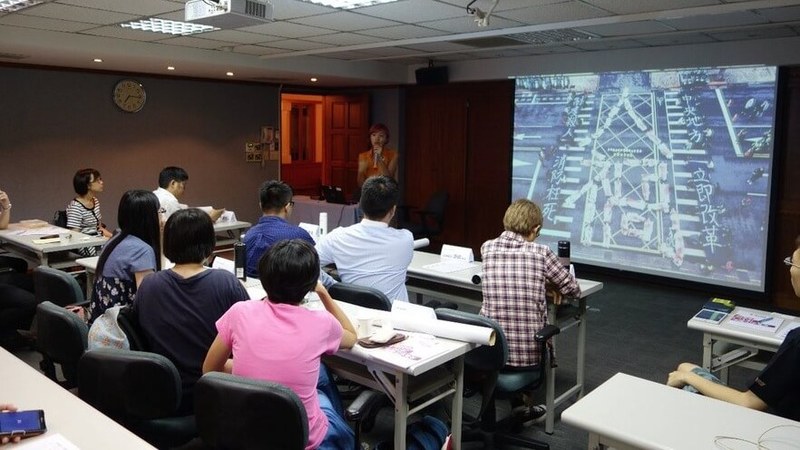 Photo / Association for the Promotion of Firefighters' Working Rights Secretary-General Cheng Ya-ling explaining the working conditions of firefighters.
Disaster Relief is a Duty, But Sacrificing One's Life is Not an Obligation
Association for the Promotion of Firefighters' Working Rights Secretary-General Cheng Ya-ling
Society's imagination regarding the nature of a firefighter's job seems to "rationalize" the high fatality rate of this profession, and therefore few people view the sacrifices of firefighters as a systemic issue. In fact, while the incidence of fires has decreased considerably in recent years, the fatality rate of personnel has risen instead of fallen. Through the association's efforts, people have gradually come to realize that equipment and manpower shortages, as well as unsound training systems, are all reasons for the increasing fatality rate among firefighters—especially young personnel.
Bound by their status as civil servants, firefighters are unable to unionize. The Association for the Promotion of Firefighters' Working Rights was established against this backdrop. However, the power of civil society groups falls far short of being able to rival the official establishment; therefore, the association more frequently uses public opinion or street protests to clash with the system, express its demands, and strive for room for negotiation and bargaining.
The intervention of the state's massive resources and pensions often causes the truth of disaster scenes to sink into oblivion. It was not until the Hsinwu fire in Taoyuan in 2015 that significant progress was made in the truth-investigation work of the association and lawyers. The sudden flashover and structural collapse in this fire claimed the lives of six young firefighters. Yet, the Fire Bureau held an internal meeting on the very day of the incident in an attempt to cover up the truth, running into walls everywhere in the process of gathering witness testimony and physical evidence for the association and lawyers.
The testimony of survivors pointing out poor water supply deployment at the scene explained why firefighters were unable to follow fire hoses to evacuate the burning building in time; furthermore, footage captured by a neighbor's security camera showing the movement of fire engines was critical evidence that the on-site water supply had once been interrupted. All of these showed that the fire department not only suffered from manpower and equipment shortages, but that loopholes also appeared in the disaster-site management and command system, leading to the casualties of personnel.
Truth investigations into disasters require working groups to conduct in-depth research and excavation, but in the absence of a occupational union, the association can only rely on limited resources to actively fight for a safer working environment for firefighting personnel. Public opinion may arouse outside attention, but ultimately it is temporary, and the public quickly forgets. Therefore, the association's current strategy is to combine litigation with social movements, hoping to continuously pressure the authorities through legal litigation procedures and initiate truth investigations.
For a long time, the training received by firefighters has been about obedience and following orders. However, superiors are not sages either; who among us makes no mistakes? The association believes that firefighters should appropriately disobey orders for the sake of their personal safety. Cheng Ya-ling said, "Beyond uncovering the truth, we hope even more to create a safe working environment."
In addition, wrongful dismissals of firefighters are also a core work item of the association. In the first year of the association's establishment, there appeared the first casualty who paid the price for challenging the police and firefighting system: Hsu Kuo-yao. He was intensively and consecutively given 42 reprimands within a mere two months. Even though among them were accusations out of thin air, he was ultimately dismissed nonetheless. Such disciplinary action is quite rare within the civil service system, because civil servants who are dismissed are mostly involved in leaking secrets or criminal offenses that cannot be commuted to fines. However, the disciplinary actions taken by the fire bureau belong to internal management mechanisms, and courts have no jurisdiction to investigate whether the disciplinary content is reasonable, but can only argue against the legality of the dismissal order, thus increasing the difficulty of individual case relief. Nevertheless, because of this, the lawyers participating in the association's work have all become experts in administrative litigation.
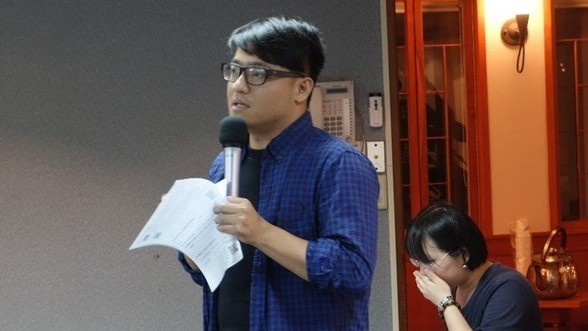 Photo / Lin Tzu-wei explaining how the TADC cooperates with defense lawyers in death penalty cases.
Death Penalty Defense Does Not Require Pity
Taiwan Association for the Death Penalty Legal Director Lin Tzu-wei
The Taiwan Association for the Death Penalty (TADC) was established in 2003 out of the rescue of Hsu Tzu-chiang. In addition to advocacy, the alliance also regularly holds homicide film festivals, lectures, and other public events, hoping that discourses and discussions related to the death penalty issue can ferment in society.
Excluding Cheng Chieh, who was executed earlier, and Cheng Hsing-tse, who successfully reopened his trial, there are still 41 final death row "classmates" (i.e., "death row prisoners") in Taiwan. The alliance's work is to guard every single "classmate" to the greatest extent possible within feasible limits, researching the legal relief possibilities for each respective case to apply for retrials, extraordinary appeals, and Constitutional Court interpretations. In addition, regarding cases still undergoing trial that may face a final death sentence—such as Wang Ching-yu and Kung Chung-an and other major social incidents—the TADC also actively discusses with defense teams and conducts courtroom observation.
In fact, it was only in recent years that the TADC began to heavily invest in individual case relief; therefore, it often learns and accumulates experience in the process of rescue. Although veteran defense lawyers such as Lo Ping-cheng, Yu Po-hsiang, and Kao Yung-cheng serve as the main fighting force, the alliance's work still severely lacks a new generation of lawyers.
Death penalty cases possess their own specificity, and therefore defense teams are formed for every individual case whenever possible. Taking the rescues of wrongful convictions such as Cheng Hsing-tse, Hsieh Chih-hung, and Chiou Ho-shun as examples, the operation of defense teams not only allows veteran lawyers to systematically pass on their hands-on experience to the new generation of lawyers, but they also hope to inject fresh blood, examine cases from different perspectives, and spark defense strategies. On the other hand, for non-wrongful cases, defense lawyers may not only face pressure from all sectors of society, but they also occasionally encounter clients with mental disorders. At this time, how to fight for reasonable sentencing for the defendant, or even consider their criminal responsibility and fitness to stand trial, will test the wisdom of the counsel. If other lawyers can exchange ideas and hone skills with each other, it will be of great help to every defense counsel.
In fact, in the process of participating in death penalty defense, lawyers can not only accumulate personal practical experience, but also stand at the front line of driving changes in the judicial system. Taking the Supreme Court as an example, some judgments have recently begun to cite international human rights conventions or foreign precedents, and many of these have been collected from briefs submitted by lawyers over the years. This also shows that the painstaking efforts put in by counsel for individual cases can actually have a huge subsequent effect and enhancement of human rights awareness on Taiwan's legal practice interpretations.
Taipei Bar Association New Attorney Committee Chairperson Attorney Wang Chan-hsing himself has rich experience in death penalty defense, so the question he is most frequently asked is none other than "Don't you think these people deserve to die?" Facing such questions, Attorney Wang only smiles and responds, "This is my job." He emphasizes that taking on death penalty defense work does not mean that he agrees with the actions of these defendants, but rather that he disagrees with the death penalty system.
rYears of practicing as a lawyer have allowed Attorney Wang to witness all walks of life. "Some people truly cannot restrain themselves because of their mental condition; there are also some people who commit grave mistakes in a moment of impulse;" Attorney Wang helplessly confesses, "but there are also some people who truly make me feel like they are demons." When encountering such cases, Attorney Wang chooses to withdraw his representation after conscientiously completing the stage task. He believes that human hearts are made of flesh, and when encountering circumstances that he cannot convince himself of, a lawyer should not force himself to take the case, much less hold the mindset of "pitying the defendant" to accept representation.
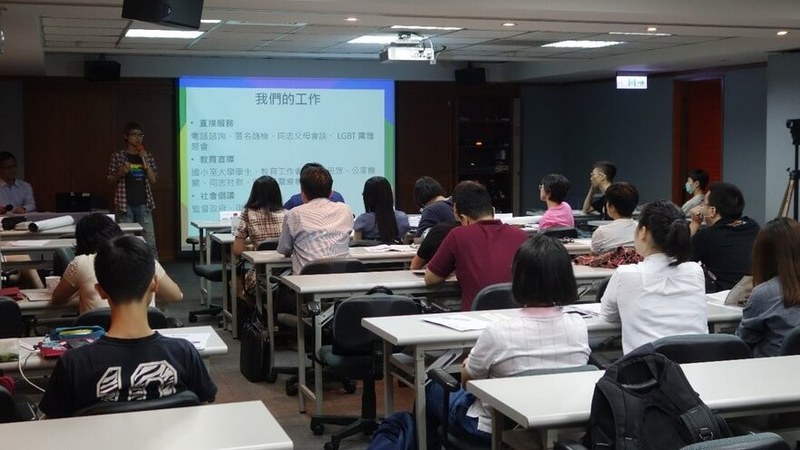 Photo / Taiwan Tongzhi Hotline Association ensures that Tongzhi friends are no longer lonely
Choosing Confidentiality Does Not Mean Abandoning Rights
Taiwan Tongzhi Hotline Association / Legal Advisor Hsiao Hu, Deputy Secretary-General Olivia
Because mainstream society in the past often held negative stereotypes against the Tongzhi (LGBTQ+) community, Tongzhi individuals often had reservations about coming out, and Pai Hsien-yung's novel even refers to this as "a kingdom of the night." When the Taiwan Tongzhi Hotline Association was established in 1998, it primarily provided counseling services via telephone, allowing Tongzhi friends to seek the warmest companionship in an anonymous environment. As counseling operations gradually expanded, the association also discovered that many problems—such as Tongzhi students being bullied by peers and humiliated by teachers—could not be improved merely through "companionship." Therefore, the association has currently developed eight different working groups: family support, public education, gender equality, intimate relationships, elderly Tongzhi, and transgender issues, in addition to conducting in-depth research on more diverse and marginalized topics.
Speaking of the legal issues most closely related to Tongzhi individuals, most people might immediately think of marriage equality, medical proxy arrangements, and so on. But in fact, society's unfriendliness and discrimination against individuals with diverse gender identities may instead be the most fundamental problem preventing their basic rights and interests from being protected.
Just like heterosexuals, the Tongzhi community also faces various problems in romantic lives. But unlike heterosexuals, if Tongzhi friends want to seek help, it often equates to having to come out. Intimate partner violence stemming from emotional problems—the threat of being "outed" after a breakup, intimidation and extortion, property disputes, etc.—is actually not uncommon, and occasionally even homicide cases occur. However, Taiwan's police and judicial systems are not friendly to the Tongzhi community, making victims reluctant to report cases and seek help, and often falling into a dilemma regarding whether to come forward and access justice.
Attorney Hsiao Hu had previously heard of a case where someone who was initially having pleasant conversations suddenly turned hostile after having intimate contact with a Tongzhi client, and extorted money from the Tongzhi client with threats. However, due to fear of strange looks from the outside world, this Tongzhi friend did not dare to call the police for help at the time and could only choose to pay to settle the matter. Cases similar to this happen from time to time, but clients may choose to forego seeking judicial assistance due to reasons such as sexual orientation, partners, or willingness to come out. In response to this, Attorney Hsiao Hu also specially reminded that lawyers may more or less come into contact with Tongzhi clients during their careers. In addition to providing appropriate legal assistance tailored to the case, they should explain the special circumstances of Tongzhi clients' privacy concerns to the court.
 Photo / Taiwan Association for Human Rights Secretary-General Chiu I-ling recounts various issues followed by the "veteran human rights grocery store."
Freedom and Rights Belong to Every Him and Her
Taiwan Association for Human Rights Secretary-General Chiu I-ling
Established in 1984, the Taiwan Association for Human Rights (TAHR) is a homegrown veteran NGO, even older than the Democratic Progressive Party. In the early days, lifting the ban on political parties and fighting for freedom of speech were very important tasks for the TAHR at that time. To this day, promoting the amendment of the Assembly and Parade Act remains a focal work item of the TAHR.
The TAHR is not an association that focuses on a single specific group. Taking the promotion of the freedom of assembly and procession as an example, in addition to paying attention to local protest scenes and issues such as police brutality in law enforcement, the TAHR also provides special individual case assistance and relief. Taking the Hydis protest incident from a period ago as an example, this was originally a labor dispute over plant closure, but in the process, a South Korean employee was deported and even restricted from entry simply for participating in a sit-in protest. In addition, there was also a German person who came to Taiwan to do environmental work and was listed by the National Immigration Agency as a person prohibited from entering Taiwan after participating in an anti-nuclear march. The occurrence of these individual cases reveals that the rights of foreigners participating in assemblies and processions in Taiwan still need to be strengthened.
Some people might be curious why the Taiwan Association for Human Rights cares about matters concerning foreign nationals. However, Taiwan has signed international covenants such as the Two Covenants, and therefore has an obligation to comply with the norms of these covenants. The TAHR firmly believes that the right to life, right to privacy, freedom of speech, and the right to participate in assemblies and processions of anyone in Taiwan should be protected.
Regarding the right to privacy, the TAHR has also long been dedicated to the protection of personal data. The Household Registration Department of the Ministry of the Interior once attempted to collect fingerprints from all citizens while updating national ID cards. The TAHR believed that when citizens have not infringed upon the rights of others, the state has no right to infringe upon citizens' right to privacy. Therefore, it launched an action to refuse fingerprinting at that time and filed a constitutional interpretation. Judicial Yuan Interpretation No. 603 was the outcome of that time. In addition, the TAHR also opposes the government's promotion of the integration of multiple cards such as ID cards, national health insurance cards, EasyCards, and criminal records. After all, this data should originally be stored and managed separately by relevant units; if all databases are linked together, citizens before the state would appear as if they were transparent, because the government would be able to easily grasp every piece of personal information of all citizens.
In recent years, concepts such as information openness and transparency have also been fermenting in government departments; however, the government chooses to selectively open citizens' data rather than publish information related to governance. Taking National Health Insurance data as an example, Taiwan's national health insurance system forces all citizens to enroll, but arbitrarily opens enrollees' data for application and use by research units and pharmaceutical companies without legislation and without obtaining anyone's consent. Although the TAHR has already filed an administrative lawsuit, it received the reply that "just as you did not consent to enrollment back then, you cannot withdraw now." In addition, in the controversy over the curriculum guidelines fine-tuning, the Ministry of Education refused to publish the list of names based on protecting the privacy of review committee members. The TAHR therefore advocates that a comprehensive information disclosure mechanism should be established.
In addition to the freedom of assembly and procession and the right to privacy, the TAHR also extensively touches upon issues such as forced evictions and the Refugee Act, and actively supports the work of the Taiwan Association for International Covenants Implementation. Because these tasks all involve legislative amendments, the TAHR is in great need of the participation of individuals with legal professional backgrounds.
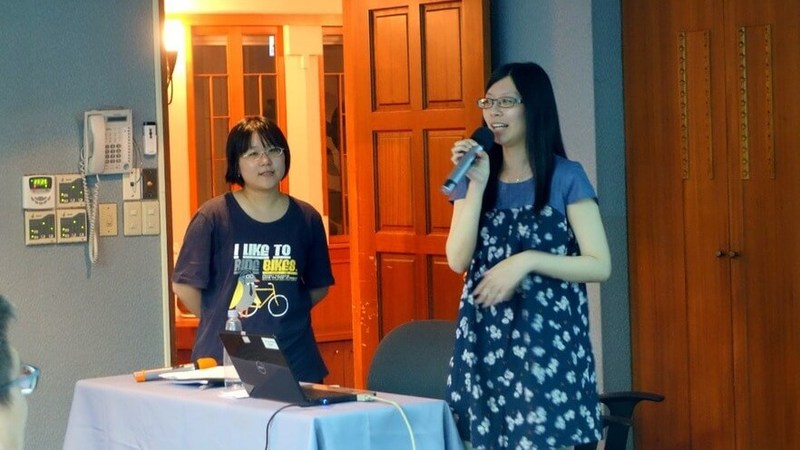 Photo / Taiwan Police Workers' Rights Promotion Association Hsiao Nung-yu, Lu Yi-hsuan analyzing the obedience culture of the police community.
Solving Police-Public Conflicts Begins with Improving Police Labor Conditions
Taiwan Police Workers' Rights Promotion Association Hsiao Nung-yu, Lu Yi-hsuan
Police officers are the front-line executors of the state apparatus facing the masses; however, the labor rights of rank-and-file police officers are often unable to be protected. With the surging social movements in recent years, rank-and-file police officers are frequently caught awkwardly between the state and the people. Because according to current legal provisions, police officers are not allowed to form labor unions; in 2014, multiple citizens and rank-and-file police officers aspiring to improve police-public relations decided to establish the Police Workers' Rights Promotion Association, hoping to enhance the quality of public services by protecting the basic labor conditions and dignity of police officers.
Many people worry that if police officers unite or even form a labor union, might they become even more arbitrary and abusive of power? However, the Police Workers' Rights Promotion Association believes that if rank-and-file police officers can be encouraged to fight for their own rights within an oppressed system, they may also have more empathy for other oppressed protesters. Through reflecting on and reviewing the existing management system, the police and the public should jointly discuss and seek a healthier and safer society.
Taiwan's police are severely overworked. Most police officers work shifts as long as 12 hours a day, and even in the southern region, three-segment shift schedules remain quite common, preventing officers from getting adequate rest. The result of long-term overwork is that quite a few rank-and-file police officers suffer from physical ailments, fatigue and anxiety, and even cardiovascular diseases. However, these health conditions are rarely recognized as occupational injuries. Regarding the problem of overwork, the National Police Agency recently replied that it will supplement 3,000 personnel within five years; but according to preliminary calculations by the Police Workers' Rights Promotion Association, to solve the current overwork situation, at least 20,000 more personnel should be added, and the training capacity of training centers should be increased to protect the training environment of trainees.
There are countless disciplines and internal rules in the police world. Although many regulations—such as having nothing on desks, no quilts on beds, and not being allowed to buy food in uniform—have no clear help for police officers performing their duties, because obedience to discipline is the core of police education, rank-and-file police officers or trainees who attempt to challenge internal norms may face disciplinary action or even dismissal. Yeh Chi-yuan, who received a reprimand for growing his hair, is both an individual case and not an individual case.
Lu Yi-hsuan is another client who was unable to practice her profession due to the cumbersome internal rules of the police world. She and her cohort trainees achieved the physical fitness standards set by training superiors before the end of their training and graduated smoothly. However, after this batch of trainees was dispatched to their service units, the National Police Agency claimed that the standards set by superiors at the time did not comply with the National Police Agency's regulations, and therefore revoked their graduation certificates and required them to re-test. Many trainees in the same cohort lost their right to work after graduation due to the shifting policies of the higher-ups.
Lu Yi-hsuan also shared the collective leave-taking movement she participated in during her training period. Life in the training unit essentially amounted to sleeping, listening to lectures, cleaning, and chatting in dormitories. Lu Yi-hsuan and her cohort trainees believed that this time could actually be utilized more properly, such as taking leave to return home to take elderly family members to see a doctor. In fact, according to the Civil Service Protection and Training Commission's regulations, trainees have the right to take personal leave, but in the training unit, trainees were often subjected to all sorts of obstruction and harassment by superiors. There was once a trainee who wanted to take leave to return home to worship ancestors; not only was he required to write a formal leave report, provide complete train schedule information, and the name and telephone number of a fortune-teller, but he was even required to submit photos of the ancestor worship.
These stories reflect only a small corner of the police culture. By assisting in cases of this nature, the Police Workers' Rights Promotion Association is also striving to find possibilities for promoting changes in the police system.
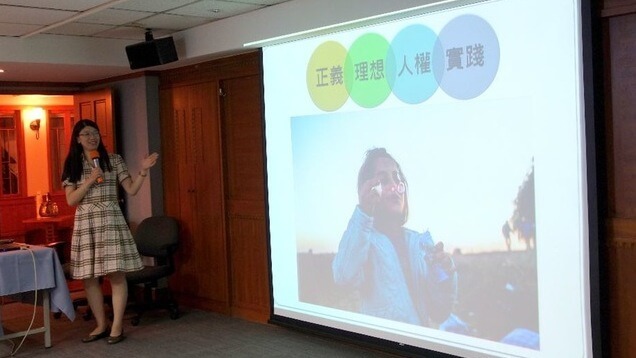 Photo / 2015 PILnet Fellow Lin Yu-ju sharing experiences of interning in New York
Go! Recharge in New York
PILnet Public Interest Law Fellowship Researcher Lin Yu-ju
PILnet: The Global Network for Public Interest Law (formerly the Columbia Center for Public Interest Law) has steadily provided a full scholarship program every year since 1998, enabling public interest lawyers and NGO workers with legal expertise from all over the world to go to Columbia Law School to study human rights and public interest law courses, and intern at local public interest organizations in New York.
PILnet believes that justice, ideals, and human rights do not fall from the sky, but must be practiced through advocacy. Therefore, through an 8-month program, PILnet aims to help public interest lawyers and human rights workers with leadership potential expand their professional networking, study human rights-related expertise, make good use of New York's rich research resources, and arrange for award recipients to conduct field visits to non-profit organizations in Europe and Washington, D.C., accumulating practical experience. PILnet hopes that human rights workers can possess practical action capability while cultivating a macro international perspective.
Lin Yu-ju, a legal researcher at the Science and Technology Law Institute of the Institute for Information Industry, is a recipient of this scholarship in 2015. The PILnet fellowship program not only allowed her to make like-minded friends from all over the world and attend a Tongzhi wedding banquet held by Chinese classmates locally, but also gave her the opportunity to intern at the Business & Human Rights Resource Centre in New York, a place local students scramble hard to get admitted into.
The scholarship provided by PILnet includes round-trip airfare to the United States, emergency medical insurance, local accommodation in New York, and a monthly living allowance. Lin Yu-ju stated that although everyone's living habits vary somewhat, these items should be sufficient for trainees to spend eight fulfilling months of life in New York. In addition, because the fellowship program arranges for trainees to live together in an international dormitory, this also gives them the opportunity to conduct deeper cultural and academic exchanges. To prevent trainees' development from being limited by language proficiency, PILnet also assists in arranging English tutoring courses.
The evaluation criteria of the fellowship program can be mainly divided into three dimensions. First, applicants must demonstrate that they possess leadership potential in Taiwanese society and have potential influence in pursuing public interests. In addition, the applicant's recommending unit must also have sufficient movement strength and influence. Finally, Lin Yu-ju also specially reminded that the public interest project submitted by applicants should clearly highlight the specificity of the issue within the social context of Taiwan.
Sparking Potential Amidst Despair
JRF Deputy Executive Director Attorney Ch'en Yu-fan said, "In NGOs, legal cases mostly find possibilities amidst despair." Although arduous, it often sparks the fighting spirit of lawyers. Defense strategies and combat techniques that are not normally opportunities to use may come in handy in public interest cases, making them exceptionally suitable for lawyers who like to accept challenges or intend to spark their potential. More importantly, along this road, lawyers will not be lonely, because in addition to the battle of wits inside the courtroom, there will be even more advocacy and action.
The above groups all warmly welcome the participation of professionals with legal expertise, and you are welcome to proactively contact them! In addition, the JRF is also very happy to assist in recommending lawyers to apply for the PILnet fellowship program.
This article is an AI-generated translation of the original Chinese text. In the event of any discrepancy, the Chinese version shall prevail.