
Statement by the Foundation Regarding the Judges Evaluation Commission Resolution (104-Yuan-Ping-Zi No. 11)
Last edited: 2026-07-24
Regarding the Judges Evaluation Commission Resolution (104-Yuan-Ping-Zi No. 11), the Foundation issues the following statement:
- The individual judge evaluation request against Judge Lai Hsiu-wen of the Taichung District Court, submitted by the Foundation on November 24, 2015, was addressed by the Judges Evaluation Commission under Resolution 104-Yuan-Ping-Zi No. 11 with the main text: Regarding the part shown in the attached table, no evaluation shall be instituted; the remaining requests are dismissed.
- Regarding the part where the Judges Evaluation Commission resolved that the "request is dismissed," the Foundation believes that whether the circumstances were serious leaves room for judgment and discretion; however, the Foundation deeply regrets that the Judges Evaluation Commission concluded that, given the circumstances of this case, even official supervision is unnecessary.
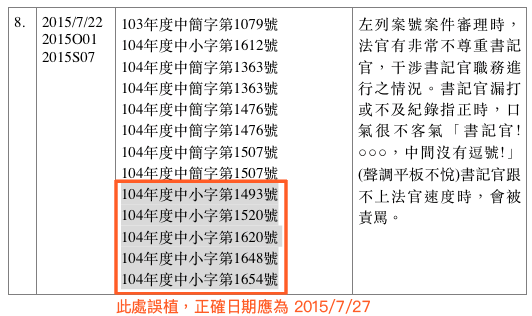
- Regarding the part where the Judges Evaluation Commission resolved "no evaluation shall be instituted," procedural section (2) of the reasoning column of the resolution stated: The cases listed in the resolution's attached table (namely, five of the ten cases in which the Foundation alleged Judge Lai Hsiu-wen had poor attitude toward clerks)—Taichung District Court Cases 104-Zhong-Xiao-Zi No. 1493, 104-Zhong-Jian-Zi No. 1520, 104-Zhong-Xiao-Zi No. 1620, 104-Zhong-Xiao-Zi No. 1648, and 104-Zhong-Xiao-Zi No. 1654—"had no court sessions scheduled on that day" (July 22, 2015), and the request was evidently groundless. Therefore, pursuant to Article 37, Subparagraph 7 of the Judges Act, a resolution not to institute an evaluation was made. This subsequently triggered questions as to whether the Foundation's evaluation request was fabricated out of thin air.
- Upon re-examination by the Foundation internally, the aforementioned five cases were indeed cases adjudicated by Judge Lai Hsiu-wen. However, the hearing dates listed in the table of the Foundation's evaluation request were entered incorrectly. Upon cross-referencing the original records, the correct hearing date should have been July 27, 2015.
- The reason for the omitted date was that these five cases all pertained to complaints against Judge Lai Hsiu-wen for a poor attitude toward court clerks. Consequently, when placing these five cases and the case numbers of another five cases into the same table, we inadvertently failed to note that the hearing dates spanned two different days. This was truly a negligence, and the Foundation cannot shirk its responsibility. (Refer to the attached figure of the original table) In the future, during the review process, the Foundation will certainly be more careful and cautious, paying attention to details. The Foundation has also written to the Judges Evaluation Commission, hoping that in the event of similar situations, they can officially issue a formal notice to the Foundation to facilitate prompt correction and handling.
- Finally, the Foundation is deeply aware of the importance of judicial independence and fairness, and recognizes that public trust in the judiciary is the cornerstone for maintaining the judiciary's role in resisting majority opinion and protecting minority rights. We have always approached evaluation requests with utmost diligence and care, and it is absolutely impossible for us to fabricate facts out of thin air. The Foundation sincerely hopes that the evaluation system can function well and flawlessly under the careful maintenance of all parties, thereby earning the judiciary greater public trust.
Press Contact
Kao Jung-chih, Attorney-at-Law, Executive Director, Judicial Reform Foundation 02-2523-1178
This article is an AI-generated translation of the original Chinese text. In the event of any discrepancy, the Chinese version shall prevail.