
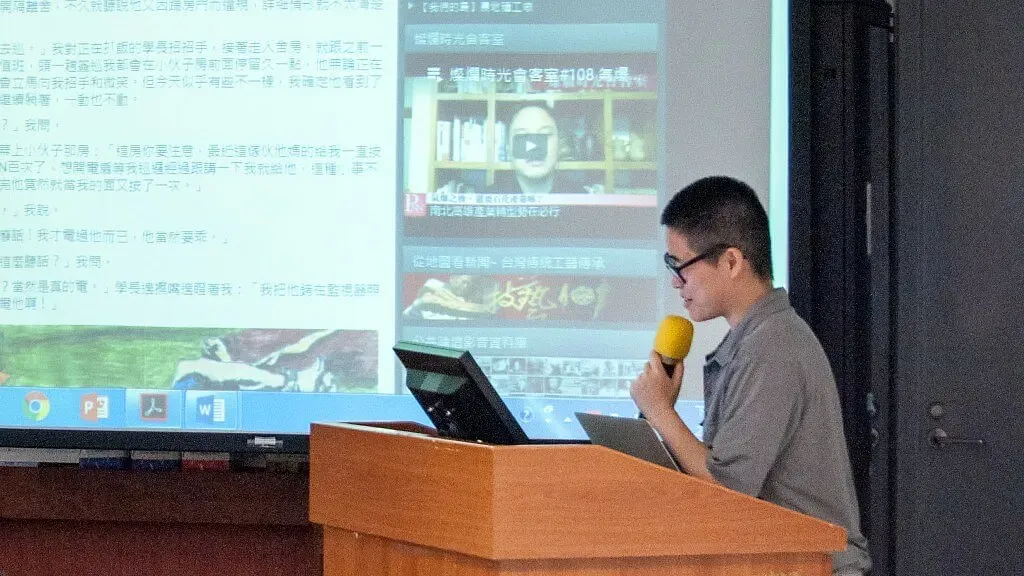
Judicial Review Standards for Civil Servant Disciplinary Actions—Origin of the Forum: Opening Remarks by Lin Wei-ting
Last edited: 2026-07-27
This case originated from an article and drawing titled "Repentance" created by Ch'en Lin Wen-wei. Initially, the article received little attention until it was featured on Public Television Service (PTS) news, gradually drawing public interest, which likely led the prison where Lin worked to notice the piece. The article mentioned instances of prison officers unlawfully using stun guns. However, Lin's prison deemed his account fabricated and damaging to the institution's reputation, resulting in two reprimands.
Upon receiving the official disciplinary notice, Lin Wen-wei felt deeply disappointed with the correctional system. When he originally wrote the story, his purpose was to improve the conditions of the inmate in question. Aside from hearing about the case from other colleagues, he had witnessed firsthand the inmate's deteriorating condition. Never did he expect to face discipline because of this article. Consequently, he wrote another piece titled <Continuing to Write and Draw Until the Future Changes>, expressing his determination to keep striving for prison reform despite facing disciplinary action. This article received widespread shares, with many people responding in support and offering assistance. Judicial Reform Foundation (JRF) Deputy Executive Director Ch'en Yu-fan also saw Lin's Facebook post, prompting the JRF to proactively reach out and inquire if assistance was needed.
The JRF assisted in this case for reasons of public interest. Correctional institutions are total institutions where much information remains completely inaccessible to the outside world. Under such circumstances, internal reflection and whistleblowing by staff become crucial. Moreover, because correctional facilities are total institutions, many messages cannot be independently verified. If this incident truly occurred, the person who used the stun gun would not admit to it, and the inmate subjected to it, trapped in that environment, might not dare to speak out due to the hostage effect. Furthermore, it is unreasonable to expect Lin Wen-wei to expose the person who told him about the matter, as doing so would likely brand him a traitor among his colleagues, making it impossible for him to survive within the prison system. Under these conditions, demanding that Lin prove the event actually happened or provide his source and finger-point the colleague who used the stun gun is placing an impossible burden on him.
This is the reason for the JRF's intervention: this is a public-interest case with landmark significance. If such speech is subject to punishment, then many internal matters within correctional facilities can never be spoken of in the future, ultimately creating a chilling effect, which is a gravely serious issue.
The JRF invited lawyers to assist Lin Wen-wei pro bono in filing a grievance. The primary argument in the grievance petition was that civil servants' freedom of speech must be protected. The petition raised roughly the following grounds: the disciplinary standards violated the principle of legal reservation; the concept of "improper conduct and speech" violated the principle of legal clarity; the content of the article (concerning solitary confinement, the unlawful allocation of stun guns, and their potential misuse) constituted a key focus of prison reform and related to the public interest; definitive evidence of damage to the prison's reputation was lacking; and Lin Wen-wei did not write the article with actual malice.
Subsequently, the prison where Lin Wen-wei worked issued an official response upholding the original disciplinary action, reasoning that Lin was unwilling to provide information allowing the prison to verify whether the events were true rather than baseless rumors, while completely ignoring the arguments regarding civil servants' freedom of speech raised in the grievance. The content of the subsequent grievance was identical to the initial one. In its recommendation to the Civil Service Protection and Training Commission (CSPTC) to dismiss the secondary grievance, the prison similarly ignored all arguments concerning civil servants' freedom of speech raised in the secondary grievance petition.
I believe that if the prison had put forth counterarguments against civil servants' freedom of speech, we could at least discuss those points; however, the method of completely ignoring them is terrifying. The purpose of this seminar is to hope that everyone will care about this issue, and that the authorities will genuinely take it seriously rather than passively dodging the question of civil servants' freedom of speech.
Chronology of the Lin Wen-wei Case
|
Date |
Event |
|
2015.11.11 |
The article <Repentance> written by Lin Wen-wei is published on the PTS news website. |
|
2015.12.31 |
The prison where Lin Wen-wei works issues two reprimands on the grounds that Lin cited unverified rumors in his article "Repentance," misleading readers into believing the described disciplinary methods were real, thus harming the reputation of the correctional institution and engaging in improper speech and conduct. |
|
2016.1.25 |
In an article titled <Continuing to Write and Draw Until Change Arrives> published on his Facebook fan page "Lin Wen-wei Ewam Lin," Lin Wen-wei mentions receiving the reprimands and states that he will continue to create until prison reform receives genuine attention and brings about change. |
|
2016.1.26 |
The JRF proactively contacts Lin Wen-wei, stating that this matter concerns systemic issues rather than merely personal discipline, and therefore the JRF is willing to assist to the best of its ability. |
|
2016.2.5 |
Lin Wen-wei files a grievance. The primary arguments of the grievance petition are that civil servants are also protected by freedom of speech:
|
|
2016.4.1 |
The prison where Lin Wen-wei works issues an official response upholding the original disposition. The official document states that because Lin Wen-wei was unwilling to provide information for the prison to verify whether the events were true rather than baseless rumors, the grievance is groundless. The entire official document completely ignores the arguments concerning civil servants' freedom of speech raised in the grievance petition. |
|
2016.4.29 |
Lin Wen-wei files a secondary grievance. The key points emphasized in the secondary grievance petition are identical to the initial grievance. |
|
2016.5.23 |
The prison where Lin Wen-wei works issues an official statement recommending that the Civil Service Protection and Training Commission dismiss the secondary grievance. The reasoning is: the security division interviewed relevant on-duty personnel and inmates at the scene of the incident, all of whom stated they had never heard of stun guns being used to discipline inmates. The entire official document once again completely ignores the arguments concerning civil servants' freedom of speech raised in the secondary grievance petition. |
This article is an AI-generated translation of the original Chinese text. In the event of any discrepancy, the Chinese version shall prevail.