
Discussing Civil Servants' Freedom of Speech from the Perspective of "Special Legal Relationship"
Last edited: 2026-07-27
Introduction—Discussing from the Perspective of "Special Legal Relationship"
Regarding the Lin Wen-wei case, Lin was a custodial officer (Rank 5 under the appointment system) working in a prison who received two reprimands for writing an article titled "Repentance" on the internet. The issue is whether the prison's issuance of these two reprimands unlawfully and excessively infringed upon Lin's freedom of speech.
To clarify this issue, it is necessary to examine the current relationship between civil servants and their employing agencies, which leads back to the traditional doctrine of "special power relationship." In the early era when special power relationships were recognized, "freedom of speech" and the "right to hold public office" existed in an antinomic relationship: "Because you hold a public office, you have no freedom of speech." A civil servant's status constituted a barrier to the individual's exercise of freedom of speech. However, today, with the liberation of special power relationships, the right to hold public office and freedom of speech should be in a substantive concurrent relationship; one does not naturally forfeit basic constitutional rights to freedom of speech simply by virtue of being a civil servant. Consequently, an ensuing question arises: "Can civil servants be equated with ordinary citizens in enjoying absolute and complete freedom of speech?" Some scholars argue that even though special power relationships have been liberated today, based on a "special legal relationship" or so-called "special status relationship" and considering the specific nature of a civil servant's status, the state should still be permitted to specifically restrict the exercise of their freedom of speech by law when for a legitimate purpose. Conversely, other scholars argue that the "special power relationship" should be comprehensively dismantled, and the protection of civil servants' basic rights should entirely revert to the protection afforded to the basic rights of ordinary citizens.
The latter view would undoubtedly grant civil servants the broadest protection of their right to freedom of speech. Lin Wen-wei's arguments in his grievance petition lean toward this perspective, contending that he should not be subjected to restrictions different from those applied to ordinary citizens merely because of his civil servant status, citing Judicial Yuan Interpretation Nos. 653 and 684 to support this view. Nevertheless, current legal practice, despite having discarded the theory of "foundational relationship versus operational relationship" in breaking through the special power relationship of civil servants, generally continues to follow the tone of Interpretation No. 298 regarding the "theory of significant impact." According to the intent of that interpretation, a civil servant may seek judicial relief against disciplinary actions only "when such actions are sufficient to alter the civil servant's status or have a significant impact on their rights and interests." This demonstrates that current legal practice does not yet entirely equate the protection of civil servants' rights and interests with that of ordinary citizens. Therefore, if one wishes to move beyond breaking through the "special power relationship" to further break through the "special legal relationship" and establish the proposition that civil servants are identical to ordinary citizens, a much higher degree of argumentation is required.
Therefore, regarding the Lin Wen-wei case, I am personally inclined to start from the more conservative perspective of a special legal relationship (special status relationship) to examine whether this case meets the conditions of "purposeful reasonableness that permits special restrictions." The advantage of this approach is that if, even under this conservative and restrictive perspective, it can be determined that the state should not restrict the civil servant's speech and that the disciplinary disposition in question is illegal, then adopting the stance of granting civil servants the same basic rights protection as ordinary citizens would undoubtedly lead even more forcefully to the conclusion that the disposition is illegal. Consequently, the following discussion will proceed on the premise of acknowledging the "special legal relationship" to examine whether the disciplinary disposition by the correctional institution in Lin Wen-wei's case is lawful.
Insights from American Legal Cases
If we adopt the viewpoint that "a civil servant's right to freedom of speech is fundamentally restricted," we find that civil servants have almost no freedom of speech concerning their official duties. In this regard, we can refer to Article 4, Paragraph 2 of the Civil Service Employment Act: "Without the permission of their superior officer, civil servants may not arbitrarily issue statements concerning their official duties in a private capacity or in the name of representing the agency." Article 5 of the Civil Service Employment Act also provides: "Civil servants shall be honest, upright, cautious, and diligent, and shall not engage in arrogant, greedy, lazy, luxurious, dissolute, or disreputable behaviors such as frequenting houses of ill repute, gambling, or using drugs, which are sufficient to impair their reputation." Such legal norms naturally have their reasons for existing when observed from the perspective of past authoritarian systems. Since the government historically did not wish for civil servants to make statements disadvantageous to the government, it naturally maintained that "civil servants should not enjoy freedom of speech." However, today, under the adherence to the principle of the rule of law, we must at least acknowledge that civil servants should enjoy a certain degree of freedom of speech.
In the United States, although freedom of speech is stipulated in the First Amendment of the U.S. Constitution and holds a very exalted status, this does not mean that civil servants' right to freedom of speech is unrestricted under American law. In American free speech jurisprudence, many scholars distinguish the nature of public power by which the government restricts people's speech into two different roles: "the government acting as a sovereign" ("sovereign capacity," restricting people's freedom of speech based on traditional state functions) and "the government acting as a manager" ("managerial power," restricting freedom of speech due to a special legal connection and out of the necessity for management or supervision). Representative examples of government regulation in the capacity of a "manager" include "restrictions on radio broadcasting due to the scarcity of the radio spectrum," "management of public property (the public forum theory)," and "internal management of civil servants by government agencies," among others.
Although American law does not use terms like "special power relationship" and has abandoned the "privilege doctrine" mentioned by Attorney Kuo Te-t'ien, American scholars still generally recognize that the government may exercise necessary and special management over its employees (namely, civil servants) based on its identity as an "employer." In the constitutional review of speech-regulation measures, such "necessary and special management" (acting in the capacity of a manager) can naturally be distinguished from restrictions on "private individuals' freedom of speech" (acting in the capacity of a sovereign).
Although Attorney Kuo Te-t'ien has already introduced cases in American law concerning the current restrictions on civil servants' freedom of speech, I would still like to provide some supplementary explanations.
The 1968 case of Pickering (Pickering v. Board of Education, 391 U.S. 563, 1968) involved a high school teacher, Pickering, who wrote a letter to the editor expressing dissatisfaction with financial policies such as the issuance of bonds by the school board. The school board subsequently dismissed Pickering on the grounds that his statements severely damaged the reputation of the board and the school and disrupted the harmonious atmosphere among school personnel.
The court in this case ruled in favor of the plaintiff, Pickering, and divided the review of freedom of speech into two tiers:
- First, determine whether the content of the civil servant's speech is a "matter of public concern."
- If not, the content of the civil servant's speech is not protected by the First Amendment's guarantee of freedom of speech. If it is, it must then be determined whether the "civil servant's speech interest" (e.g., the public's right to know) outweighs the "manager's management interest" (including the harmony of official order and the efficiency of the public services). Only when the "civil servant's speech interest" outweighs the "manager's management interest" will the civil servant's speech be protected.
Furthermore, the court in Pickering held that if a portion of the statements in a civil servant's speech is inaccurate, the "actual malice" standard established in N.Y. Times Co. v. Sullivan (376 U.S. 254, 1964)—whereby factual errors are not actionable unless made with "actual malice" (i.e., with knowledge of falsity or with reckless disregard of whether it was true or false)—may apply to lower the standard of review regarding the truthfulness of the civil servant's speech. However, it should be added that I personally disagree with the constitutional privilege of applying the "actual malice" standard to civil servants' speech. This is because the factual context of the "actual malice" standard established in the N.Y. Times Co. case was directed at situations where "strict verification obligations are more difficult to demand of the media." However, it does not seem the same when civil servants have verification obligations regarding matters they wish to whistleblow, as compared to the media's "difficult-to-enforce strict verification obligations."
The next important case is Connick v. Myers (461 U.S. 138, 1983). The facts of the case were: Myers, an assistant district attorney, disagreed with a transfer order issued by her superior. She conducted a questionnaire survey of 15 colleagues regarding the policy content of the job transfer, workplace ethics, the need to establish a grievance committee, trust in superiors, and job pressure. This act of "distributing a questionnaire" was viewed by her superiors as insubordination and disruption of workplace order, and she was dismissed on these grounds.
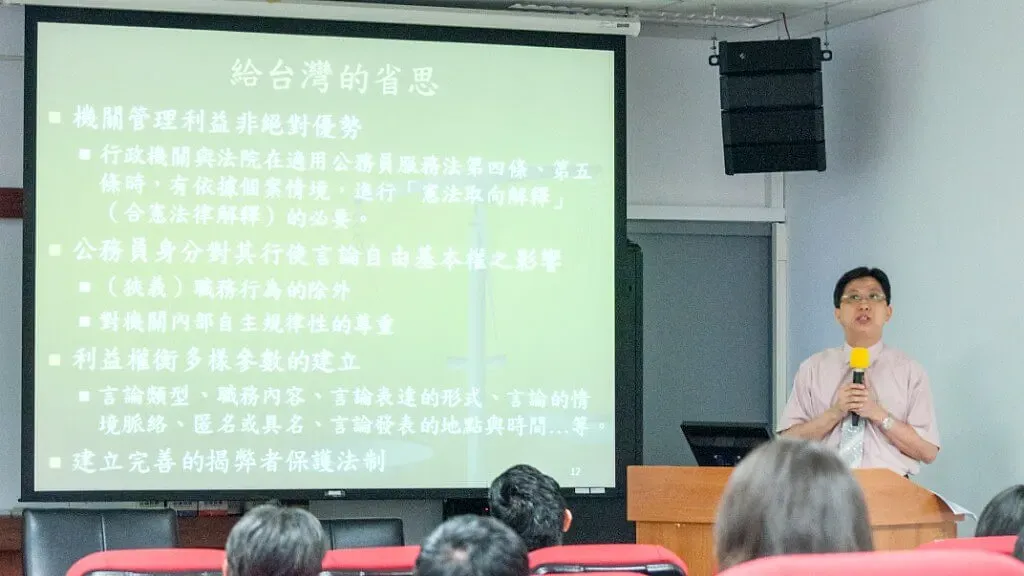
The court ruled against Myers, holding that the job transfer was merely an internal management measure for prosecutors, and Myers's statements regarding the transfer did not constitute a "matter of public concern." In this case, the court provided more detailed criteria for the first review standard established in Pickering—whether the content of the civil servant's speech is a matter of public concern: determining whether speech is of public concern requires a comprehensive assessment of the content, form, context, expression method, and the time and place of the speech.
The next case is one not specifically discussed by Attorney Kuo, yet it is a very crucial one: Garcetti v. Ceballos (547 U.S. 410, 2006). In this case, Ceballos was also an assistant district attorney who believed that a search warrant was obtained by the police based on a false affidavit. He therefore wrote a "disposition memorandum" to his supervisor, Garcetti, explaining that the search warrant's content was problematic and recommending the dismissal of the prosecution. Ceballos even expressed his views regarding the false affidavit during a search warrant review hearing, but his views were not adopted by the court. Afterward, Ceballos was demoted and transferred by his supervisor, Garcetti.
The court ruled against Ceballos, holding that the memorandum submitted by Ceballos was speech made pursuant to his official duties, and such "official speech" is not protected by freedom of speech. This case sparked widespread controversy and discussion in American academic circles, with many scholars arguing that the court's view excessively narrowed the scope of civil servants' freedom of speech.
Critique of the American Legal System
Regarding the critique of the American legal system, on the one hand, I believe that although "official speech" and "private speech" are distinct, excessively ignoring the freedom of speech that civil servants should enjoy as citizens may lead civil servants collectively to become unwilling to express critical opinions about their official duties. Once civil servants, who understand the civil service system best, dare not voice criticisms of the system, the transparency of government operations will gradually decline, and ordinary citizens will be unable to discern where state malfeasance lies (such as fraud, abuse of power, and corruption). Ultimately, the entire populace, including civil servants, will suffer the disadvantages.
On the other hand, it is undeniable that there is still a certain practical utility in distinguishing between "official speech" and "private speech." This is because, in constitutional fundamental rights dogmatics, the state is the object bound by fundamental rights rather than the subject enjoying them. Since civil servants act as an extension of the state's hands and feet, their official speech should be evaluated as state speech. Therefore, in legal dogmatics, it is naturally difficult to incorporate "official speech by civil servants" into the scope of protection guaranteed by the fundamental right to freedom of speech. Nevertheless, civil servants' criticisms of the civil service system still retain their value. Consequently, future efforts in academic theory can focus on narrowing "official speech" considerably to encourage civil servants not to fear voicing criticisms of the civil service system, while also avoiding undue hindrance to the state's managerial interests over civil servants. Of course, the "Whistleblower Protection Act" mentioned by Attorney Kuo Te-t'ien is undoubtedly a method worth referencing to encourage civil servant speech.
As for the standard established in the Pickering case using "speech of public concern" as a prerequisite to determine whether speech falls within the protected scope of freedom of speech, it has been critiqued by many scholars. I argue that whether speech is a "matter of public concern" should not be treated as an isolated prerequisite for determining whether certain speech is protected, but rather should serve as a "parameter for judicial assessment."
Regarding the burden of proof for the protection of civil servants' freedom of speech, American law originally required administrative agencies only to meet the preponderance of the evidence standard (roughly equivalent to a mental conviction strength of over fifty percent) to establish the legitimacy of their personnel actions. However, as Attorney Kuo Te-t'ien's report also mentioned, following the enactment of the federal Whistleblower Protection Act, practical operations further require administrative agencies to meet a higher burden of proof regarding the legitimacy of personnel actions. In other words, the agency must present "clear and convincing evidence" (roughly equivalent to a seventy percent conviction strength) to prove that the personnel action in question is unrelated to the individual's whistleblowing activities, thereby establishing the legitimacy of the disposition. I believe that in order to thoroughly protect whistleblowers and strengthen the protection of civil servants' rights and interests, it is more reasonable to require administrative agencies to meet the standard of "clear and convincing evidence."
As to whether civil servants' whistleblowing should first follow internal grievance mechanisms: some scholars affirm this, arguing that the priority of internal response mechanisms is "to maintain group discipline and team spirit." However, other scholars argue that following internal mechanisms should not be mandatory, and the focus should instead be placed on "whether the speech in question will genuinely cause disruption to the internal order of the agency." I believe that internal mechanisms should in principle take priority, but this must be premised on the provision of adequate protection by the "whistleblower protection legal regime." Under current conditions where there is no Whistleblower Protection Act, or if future whistleblower protection legislation fails to provide adequate protection to whistleblowers—thereby forcing civil servants using internal mechanisms to still fear suffering professional disadvantages as a result—then such internal response mechanisms lose their necessary priority and justification.
Conclusion
In conclusion, I believe that an agency's managerial interests are not supreme. Articles 4 and 5 of the Civil Service Employment Act should be subjected to teleological narrowing based on a balancing between the "interests of civil servants in expressing speech" and the "management interests of the agency." Regarding this aforementioned "balancing of interests," standards can be gradually established in the future concerning types of speech, official duties, forms of expression, the contextual framework of the speech, anonymity versus authorship, and the time and place of the speech. It is also hoped that a comprehensive "whistleblower protection legal regime" will be established domestically.
Finally, regarding the Lin Wen-wei case, referencing the aforementioned American legal principles from the perspective of protecting civil servants' fundamental right to freedom of speech, a "constitutionally oriented interpretation" of the relevant provisions of our country's Civil Service Employment Act yields the following brief review:
- Lin Wen-wei's article took the form of drawings rather than prison management acts, and thus did not constitute official duties in the narrow sense.
- Furthermore, since the article was widely shared and discussed on the internet, it should be regarded as a "matter of public concern."
- The administrative agencies and the Agency of Corrections, Ministry of Justice should bear a higher burden of proof to explain why Lin Wen-wei's article caused damage to reputation. The Agency of Corrections, Ministry of Justice should bear a heightened obligation of proof.
I personally hope that the Lin Wen-wei case can serve as a touchstone in our country allowing civil servants to still enjoy the fundamental right to freedom of speech despite the institutional assertion of managerial interests, and I look forward to seeing Lin Wen-wei successfully vindicated.
This article is an AI-generated translation of the original Chinese text. In the event of any discrepancy, the Chinese version shall prevail.