
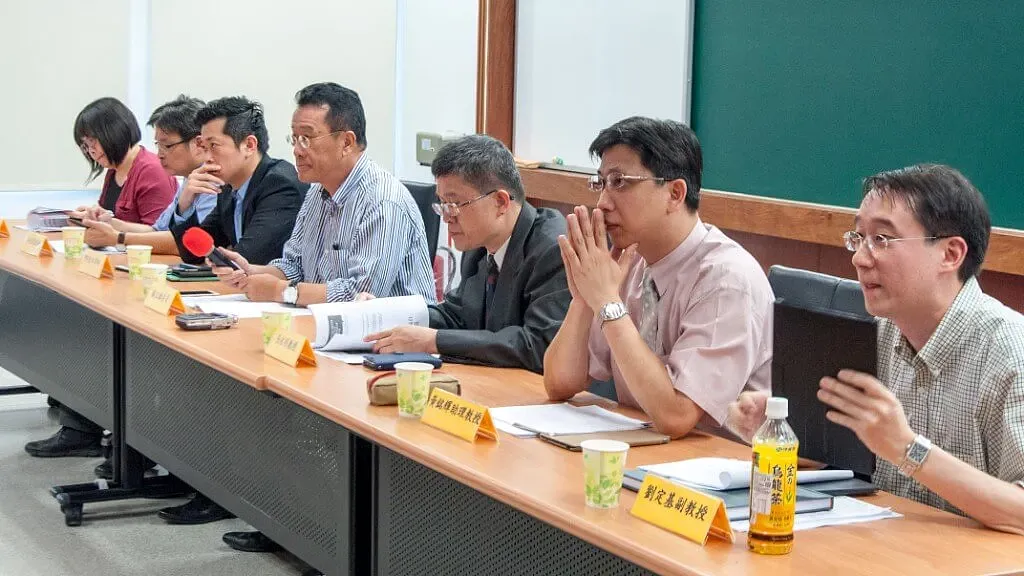
Judicial Review Standards for Civil Servant Disciplinary Actions—General Discussion
Last edited: 2026-07-27
-
Questioner A
-
I would like to first ask Attorney Kuo Te-t'ien. You just mentioned that Taiwan does not distinguish between speech criticizing the government and whistleblowing speech. Is there really a necessity to differentiate between the two? Additionally, I would like to ask Yen Szu-yü from the Taiwan Association for Human Rights (TAHR): Do you think we need to first improve medical conditions within correctional facilities and ensure basic medical resources and records? Otherwise, whether it is custodial escort or medical parole, won't it place immense pressure on civil servants? Lastly, I would like to ask Professor Huang Ming-hui. You previously mentioned that private speech may receive less protection, but shouldn't we simply discuss whether the speech causes any actual impact? Also, you mentioned that whistleblower protection should prioritize internal reporting, but internal reporting inherently means having to submit opinions under one's real name. In practice, however, this still very likely leads to adverse consequences, even if it does not formally constitute a disciplinary action.
-
Questioner B
-
I would like to ask Professor Lin Chia-fan: Regarding the fact that receiving two admonition penalties effectively bars individuals from filing administrative litigation before the Civil Service Protection and Training Commission, is it possible to file a petition for constitutional interpretation? Even if this case is won, if a correctional facility finds other pretexts to issue admonitions (such as the case of firefighter Hsü Kuo-yao, who received 42 admonitions), how can civil service protections be truly implemented?
I would also like to ask Professor Chang Yung-ming: When a superior is involved in criminal acts and a civil servant has no obligation to obey, can the civil servant invoke this lack of duty of obedience to directly expose the superior's illegality to the outside world, and accordingly claim that their speech is protected by freedom of speech?
-
JRF
Yü-ts'ang -
Kuo Kuan-ying caused a massive uproar because of his discriminatory remarks, and the recent Hung Su-chu incident is a similar situation. Is it justifiable to dismiss civil servants whose speech involves discriminatory remarks?
-
Kuo Te-t'ien
Attorney -
I believe it is difficult in Taiwan to distinguish between speech criticizing the government and whistleblowing speech. Discussions on speech restrictions in the United States generally weigh the value of a given speech, but civil servant speech is rarely discussed this way. When conducting a balancing of interests, the civil servant in question is naturally required to explain the intent behind making such statements. If Taiwan were to truly introduce a balancing-of-interests model, a civil servant's entire statement might encompass multiple categories simultaneously, making granular distinctions operationally difficult. When we draft a whistleblower protection act or a whistleblower protection law in the future, how do we define what constitutes whistleblowing and what does not? Might civil servants abuse whistleblower protection laws? How should portions of speech that do not involve whistleblowing or disclosures be handled?
Taiwan does not meticulously review or categorize speech as discriminatory versus political because everything is subject to penalties. Prosecutors expressing stances either supporting or opposing Chen Shui-bian constitute political speech, which falls under high-value speech in the United States; whereas Kuo Kuan-ying's case involved discriminatory speech. The Commission for the Disciplinary Sanctions of Functionaries did not perform a meticulous operation because at the time, penalties were imposed directly upon finding a violation of the duty of loyalty (pledging allegiance to China), without examining the discriminatory remarks. When introducing the American balancing-of-interests model, the balancing of interests for discriminatory speech should be relatively straightforward to operate, as it brings no benefits whatsoever, only harm.
-
TAHR
Yen Szu-yü -
Regarding medical care in correctional facilities, it is not to say that other issues in correctional facilities are of lesser priority. We hope the Agency of Corrections can sincerely recognize that frontline staff are already overwhelmed simply by custodial escorts—how can we even discuss medical care and rehabilitation? We believe the involvement of the Ministry of Health and Welfare could serve as an opportunity for inter-ministerial cooperation. However, relevant discussions have constantly stalled at the mere assertion that "we have already provided them with National Health Insurance" and have gone no further.
-
Huang Ming-hui
Assistant Professor -
First, regarding the issue of private speech protection, let us parse the layers more clearly. We must first examine the capacity in which a civil servant is speaking. Official statements made strictly in a professional capacity are not protected by freedom of speech; non-official speech enters the Pickering framework, and only within the Pickering framework do we examine whether a speech is private or pertains to matters of public concern. My personal view is that whether speech is private or a matter of public concern merely serves as a parameter determining the degree of protection, rather than a threshold. When a civil servant speaks in a private capacity on a matter lacking public relevance, the competent authority can easily justify its disciplinary action against that civil servant on grounds of internal management. While I think removing this threshold would be ideal, even if it is not removed, it may not necessarily have a massive impact.
Second, even with a legislative framework for whistleblower protection, a whistleblower may still face retaliation. Therefore, must they first go through internal channels to voice concerns before speaking outwardly? My premise is built upon the existence of a "comprehensive" legal framework for whistleblower protection. If one truly suffers retaliation from superiors afterward, other procedures must naturally be in place to handle it. It is hoped that such a legal framework will allow civil servants to express opinions as much as possible, and internal feedback can also serve as counter-evidence that the civil servant harbored no malicious intent and merely sought to reform institutional deficiencies.
-
Questioner A
-
May I ask Professor Chang Yung-ming: Regarding the situation where orders from a superior involve criminal offenses and a civil servant has no obligation to obey, can the civil servant invoke a lack of duty of service to directly expose the superior's illegality to the public and thereby claim...
-
Chang Yung-ming
Professor -
Someone asked about the issue where a superior's order violates criminal law. According to the Civil Service Protection Act, a civil servant has no duty to obey under such circumstances. However, can the content of what one has no duty to obey be publicly disclosed? This has nothing to do with Article 3 of the Civil Servantswork Act; nevertheless, because paragraph 2 of Article 4 of the same act still exists, one still cannot speak out without permission. Furthermore, as to whether a superior's order violates criminal law, this question is likely not so easy to determine. Whether a violation has ultimately occurred may still need to be decided by a court in the end. Regarding discriminatory speech, it is theoretically possible to make distinctions, but whether this can become a benchmark for practical operational judgment in Taiwan is likely not going to happen overnight. It depends on the circumstances of individual cases before conducting a balancing of interests, which naturally also involves questions of whether the Civil Servants Administrative Neutrality Act was violated. Finally, I am also curious here: What is the actual impact of an admonition on a civil servant? From a substantial impact perspective, status protections (such as seniority progression) are unaffected; however, for future competitive positions, if a superior notices a demerit or admonition on record, it could still have an impact. Therefore, discussing the necessity of protection here remains warranted.
-
Lin Chia-fan
Professor -
In Taiwan, it is quite possible for civil servants to receive admonitions while being stripped of opportunities for legal remedies due to the special power relation. However, completely stripping away opportunities for legal remedies in procedural terms over fundamental rights such as freedom of speech due to the special power relation is highly inappropriate. Conversely, in the United States, lawsuits can be filed regardless of context, and whether issues exist can be judged subsequently. Special power relations in Taiwan serve little purpose other than preventing an excessive caseload.
Regarding Kuo Kuan-ying's case, human rights covenants note that discriminatory and hate speech are not protected by freedom of speech because they already infringe upon specific individuals. This issue arises not because of civil servant status per se, but fundamentally because the speech itself is discriminatory.
-
Liu Ting-chi
Associate Professor -
Regarding issues of discrimination or hate speech, it is indisputable that they obstruct institutional operations, especially when the institution frequently interacts with the general public. The legitimacy of disciplinary actions here is relatively easier to substantiate. However, in the absence of corresponding anti-discrimination regulations in Taiwan, we are instead forced to use the Civil Servantswork Act as the basis for handling these matters, which is open to further discussion.
When discriminatory or hate speech is published anonymously, should it still be constitutionally protected? This remains controversial abroad as well. Current U.S. Supreme Court Justice Sotomayor, while serving as a federal appellate judge, once wrote a dissenting opinion noting that civil servants speak anonymously precisely to sever their connection with the institution, and therefore they should not be penalized. That, however, was a dissent.
-
Ku Li-hsiung
Legislator -
Civil servants derive public governance power through authorization from the people. Based on this authorization, they make policy decisions, which is why the public needs to examine civil servants' value choices and how they make decisions under conflicts of interest.
A civil servant's political speech naturally needs to be scrutinized. How can career civil servants make statements off-duty that violate administrative neutrality or prosecutorial neutrality? Discriminatory speech is even more blatantly a distortion of values, reflecting values that are unacceptable to the public.
-
JRF
Lin Wei-t'ing -
First, I would like to ask Yen Szu-yü. This case originally stemmed from correctional facility reform. The issue we witnessed involves the circumstances faced by correctional officers. There is an online community group called "Bitch about Correctional Facilities" (靠北監所). Although the statements within it are individual complaints, some may touch upon issues of prison reform. I would like to ask whether these individual complaints and grievances could potentially transform into collective action, which might constitute an important part of correctional reform.
Next, I would like to ask Legislator Ku regarding legislative amendments. Professor Chang's article mentioned many potential amendments to the Civil Service Protection Act. Are there currently any plans or initiatives to amend the law?
Additionally, although whistleblowing legislation has not yet passed, JRF has received a grievance case concerning someone who suffered adverse consequences after whistleblowing, and I would like to ask if there is any way we can help. The client is a civil servant who helped a superior handle expense accounts and later discovered that the superior was charging personal expenses to public accounts. Finding this increasingly wrong, the client blew the whistle. Although the superior was criminally convicted and dismissed, the client—despite receiving a sentence exemption in the criminal proceedings—was still dismissed by the Commission for the Disciplinary Sanctions of Functionaries.
Furthermore, I would like to ask Professor Huang Ming-hui: In Garcetti v. Ceballos, a prosecutor wrote a memorandum because he believed police obtained a search warrant through a false affidavit. I feel this matter had high public interest, but why wasn't the prosecutor's speech protected by freedom of speech?
Finally, when handling the Lin Wen-wei case, we encountered a situation where, during the grievance process, we did not know what the agency investigated, who was interviewed, or what the content was. Protection of the right to grieve is severely inadequate. Are there any possibilities for legislative amendments or improvements?
-
TAHR
Yen Szu-yü -
Regarding the current plight of correctional officers, internal mechanisms such as job deputization do indeed exist as a solution. In reality, even if job deputies or alternative service conscripts enter correctional facilities, certain emergency situations cannot be handled by deputies and still require intervention by correctional officers. Much of the content in "Bitch about Correctional Facilities" relates to heavy operational stress. Are there opportunities for solidarity under such conditions? Perhaps we can look to foreign cases of correctional officer strikes for reference, though I have not delved deeply into this and we can discuss it further later.
-
Ku Li-hsiung
Legislator -
Correctional reform may span a wide range of aspects and is worth discussing more in the future, but it is not the main focus of this forum.
-
Huang Ming-hui
Assistant Professor -
Regarding Garcetti v. Ceballos, Prosecutor Ceballos, alerted by the defendant's attorney, discovered that a search warrant had been obtained based on a false affidavit, and consequently drafted a memorandum reporting it to his superior, suggesting that the prosecution should be withdrawn. Withdrawing the prosecution at that point, however, would have caused severe conflict between prosecutors and police. Ultimately, the court accepted the prosecution's argument that even if the affidavit contained falsehoods, other lawful bases existed to obtain the search warrant, thereby upholding the legality of the search. Subsequently, the superior deemed Ceballos's report to be an impediment to prosecutor-police relations and reassigned him. Ceballos filed a grievance out of dissatisfaction, arguing that writing the memorandum fell under his freedom of speech. Aside from legal doctrinal reasons, there is also a vital legal-policy reason in this case: if actions taken in an official capacity are involved, superiors inherently possess supervisory and corrective powers; invoking freedom of speech would instead restrict that supervisory authority. As a superior, space must be preserved for internal management. This is also the basis for distinguishing between official capacity and private capacity.
-
Ku Li-hsiung
Legislator -
Enacting whistleblower protection is no simple matter. The model for whistleblower provisions in the Act Governing Food Safety Sanitation actually relies on providing financial incentives. Because remaining at the original company after blowing the whistle is inherently difficult, whether one gets fired is not the primary consideration for a whistleblower. Civil servants are in a completely different situation. Issues concerning civil servant discipline, promotions, and transfers must go through established procedures; therefore, administrative remedy proceedings must review the correlation between the whistleblowing and the sanction to examine whether the superior substantially used that reason to intentionally impose penalties or reassign positions.
In cases of civil servant whistleblower protection, the most difficult question is: Must the content of the whistleblowing be entirely true to receive protection? If Lin Wen-wei states something is true, must he actively prove its existence? How can I prove something that the correctional facility claims never happened? Today, we cannot accept Lin Wen-wei being penalized simply for whistleblowing. The question, however, is: To what extent should whistleblowing be protected? Where is the distinction between smear campaigns and whistleblowing? Should we require appropriate internal reporting first rather than constantly running out to complain, as it is otherwise difficult to build a cohesive administrative team?
A corporation can fire you, but public agencies cannot do so in that manner. Legislation can only establish general, abstract norms, leaving individual judicial bodies to review and balance cases in the end. People must not blindly assume that anyone who comes out blasting an agency like a cannon is necessarily a whistleblower, nor can we say that everyone inside is an accomplice to the system. Such matters are frequently difficult to judge. What impact would such a whistleblower provision actually have? Whether legislation can truly solve the problem is worth pondering further.
This article is an AI-generated translation of the original Chinese text. In the event of any discrepancy, the Chinese version shall prevail.