
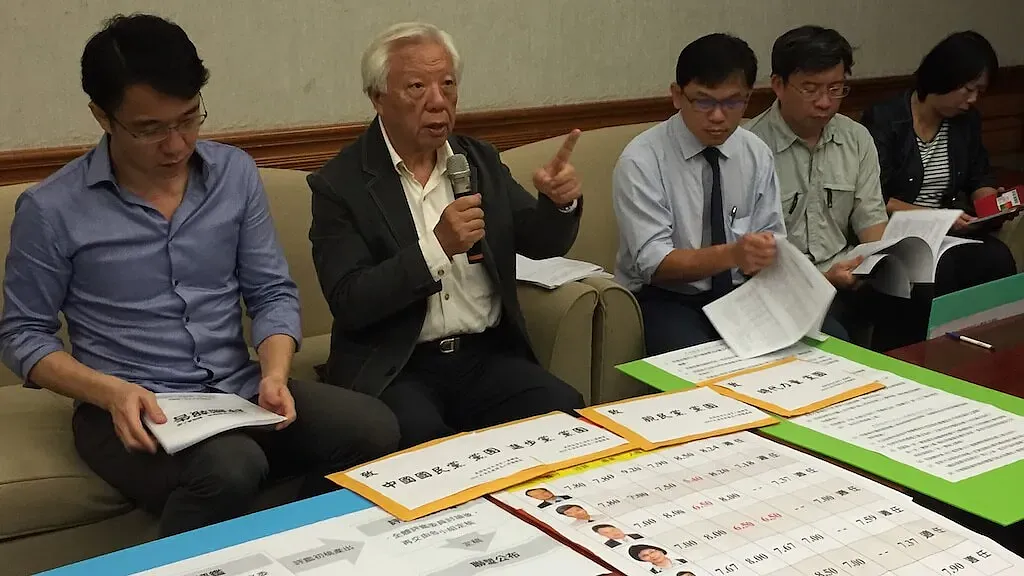
Grand Justices Evaluation Report Released! The Legislative Yuan Should Conduct Rigorous Reviews! Press Conference by the Alliance for Citizen Monitoring of Grand Justices Nominees
Last edited: 2026-11-03
Following President Tsai Ing-wen's official nomination of Professor Hsü Tsung-li and six others as Grand Justices, the Alliance for Citizen Monitoring of Grand Justices Nominees immediately formed an evaluation committee to conduct evaluations of the seven nominees.
Formation and Process of the Evaluation Committee
Following the Alliance's established practice, the evaluation committee was composed of one to three scholars and experts recommended by each member organization of the Alliance. Since several nominees had previously held important positions in the Taiwan Law Society, the Taipei Bar Association, and the Association for Reform of Criminal Procedure (now the Judicial Reform Foundation), and because both the Taipei Bar Association and the Taiwan Law Society had also recommended Grand Justice candidates, these three organizations were barred from recommending evaluation committee members based on the principle of recusal.
A total of 15 evaluation members participated in this evaluation committee, including 3 judges, 4 attorneys, and 8 scholars and experts. The evaluation members operated independently, conducted anonymous reviews, and were divided into seven sub-committees based on the number of nominees. The President and Vice President nominees were each evaluated by six members, while the five other nominees were each evaluated by three members; each member participated in at most two sub-committee evaluation operations. After the initial draft of the evaluations was produced, a comprehensive discussion was held at the plenary meeting of the evaluation committee, where members of each sub-committee exchanged views and suggestions before the final drafts were finalized by the respective sub-committees. Only after all drafts were finalized were they handed over to the Alliance for unified publication.
Evaluation Results
| Nominee | Moral Integrity | Personality Traits | Academic Professionalism | Constitutional Human Rights | Judicial Reform Policy | Average | Conclusion |
|---|---|---|---|---|---|---|---|
| Hsü Tsung-li | 7.80 | 7.80 | 9.20 | 7.90 | 8.50 | 8.24 | Qualified |
| Tsai Chiung-tun | 7.80 | 7.00 | 7.50 | 5.40 | 8.20 | 7.18 | Qualified |
| Hsü Chih-hsiung | 7.00 | 8.00 | 6.50 | 8.00 | -- | 7.37 | Qualified |
| Chang Chiung-wen | 7.00 | 8.00 | 6.50 | 6.50 | -- | 7.00 | Qualified |
| Huang Jui-ming | 7.67 | 8.00 | 7.67 | 7.00 | -- | 7.59 | Qualified |
| Chan Sen-lin | 7.00 | 7.00 | 8.50 | 7.00 | -- | 7.37 | Qualified |
| Huang Chao-yuan | 8.30 | 7.00 | 9.30 | 7.00 | -- | 7.90 | Qualified |
Rating Reference Standards
- Sub-item Scores
- 9–10 points: Clearly positive performance in the item
- 7–<9 points: Positive performance in the item with no significant flaws
- 5–<7 points: No performance or slightly negative performance in the item
- 0–<5 points: Significantly negative performance in the item
- Final Average Score
- 9–10 points: Highly Qualified (actively positive performance in all items)
- 7–<9 points: Qualified (actively positive performance in some items; no significant flaws in others)
- 5–<7 points: Unqualified (no performance in most items, or negative performance)
- 0–<5 points: Highly Unqualified (significantly negative performance in most items)
Based on the current evaluation results, all seven nominees are qualified. However, regarding individual nominees, the evaluation committee adds the following comments:
- Nominee Hsü Tsung-li's response to the Alliance's questions regarding same-sex marriage revealed flaws in his thinking on human rights protection issues.
- Nominee Tsai Chiung-tun is a qualified candidate for Vice President, but his answers regarding constitutional human rights principles were vague and lacked the standing in human rights protection expected of a Grand Justice.
- Nominee Hsü Chih-hsiung would be more suitably nominated under the criteria of Article 4, Paragraph 1, Subparagraph 6 of the Judicial Yuan Organization Act (possessing political experience).
- Nominee Chang Chiung-wen has no major flaws, yet lacks prominent strengths, appearing somewhat bland and uninspiring; does this reflect that today's judicial system actually struggles to nurture qualified Grand Justice candidates?
- Nominee Huang Jui-ming's responses, while possessing human rights ideals, clearly lack depth; how nominees with a background as attorneys should be examined remains to be considered.
- Nominee Chan Sen-lin has no obvious flaws or defects, but also lacks overly prominent performance worthy of high praise or commendation.
- Nominee Huang Chao-yuan did not answer nine questions, but his past publications will presumably become the basis for evaluating constitutional interpretation standards in the future.
The Nomination Process by the Office of the President Should Be More Open and Transparent
We affirm that, following the announcement of the nominees by the Office of the President, a dedicated webpage was established on the official website for the first time to explain the review process and provide relevant materials on the nominees for public review. However, the information provided by the Office of the President is extremely vague, consisting only of brief profiles and autobiographies of the nominees, which is insufficient for the public to examine whether the nominees are qualified.
Vice President Ch'en Chien-jen, convener of the "Grand Justice Review and Recommendation Group" responsible for recommending nominees, only briefly outlined the reasons for the nominees' selection during the nomination press conference. He completely failed to release the materials collected during the review process or explain the group's screening criteria, making it impossible for the public to scrutinize the nomination process and standards.
The Legislative Yuan Should Promptly Amend Laws and Implement Rigorous Reviews
Last week, the Legislative Yuan held a public hearing on the review of Grand Justices and the President and Vice President of the Judicial Yuan, inviting scholars and experts to expound their views. However, the entire meeting was reduced to a mere formality. Not only did most legislators fail to listen to the opinions of scholars and experts from beginning to end, but some legislators' remarks were limited to stating their own views. Out of a whole day's agenda, only the last thirty minutes were left for legislators to question and converse with experts and scholars, a clearly erroneous arrangement.
The Alliance believes that a "Grand Justice Review Hearing" should be adopted to implement the review mechanism and replace the formalized and hollowed-out public hearings. Nominees should not only participate throughout the entire process, but should also be subject to questioning by scholars and experts during the legislators' hearing procedures. Even if hearings cannot be held, various caucus groups should pre-formulate questions they wish to clarify and dispatch representatives to question scholars and experts in order to clarify controversies and gather review materials.
Although the current review has adopted individual reviews for each nominee, the very purpose of a public hearing should be to collect review materials rather than having experts, scholars, and legislators merely venting their own views. Following this process, one cannot help but worry that subsequent reviews will once again be reduced to a mere formality. Fundamentally, the problem lies in the fact that the provisions of the Law Governing the Legislative Yuan's Power have not been amended. Consequently, although the review process attempts to follow the spirit of the new law, it still devolves into a formality and fails to implement a rigorous review mechanism. Promptly amending the Law Governing the Legislative Yuan's Power should be an urgent priority for congressional reform.
Finally, in addition to publishing the review report, the Alliance will also release its accumulated questionnaire question bank in accordance with past practice for legislators to use in interpellation. The review report, the nominees' responses to the Alliance's nine questions, and the accumulated questionnaire question bank will be forwarded to all political parties in the hope that legislators will refer to and use them during their reviews. The Alliance once again calls on the Legislative Yuan to immediately amend the Law Governing the Legislative Yuan's Power to implement a rigorous review mechanism for Grand Justices.
Appendix
Alliance Attendees and Representatives
Professor Ch'ü Hai-yüan / Alliance Convener
Attorney Cheng Wen-ting / Taiwan Law Society
Professor Chiu Wen-tsung / The Society of Constitutional and Jurisprudential Studies
CEO Chang Hung-lin / Citizen Congress Watch
Attorney Kao Jung-chih / Alliance Spokesperson
Alliance Member Organizations
Taiwan Law Society
The Society of Constitutional and Jurisprudential Studies
Taiwan Association for Human Rights
Taiwan Democracy Watch
Citizen Congress Watch
Association for Innocence Project Taiwan
Alliance for Citizens Constitutional Movement
Judicial Reform Foundation
Press Contact
Attorney Kao Jung-chih 02-25231178
This article is an AI-generated translation of the original Chinese text. In the event of any discrepancy, the Chinese version shall prevail.