
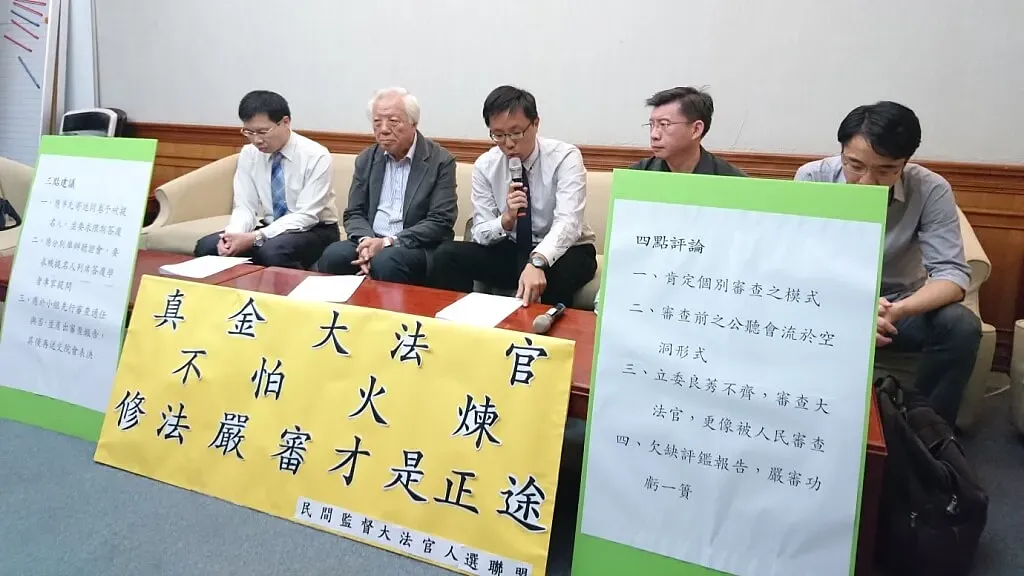
True Gold Grand Justices Fear No Fire, Rigorous Review is the Right Path: Press Conference by the Alliance for Citizens' Watch on Grand Justice Nominees
Last edited: 2026-07-27
Tomorrow morning and afternoon (October 25), the Legislative Yuan will hold consent vote sessions for the President and Vice President of the Judicial Yuan, as well as five Grand Justices. The Alliance for Citizens' Watch on Grand Justice Nominees offers the following comments:
Part I: Regarding the Nomination Review Process This Time
-
Affirming the Individual Review Model
The biggest difference between this review and previous ones is the individual review of nominees. Each nominee was given a separate and independent review period, and the review time was also more ample than in the past. As the saying goes, "true gold fears no fire;" the fact that this Grand Justice review was able to spark widespread public attention and heated discussion is closely related to the adoption of the individual review model. The exchanges between legislators' inquiries and the nominees' responses deepened both democracy and the rule of law, which is commendable.
In past review models, multiple nominees were reviewed jointly, and time was insufficient. As a result, while a certain nominee received intense attention from legislators, the question of whether other nominees were suitable was easily glossed over and failed to be presented before the public.
Since its establishment, the Alliance has repeatedly called for individual nominees to be reviewed separately. The Alliance is deeply gratified that the Legislative Yuan was able to conduct the review through individual evaluation. It is precisely because of the efficacy of individual reviews that the public could discern the suitability of each Grand Justice and thereby judge whether the President's nominations were appropriate.
-
Public Hearings Prior to Review Reduced to an Empty Formality
Before the review proceedings officially commenced, the Legislative Yuan held two public hearings to consult scholars and experts. However, the operation and results of these public hearings consumed national resources and precious time without achieving the expected effects. The hearings were characterized by participants talking past each other, appearing hollow and tedious; almost no legislators attended the sessions from beginning to end, and the opinions of scholars and experts could not be effectively submitted or utilized by legislators for their review. While the various opinions expressed at the public hearings were valuable, unfortunately, they failed to effectively enhance the quality of the review.
-
Legislators Vary in Quality; Reviewing Grand Justices Felt More Like Being Reviewed by the Public
A total of 50 legislators participated in the review this time (15 from the Democratic Progressive Party, 27 from the Kuomintang, 5 from the New Power Party, and 3 from the People First Party). However, most legislators seemed to lack the most basic understanding of the powers and scope of authority of the President and Vice President of the Judicial Yuan as well as the Grand Justices. Consequently, their inquiries failed to clearly gauge the suitability of the nominees, and a small minority of members even engaged in absurd and erratic questioning akin to buffoonery, undermining the professional image of the parliament.
-
Lack of Evaluation Reports Falls Short of Rigorous Review
Only two working days separated the conclusion of the plenary review and the plenary voting date. How could a detailed review report be produced in such a timeframe for the public and non-participating legislators to reference? The Alliance has repeatedly called for the results of congressional reviews to be produced in written reports and published on the Legislative Yuan website for public scrutiny. Despite group reviews being conducted and the quality of review showing improvement, the failure to produce a detailed review report in the end fell short of success.
Part II: Rigorous Review Through Legal Amendment is the Right Path
Although the review process for Grand Justices this time showed progress compared to the past, it remains a long way from a rigorous review. Therefore, the Alliance proposes the following recommendations in the hope that parliament can pursue reforms accordingly.
-
Questionnaires Should Be Sent to Nominees in Advance with a Deadline for Response
Previous review operations fell into the dilemma of having no data to review; legislators could only collect or inquire about information on their own, making effective review impossible. Therefore, the parliament should proactively send questionnaires to nominees, requiring them to respond by a deadline and demanding relevant information to be provided for review purposes.
-
Separate Hearings Should Be Held, Requiring Nominees to Attend and Answer Questions from Scholars and Experts
Although legislators are representatives of the people, they are not proficient in all issues and still need the assistance of scholars and experts. Because the review of Grand Justices is highly specialized—taking the United States as an example, where nominees' legal and human rights literacy as well as the consistency of their words and actions are examined—the joint participation of scholars and experts is all the more necessary to clarify related issues. If our country wishes to achieve substantive review, it should emulate the United States by inviting scholars and experts to jointly conduct hearings and requiring nominees to attend and answer questions from all sides.
-
Preliminary Suitability Reviews Should Be Conducted in Committees Producing a Review Report Before Submission to the Plenary Session for Voting
The current Grand Justice review system adopts a "plenary review" approach where all members can sign up, yet not all members actually participate in the review. Since the consent power for Grand Justice appointments is decided collectively by all members, how can members who did not participate in the review judge the suitability of nominees if there is a lack of a review report?
The Alliance suggests that in order for all members to understand the nominees' suitability before voting as a basis for supporting or opposing them, the parliament should have the members who participated in the hearings conduct a preliminary review of suitability, produce a review report, and submit it to the plenary session for a vote.
The review procedure for Grand Justice appointment consent is stipulated in the Organic Law of the Legislative Yuan. Although current legislators have reached a consensus on rigorous review and produced many brilliant Q&As, in the absence of explicit statutory regulations, the review process still fails to be institutionalized.
Four Grand Justices will step down in 2019. The Alliance sincerely hopes that before the next review, the Legislative Yuan can complete amendments to the Organic Law of the Legislative Yuan along the directions recommended by the Alliance, so that rigorous reviews of Grand Justices can become the norm and fulfill the public's expectations of Grand Justices upholding constitutional rights.
Part III: Supplementary Opinions from Evaluation Committee Members on Nominees Following Legislative Yuan Review
-
Supplementary Opinions Regarding Nominee Chang Chiung-wen
Nominee Chang Chiung-wen replied to the Alliance's nine questions only after the Alliance had publicly released its evaluation results. The evaluation committee provides the following supplementary opinions regarding Nominee Chang's response:
Overall, Judge Chang has participated in professional communities and handled public affairs, indicating that she possesses a certain degree of professional coordination and communication skills. Throughout her judicial career, she has also participated in the formation of several noteworthy judgments, showing her familiarity with legal affairs. However, our country's administrative litigation system has been criticized as a "dismissal court." Having long served within the administrative litigation system in her professional field, we did not see Judge Chang express any particular opinions or thoughts regarding this criticism; nor did we observe many insights into constitutional rights, legal philosophy, or jurisprudence in her legal career.
As the sole female nominee among this batch of Grand Justice candidates, whether Judge Chang possesses gender consciousness is a focal point of her suitability. In her early years, Judge Chang participated in drafting the Domestic Violence Prevention Act and also petitioned for a constitutional interpretation regarding legal provisions on children bearing their mother's surname, which indicates she may possess basic gender consciousness. However, the gender equality movement has moved into its next phase in recent years, and since Judge Chang assumed judicial administrative positions, she has no longer been seen expressing views on gender equality. Judging from her questionnaire responses, regarding gender equality, aside from endorsing Judicial Yuan Interpretation No. 728—which held that the bylaws or regulations of ancestral property associations entail freedom of contract and do not risk violating the principle of equality—she opposes same-sex marriage and leans toward the German same-sex partnership model, making her views relatively conservative. Her conservative side is also visible in her views on constitutional petitions and the death penalty, showing that she thinks from the perspective of the judiciary as an institution while ignoring the perspectives or needs of the people. She appears quite conservative toward institutional change, which raises concerns about whether Judge Chang will adopt a relatively conservative tendency in future constitutional interpretation practice that defends established systems.
-
Supplementary Opinions Regarding Nominee Huang Chao-huei
Nominee Huang Chao-huei stated when answering questions in the Legislative Yuan that his reason for not replying to the independent alliance's questions was based on: (1) Many cases have currently been petitioned for constitutional interpretation, making it inconvenient to answer; (2) Nominees are subject to congressional review, and gathering related questions in the Legislative Yuan is a better approach.
The evaluation committee responds as follows:
-
On major controversial social issues, when Grand Justice nominees are questioned by the congress or citizens, although they should pay attention to the political and constitutional interpretation effects generated by their words and actions and avoid excessive speech, they still have the obligation to articulate their own value orientations on the issue to facilitate substantive review of whether the nominee's stance aligns with public expectations.
-
Units that care about Grand Justice nominations and possess the capability to raise substantive and objective questions are extremely rare. Furthermore, parliamentary representatives vary in standards and may have differing starting points and objectives, frequently leading to poor-quality dialogues between the two sides in the congressional hall, to the extent of losing the intent of the review purpose. For the reasons above, gathering questions in the Legislative Yuan is currently not the "better" approach.
-
Attending Representatives
Chu Hai-yuan (Professor / Convener of the Alliance)
Weng Kuo-yen (Attorney / Vice President of Taiwan Association for Human Rights)
Tu Yu-yin (Professor / Board Director of Taiwan Forever)
Chang Hung-lin (Executive Director of Citizen Congress Watch)
Kao Jung-chih (Attorney / Spokesperson of the Alliance)
Alliance Member Organizations
Taiwan Law Society
Taipei Bar Association
Fairness Society
Taiwan Association for Human Rights
Taiwan Forever
Awakening Foundation
Citizen Congress Watch
Taiwan Association for Innocence
Citizen Constitutional Promotion Alliance
Judicial Reform Foundation
Press Contact
Attorney Kao Jung-chih 02-25231178
This article is an AI-generated translation of the original Chinese text. In the event of any discrepancy, the Chinese version shall prevail.