
State Atrocity in Dispersing Assemblies—In the Name of the Law?
Last edited: 2026-07-27
Photo source / wikipedia
From March 24, April 11, to April 28, people kept asking me: Professor, can the German police disperse crowds like this? I said, that is too far off; it would probably be more realistic to compare us with the "bottom-tier student" of European rule of law.
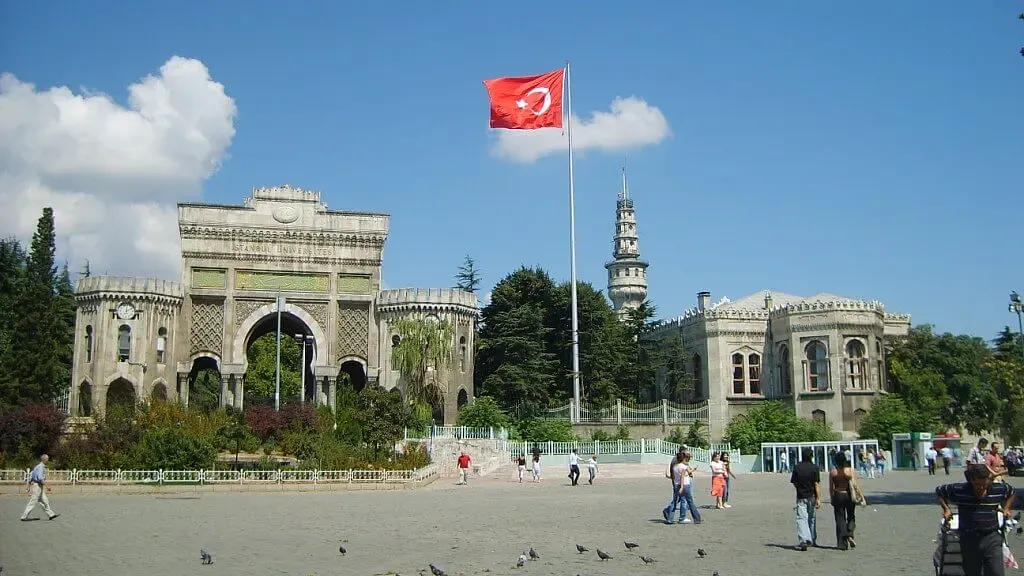
On the eve of Women's Day in 2005, a Turkish women's group held a peaceful assembly in Istanbul's Beyazit Square (located in a busy commercial district), initially just reading declarations of equal rights and shouting slogans. However, citing the assembly as "unauthorized," the police first ordered its dispersal followed by a forceful crackdown, causing bloody clashes and arresting dozens of "troublemakers."
The following day, the suppression made international and European media headlines (the Turkish police certainly did not dare to disperse or assault reporters!), yet Turkey's pro-government media incessantly broadcasted a "rioter perspective." The police also claimed the assembly was illegal and disorderly, and that public authority was invoked to clear the area only to maintain public order and prevent traffic obstruction (plain-language version: returning the road to citizens). Furthermore, the government accused demonstrators of throwing stones at the police (please note: not cardboard or paper cups) and smashing several police cars, injuring seven police officers (and the count was not exaggerated).
Looking at Taiwan's rampant phenomenon of "in the name of the law," what do you suppose the "sequel" to this story would be? Would the state fully summon the ghost of martial law (Turkey ended its military rule only in 1982)? Would "rioters" be prosecuted across the board? Would NGO street rights be arbitrarily revoked? Would masterminds be subjected to abusive preventive detention? Would social networks be fully monitored for evidence gathering? Would even MRT commuters and shoppers be subjected to unwarranted stop-and-search? Wrong, completely wrong! Because "what the law is is not up to the government or the police to decide"—at least not in Europe, not even in Turkey!
A woman named Izci, who was injured during the dispersal, filed a complaint with the European Court of Human Rights against Turkey's atrocities. In its 2013 judgment in Izci v. Turkey, the Court unanimously declared that the Turkish government had violated Articles 3 and 11 of the European Convention on Human Rights and should be held liable for damages. The reasoning behind the judgment is well worth referencing and warning for our country. In particular, Articles 7 and 21 of the United Nations International Covenant on Civil and Political Rights provide identical protections, and the views of its Human Rights Committee are the same. Pursuant to Articles 2, 3, and 4 of Taiwan's Enforcement Act of the Two Covenants, these provisions have domestic legal force and bind all state organs in our country.
Forcible Dispersal Amounts to Torture
First, the European Court of Human Rights reaffirmed its consistent view: even if a peaceful assembly is "illegal," considerable tolerance must be afforded. The Convention does not permit the government to threaten demonstrators with criminal penalties, let alone allow the police to resort to forcible dispersal at every turn, as this suppresses people's will to participate in assemblies and creates a chilling effect. Once people become afraid of assembling for this reason, the vital cornerstone of a democratic state crumbles along with it. Turkey has clearly violated the protection of freedom of assembly under Article 11 of the Convention.
Second, using batons and tear gas against unarmed demonstrators not only violates Article 11 of the Convention but simultaneously breaches the "absolute prohibition of torture" under Article 3 of the Convention. In other words, anti-riot police beating peaceful demonstrators constitutes the state inflicting torture on the people, which is no different in nature from torturing defendants to extract confessions. The European Court of Human Rights has repeatedly admonished that force may only be applied in situations of major turmoil and riots, and excessive reactions are strictly prohibited. The Turkish government failed to prove the necessity of the police's forceful dispersal; on the contrary, precisely because the police frequently resorted to disproportionate force, and even hurled insults, provoked, or chased down departing citizens, did they cause the crowd to spin out of control and the scene to turn tumultuous. In a word, the assembly was "rendered violent by the crackdown"; the government's improper crowd control was the prime culprit that turned the assembly from peaceful to chaotic.
Condoning Brutal Police Violates the Duty to Investigate
More importantly, the European Court of Human Rights also criticized Turkey for violating its positive obligation to conduct an "effective investigation" into state violence. To the people of Taiwan, this sounds like "Arabian Nights": the Turkish government had already stepped forward to apologize, the Minister of the Interior was demoted, and senior police officers received disciplinary demerits. Moreover, Turkish prosecutors did not quite act like government hounds or police vassals; the prosecution not only initiated an investigation into the police but indicted as many as 54 violent police officers at once, several of whom were subsequently sentenced by Turkish courts. Despite this, the European Court of Human Rights nonetheless unanimously ruled that Turkey had violated the Convention because: first, Turkish anti-riot police actually "concealed their identification badges" and wore helmets with visors, making it difficult for victims to identify them and dragging out the investigation and trial procedures. Such practices hindered the realization of the effective (including prompt) investigation obligation required by the Convention. Second, police officers accused of illegal violence during ongoing investigations and trials should have been suspended or dismissed, and third, judicial organs should have actively investigated the offenses of senior police officers or public officials who ordered the dispersal—none of which obviously happened in this case. Given prior cases such as Pekaslan and Others v. Turkey in 2012, where the factual background and grounds for finding a violation were identical, the European Court of Human Rights ultimately admonished the Turkish government to learn its lesson and comprehensively review everything from police duty instruction and the use of police equipment to the legal system governing assemblies and parades, so as to avoid repeating the tragedy.
Returning to Taiwan, the rule of law has sunk so low that we dare not even compare ourselves to Turkey, nor is there any comparison left. The authorities uninhibitedly summon the state leviathan—in the name of the law. As a legal professional, writing up to this point, I know not why anger has escaped me, leaving only a hard-to-mask sorrow, weeping as I write this…
This article is an AI-generated translation of the original Chinese text. In the event of any discrepancy, the Chinese version shall prevail.