
Do Not Let the Ghost of the Police State Be Resurrected
Last edited: 2026-07-27
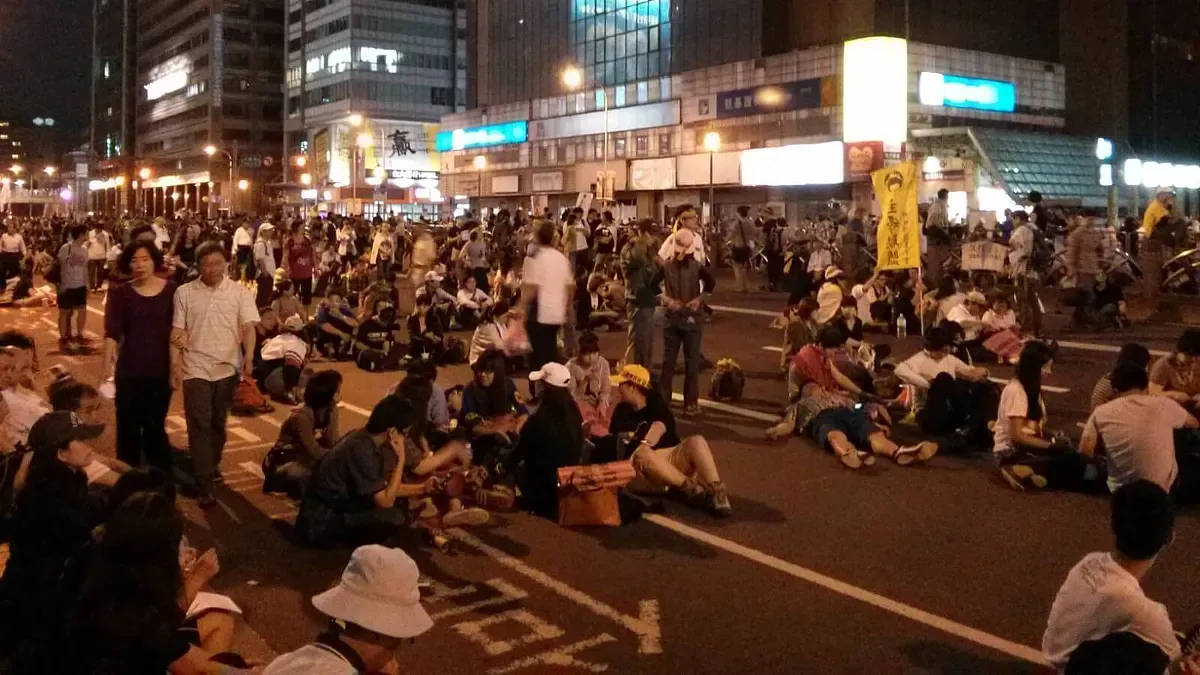
Taipei City Mayor Hao Lung-bin ordered the police to disperse protesters occupying Chung Hsiao West Road under the banner of "returning the road to the people." While this may seem to have some basis at first glance, before beginning the dispersal, the Taipei City Police actually ordered reporters performing their reporting duties on a pedestrian bridge in a "public space" to leave, and even used coercive force to drive them away, resulting in injuries to the reporters. This is the second "bad precedent" of using coercive force to expel on-site reporting media since the police dispersal of the occupied Executive Yuan on March 23. It not only violates freedom of the press guaranteed by the Constitution, but also infringes upon the people's right to know. This constitutes a serious flaw in law enforcement and is highly objectionable.
The vocational calling of the news media is precisely to stand guard at every "news scene," to "record" first-hand images and footage, and to "report" authentic, unedited information for circulation. The purpose is precisely to satisfy the "right to know" of all other people who are not at the scene. After all, if the people's "right to know" is also deprived, how can they possibly "monitor" the government or assert that their rights are not infringed upon? Therefore, the protection of freedom of the press is precisely a "institutional protection" designed to safeguard the people's "right to know" and other derivative rights. It is precisely from this that the media derives its title as the Fourth Estate, alongside the executive, legislative, and judicial branches. Naturally, a government that cannot be laid bare under the media and thereby accept the supervision of the people can hardly be recognized as a democratic country. Therefore, the degree to which a country can tolerate freedom of the press is often an important dividing line distinguishing democratic countries from non-democratic countries.
Mayor Hao proclaimed that he was lawfully exercising police power to use coercive force to disperse illegal protesting crowds. If this were such a responsible, legally grounded law enforcement action that has no fear of scrutiny, he should all the more gracefully accept the media's full-process recording, filming, and reporting. Why, instead, forcefully prohibit media reporting first? Could it be that what the police were "actually" doing was not as Mayor Hao described on the "surface"? Furthermore, during the dispersal at the Executive Yuan on the night of March 23, because the media was located inside an "official office," there might have been issues of privacy within the building. However, in the early morning of April 28, the media was located on a "pedestrian bridge," which is a completely open "public space" that anyone can enter and exit, with absolutely no issues of privacy infringement. Moreover, given the height of the "pedestrian bridge," there was no indication that the presence of the media would cause any interference or impact on the police executing their official duties (i.e., dispersing the protesting crowd on Chung Hsiao West Road).
Therefore, what on earth is the legal basis for the Mayor of Taipei to boldly and publicly employ executive power, direct the police to use "coercive" dispersal methods, prohibit the media from filming, and thereby infringe upon freedom of the press and the people's right to know? Many people, like myself, have thumbed through all the legal provisions of our country yet still cannot understand. It feels as though martial law has clearly been lifted, yet it is as if we have returned to the era of martial law? How is it that in a realm claiming to be a democracy, the regulation of news is even inferior to that of an autocratic state?
How is it that the giant Gabriel García Márquez, who won the Nobel Prize in Literature for "One Hundred Years of Solitude," has only just passed away, yet the news we have staged recently—in terms of its absurdity, astonishment, magical realism—all reminds me of what he wrote: the Buendía family that could never truly die, the perpetually lingering "revolutionary ghosts" of Latin America, and the feeble common folk caught in between and at the mercy of others. Comparing our present to our past, could it be that the "ghost of the police state" which we foolishly thought we had long since left behind is likewise incapable of truly dying, still lingering and haunting the streets of Taiwan today......
This article is an AI-generated translation of the original Chinese text. In the event of any discrepancy, the Chinese version shall prevail.