
Mei Ho City: Nothing to See Here?
Last edited: 2026-07-27
On April 24, the Taipei District Prosecutors Office concluded its investigation into the MRT Hsintien Depot development project (the "Mei Ho City scandal"), indicting former Department of Rapid Transit Systems (DFORTS) Joint Development Division Director Kao Chia-nung and Section Chief Wang Ming-tsang on corruption and other charges. Nevertheless, public opinion questions why the Taipei District Prosecutors Office made no mention whatsoever of former Engineering Office Director Chang Ch'i-te, who was impeached in 2012, nor of former Deputy Mayor Lin Ch'ung-i, identified as a key figure in the Control Yuan's investigation report, leaving many curious.
The Taipei District Prosecutors Office appears to have "concluded" this case by indicting low-to-mid-ranking civil servants Kao Chia-nung and Section Chief Wang Ming-tsang, offering no further explanation regarding the handling of other high-ranking officials who may have been involved. Whether an investigation took place can only be one of two possibilities: either it was conducted and has already been closed or remains ongoing, or no investigation was initiated at all.

Clarity and Transparency in Procedures
If it is the former, have the others been issued case-closing memos or non-prosecution dispositions? The Taipei District Prosecutors Office has offered no explanation. If it is the latter, the Taipei District Prosecutors Office seemingly should also explain why there was even no need to initiate investigative procedures. After all, Chang Ch'i-te has already been impeached, and Lin Ch'ung-i faced impeachment twice. Given that the Control Yuan took such severe measures, if the prosecutorial authorities did not even investigate the matter at all, there must be some special reasons. Shouldn't they provide a brief explanation?
All of the above are merely procedural issues, completely unrelated to the substantive contents of the case and investigation. If the Taipei District Prosecutors Office is too lazy to even explain these matters, then being questioned as a black-box operation is perhaps self-inflicted.
Substantive Merits Also Questioned
Regarding the substantive content, since it has already been established that subordinates are suspected of profiteering, under the prosecutors' customary "practical approach," the supervising superiors responsible for review would invariably be investigated "along the way." Even if superiors or responsible persons only possess formal review authority, it is not uncommon for them to be "indicted together and left to the court to decide." While it is certainly a virtue for prosecutors to "pay equal attention to matters favorable to the defendant," the public expects consistency in standards above all!
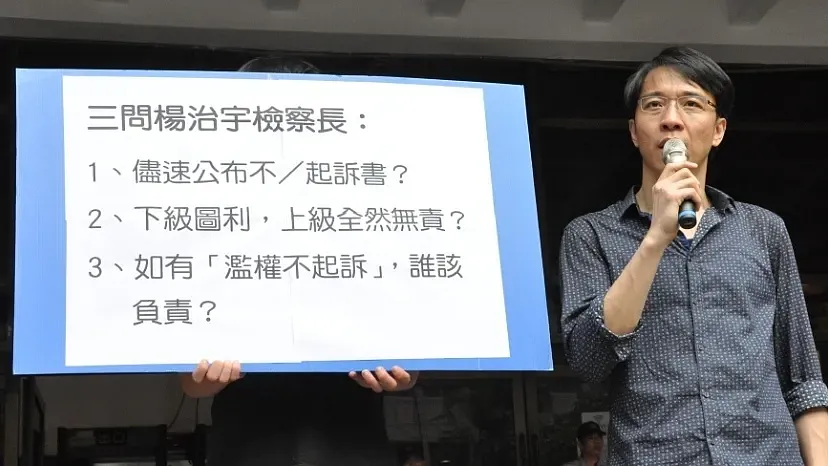
In truth, regarding such a major case of high public concern, shouldn't the Taipei District Prosecutors Office consider publishing the written indictment or non-prosecution disposition to allow for public appraisal and build public trust? If the Taipei District Prosecutors Office considers the matter and is unwilling to publish this case, what standard is then applied when sometimes they publish and sometimes they do not?
The spokesperson for the Taipei District Prosecutors Office gave a perfunctory response, stating: "After indictment, it is reviewed by the court; non-prosecution will be submitted for a motion for reconsideration ex officio to be reviewed by the Taiwan High Prosecutors Office." This attitude of "I will be a fine official as I please" seems to suggest the Taipei District Prosecutors Office need only answer to superiors or the court. By implication, does this mean there is no need to account to the public and the outside world? If so, can prosecutors still be considered representatives of the public interest?
"Prosecutorial Unity": Who Should Bear Responsibility?
Under current practice, whether an indictment is filed or not, legal documents are signed and issued by the handling prosecutor. According to media reports, the prosecutor handling this case is Prosecutor Ch'en Yün-ju, and it is expected her name is signed on the indictment taking responsibility. However, we are curious whether, in the face of such a major scandal, other prosecutors collaborated on the case, or if the Chief Prosecutor intervened and directed it? Their names do not appear on the documents, leaving outsiders with no way of knowing.
Article 92, Paragraph 2 of the Judges Act explicitly states: "Where a command and supervision order involves the exercise of compulsory disposition power, the determination of criminal facts, or the application of law, such order shall be made in writing with reasons attached." Pursuant to the aforementioned principle of "prosecutorial unity," a Chief Prosecutor may naturally intervene and direct cases according to law as long as it is done in writing with reasons attached, and may also assign other prosecutors to collaborate on the case.
Thus, we must ask: Did the Chief Prosecutor invoke "prosecutorial unity" in this case to intervene in the investigative process? If not, should any future liability for "abuse of power in non-prosecution" rest solely upon Prosecutor Ch'en Yün-ju in accordance with the law? But if so, precisely who should bear the ultimate responsibility?
It is said that the handling prosecutor, Ch'en Yün-ju, made an ardent appeal at the end of the indictment urging the Taipei City Government to file a massive civil lawsuit for damages against the construction company Jih Sheng Sheng (Ruentex), evidently also believing that the Taipei City Government truly "got a raw deal." With tens of billions of NTD in seductive profits mirroring the weakness of criminal accountability, as "Mei Ho City" emerges unscathed, the nation seems destined to continue experiencing tragedies.
This article is an AI-generated translation of the original Chinese text. In the event of any discrepancy, the Chinese version shall prevail.