
“Just Passing By” / “Taking a Stroll” and J.Y. Interpretation No. 718
Last edited: 2026-07-27
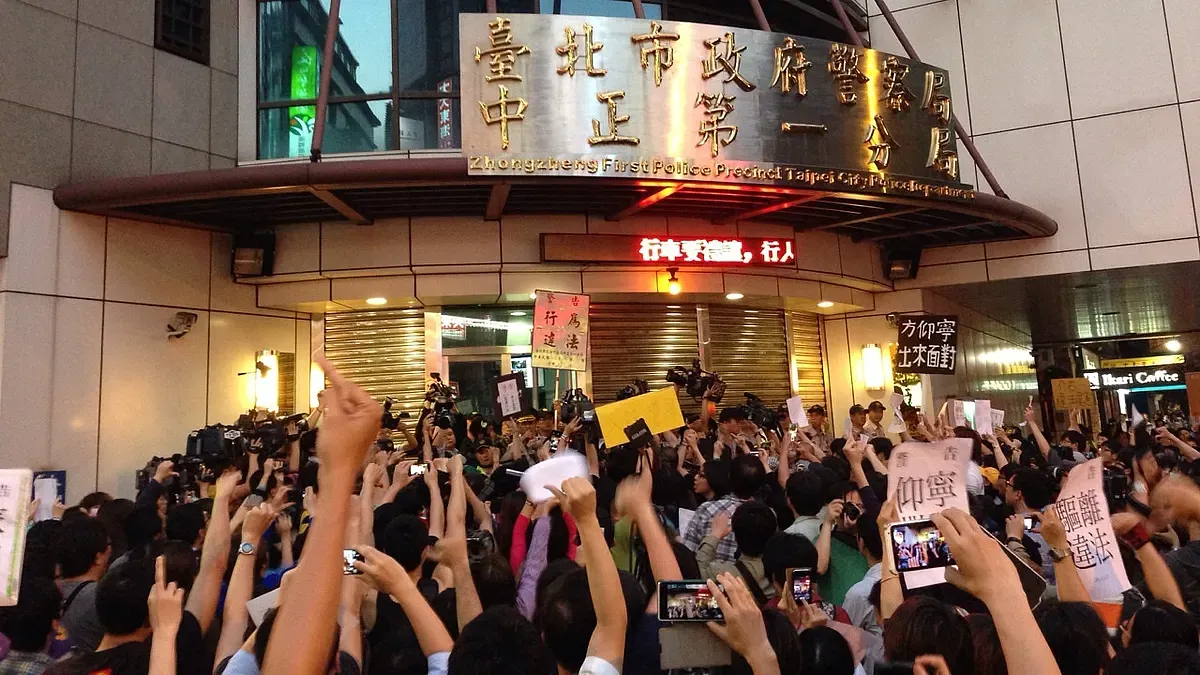
The Sunflower Student Movement wrapped up on the 10th, but crowds unexpectedly re-gathered the very next day. This time, the target of the encirclement was the Zhongzheng First Precinct. The Zhongzheng First Precinct has always been an "expert" at handling assemblies, parades, and mass movements, but today, finding even its own headquarters surrounded and in need of "being handled," it must have felt a rather unique taste of its own medicine.
Because students and citizens were dissatisfied with the precinct's chief—who went back on his word after promising not to promising not to disperse the Gongtoumeng (Alliance of Referendum Action) after promising not to disperse them, while aggressively declaring that all future assembly permits for the group would be revoked—the outraged masses initiated an online event to "just pass by" the Zhongzheng First Precinct.
"Passing By" vs. "Taking a Stroll"
The term "passing by" was a headline coined by reporters, naturally meant to satirize the government. Back when "White Wolf" (Chang An-le) led a crowd to the Legislative Yuan without applying in advance for a permit from the Taipei City Government, the city's spokesperson strongly endorsed his actions, claiming they were merely "passing through" the route and therefore it did not constitute an assembly or parade, raising no question of prior application requirements and thus involving no illegality.
This claim was laughable because, thanks to heavy media broadcasting, everyone in Taiwan knew the White Wolf was heading to the Legislative Yuan and understood his purpose was to confront the students (otherwise, why would the police make such a big deal out of pre-deploying forces and separating the rival camps?), yet the Taipei City Government could still look straight into the camera and talk nonsense.
Flash back to 2012: Prosecutor Wu Xun-long staged a sit-in protest in front of the Supreme Court, and nearly a hundred prosecutors "took a stroll" to offer flowers to Wu in a show of support. The Supreme Court flew into a rage, accusing the prosecutors of "leading by bad example" and teaching citizens how to evade the Assembly and Parade Act.
Both "passing by" and "taking a stroll" are farces, proving the absurdity of the Assembly and Parade Act itself. "According to the law" (this absurd law), prosecutors who merely wanted to stage a two-hour sit-in were prohibited by the "law," and any other prosecutors who went to deliver flowers and offer encouragement also "violated the law." The White Wolf went to hold a parade without prior application, which was also a "law violation." Consequently, the government and prosecutors resorted to distorted interpretations: This is not a "parade"! This is not an "assembly"!
The Assembly and Parade Act is Deeply Flawed
When a law is problematic, the root cause lies in a problematic ideology; the ghosts of state authoritarianism and control still linger in the shadows. As long as one is willing to acknowledge that assemblies and parades are fundamental rights conferred upon the people by the Constitution, then enjoying the freedom of assembly and parade is the principle, while restrictions imposed by law are the exception. Conversely, denying that this is a fundamental right of the people means it is prohibited in principle, making the enjoyment of freedom the exception—and the latter describes the current reality of our existing Assembly and Parade Act.
Taiwan's progressive, vibrant, and creative civil society has long rendered the Assembly and Parade Act so outdated that it is "unfit to be seen in public." Enjoying freedom means that as long as one does not go too far or harm others, one can say whatever they want, do whatever they want, take to the streets whenever they want, and gather whenever they want, without having to ask the government for permission about everything, and without requiring prior state consent.
Prosecutors certainly enjoy the right to collectively take to the streets and shout grievances at the Supreme Court; as long as the process is peaceful, it is fully protected by the Constitution, poses no legal issues, and requires no prior state consent. The White Wolf certainly also enjoys the right to shout at students, as long as there is no public insult or outbreak of conflict. And if verbal abuse or physical clashes occur, they should be dealt with according to criminal offenses or civil liabilities—penalizing where penalizing is due, and compensating where compensation is due. Afterward, they still retain the freedom and right of assembly and parade, and the state cannot completely ban all future assemblies or parades in advance.
All this discussion boils down to the question of whether the Assembly and Parade Act should maintain a "prior permission system" or be changed to a "subsequent notification system." As clearly demonstrated by the example of the Gongtoumeng, the "prior permission system" grants the state a massive "discretionary space," making the government's grant of the right of assembly and parade feel like "imperial benevolence"—bestowed on a whim and revoked on a whim, backed by whatever flimsy excuse is convenient. Grand Justice Lee Chen-shan already severely criticized this in his dissenting opinion to J.Y. Interpretation No. 718, pointing out that it easily triggers controversies over inconsistent standards and unfair law enforcement, rendering "lawful administration" highly "unpredictable."
J.Y. Interpretation No. 718 Perpetuates the Farce
Regrettably, J.Y. Interpretation No. 718—which "arrived in the nick of time" riding the coattails of the Sunflower Student Movement and was issued on March 21—was a profound disappointment. The majority of the Grand Justices still buried their heads in the sand, unwilling to confront the riddled flaws within the Assembly and Parade Act, and merely took a very passive approach by "opening up" so-called "urgent and spontaneous" assemblies and parades.
Beneath the seemingly "open" surface actually lies a wealth of conservative and reactionary implications. First, through J.Y. Interpretation No. 718, the Grand Justices declared that as long as an assembly or parade is "urgent and spontaneous," prior application is unnecessary; as for everything else, they remain tight-lipped.
The Grand Justices are well aware that the core issue of the Assembly and Parade Act is whether to adopt a "permission system" or a "notification system," and the judiciary's conscious silence amounts to an unbridled condonation of administrative abuse of power. At a time when the people are urgently pleading with the Grand Justices to express their legal opinions, apathy, passivity, evasion, and refusal to hear cases make it difficult for even the most eloquent rhetoric to restore public confidence in the judiciary.
Furthermore, regarding so-called "urgent and spontaneous" assemblies and parades, there are two ways to interpret this ruling. One interpretation is that it is "nonsense," as the very nature of "urgent and spontaneous" events naturally makes it impossible to apply in advance. Another interpretation is that it is "taking the bait," rushing to squeeze into the "ill-fitting trap shoe" custom-made by the Grand Justices.
Under circumstances where people do not wish to make prior notifications to the state, they will try their utmost to frame their actions as "urgent" and "spontaneous." As internet mobilization becomes increasingly common, as long as an issue is sufficiently compelling, scenarios where "one person issues a call and ten thousand respond" will become increasingly frequent. If the person issuing the call merely shouts casually or even fails to show up themselves, space is created for interpreting the event as "passing by."
The real point is that "urgency" or "spontaneity" requires interpretation. Just like permitting or prohibiting an assembly or parade, this power reverts to the hands of the state, which holds the authority to interpret and rule. The standards are difficult to articulate clearly and are easily influenced by individuals, events, and differing political stances.
Since the fundamental "issue" remains unresolved, the Grand Justices have simply cleared out a different "trap battlefield," having everyone waste their energy here. Much like the current frantic scramble to secure "parading rights," its essence still requires first "begging and pleading" with the state before one is allowed to take to the streets.
In short, as long as laws that prohibit people from enjoying their rights in principle are not abolished, assemblies and parades will still not truly be our fundamental rights. Accompanied by fluid enforcement standards, it will continue to be an ugly and agonizing farce.
This article is an AI-generated translation of the original Chinese text. In the event of any discrepancy, the Chinese version shall prevail.