
Why Was Lo Ying-syu in Such a Rush to Take a Stance?
Last edited: 2026-07-27
The Minister of Justice claimed that whether student movement cases are "unconstitutional" cannot be decided arbitrarily by anyone, and that student movement participants cannot represent the people. By the same logic, whether this case involves "civil disobedience" certainly cannot be decided arbitrarily by the Minister of Justice, nor can the Minister represent the prosecution and judicial circles!
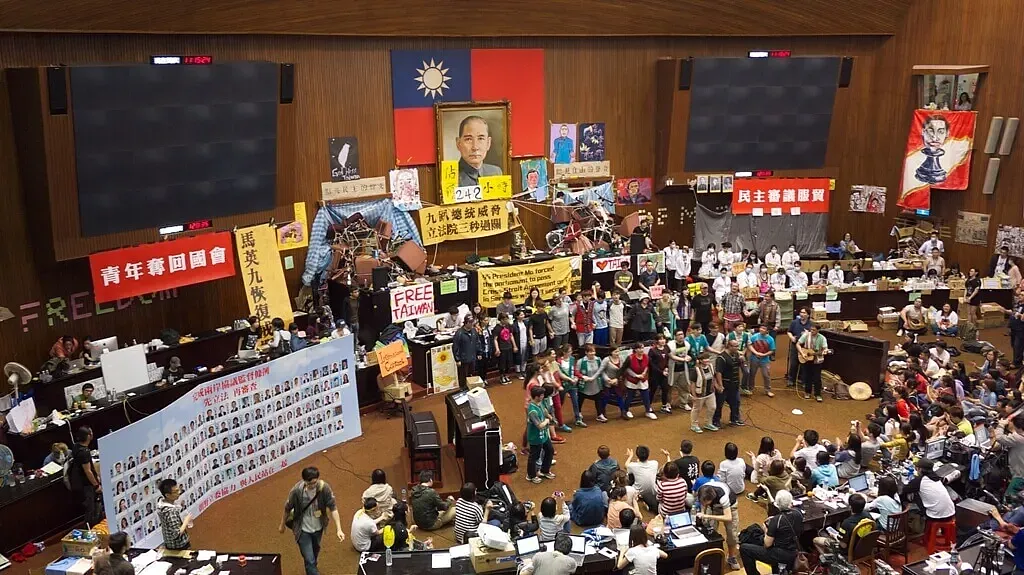
Overall, this kind of student movement occupying the "Legislative Yuan" caused social unrest to a certain extent. However, this alone does not automatically make everyone who participated in various forms a criminal! Specific actions that may constitute criminal offenses include the destruction of "public property" in the Legislative Yuan, obstruction of "official duties" in the Legislative Yuan, and "compulsion" against people in the Legislative Yuan. Yet, whenever a "legal interest" is infringed, does it necessarily constitute a crime? And must everyone be prosecuted? Of course not.
In the 21st century, the "principle of mandatory prosecution"—or the doctrine of comprehensive state prosecution—has proven to be a backward criminal justice policy with high implementation costs. Following the German model, Taiwan has empowered prosecutors with discretionary closing methods such as "suspended prosecution" and "discretionary non-prosecution" to mitigate the ill effects of the "criminal stigma effect" and the "waste of judicial resources." This allows handling prosecutors to grant non-penal treatments based on the specific circumstances of the defendant and the victim in individual cases, paired with suspended prosecution or discretionary non-prosecution, enabling offenders and victims to replace "continued confrontation" with "forgiveness and letting go," and using a "healing perspective" to supplement the excessively reinforced "retributive perspective" in criminal proceedings.
In other words, allowing defendants and victims to truly reconcile, walk out of their trauma, return to the right track, and restore the original order—this type of "restorative justice" is a criminal justice policy that can be seen advertised and promoted even on the official website of the Ministry of Justice. As the Minister of Justice, she surely cannot be unaware of this principle.
Indirect Interference in Individual Cases
However, today, while the individual case is still under investigation, Legislative Yuan President Wang Jin-pyng, the primary victim of the crime, has not yet officially expressed his views on the various specific infringements upon the legal interests suffered by the Legislative Yuan. It remains unclear whether he is willing to uphold the spirit of "restorative justice" to forgive these students on conditional terms, allowing this case to be handled with flexibility rather than confrontation, and enabling social order to return to the right track at an early date. In other words, in this case, when the victim whose legal interests were infringed is not in a rush to pursue criminal liability, it is quite intriguing why the Minister of Justice, as a third party outside the case, is in such a rush to take a stance on holding people accountable.
In particular, the Minister of Justice holds an administrative position, exercises only prosecutorial administration, and does not hold the status of a prosecutor. She fundamentally cannot use the principle of the unity of the prosecution service to guide legal interpretations in individual cases. Therefore, regarding factual determinations or legal interpretations in specific cases under investigation, she should still abide by the principle of non-disclosure of investigation. If there is indeed a necessity to unify prosecutors' legal interpretations, it should only be done indirectly through the Prosecutor-General or chief prosecutors. This is an important rule of law principle in a constitutional state. If one lacks such legal knowledge, it is hard to tell who is the one in need of rule of law education!
Yet, why did the Minister of Justice, despite lacking the authority to interfere in individual cases based on the unity of the prosecution service, still spare no occasion to target this case, violate the principle of non-disclosure of investigation, and demonstrate loyalty? What is the real reason? Because although the Minister of Justice cannot directly reach into and interfere with individual cases, she holds the power of appointment and dismissal over important personnel in the prosecution circle, such as chief prosecutors. Therefore, the Minister of Justice can use such public policy declarations to hint at and warn the handling prosecutors and the chief prosecutors of their respective prosecutors' offices that if they fail to prosecute in the future according to the established policies and positions of the Ministry of Justice, they will not only have no hope of future promotion within the prosecution circle but may also be sent to a cold department as retribution. Through this method, she indirectly and subtly achieves her goal of "interfering in individual cases."
Fortunately, there still exist within our country's prosecution circle a minority of grassroots prosecutors who can resist pressure from superiors and are willing, even at the cost of defying the will of the Minister of Justice, to prosecute the Prosecutor-General to demonstrate their accountability to their conscience and the law. This kind of "integrity shining through in times of adversity" is the only safeguard that can allow the prosecution circle to extricate itself from the political mire, and it is the only way to truly keep a Minister of Justice who is accustomed to "using the rule of law to package authoritarianism" in check.
This article is an AI-generated translation of the original Chinese text. In the event of any discrepancy, the Chinese version shall prevail.