
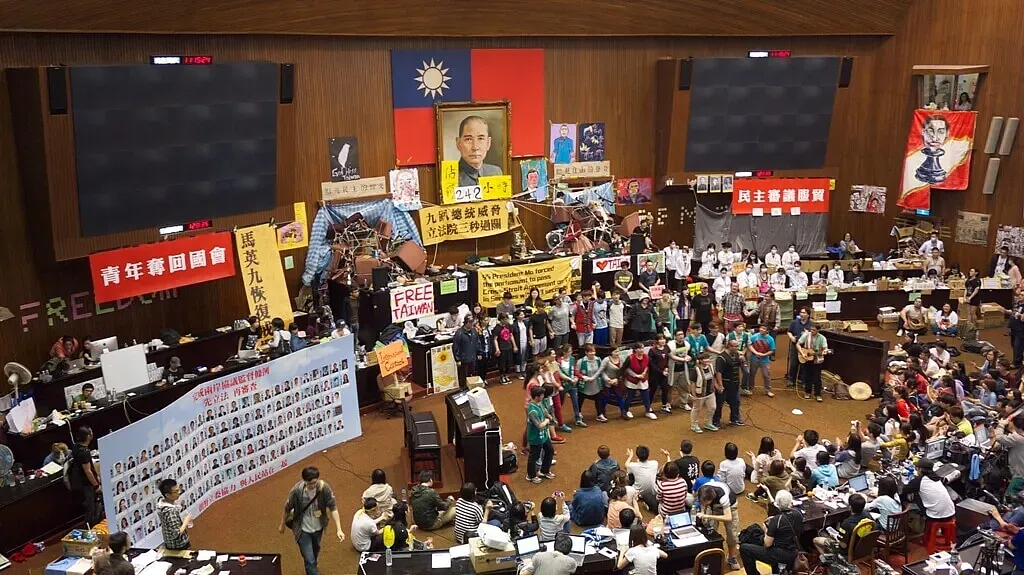
Politics/Economics, the Sunflower Student Movement, and the Judiciary
Last edited: 2026-07-27
If we accept the highly persuasive arguments put forward by Daron Acemoglu and James Robinson in their 2012 book Why Nations Fail and examine the Sunflower Student Movement through their perspective, it yields fascinating insights. In particular, regarding the students' demands for the "institutionalization of oversight for cross-strait agreements" and "convening a citizens' constitutional conference"—and after much discussion concerning executive and legislative powers—was the "judiciary" overlooked in this wave of movement?
It's Politics, Stupid!
Both authors are master scholars. Through fifteen years of research, they attempt to explain why countries that were roughly identical a few centuries ago now exhibit vast differences. Their conclusion is that political regimes characterized by "openness, pluralism, tolerance, and the rule of law" can sustain a virtuous cycle of economic growth, and that the manner in which power operates is the root cause of affluence or poverty (as reflected in the book's subtitle). The authors distinguish between two models: so-called "inclusive" political institutions are the fundamental cause of economic success; conversely, "extractive" institutions are forces of a vicious cycle that ultimately doom a nation beyond redemption.
In fact, Professor Lin Ming-jen of the Department of Economics at National Taiwan University, in his introductory preface to the traditional Chinese edition in early 2013, had already cited the aforementioned arguments to explain that "institutions" are the very factor determining whether our efforts to "boost the economy" can succeed. Examples include: "establishing rules of the game that do not vary from person to person," "broadly distributing power in politics and establishing checks and balances," and "encouraging diverse ideas" (p. 15).
Regrettably, when political elites "get things wrong," it is frequently not out of "mistake or ignorance," but rather because they "deliberately get things wrong" (p. 93). The economic systems yearned for by the elite class often treat "the broad masses of society as sacrificial straw dogs in order to achieve the goals of self-enrichment and permanent rule" (p. 429). Thus, political struggle is not terrifying; rather, the objectives and outcomes of power struggles determine everything. If it is for the purpose of changing the political system and restricting the exercise of power, the nation will enter a virtuous cycle; conversely, if it is for personal gain and the expansion of power, it will lead to national failure.
Professor Lin cited another paper by the authors pointing out: "The reason political elites are willing to initiate political reforms and release power is not out of love for the people, but because they fear that social discontent will spread, causing turmoil or even revolution, which would in turn compromise their interests" (p. 19). In short, political reform generally represents a self-reduction of power by those holding it. Without the possibility of losing even greater power, and after weighing the pros and cons, expecting political elites to "self-reform" is basically unfeasible.
The next question is, why pursue "political reform" rather than "redistribution without changing the existing system"? The answer is: "Because this promise is not credible: once the protesting crowds disperse from the plaza, it is virtually impossible to assemble them again, and those in power naturally no longer have to keep their promises." Therefore, "the masses must persist until a reasonably credible arrangement emerges" (p. 19).
As if prophesying, the two authors and Professor Lin both offered their views on China's future development, concluding that China's current political and economic system "remains essentially an extractive institution." The implication for Taiwan is: "As we move forward toward the virtuous cycle of an inclusive institution, how do we avoid being sucked into the vicious cycle of an extractive institution?" (p. 22).
Fix Politics Before Boosting the Economy
To summarize the advice of the two master economists: "If you want to boost the economy, fix politics first." If so, then even those of us who do not understand economics can say that the Ma administration's "boost the economy" policies may have directly contravened the very purpose of those policies. Because the Cross-Strait Service Trade Agreement clearly tilts toward today's Chinese political and economic system, it increases Taiwan's risk of being sucked into an extractive institution. If a vicious cycle begins, it would ultimately prove detrimental to economic development.
This kind of discourse is not merely opposition to the "black-box" formulation of the Service Trade Agreement; it is a step further into opposing the "Service Trade Agreement" itself. Proponents and opponents can, of course, continue to debate deeply, but undeniably, this is the primary source of anxiety for all people in Taiwan: even if it buys short-term economic development, is it worth it for Taiwan from a long-term, sustainable perspective? However, if we temporarily set aside the "China" factor while agreeing with the authors' other points and comparing them to the demands of the "Sunflower Student Movement," it is well worth noting.
First, institutions that "broadly distribute power" are crucial. The opportunity sparked by the "Sunflower Student Movement" is whether Taiwan's executive and legislative branches can truly achieve thorough "separation and checks and balances." Furthermore, can the representative system itself pluralistically reflect public opinion? That is, can the diverse viewpoints of all social strata be fully presented and negotiated within the legislature? From the authors' perspective, this is fundamentally vital for Taiwan's economic development. Therefore, under the problem consciousness of "constructing institutions," the issue of the "Service Trade Agreement" recedes to the secondary level, giving rise to the demand to "convening a citizens' constitutional conference."
In short, the "Service Trade Agreement" is merely the tip of the iceberg poking above the surface. The real problem lies in our constitutional system: an all-powerful president with power but no accountability, a president who leads the government through the party while simultaneously serving as party chairman, strict party discipline control characteristic of a Leninist party, a weakened legislature heavily suppressed by the executive branch, and a representative arena that has betrayed pluralistic public opinion. These are the core cruxes of all problems. This is a political problem and simultaneously an economic problem. If we only treat the "Service Trade Agreement," the "cold" will not be cured.
Secondly, the students' cry for the "institutionalization of oversight for cross-strait agreements" is also justified. If politicians agree to reform, they must "establish new rules of the game" because politicians' promises are not credible. The only reason they make concessions is simply because social unrest will harm their interests, not because they care for the people. They actually do not care whether the adopted system best enhances the people's well-being or even promotes economic growth, because these do not necessarily serve their own interests.
Hence, "institutionalization" can ensure that a new "set of rules of the game" is established. The process of cross-strait agreements requires institutionalization, just as changing existing constitutional rules requires "constitutional entry and constitutional amendment." Rules of the game set down in black and white are the only way to ensure that political elites have no opportunity to break their promises once public discontent subsides. From this, it can be seen that the students vacating the legislative chamber carries a certain degree of danger, because they did not wait for the appearance of a "reasonably credible arrangement." Gathering again subsequently, if not impossible, faces numerous variables and remains up in the air.
The Role of the Judicial Power Within the Constitutional System
Finally, we must examine what role the "judiciary" played in this wave of movement. Ordinarily, if the executive and legislative branches fall into an impasse, it is possible to appeal to the judicial power to seek a solution—whether addressing lower-level issues, such as seeking a supplementary interpretation from Grand Justices via Interpretation No. 329 to determine the nature of cross-strait "agreements"; or at a higher level, clarifying the boundaries between the executive and legislative branches, or even declaring Leninist, non-democratic political parties unconstitutional—all of these are potential entry points for the Grand Justices. However, given that many legal heavyweights harbored little trust that the current Grand Justices could produce any innovative actions, the judicial power was marginalized in this movement as if it were absent.
We believe that as long as the Grand Justices, or even ordinary judges, are willing and possess the mindset of "broadly distributing political power," "establishing checks and balances," and "encouraging diverse ideas," the judicial power will not hide beneath the large umbrella of "stability" and continue to mutter to itself. For even if they do not display an appearance of desperately maintaining the current system, non-expression and false neutrality amount to "standing still is going backward"; in reality, they are maintaining the status quo, which means maintaining vested interests. The current system has already proven to be a political institution that is insufficiently "inclusive." Without reforming politics, economic development cannot be promoted.
As for the prosecutors who "stuck a foot in" during the Sunflower Student Movement just like judicial police officers, they are even less worthy of mention. Lacking constitutional stature and devoid of systemic reflection from political and economic dimensions, confined to a narrow legalistic mindset, self-demeaning and subservient to the regime, they have once again proven themselves unqualified for the independent attributes of judicial officers. Can prosecutors who refuse to accept unearned infamy truly remain without a shred of alertness and self-reflection?
This article is an AI-generated translation of the original Chinese text. In the event of any discrepancy, the Chinese version shall prevail.