
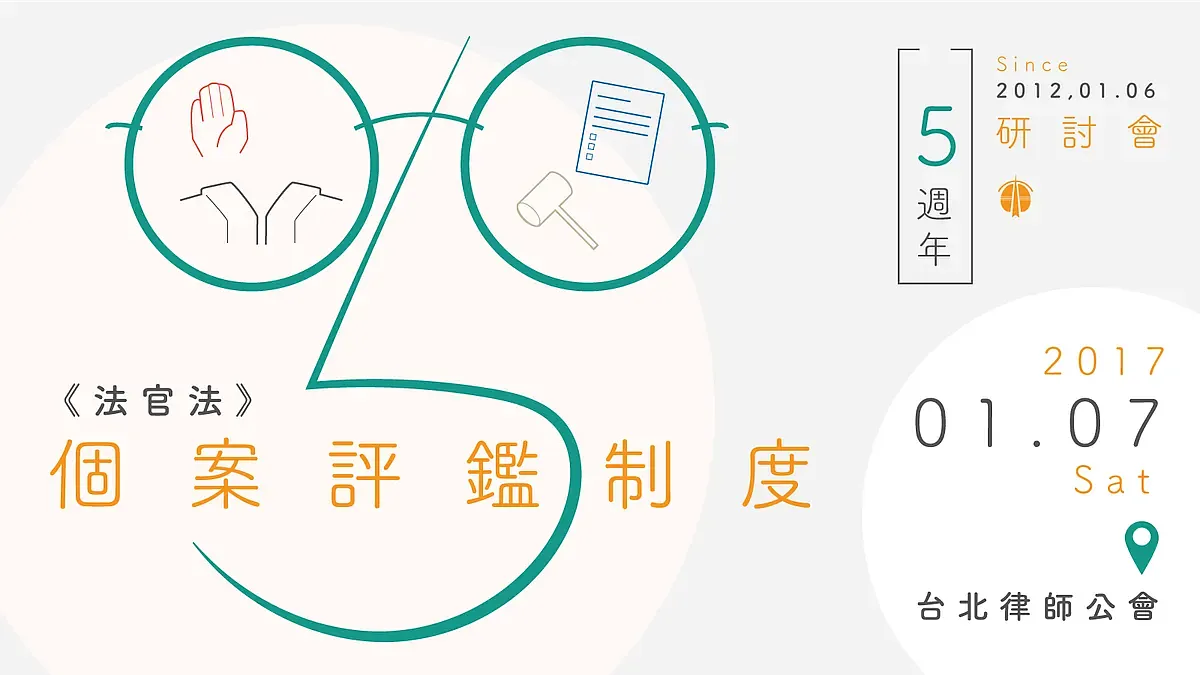
Seminar | Seminar on the Individual Case Evaluation System and the Supervision of Judges and Prosecutors
Last edited: 2026-07-27
The Judges Act was enacted and promulgated on July 6, 2011. The legalization of the individual case evaluation system can be considered one of the key features of the Judges Act. Its mission is to initiate subsequent disciplinary or administrative penalty procedures based on the severity of individual misconduct by judges and prosecutors, in order to determine the appropriate sanctions for those involved in misconduct, with the legislative objective of enhancing public trust in the judiciary.
In May 2016, the Judicial Reform Foundation launched the "National Judicial Reform Campaign," inviting the public to vote and select judicial issues urgently in need of resolution. The voting results showed that the "lack of clear and objective review standards to weed out truly unfit judicial officers" made the list, reflecting doubts among judicial practitioners and the general public regarding the individual case evaluation system and even the practical effectiveness of the disciplinary and supervisory systems for judges and prosecutors: What exactly do the people mean by "unfit" judges and prosecutors? Can the current individual case evaluation system screen out truly unfit judges and prosecutors, or does it cause a reverse selection effect?
Since the "Individual Case Evaluation System" under the Judges Act came into effect on January 6, 2012, it has accumulated a certain number of evaluation resolutions for public review. Have the review standards developed by the Judges and Prosecutors Evaluation Commissions been sufficiently concrete and clear? Do they help construct observational indicators for "unfitness"? What is the relationship between the Judges and Prosecutors Evaluation Commissions and the Control Yuan's impeachment, the Judicial Yuan's Personnel Review Committee, and the Prosecutor's Personnel Review Committee? Furthermore, does the implementation of the individual case evaluation system help establish an effective supervisory mechanism for judges and prosecutors? Therefore, the Judicial Reform Foundation and the Judicial Reform Committee of the Taipei Bar Association are jointly holding this seminar, gathering representatives from the bench, prosecution, defense, and academia. Your critical feedback and guidance are warmly welcomed.
時間
2017 年 1 月7 日 (六)14:00-17:00
地點
台北律師公會(台北市中正區羅斯福路一段7號9樓)
與會者
主持人
林永頌/民間司法改革基金會董事長
報告人
高榮志/民間司法改革基金會執行長
黃齡萱/民間司改會執行秘書
與談人
蔡博方/臺北醫學大學醫學人文研究所 助理教授
王金壽/成功大學政治學系 教授
姜世明/國立政治大學法學院特聘教授
林振煌/中華人權協會理事兼法律服務委員會主委
林三元/司法院司法行政廳副廳長
施泓成/律師、台北律師公會代表
吳萃芳/台灣高等法院台中分院檢察署主任檢察官
流程
| 時間 | 議程 | 主持人/報告人/與談人 |
| 13:50~14:00 | 報到 | -- |
| 14:00~14:10 | 主持人開場 | Lin Yung-sung / Chairman, Judicial Reform Foundation |
| 14:10~14:40 | 民間司改會年度觀察報告發表 | Kao Jung-chih / Executive Director, Judicial Reform Foundation Huang Ling-hsuan / Executive Secretary, Judicial Reform Foundation |
| 14:40~15:25 | 與談(一) | -- |
| 15:25~15:35 | 中場休息 | -- |
| 15:35~16:35 | 與談(二) | -- |
| 16:35~17:00 | 現場發問及回應 | 全體與會者 |
主辦
台北律師公會司法改革委員會
民間司法改革基金會
This article is an AI-generated translation of the original Chinese text. In the event of any discrepancy, the Chinese version shall prevail.