
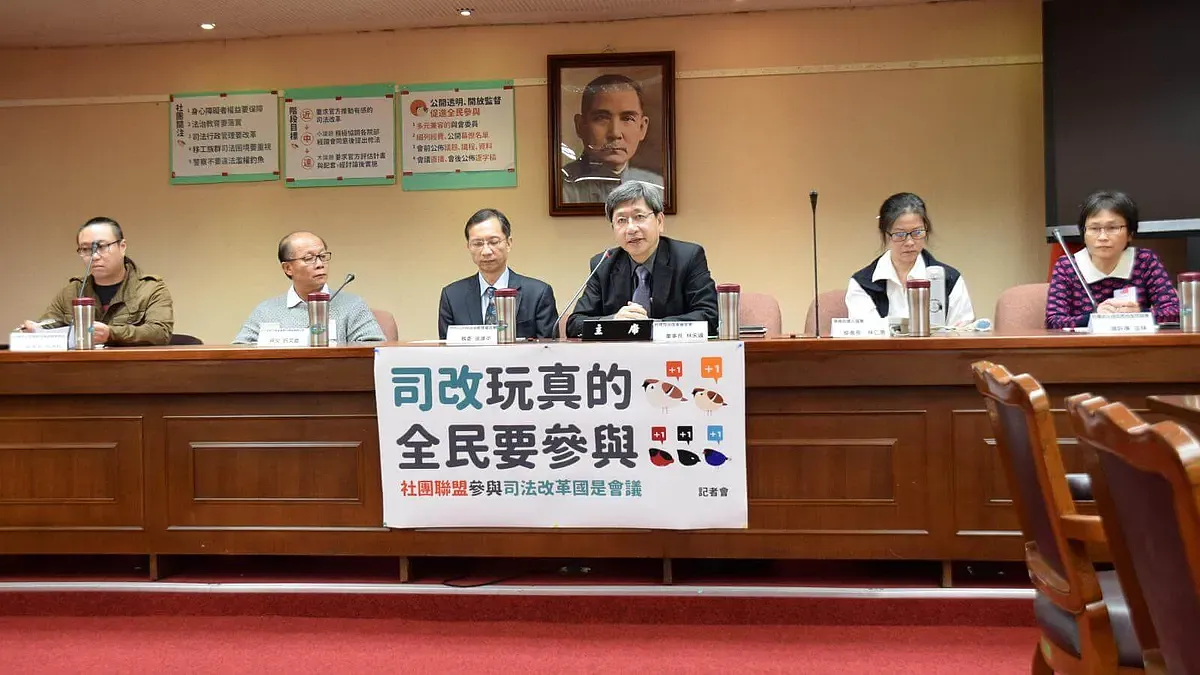
Judicial Reform Means Business, Public Participation is Essential: CSO Coalition Joins the National Official Conference on Judicial Reform
Last edited: 2026-07-27
The first phase of soliciting public opinions for the National Official Conference on Judicial Reform is nearing its end. However, whether through the Office of the President's online collection or physical submissions via mail and the Legal Aid Foundation, public response to the Conference has felt insufficiently enthusiastic. To prevent the judicial reform from falling short due to a lack of public participation, civil society organizations have formed a coalition to engage in the National Official Conference on Judicial Reform and actively invite the general public to make their voices heard.
-
Promoting Public Participation and Expression
The Coalition demands that official authorities take a more proactive, expansive, and active approach to publicize the National Official Conference on Judicial Reform. For example, when the Judicial Yuan allocated tens of millions of dollars in budgets a few years ago to promote the "lay participation system" (Guan-Shen-Zhi), a nationwide judicial reform conference carries even greater significance. The Coalition demands that the Office of the President, the Judicial Yuan, and the Ministry of Justice all step up their advocacy efforts to gather judicial reform opinions from the entire populace, making the collection of reform issues and public participation more comprehensive.
At the same time, the Coalition demands greater openness and transparency in the proceedings to allow external participation and oversight. Specifically:
- The Coalition demands that subsequent members of the sectional committees strike a balance of diversity and inclusivity, with active speakers participating, and that stakeholders of specific issues be allowed to register independently, minimizing the selection or election of representatives by institutional quotas to prevent departmental egotism;
- Before issues for sectional meetings are finalized, they must first be publicized to allow all sectors to express their opinions, and the same applies before issues are discussed and moved to the plenary meeting; r
- Prior to relevant meetings, agendas and meeting materials should be released in advance, meetings should be live-streamed with public interaction to foster citizen participation, and verbatim transcripts of the meetings must be published afterwards; r
- Resources from relevant departments such as the Office of the President, the Judicial Yuan, and the Ministry of Justice should be invested, allocating appropriate staff and funding. In addition to publishing staff lists for oversight, civil society individuals should also be invited to serve as staff.
-
The Coalition Believes Judicial Reform Should Be Divided into Three Stages
The Coalition believes that the judicial reform plan should consist of three stages:
- Short-term plan: Urging authorities to promote immediate, tangible judicial reforms (e.g., the court interpreter system). Therefore, the Coalition will subsequently visit the President of the Judicial Yuan and the Minister of Justice to demand immediate action on issues where a consensus has already been reached.
- Medium-term plan: Intended to actively coordinate among various branches and ministries on issues with narrower impacts, and propose amendments after obtaining parliamentary approval (e.g., reforming the evaluation mechanism under the Judges Act).
- Long-term plan: For more macroscopic judicial reform issues, authorities will first be asked to formulate assessment plans and implement them only after thorough discussion and配套 (complementary measures) (e.g., establishing a system of public participation in trials).
-
Judicial Reform Opinions Concerning Various CSO Coalition Members
To make the collection of judicial reform opinions more comprehensive, representatives of various civil society organizations at the press conference will present judicial issues from their respective fields—such as legal education, rights of persons with psychosocial and physical disabilities, judicial administration and management, migrant workers and immigrant communities, illegal police entrapment, and more. Following the press conference, these judicial reform opinions will be posted on the Office of the President's National Official Conference on Judicial Reform website to convey civil society opinions to the authorities and spark public attention toward the National Judicial Conference.
-
The National Official Conference on Judicial Reform is a Movement for All Citizens
The 2016 National Official Conference on Judicial Reform is personally convened by the President, calling for judicial reform. Since the President is willing to inject political energy into judicial reform, it will possess greater momentum for judicial reform compared to the judicial reform conference convened by the Judicial Yuan in 1999. The Coalition calls on authorities to seize this opportunity for judicial reform, invite public participation, and turn judicial reform into a movement for all citizens, thereby building a judicial system that belongs to the people, responds to their needs, and earns their trust.
Civil Society Organization Representatives in Attendance
中華民國智障者家長總會 (Parents' Association of Persons with Intellectual Disabilities, R.O.C.) / Deputy Secretary-General Sun I-hsin
天主教新竹教區越南外勞配偶辦公室 (Hsinchu Diocese Migrant and Immigrant Service Center) / Father Nguyễn Văn Hùng
社團法人台北市心生活協會 (Taipei New Life Association) / Secretary-General Chin Lin
社團法人台灣永社 (Taiwan Forever Association) / Executive Secretary Hung Chung-yen
台灣酷兒權益推動聯盟 (Taiwan Queer Rights Promotion Alliance) / Secretary-General Hu Sheng-hsiang
台灣冤獄平反協會 (Taiwan Association for Innocence) / Executive Director Lo Shih-hsiang
民間公民與法治教育基金會 (Association for Public Advocacy and Civil Education) / Executive Committee Member Chang Tse-ping
環境法律人協會 (Environmental Jurists Association) / Secretary-General Lin Jen-hui
民間司法改革基金會 (Judicial Reform Foundation) / Chairperson Lin Yung-sung
民間司法改革基金會 (Judicial Reform Foundation) / Executive Director Kao Jung-chih
Coalition Member Organizations
Covenant Watch
Parents' Association of Persons with Intellectual Disabilities, R.O.C.
Taiwan Alliance Against Forced Evictions
Hsinchu Diocese Migrant and Immigrant Service Center
Debt Debtors Self-Help Association
Taiwan Association for Innocence
Taiwan Jury Promotion Association
Taipei New Life Association
Taiwan Association for Human Rights
Taiwan Forever Association
Taiwan Queer Rights Promotion Alliance
Taiwan Alliance to End the Death Penalty
Nanyang Taiwan Sisterly Association
Association for Public Advocacy and Civil Education
Legal Aid Foundation
Open Culture Foundation
Judicial Reform Foundation
Environmental Jurists Association
Press Contact
Judicial Reform Foundation Executive Director Kao Jung-chih 02-25231178
Attachments
- Statement by Environmental Jurists Association
- Statement by Taiwan Queer Rights Promotion Alliance
Environmental Jurists Association Representative Proposes Three Recommendations
By / Environmental Jurists Association Secretary-General Lin Jen-hui
-
Emulating the mechanism of the Financial Supervisory Commission's prosecutor's office, station prosecutors within the Environmental Protection Administration (EPA) to strengthen the connection between the EPA and judicial authorities.
Many environmental cases involve conglomerates, such as Formosa Plastics' air and soil pollution and China Steel's furnace slag and dust collection ash, which ultimately fizzled out. This is related to the initial lack of prosecutorial intervention to assist in evidence collection and the support of independent judicial investigations. To cope with air pollution by large corporations, Mexico established an Office of the Environmental Protection Prosecutor, granting it administrative investigative, reporting, and criminal prosecutorial powers. Although Taiwan is a civil law jurisdiction and cannot bestow excessive administrative powers upon prosecutors, stationing prosecutors to provide consultation and assistance in referring cases for prosecution might make environmental criminal cases involving large corporations, as well as administrative inspections, more effective.
- Amend the provisions concerning the stay of execution in administrative litigation laws. The current law adopts the principle that "filing an action shall not stay the execution," but we hope to amend it to "a stay of execution shall be the principle, and non-stay shall be the exception" to prevent the execution of unlawful administrative dispositions from infringing upon people's rights.
- Promptly establish specialized environmental divisions in accordance with Article 14 of the Environmental Basic Act—"Courts may establish specialized divisions or designate specialized personnel to handle environmental protection dispute cases."
Statement by Taiwan Queer Rights Promotion Alliance
By / Taiwan Queer Rights Promotion Alliance Secretary-General Hu Sheng-hsiang
Recently, President Tsai announced the list of members for the Preparatory Committee of the National Official Conference on Judicial Reform. Regardless of how impressive the list may look, no selection process was visible, which is truly disappointing. However, marginalized and stigmatized issues have long been neglected. A black-box judicial reform could worsen this disregard, indirectly reducing judicial reform to a mere formality that fails to serve its purpose.
Over the past decade, we have campaigned for the repeal of Article 29 of the Child and Youth Sexual Exploitation Prevention Act. In recent years, issues and groups facing marginalization and stigmatization—such as those related to the Narcotics Hazard Prevention Act, drug users, sexual minorities, persons with mental disabilities, or individuals with intersectional identities such as mentally disabled sexual minorities—not only receive insufficient attention but are also vulnerable to rights violations caused by the judiciary's lack of understanding. Clearly, judicial reform is urgently needed.
We raise three issues and dilemmas of concern, hoping that President Tsai will take such judicial reform needs seriously:
-
Article 29 of the Child and Youth Sexual Exploitation Prevention Act
The legislative intent of this provision is to protect children and youth. In practice, however, we have encountered many instances where neither party is a child or youth, yet they are still prosecuted. These cases involve police officers arbitrarily determining that online nicknames have sexual implications, inducing victims to agree to a transaction price proposed by the police, and conducting off-site arrests. Such police practices exploit the stigma of sex work to force parties into submission, ignoring procedural rules that forbid proactive entrapment and solicitation. Moreover, during the interrogation process, parties are frequently subjected to police coercion and inducement. If a party fails to cooperate, police will interrupt the audio and video recording and re-record the statement, leading trial outcomes to lean heavily toward the presumption of guilt.
-
The Narcotics Hazard Prevention Act and Drug Users
The government adopts a high-pressure, containment policy toward drugs and drug users, resulting in severe stigmatization and labeling of drug users. We once handled a "drug case where a gay man was referred to authorities through police entrapment." In that case, a police officer disguised himself as a gay man on an app to randomly scout for targets. Once the subject expressed willingness, the police officer immediately asked whether drug transactions could be provided. However, the subject stated that he had not used drugs for many years and had no drugs on him. Yet, at the police's request, he ultimately brought drugs to the rendezvous and was arrested as a flagrante delicto offender by plainclothes police officers, even though his urine test result was negative.
In the past, numerous cases have shown that police failed to follow procedures during law enforcement, resulting in prosecutors issuing non-prosecution dispositions upon referral to the prosecutors' offices. Clearly, police officers frequently fail to follow procedures, or even break the law, when enforcing the law.
-
Sexual Minorities
Sexual minorities often need to conceal their identities due to a lack of understanding from society or their families. When facing litigation, however, they are frequently forced to out themselves. When compounded by cases involving the Child and Youth Act, drug charges, or when the individual is an HIV carrier, they are even more vulnerable to double stigmatization, leaving them powerless to defend themselves. Therefore, it is clear that the judiciary still lacks sufficient understanding of sexual minorities.
Based on the three points explained above, we hope that the National Judicial Conference convened by President Tsai Ing-wen will address the expectations and needs of all people rather than being a superficial judicial reform. Thank you.
Summary of Remarks
Judicial Reform Foundation / Chairperson Lin Yung-sung
The collection of opinions for the Office of the President's judicial reform began in November, but the response has been lukewarm. Society holds various voices and judicial problems that cannot be understood merely by consulting judges, prosecutors, and defense attorneys. The Coalition hopes that authorities will actively publicize and gather opinions, allowing the people's opinions to enter the core of discussion.
The first preparatory meeting released only meeting minutes. Judicial reform must communicate with the people and allow public opinions to interact with the conference meetings. We hope the National Official Conference on Judicial Reform achieves the following points: First, agendas and attachments should be publicized in advance so the public can express their opinions; second, meetings should be live-streamed on the day of the session to interact with the public, ensuring that reform outcomes are understood by the public and allowing them to provide opinions and criticisms, with post-meeting records also published; third, sectional preparatory committee members must be diverse and inclusive rather than serving as institutional representatives, to prevent departmental egotism; fourth, civil society staff should be incorporated into the conference's staff team.
For judicial reform to succeed, the Judicial Yuan and the Ministry of Justice should not merely put forward a few major issues; opinions raised by the people, regardless of their scale, are important judicial reform issues, and many can be resolved immediately. For example: reforming the court interpreter system and ensuring the implementation of the principle of non-disclosure of investigations. Issues with a broader scope can then enter the National Official Conference on Judicial Reform.
Association for Public Advocacy and Civil Education / Executive Committee Member Chang Tse-ping
Society is changing rapidly. For instance, regarding the amendment for same-sex marriage, there was clear polarization this year. Judicial reform and civil society interaction have become increasingly difficult, and public opinion is hard to grasp. The previously silent majority is now voicing opinions through the media. Ultimately, the root lies in education; education must appropriately provide rational critical thinking and communication learning methods. If all sectors are to have the enthusiasm to promote judicial reform, two key points must be grasped: first, full debate is the true driving force behind reform; second, a judge's sentiment of justice may be eroded by busyness. Laws are enacted with justice as their appeal, and the concept of justice must be put into practice.
Hsinchu Diocese Migrant and Immigrant Service Center / Father Nguyễn Văn Hùng
Father Nguyễn Văn Hùng stated that Taiwanese government agencies still lack concrete solutions when dealing with language barriers faced by migrant workers. For instance, when making police records at police stations, because police and investigative units are not proficient in Vietnamese, they can only ask acquainted foreign spouses to assist. However, foreign spouses have limited legal knowledge, making it easy for meanings to be expressed unclearly and creating communication barriers between victims and the police.
Taiwan's interpretation system currently faces several problems. First, although Taiwan has a judicial interpreter database, due to insufficient training, interpreters sometimes inject their personal opinions into translations, confusing the true intentions of investigators and parties. Second, while foreign spouses can assist with simple conversations, their professionalism is clearly insufficient, making them unsuited to serve as interpreters. Third, while NGO organizations can provide timely assistance, given limited manpower, it is impossible for them to show up for support every time. The government should pay more attention to the field of interpretation rather than leaving NGO groups and police-investigative units to tug-of-war with each other.
Within the judicial system, migrant workers and spouses face a rather unfriendly environment. We hope the National Official Conference on Judicial Reform will incorporate migrant worker issues into discussions, foster more dialogue, and improve the harsh plight of migrant workers and foreign spouses in Taiwan.
Taiwan Queer Rights Promotion Alliance / Secretary-General Hu Sheng-hsiang
Secretary-General Hu Sheng-hsiang stated that seeing President Tsai announce the list of members for the Preparatory Committee of the National Official Conference on Judicial Reform—regardless of how impressive the list may look—we could not see the selection process. A non-public and opaque process is disappointing. Marginalized and stigmatized issues have long been neglected. Under such a premise, judicial reform is tantamount to a black-box, which may worsen the state of neglect and indirectly cause judicial reform to be merely formalistic and fail to function.
Over the past decade, we have campaigned for the repeal of Article 29 of the Child and Youth Sexual Exploitation Prevention Act. In recent years, we have advocated for issues and groups facing marginalization and stigmatization, such as the Narcotics Hazard Prevention Act, drug users, sexual minorities, persons with mental disabilities, or individuals with intersectional identities such as mentally disabled sexual minorities. However, these issues are not favored by the media and are even more vulnerable to rights violations due to the judiciary's lack of understanding. Clearly, judicial reform is urgently needed for the groups we care about.
We raise three issues and dilemmas of concern, hoping that President Tsai will take such judicial reform needs seriously: First, repeal Article 29 of the Child and Youth Sexual Exploitation Prevention Act; second, reform police violations in entrapment drug cases and the arbitrary determination of drug charges; third, address the issue of sexual minorities being forced to out themselves during police questioning and court appearances.
Taipei New Life Association / Secretary-General Chin Lin
Secretary-General Chin Lin stated that we are a service organization for persons with psychosocial disabilities. The psychosocially disabled demographic requires something akin to interpretation assistance in the judiciary to help express themselves and proceed with cases, yet there is no institutionalized assistance within the judicial system. Within the prison administration system, whether inmates with mental illnesses receive treatment remains a question. Taiwan lacks a professional consultation hotline for drug prevention; people surrounding addicts may lack professionals to consult for early cessation and treatment. A lot of assistance is also needed during rehabilitation, and Taiwan lacks such community services and employment counseling.
If the National Official Conference on Judicial Reform can be publicized, with opinions unconditionally accepted first and then reviewed by legal professionals, and if the public is encouraged to speak up, one would be surprised to find how many things were overlooked in the past, and everyone could then work together to make various systems better.
Environmental Jurists Association / Secretary-General Lin Jen-hui
Secretary-General Lin Jen-hui stated that Taiwan is seeing an increasing number of environmental pollution cases, such as air pollution, soil pollution, and slag contamination, yet these cases often fizzle out within the judicial system. The Association proposes three points: First, to avoid insufficient prosecutorial evidence collection and professional support, station prosecutors within the EPA to strengthen the connection between the EPA and judicial authorities; second, environmental cases are time-consuming and often require petitions for temporary suspension of development, but such petitions are frequently rejected. Provisions concerning the stay of execution in the administrative litigation system should be amended to "a stay of execution shall be the principle, and non-stay shall be the exception" to prevent the execution of unlawful administrative dispositions from allowing development facts to occur and infringing upon people's rights; third, judges are unfamiliar with environmental regulations, which requires incorporating environmental education into their training, and specialized environmental divisions or designated personnel should be promptly established in courts pursuant to Article 14 of the Environmental Basic Act to avoid misjudgments.
Taiwan Association for Innocence / Executive Director Lo Shih-hsiang
Executive Director Lo Shih-hsiang stated that he is full of expectations for the National Official Conference on Judicial Reform, but many issues do not necessarily have to be elevated to the plenary conference to begin reforms. For example, the Ministry of Justice's establishment of a conviction-review panel to re-examine finalized guilty verdicts is commendable.
Authorities have historically avoided using the word "wrongful conviction," opting instead for terms like retrial cases and extraordinary appeal cases to refer to miscarriage cases. The Chiang Kuo-chi (Chiang Kuo-ching) case was also granted a retrial resulting in a not-guilty verdict, and retrials have no statute of limitations. The fact that miscarriages of justice targeting the innocent have taken root in the judicial system cannot be denied. Many cases have proven to be misjudgments and wrongful convictions, but a miscarriage case does not end with a not-guilty verdict; compensation must also be provided to the wrongfully accused. For judicial reform to be felt, for cases proven to be misjudgments, those in power should give the wrongfully accused defendants and their families more care and support, such as a public apology from a judge.
Forensic science quality should also be upgraded; the frequent lack of forensic science is often a cause of wrongful convictions. We hope to promote science-based judicial reform rather than letting it degenerate into ideological battles or battles over study-abroad countries.
Taiwan Forever Association / Executive Secretary Hung Chung-yen
Hung Chung-yen stated that Taiwan Forever Association wishes to emphasize the judicial administration aspect, such as case allocation, audio recording, procedures, and appraisal procedures. We hope to introduce scientific methods and talents to improve the procedures and efficiency of judicial administration. Regarding judges' workloads, we hope for clear statistics incorporating scientific and managerial methods rather than legal professionals daydreaming on their own. In subsequent judicial reform processes, professional talents should be broadly incorporated rather than remaining confined to judicial trials themselves.
This article is an AI-generated translation of the original Chinese text. In the event of any discrepancy, the Chinese version shall prevail.