
JRF Newsletter
At a Crucial Juncture for Marriage Equality in Taiwan, Looking at LGBT in China
Last edited: 2026-07-27
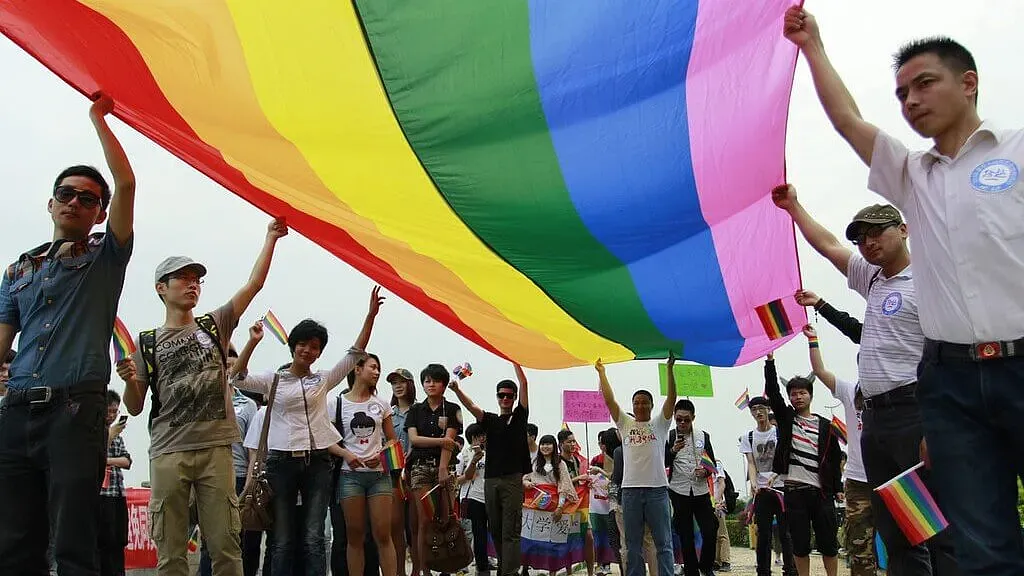
Photo/Ch'en Ch'iang May 17, 2013, International Day Against Homophobia, a summer gay anti-discrimination street parade held in Changsha, Hunan, China.
On the morning of December 26, tens of thousands of citizens gathered outside the Legislative Yuan, witnessing through live broadcasts the historic moment when the marriage equality bill was sent out of the Judiciary and Organic Laws and Statutes Committee after long-term promotion and efforts by various political parties. Many countries around the world are also watching the future progress of the bill. This issue's e-newsletter features an interview with friends in China dedicated to LGBT rights. At this critical juncture for gender equality in Taiwan, we also examine gender equality in China.
Homosexuality under the "Catch-All Crime"
From 1983 to 1996, the Chinese Ministry of Health classified homosexuality as a "psychopathological mental disorder." "Homosexual acts" in public places or involving crowds could be classified as the crime of hooliganism—for example, homosexual acts in public restrooms, or simply gatherings and socializing in bars or dance halls, could all lead to criminal prosecution under the crime of hooliganism.
Article 160 of the Criminal Law of the People's Republic of China: "Whoever gathers crowds to engage in brawls, picks quarrels and provokes trouble, insults women or engages in other hooliganism, disrupting public order, and circumstances are serious, shall be sentenced to fixed-term imprisonment of not more than seven years, criminal detention or public surveillance."
The crime of hooliganism was considered a "catch-all crime" in China because its provisions were vague and ambiguous, and its actual implementation was full of arbitrariness. As a saying went: "The crime of hooliganism is a basket, and any crime can be stuffed into it." Although there were no explicit legal provisions, in the Chinese society of that time, it was not uncommon for homosexuals to be subjected to fines, detention, re-education through labor, and dismissal from public office under the charge of hooliganism.
It was not until 1997 that the criminal law was amended to abolish the crime of hooliganism, an event considered a milestone in the decriminalization of homosexuality in China. The revision of the "Chinese Classification and Diagnostic Standards of Mental Disorders" in 2001 finally stopped classifying homosexuality as a disease.
Invisible Sexual Minorities
After 1997, although the law no longer regarded homosexuals as "hooligans," society generally held an aversion toward non-heterosexuals, and there was basically no awareness or visibility of lesbians, bisexuals, and transgender people. Under such circumstances, LGBT individuals had to learn to hide themselves in their daily lives, studies, and interpersonal interactions. The greatest pressure usually came not from outsiders' judgments, but from the guilt and anxiety toward their families of origin for failing to meet their relatives' expectations. Due to traditional notions of starting a family, establishing a career, and continuing the family line, non-heterosexuals were forced to enter into marriages, making "formal marriage" the only exit.
"Formal marriage," abbreviated as xinghun, is a mutual aid marriage model that has emerged in recent years, where both parties may consist of people who prefer not to marry, or a gay man and a lesbian. On the surface, it is a "normal family" composed of a man and a woman; but in reality, the two parties do not have a substantive "husband and wife" relationship, with the purpose being to use the form of marriage to fend off traditional social or external pressures.
The interviewed friends stated that the cases they generally handle the most are those related to formal marriages and partner rights issues. Because the marriage system encompasses a wide variety of rights and obligations, formal marriages also carry certain risks. The friends shared an incident from the local community: a lesbian and a gay man entered into a formal marriage. Unexpectedly, shortly after the wedding, the "husband" was hospitalized for a long term due to an accident, leaving the "wife" obligated to care for him. After the "husband" passed away, the "wife" was also obligated to care for the "husband's" parents, with no recourse even if she told others it was a "formal marriage."
Although formal marriages may carry various risks, quite a large number of people in China still enter into formal marriages every year.
Marriage Equality in China
Because the LGBT community is relatively marginalized in society, lacking attention and understanding—let alone effective legal remedy channels—with the growth of gender awareness in recent years, many Chinese lawyers and legal workers have gradually become aware of the legal needs faced by the LGBT community. Teams composed of lawyers and legal workers have begun to emerge across various regions to provide legal consultation and assistance to LGBT individuals. Lawyers friendly to the LGBT community like this are known as "rainbow lawyers."
 Photo/Members of the public waiting in line at the scene to enter the courtroom to observe China's first successfully accepted and filed same-sex marriage registration case.
In June 2015, Sun Wen-lin (孫文麟) and his boyfriend Hu Ming-liang (胡明亮) went to the Changsha Civil Affairs Bureau to apply for marriage registration. After being rejected by the staff, they filed a lawsuit against the Civil Affairs Bureau for "administrative inaction," assisted by lawyers from the Rainbow Lawyers Group. The case was accepted in January 2016, marking the first same-sex marriage registration case successfully accepted and filed by a court in China. Regardless of victory or defeat, it holds historical significance.
When the court held a public trial in April 2016, nearly two hundred members of the public came to the scene to observe, including media reporters, the gay community, and supporters of gay rights. The trial lasted two and a half hours, with the core of the debate between the two sides focusing on the interpretation of "monogamy" in the Marriage Law.
Chapter 1, Article 2 of the Marriage Law of the People's Republic of China: "A marriage system based on the freedom of marriage, monogamy, and equality between men and women shall be applied. The lawful rights and interests of women, children, and the elderly shall be protected."
The attorneys representing Sun Wen-lin and his boyfriend Hu Ming-liang argued that China's Marriage Law does not "prohibit" parties of the same biological sex from going to the civil affairs bureau to register for marriage. They also argued that "monogamy" in the provisions does not mean "one man and one woman," but rather the concept of a "one-to-one" relationship, rather than restricting only one man and one woman from registering for marriage.
The representing attorneys also argued that marriage registration is not an "administrative permission," but should be an "administrative confirmation." Administrative permission refers to the need for the government to determine qualifications and permit an action before it can be carried out, such as the development of natural resources. Administrative confirmation, on the other hand, is a state where a fact already exists, and the government only needs to recognize that factual state—for instance, when a traffic accident occurs, the traffic accident determination certificate issued by the police is a type of administrative confirmation. Under this logic, the partnership between Sun Wen-lin and his boyfriend Hu Ming-liang was a pre-existing fact rather than something that occurred only after government permission; it merely required government confirmation of the existence of this relationship.
The attorney for the Civil Affairs Bureau stated: "If you find a thousand people, a thousand people will also feel that the Marriage Law is for one man and one woman. Even if the monogamy system were changed, in the future it would be one woman and many men, or one man and many women, and it will not be homosexuals."
After several rounds of debate between the two sides, the court seemingly went through all procedures earnestly, and the judge adjourned the session to take a recess. After a recess of more than ten minutes, the judge ultimately dismissed the plaintiffs' claims and pronounced the plaintiffs' defeat right there in court. Many people believed the judgment may have been written in advance before the trial even began, as it is quite rare in Chinese trials for a verdict to be pronounced on the very day of the court hearing.
Gender Equality in China
In addition to same-sex partner marriage registration cases, there have been other cases related to gender identity and sexual orientation in recent years. From these cases, one can witness the various predicaments faced by the LGBT community in China.
Conversion Therapy Cases

Due to society's widespread prejudice and discrimination against homosexuality—although homosexuality was long ago removed from the list of mental illnesses in the third edition of the Chinese Classification and Diagnostic Standards of Mental Disorders (CCMD-3) in 2001—many gay individuals are often forced to "correct" themselves due to pressure. Today, "conversion therapy" institutions remain quite common across Chinese streets and alleys. Although these agencies are well aware that "homosexuality correction" has no scientific basis, market profits continue to drive them to keep performing conversion therapy.
In 2014, the LGBT Rights Advocacy China assisted in the first "homosexuality correction" lawsuit case in China. The client, Hsiao-chen (小振), was a gay man who faced immense psychological pressure because his parents constantly urged him to marry. Consequently, he found a psychological counseling advertisement for "correcting homosexuality" by the Chongqing Xinyu Piaoxiang Psychological Counseling Center on the Baidu website, and went for consultation and treatment. Xinyu Piaoxiang claimed to Hsiao-chen that "homosexuality can be successfully cured through conversion therapy" and subjected Hsiao-chen to electroshock therapy, but the results produced no effect at all. After returning to Beijing, Hsiao-chen filed a lawsuit against Xinyu Piaoxiang.
In December 2014, the court's first-instance judgment ruled that Xinyu Piaoxiang must publicly apologize to Hsiao-chen and pay compensation, with the judgment explicitly stating that "homosexuality is not a mental illness." This judgment judicially confirmed that "homosexuality correction" is an illegal act. However, even with a winning judgment, due to government departments kicking the ball to each other, no unit has actively handled these illegal conversion therapy agencies to this day, and psychological counseling centers that correct homosexuality still widely exist in China.
Homophobic Textbook Cases

Ch'iu Pai (秋白) was a lesbian and a university student. While reading psychology textbooks, she discovered that many university psychology textbooks treated homosexuality as a "mental illness" or "perversion," which had a huge negative impact on her. In early 2015, she applied for "information disclosure" to the Ministry of Education regarding this matter in accordance with China's "Regulations on Open Government Information," hoping the Ministry of Education would respond and explain what the government's supervisory and management responsibilities are regarding textbooks used by schools. However, the Ministry of Education failed to fulfill its information disclosure duties to respond to Ch'iu Pai within the time limit. To stop and correct these erroneous textbooks that discriminate against homosexuals, Ch'iu Pai filed a lawsuit against the Ministry of Education for "administrative inaction."
After Ch'iu Pai filed her first lawsuit against the Ministry of Education, the Ministry promised there would be a designated channel to help her resolve the issue, so the two sides reached a settlement. However, when she reported the issue according to the method promised by the Ministry of Education, the Ministry still took no action regarding these homophobic textbooks. In early 2016, she had no choice but to sue the Ministry of Education for a second time. On the day of the hearing, many concerned supporters came to support her action, and the media also live-streamed that day's court hearing.
Ultimately, the court dismissed Ch'iu Pai's claims on the grounds that her demand requested the Ministry of Education to fulfill the correction of errors in textbooks, whereas the court deemed that this request had no legal interest concerning her. This case is currently still in the appeal process.
Transgender Employment Discrimination Cases

Mr. C is a transgender man. In April 2015, after a brief interview with the personnel manager, Mr. C joined the Guiyang Ciming Medical Examination Center to work. However, after Mr. C had worked for 9 days, the personnel manager discovered his biological sex was female while his dress and appearance were masculine, mistakenly believing he was homosexual, and dismissed him on the grounds of "affecting the company's image." Mr. C provided recording evidence to prove the personnel manager's statements.
In March 2016, Mr. C applied for labor arbitration with the Labor Dispute Arbitration Commission, requesting the company to pay wages and confirm that the company's illegal dismissal warranted compensation. The company responded that "Mr. C was dismissed because he was unwilling to wear the work uniform and failed to meet the recruitment conditions during the probation period." Ultimately, the labor arbitration only agreed to the request for wage payment and did not accept that the company's dismissal was illegal.
The case is currently still in the first instance at the court. One highlight worth mentioning is that during the second court hearing, an expert on anti-employment discrimination research from China University of Political Science and Law was requested to testify in court, explaining to the judge whether the company's actions involved implicit employment discrimination. This marked the first time in an employment discrimination case that an expert witness was allowed to take the stand to explain professional opinions on employment discrimination.
The Law Cannot Serve Prejudice
Different sexual orientations are, for society, a concrete manifestation of human diversity; for the individual, they belong to equally enjoyed, independent individual traits. They are not standards for judging a person's character and abilities, but personal privacy completely unrelated to work ability. That everyone is free from discrimination based on sexual orientation is an inherent meaning of human dignity and the bottom line of justice upheld by the law.
In China, the fundamental reason why LGBT individuals encounter various unequal treatments and pressures stems from invisibility; because they are invisible, it is even harder for them to be understood, and all kinds of stigmas and labels follow closely, making them hard to shake off. Although these cases are merely the tip of the iceberg, it is through one judicial lawsuit after another that the LGBT community can emit a faint voice, presenting a portion of their difficult plight into the public view and forcing society to confront and discuss the living conditions of LGBT individuals.
Although law may not be able to make men change their hearts, it can be used to stop them from doing it; and can be used to stop them from making their prejudices a power that, directly or indirectly, injures others.
In Taiwan, the discussion and review process of the marriage equality bill have received high attention from the LGBT community in China. Although our discourse on LGBT issues and the protection of gay rights still have room for improvement, we are already a relatively friendly society toward LGBT in East Asia. It is hoped that Taiwan can successfully become the first country in Asia to legalize same-sex marriage, raising the wind of equality and freedom, blowing westward to China, and stirring the advancement of LGBT-related rights in China until the rainbow is ushered in.
 Photo/Supporters of the marriage equality bill show their support in front of the Legislative Yuan on December 26, 2016.
This article is an AI-generated translation of the original Chinese text. In the event of any discrepancy, the Chinese version shall prevail.