
Observation Report on the Five-Year Anniversary of the Individual Judicial Evaluation System under the Judges Act
Last edited: 2026-11-03
Data Download Full Report, Slides
I. Introduction
On June 14, 2011, the Legislative Yuan passed the Judges Act in its third reading. The institutionalization of the individual judicial evaluation system is one of the key features of the Judges Act. Its mission is to target individual misconduct by judges and prosecutors, initiating subsequent disciplinary or administrative punishment procedures based on the severity of the misconduct to determine the appropriate sanctions for the involved judges and prosecutors.
The catalyst that brought the Judges Act into being—after years of deliberation and nearly being stillborn—was a series of judicial events in 2010, such as successive judge bribery scandals and discrepancies between child sexual assault verdicts and public expectations, which plunged the judicial system into a severe crisis of trust. Against this backdrop, the individual judicial evaluation system was tasked with effectively eliminating incompetent judges and prosecutors, maintaining judicial ethics, and thereby enhancing public trust in the judiciary[1].
Comparing this with the historical context of 1988 when the Judicial Yuan began deliberating the Judges Act—at which time Taiwan was still under authoritarian rule—it was expected that by introducing the Judicial Tribunal and designing elaborate disciplinary procedures, judges could be protected from arbitrary discipline, thereby ensuring judicial independence free from interference. The core value of the Judges Act has undergone a dramatic transformation over this 23-year legislative process[2].
However, judging from provisions such as the strict restriction on the qualifications of individual evaluation requesters[3] and the highly complex design of disciplinary procedures[4], preventing judges and prosecutors from arbitrary discipline or evaluation remains a value affirmed and pursued by the Judges Act. Whether to conceptualize the normative design of the individual judicial evaluation system from the perspective of an "elimination mechanism" or a "status-protection mechanism" has been a subject of relentless debate, stretching from the power struggles over the draft Judges Act to the evaluation of the system's effectiveness.
As the individual judicial evaluation system marks its fifth year of implementation, the JRF, acting as both an evaluation requester and a reform group long concerned with the oversight of judges and prosecutors, intends to summarize its participation experience and observations thus far, outline the practical appearance of the evaluation system, and analyze the factors shaping this appearance. We hope this serves as a modest stimulus to spark discussion on the future direction of reforms for the individual judicial evaluation system.
This report is divided into four parts: First, it explains the JRF's stance and observational standpoint; second and third, it presents the difficulties encountered by the JRF in the process of requesting evaluations for judges and prosecutors, respectively; fourth, it raises the concern that the Judges Evaluation Commission (hereinafter JEC) and the Prosecutors Evaluation Commission (hereinafter PEC)—specially created under the Judges Act as part of the disciplinary/punishment system—face the crisis of being weakened, which directly undermines the credibility of the individual judicial evaluation system.
II. Why Are We Here? The JRF's Role in the Individual Judicial Evaluation System
Since its inception, the JRF has held a core philosophy: to oversee the government through civic power, with a special focus on overseeing the "judicial" dimension of the "government." The core figures involved in individual adjudication and litigation activities are judges and prosecutors. Therefore, striving to ensure through civic power that judges and prosecutors perform their duties in accordance with obligations and without abusing power has always been the goal of the JRF. To achieve this goal, the JRF has tried numerous methods since its founding, including court observation, acquittal analysis, and tripartite mutual evaluation (among judges, prosecutors, and attorneys). Requesting individual evaluations is an emerging oversight strategy developed progressively after the passage of the Judges Act.
The Judges Act contains very special provisions regarding the initiation of the individual judicial evaluation system, strictly limiting the power to submit individual evaluation requests to the JEC and PEC exclusively to the agencies and organizations stipulated in Article 35, Paragraph 1 of the Judges Act. During the legislative process, the JRF consistently appealed that case parties who personally contact judges and prosecutors and are directly affected should have the authority to submit evaluation requests to the evaluation commissions. However, government representatives opposed this, fearing that an influx of public grievances would overwhelm the evaluation commissions' personnel capacity, and insisted on establishing intermediary agencies and organizations to help filter out "frivolous lawsuits," stipulating that evaluation requests could only be submitted by these entities[5]. The final version of the Judges Act adopted this stance; if a case party believes a judge or prosecutor is involved in illegal dereliction of duty, they must do so indirectly through qualified requesters.
Regarding the deprivation of case parties' qualification as evaluation requesters, the JRF considers it highly inappropriate. To substantively assist the public in submitting individual evaluation requests, the JRF decided to proactively apply to become a qualified evaluation-requesting organization and established a grievance center in 2012 to publicly accept public grievances.
On the other hand, compared to past court observations or acquittal analyses, case parties can provide richer case file materials and audio-video records, enabling the JRF to construct a more refined and complete argumentation regarding misconduct. Consequently, individual evaluation requests have become the JRF's primary oversight action at present. The ultimate goal of oversight is to improve the quality of investigation and adjudication and strengthen judicial credibility, rather than to defeat judicial practitioners and replace them. When establishing the grievance center, the JRF concurrently planned a review workflow for petition cases after case intake, striving to fully understand every grievance case, correspondingly formulate oversight strategies, and provide concrete assistance to the public. Moving from accepting public grievances to submitting individual evaluation requests requires going through three "craftsmanship" stages:
Complaint Center Case Assignment Individual Evaluation Committee Resolution Standing Executive Committee Resolution
Detailed as follows:
-
Complaint Center Case Assignment
Full-time staff and full-time attorneys within the JRF constitute the grievance center. Upon receiving a case, the center initially clarifies the main points of the public grievance and determines whether it falls under individual evaluation petition events, or applications for vindication assistance, legal consultation, or individual reform suggestions.
-
Individual Evaluation Committee Review
Attorneys and scholars are recruited to form the Individual Evaluation Subcommittee, which convenes a monthly evaluation meeting to discuss and resolve whether to submit individual evaluation requests or take other oversight actions (such as petitioning the Control Yuan or speaking out to the public) regarding the complained-of judge or prosecutor. The grievance center's work team assists the committee in contacting petitioners, investigating evidence, and handling other related matters.
-
Standing Executive Committee Review
The JRF establishes a Standing Executive Committee that holds a monthly meeting to decide on major operational matters of the foundation, with the decision of whether to submit an individual evaluation request being one of the items that must be proposed and discussed.
The JRF is a civic organization, and the members of the Individual Evaluation Subcommittee and Standing Executive Committee are all unremunerated volunteers. It is impossible for the JRF to have the power to directly conduct internal official inquiries like the government units stipulated in Article 35, Paragraph 1, Subparagraph 2 of the Judges Act, nor does the Judges Act confer investigative powers upon it. This creates an inherent limitation for the JRF and other civic units when handling public petitions for individual evaluations: our understanding of a citizen's petition case prior to submitting an evaluation request depends entirely on the extent of materials provided by the petitioner.
All along, the JRF has aspired to develop more refined and meticulous oversight strategies through concrete discussions and responses to public petitions. However, the expectations of the JEC and PEC toward civic requesting groups, including the JRF, go beyond this. The JEC, which oversees individual evaluation events nationwide, besides evaluation commissioners concurrently serving from courts, procuratorates, the bar, and professionals, has only 4 administrative staff members and 1 executive secretary assigned by the Judicial Yuan[6]. The situation of the PEC is even more dire, with only 1 executive secretary and 1 staff member assigned, both of whom concurrently serve as Ministry of Justice officials[7]. Such meager staffing inevitably impacts the evaluation commissions' capacity to review cases, creating an urgent need for evaluation-requesting groups to assist in screening cases. This is evident from the fact that the number of public grievances accepted annually by the JRF is 10 times the annual case intake of the JEC, a stark contrast that vividly illustrates the gap[8] (Table 2-1).
Table 2-1: Comparison of Annual Case Intake Between the Judges Evaluation Commission and the JRF
| Year | Number of Judicial Evaluation Petitions Accepted by JRF from Public in Given Year |
JEC Case Intake in Given Year |
| 2012 | 116 | 6 |
| 2013 | 100 | 11 |
| 2014 | 112 | 15 |
| 2015 | 94 | 14 |
| 2016 (Statistics up to Dec. 15, 2016) |
78 | 5 |
| Total | 500 | 51 |
(Source: JRF Internal Statistics, JEC Website)
Accordingly, when the JRF stepped into the individual judicial evaluation system and became one of the evaluation requesters designated by the Judges Act, it found itself simultaneously acting as an overseer of judges and prosecutors and a gatekeeper of the evaluation commissions, placing it realistically in a difficult position susceptible to criticism from all sides. Therefore, the following observations and analyses on the individual judicial evaluation system also attempt to present the reconciliations and efforts made by the JRF when facing the role conflict between "oversight" and "case screening."
III. An Impenetrable Block: Prosecutor Evaluation Requests and the Significance of Zero Requested Cases
As mentioned previously, for the JRF, after the enactment and implementation of the Judges Act, uncovering cases of incompetent judges and prosecutors and subsequently submitting evaluation requests to the JEC and PEC constitutes a vital oversight instrument.
Regarding prosecutor oversight, this vision suffered a severe setback: although the public continued to petition the JRF for prosecutor evaluations, the number of prosecutor evaluation requests submitted by the JRF dropped sharply in 2015; in 2016, the JRF did not even request the PEC to conduct an individual evaluation for a single prosecutor (Table 3-1).
Table 3-1: Overview of JRF's Handling of Public Petitions for Prosecutor Evaluations
| Year | Number of Public Petitions for Prosecutor Evaluations Accepted by JRF in Given Year[9] |
Number of Prosecutor Evaluation Requests Submitted by JRF in Given Year |
| 2012 | 68 | 2 |
| 2013 | 88 | 18 |
| 2014 | 74 | 18 |
| 2015 | 79 | 5 |
| 2016 (Statistics up to Dec. 15, 2016) |
50 | 0 |
| Total | 364 | 43 |
In fact, cases petitioned by the public to the JRF are by no means lacking in prosecutors involved in illegal dereliction of duty. However, two factors—"inability to assess whether evaluation grounds exist" and "foreseeable expiration of the two-year time limit for evaluation requests"—make submitting an individual evaluation request practically unviable when the JRF considers what actions to take.
-
Inability to Assess Whether Evaluation Grounds Exist
A preliminary categorization of the public petitions for prosecutor evaluations accepted by the JRF in 2016 shows they can be roughly divided into six categories: non-compliance with procedural regulations such as the Code of Criminal Procedure, abuse of power in non-prosecution dispositions, abuse of power in indictments, improper administrative closures (sign-off closures), poor interrogation demeanor, and abuse of compulsory measures (Table 3-1). Clarifying the facts for evaluation requests in all these categories requires examining investigative case files and actually listening to interrogation recordings. However, for the three categories of abuse of power in non-prosecution dispositions, improper administrative closures, and poor interrogation demeanor, when members of the public petition the JRF, they are restricted by the rule that case files can only be reviewed after indictment or when applying for adjudication delivery, making it virtually impossible for them to provide investigative case files or interrogation recordings. Regarding investigative case files, according to Article 258-1 of the Code of Criminal Procedure, when a defendant obtains a non-prosecution or deferred prosecution disposition, a criminal informant may appoint an attorney to review the files only upon applying for adjudication delivery. However, because applications for adjudication delivery mandate legal representation and must be filed within ten days after receiving the disposition notice dismissing a motion for re-1nvestigation, very few criminal informants apply for adjudication delivery, and naturally they cannot obtain investigative case files. Furthermore, administrative closures are not regulated by the Code of Criminal Procedure, but are a method of closing cases developed in practice by prosecutors; criminal informants are likewise unable to obtain file materials. Regarding interrogation recordings, although Article 90-1 of the Court Organization Act was added on July 1, 2015[10] to relax the requirements for obtaining court recordings, interrogation recordings are not interpreted as falling under the regulation of that act. Obtaining investigative courtroom recordings requires reverting to general criminal case file-review regulations, and criminal informants face similar dilemmas. Consequently, when a petitioner's procedural status is that of a criminal informant, the JRF is almost entirely unable to audit the actual investigative actions of the complained-of prosecutor, let alone evaluate whether grounds for evaluation under Article 89, Paragraph 4 of the Judges Act exist. This also explains why, among the cases where the JRF evaluated not to request prosecutor evaluations in 2016, nearly half lacked detailed information such as file materials and interrogation recordings (Figure 3-1).
Table 3-1: Types of Public Petitions for Prosecutor Evaluations Accepted by JRF in 2016
Type Non-compliance with Procedural Regulations
for Case HandlingAbuse of Power in
non-ProsecutionAbuse of Power in
IndictmentImproper
Administrative ClosurePoor Interrogation
DemeanorAbuse of Compulsory
MeasuresCases 12 20 7 5 5 1 Figure 3-1: Statistics on Reasons for JRF Evaluating Not to Submit Evaluation Requests for Public Petitions for Prosecutor Evaluations in 2016[11]
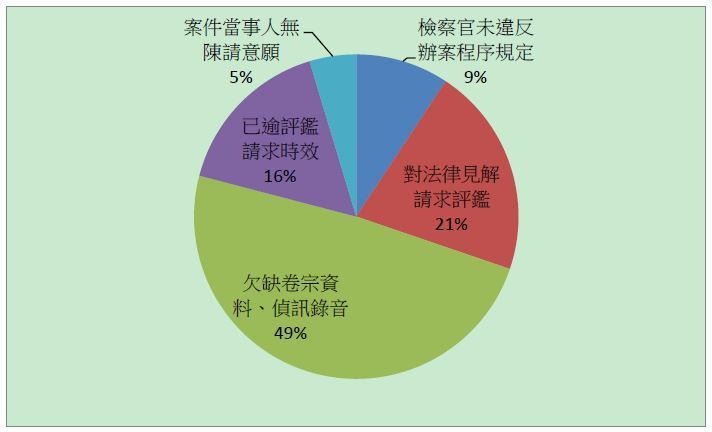
Reason Prosecutor Did Not Violate
Procedural RegulationsRequesting Evaluation
Based on Legal InterpretationLack of Case Files or
Interrogation RecordingsExpiration of Evaluation
Request Time LimitCase Party Unwilling
to PetitionCases 4 9 21 7 2 -
Foreseeable Expiration of the Two-Year Time Limit for Evaluation Requests
The initiation of individual evaluations under the Judges Act requires the JEC and PEC to conduct a formal review upon handling evaluation request cases to confirm the absence of circumstances precluding evaluation as stipulated in Article 37 of the Judges Act[12] before proceeding to substantive reviews of whether evaluation grounds exist. As described in Chapter 2, the JRF's handling of public petitions for judge and prosecutor evaluations relies heavily on the participation of volunteer attorneys. Due to limited resources, the procedural matters stipulated in Article 37 of the Judges Act also become primary items for the JRF to verify. Among them, "exceeding the evaluation request period" (Article 37, Subparagraph 2 of the Judges Act) and "requesting evaluation based on legal interpretation" (Article 37, Subparagraph 4 of the Judges Act) rank as the second and third largest reasons for the JRF evaluating not to submit prosecutor evaluation requests.
The prominent ranking of "exceeding the evaluation request period" stems fundamentally from the fact that the PEC has practically hollowed out the exceptional provisions regarding the time limit for individual evaluation requests through its resolutions. Specifically, Article 36 of the Judges Act stipulates that the time limit for requesting an individual evaluation of a judge is 2 years. For individual evaluation request cases involving cases handled by a judge, the 2-year time limit is calculated in principle from the date of "case closure"[13], with an exception extended to the date of "judgment finality or 6 years from court docketing" in cases of "manifest and gross errors in the case"[14]. However, the Judges Act has no direct and explicit provisions regarding the calculation of time limits for individual evaluation requests concerning prosecutors. It must be inferred indirectly whether a prosecutor evaluation request is submitted within the "statutory" time limit through the application mutatis mutandis of Article 36 of the Judges Act via Article 89, Paragraph 1 of the Judges Act.
Regarding how to calculate the time limit for prosecutor individual evaluation requests, the first PEC, besides referencing the views of JEC resolutions—defining the "date of case closure" as the date when "the case is detached from the evaluated prosecutor and the investigative result can no longer be altered," i.e., the date of indictment, non-prosecution, or deferred prosecution—also affirmed that the scope of application mutatis mutandis under Article 89, Paragraph 1 of the Judges Act includes the proviso of Article 36, Paragraph 2. It stated that if the evaluated prosecutor "intentionally and severely infringed upon citizens' rights, resulting in manifest and gross errors in the investigative case," the evaluation request period may be extended to be calculated from the date of final court judgment[15].
Viewed purely from the normative structure of Article 36 of the Judges Act, calculating the time limit for judicial evaluation requests from the date of final judgment is an exceptional provision. Its purpose is to encourage the prompt submission of evaluation requests by employing a request period much shorter than the exercise period for disciplinary sanctions stipulated in the Civil Servant Discipline Act[16][17]. However, since the JRF established its grievance center in 2012 to accept public petitions for judge and prosecutor individual evaluations, its experience from telephone consultations and actual case intake shows that, constrained by the rule that files can only be reviewed after indictment or when applying for adjudication delivery, defendants who have been indicted constitute the majority of those able to prepare materials enabling the JRF to confirm the submission of prosecutor evaluation requests. Yet, most indicted defendants are exhausted by the trial proceedings and have no time to contemplate petitioning for individual evaluations against prosecutors. Once the trial proceedings conclude, two years have often long since passed since the date of indictment. When existing normative forms remain unchanged, active application by the PEC of exceptional provisions regarding request time limits is the key to preventing the prosecutor individual evaluation system from falling into an unworkable predicament.
Judging from resolution documents, the second PEC not only failed to attempt any relaxation in the method of calculating the timing for request limits like the first PEC did, but even created requirements absent from the text of the Judges Act, leaving no room for the exceptional provisions to apply (see Table 3-2).
For example, in resolutions 103-Yuan-Ping-Zi No. 11, 104-Yuan-Ping-Zi No. 003, and 104-Yuan-Ping-Zi No. 009, the PEC uniformly classified the misconduct patterns of the evaluated prosecutors under other matters pursuant to Article 89, Paragraph 4, Subparagraph 1 of the Judges Act, which failed to meet the normative requirements of Article 37, Paragraph 5 of the Enforcement Rules of the Judges Act[18], leaving no room for applying mutatis mutandis the exceptional provisions. This demonstrates that the PEC rigidly and inflexibly determined regarding identical prosecutor individual evaluation request cases that matters under Article 89, Paragraph 4, Subparagraph 1 of the Judges Act and those under other subparagraphs cannot coexist. Once a prosecutor's misconduct is more easily subsumed under other subparagraphs, the PEC ceases to consider whether it might simultaneously conform to Article 89, Paragraph 4, Subparagraph 1 of the Judges Act.
Furthermore, in 103-Yuan-Ping-Zi No. 15, when consenting to an application to revoke detention, the evaluated prosecutor verbally instructed the defendant not to return to work and not to contact defense counsel—actions clearly infringing upon the defendant's right to work and right to counsel. Although the JRF strenuously argued that this conformed to the misconduct facts regulated by Article 89, Paragraph 4, Subparagraph 1 of the Judges Act, the PEC misinterpreted the text of Article 89, Paragraph 4, Subparagraph 1 of the Judges Act, restricting the fact of "due to intent or gross negligence, causing manifest and gross errors that severely infringed upon citizens' rights" to those that "must await final judgment before being sufficient to ascertain," which already exceeds the scope of statutory interpretation.
Table 3-2: Cases Dismissed by the Second PEC Due to Expiration of the Two-Year Statute of Limitations
Case Number Grounds for Evaluation Request Reasons for Dismissal on Time-Limit Grounds 102-Yuan-Ping-Zi No. 22 Prosecutor handling major cases did not personally preside over hearings; all 11 investigative court sessions were conducted by judicial investigators, and the non-prosecution disposition was riddled with errors. - The Enforcement Rules of the Judges Act did not prescribe retroactive application for Article 36. Therefore, the calculation of the 2-year time limit for prosecutor evaluation should start from the date of case conclusion, rather than the date when the case became eligible for individual evaluation under the Judges Act (Jan. 6, 2012).
- The timing of the JRF's submission of the prosecutor evaluation request exceeded the 2-year period from the date of case conclusion (Mar. 1, 2011, dismissal of motion for re-investigation).
103-Yuan-Ping-Zi No. 01 Appealed to the Supreme Court without stating how the original judgment violated laws, thereby filing an abusive appeal. - The Enforcement Rules of the Judges Act did not prescribe retroactive application for Article 36. Therefore, the calculation of the 2-year time limit for prosecutor evaluation should start from the date of case conclusion, rather than the date when the case became eligible for individual evaluation under the Judges Act (Jan. 6, 2012).
- The timing of the JRF's submission of the prosecutor evaluation request exceeded the 2-year period from the date of case conclusion (Nov. 28, 2010, appeal to third instance).
103-Yuan-Ping-Zi No. 02 Appealed to the Supreme Court without stating how the original judgment violated laws, thereby filing an abusive appeal. The timing of the JRF's submission of the prosecutor evaluation request exceeded the 2-year period from the date of case conclusion (May 11, 2010, appeal to third instance). 103-Yuan-Ping-Zi No. 03 Appealed to the Supreme Court without stating how the original judgment violated laws, thereby filing an abusive appeal. - The Enforcement Rules of the Judges Act did not prescribe retroactive application for Article 36. Therefore, the calculation of the 2-year time limit for prosecutor evaluation should start from the date of case conclusion, rather than the date when the case became eligible for individual evaluation under the Judges Act (Jan. 6, 2012).
- The timing of the JRF's submission of the prosecutor evaluation request exceeded the 2-year period from the date of case conclusion (Jun. 1, 2010, appeal to third instance).
103-Yuan-Ping-Zi No. 04 After declaring an appeal to the Supreme Court, completely failed to submit a statement of reasons for appeal. - The Enforcement Rules of the Judges Act did not prescribe retroactive application for Article 36. Therefore, the calculation of the 2-year time limit for prosecutor evaluation should start from the date of case conclusion, rather than the date when the case became eligible for individual evaluation under the Judges Act (Jan. 6, 2012).
- The timing of the JRF's submission of the prosecutor evaluation request exceeded the 2-year period from the date of case conclusion (Jan. 18, 2007, appeal to third instance).
103-Yuan-Ping-Zi No. 05 The crime of fraud is legally unappealable to the third instance, yet appealed to the Supreme Court. - The Enforcement Rules of the Judges Act did not prescribe retroactive application for Article 36. Therefore, the calculation of the 2-year time limit for prosecutor evaluation should start from the date of case conclusion, rather than the date when the case became eligible for individual evaluation under the Judges Act (Jan. 6, 2012).
- The timing of the JRF's submission of the prosecutor evaluation request exceeded the 2-year period from the date of case conclusion (Apr. 28, 2011, appeal to third instance).
103-Yuan-Ping-Zi No. 06 Defendant acquitted in first and second instances, yet ignorantly of Article 9 of the Act for Speedy Trial, abusively appealed to the Supreme Court. The timing of the JRF's submission of the prosecutor evaluation request exceeded the 2-year period from the date of case conclusion (Jun. 2, 2011, submission of reasons for appeal). 103-Yuan-Ping-Zi No. 11 When investigating the corruption case involving CH'EN I-chen, leaked to the media that the "Anyan Project" involved classified diplomacy, severely violating the principle of non-disclosure of investigation and leaking state secrets. - The Enforcement Rules of the Judges Act did not prescribe retroactive application for Article 36. Therefore, the calculation of the 2-year time limit for prosecutor evaluation should start from the date of case conclusion, rather than the date when the case became eligible for individual evaluation under the Judges Act (Jan. 6, 2012).
- The grounds for evaluation raised by the JRF against the prosecutor (violating non-disclosure of investigation) fall under Article 89, Paragraph 4, Subparagraph 5 of the Judges Act, not Article 89, Paragraph 4, Subparagraph 1. Therefore, the 2-year statute of limitations for this individual evaluation request cannot be calculated from "the time of judgment finality." (Article 36, Paragraph 2, latter part of the Judges Act)
- The timing of the JRF's submission of the prosecutor evaluation request exceeded the 2-year period from the date of case conclusion (Sep. 22, 2009, conclusion of investigation and filing of indictment).
103-Yuan-Ping-Zi No. 13 Perfunctory case investigation; abusively indicted the defendant based on facts conflicting with medical professional opinions. The timing of the Taipei Bar Association's submission of the prosecutor evaluation request exceeded the 2-year period from the date of case conclusion (Sep. 28, 2011, conclusion of investigation and filing of indictment). 103-Yuan-Ping-Zi No. 15 When consenting to an application to revoke detention, verbally instructed the defendant not to return to work and simultaneously not to contact defense counsel, abusing compulsory measures and severely infringing upon the defendant's right to work and right to counsel. - The grounds for evaluation raised by the JRF against the prosecutor (verbal instruction not to return to work) can be ascertained without awaiting a final judgment, failing to meet the circumstances stipulated in Article 89, Paragraph 4, Subparagraph 1. Therefore, the 2-year statute of limitations for this individual evaluation request cannot be calculated from "the time of judgment finality." (Article 36, Paragraph 2, latter part of the Judges Act)
- The timing of the JRF's submission of the prosecutor evaluation request exceeded the 2-year period from the date of case conclusion (Jun. 30, 2011, conclusion of investigation and filing of indictment).
104-Yuan-Ping-Zi No. 003 When investigating a drug smuggling case, two years after a co-defendant was arrested, used a photograph of the defendant displayed on a remote system to order the co-defendant to make a single identification. After the co-defendant had already formed a false impression, interrogated the co-defendant again and presented the defendant's photograph for identification without informing that the accomplice might not be among them, leading to a false identification by the co-defendant. The matter involving the evaluated prosecutor falls under Article 89, Paragraph 4, Subparagraph 5 of the Judges Act, not Article 89, Paragraph 4, Subparagraph 1. The statute of limitations for the individual evaluation request continues to be calculated from the time of case conclusion (indictment), rather than judgment finality (Supreme Court dismissing the appeal), and has exceeded the two-year request period. 104-Yuan-Ping-Zi No. 009 When investigating a defendant for bodily injury resulting in death, intimidated the defendant into confessing with statements such as "If you are not honest, his ghost will come looking for you." Improper interrogation involving ghosts seeking revenge and threats of detention against the defendant constitutes an alleged violation of Article 89, Paragraph 4, Subparagraph 7 of the Judges Act ("severe violation of prosecutor ethics norms with serious circumstances"), and does not fall under individual evaluation matters stipulated in Subparagraph 1 of the same paragraph. There remains no room for applying the 2-year statute of limitations starting from "the time of judgment finality."
In short, when the Judges Act was legislated, the special nature of prosecutor evaluation cases was not taken into consideration, and it rigidly applied the same request period general rules as judge evaluation cases. Coupled with the fact that the PEC—which holds a voice in the individual evaluation system—strictly interprets exceptional provisions and even creates requirements absent from the statutory interpretation of the Judges Act, this profoundly affects the JRF's handling of public petitions for prosecutor evaluations. When encountering cases where more than two years have elapsed since the indictment/non-prosecution disposition was made, the JRF is forced to abandon the option of submitting evaluation requests.
IV. Sarcastic Remarks and Decontextualization: Toward a Professional Oversight Mechanism for Judges' Courtroom Demeanor
In November 2015, the JRF held a press conference releasing the 2015 Court Observation Report. Based on court observation records and judgments, it requested evaluations for four observed judges, triggering a strong backlash from the legal practice sector. Both the statement by the Judges Association[19] and opinion pieces by individual judges[20] heavily criticized the JRF's method of initiating the evaluation system on this occasion as "decontextualized" and "generalizing from particulars," and called upon the Judges Evaluation Commission to explore the context before and after questions and answers during deliberations in order to arrive at a "fair" evaluation result. The executive secretary who hosted the court observation project immediately published an op-ed reiterating the JRF's position: the legal community should break free from the myth of "focusing heavily on substantive law while neglecting procedural law" regarding judges with poor courtroom demeanor, allowing judges with inappropriate speech and conduct to be customer-complained against or even eliminated[21].
In May 2016, the JRF launched the "National Judicial Reform Movement," inviting the public to vote on judicial problems urgently in need of resolution. The voting results showed that "lack of clear and objective screening standards to truly eliminate incompetent judicial officers" made the list. Netizens further left comments expressing the view that Article 30, Paragraph 2 of the Judges Act is fraught with indeterminate legal concepts, and what kind of speech and conduct by a judge will be evaluated is tied to the unstable discretionary power of JEC commissioners. Minor flaws in a judge's speech and conduct, while not reaching the level of "incompetency," are nevertheless evaluated because the current Judicial Ethics Norms are overly vague and pitched too high, creating reverse selection and leaving judges vulnerable to criticism at every turn and at a loss as to what to do[22]. This echoed the events of November 2015, when judges, upon learning that the JRF had requested individual evaluations for four judges all at once, attempted through statements and opinion pieces to persuade the JEC to incorporate the "context before and after courtroom questions and answers" into its review criteria when deliberating individual evaluation requests.
Judging from the aforementioned op-eds by judges and netizen comments, judges' questioning and concern regarding "what kind of speech and conduct by a judge will be evaluated?" is built upon a hidden presupposition: evaluation means exit. However, if "evaluation" is placed back within the normative framework of the Judges Act, it will be found that the JEC's determination that an individual evaluation is "warranted" is merely a starting point. The JEC must further determine whether the evaluated judge has "disciplinary necessity," and subsequently route the evaluated judge into disciplinary or administrative punishment procedures respectively[23]. The exit that judges are so anxious about is merely one of the disciplinary types the evaluated judge may receive once disciplinary procedures are initiated. Furthermore, in cases where the evaluated judge is determined not to warrant evaluation, the Judges Act specially stipulates that the JEC may, depending on circumstances, transfer the case to the person holding the power of judicial supervision for sanction[24]. Briefly summarizing Articles 38 and 39 of the Judges Act, the Judges Act distinguishes the severity of flaws in a judge's speech and conduct based on "presence of evaluation grounds" and "disciplinary necessity," structuring three tiers of handling methods: (1) JEC determines evaluation grounds and disciplinary necessity exist: transfer to the Control Yuan (Article 39, Paragraph 1, Subparagraph 1 of the Judges Act); (2) JEC determines evaluation grounds exist but no disciplinary necessity exists: submit to the Personnel Review Committee of the Judicial Yuan (Article 39, Paragraph 1, Subparagraph 2 of the Judges Act); (3) JEC determines no disciplinary grounds exist but internal judicial supervision necessity exists: transfer to the person holding the power of judicial supervision for sanction. From these provisions, it can be seen that the task entrusted to the individual judicial evaluation system is to target the diverse speech and conduct flaws of evaluated judges and initiate different handling mechanisms according to severity, rather than serving as an express highway directly leading to exit.
Returning to the question "what kind of speech and conduct by a judge will be evaluated?", Article 30, Paragraph 2 of the Judges Act enumerates 7 types of evaluation grounds: (1) Cases where a judgment has become final or has failed to become final within six years from the date of first-instance docketing, where there are factual grounds to believe that due to intent or gross negligence, there are manifest and gross errors in the adjudication of the case, severely infringing upon citizens' rights. (2) Circumstances under Article 21, Paragraph 1, Subparagraph 2, with serious circumstances. (3) Violation of the provisions of Article 15, Paragraph 2 or Paragraph 3. (4) Violation of the provisions of Article 15, Paragraph 1, Article 16, or Article 18, with serious circumstances. (5) Severe violation of case-handling procedural regulations or official duty regulations, with serious circumstances. (6) Delaying case proceedings without justifiable reason, thereby affecting the rights and interests of parties, with serious circumstances. (7) Violation of Judicial Ethics Norms, with serious circumstances. From the statutory structure, a judge merely violating behavioral norms does not necessarily lead to evaluation; the degree of violation must also reach "serious circumstances." As the common requirement "serious circumstances" across multiple evaluation grounds in Article 30, Paragraph 2 of the Judges Act, it indeed suffers from undefined terminology. In addition, the normative connotations of "severe violation" in Subparagraph 5, "without justifiable reason" in Subparagraph 6, and "Judicial Ethics Norms" in Subparagraph 7 are also actually highly ambiguous.
For the JRF, focusing on the fact that evaluation results help concretize evaluation grounds—especially the conceptual connotations of the behavioral norms involved—the process of requesting evaluations is also an attempt by the JRF to dialogue with the JEC and evaluated judges, using individual cases to persuade them: "What kind of behavior is unacceptable after all?"
A careful examination of the responses from the legal practice sector received by the JRF regarding cases where it requested evaluations, as well as the resolution results of the JEC, reveals a clear lack of consensus between the JRF and the legal practice sector on the question "what kind of speech and conduct by a judge will be evaluated?" in cases involving "poor courtroom demeanor." In particular, extreme divergence of views has emerged on the question of "what kind of courtroom demeanor should be evaluated?"
In the JRF's categorization structure for handling public petitions for judge evaluations, the classification category of "poor courtroom demeanor" broadly refers to all methods of directing litigation that cause persons present in the courtroom (including attorneys and case parties) to feel oppressed. Common petitioned evaluation patterns include forcing procedural decisions (forcing settlements, forcing withdrawals of claims, forcing withdrawals of appeals, etc.), directly venting emotions on persons present in the courtroom (screaming, mocking, scolding, slamming desks, rolling eyes, etc.), and obvious partiality toward one side. Because the Court Organization Act and the Codes of Procedure grant judges considerable discretionary space in how they direct litigation[25], a more precise description of "poor courtroom demeanor" should be "abuse of the power to direct litigation." The corresponding behavioral norm is primarily the Judicial Ethics Norms promulgated and issued by the Judicial Yuan on January 5, 2012. Those most frequently cited by the JEC during deliberations as supplementary provisions to Article 30, Paragraph 2, Subparagraph 7 of the Judges Act include Article 3: "In the performance of duties, a judge shall maintain fairness, objectivity, and neutrality, and shall not engage in conduct that impairs public trust in the judiciary."[26]; Article 5: "A judge shall maintain noble character, be prudent in speech and conduct, uphold integrity, and avoid improper conduct or conduct easily perceived as impairing the judicial image."[27]; Article 12, Paragraph 1: "A judge shall make adequate preparations before opening a court session; during court sessions, the judge shall listen objectively, fairly, neutrally, patiently, and politely, and safeguard the procedural rights or right to counsel of parties and interested persons."[28]; Article 12, Paragraph 2: "A judge shall maintain courtroom solemnity and order, and shall not revile, unreasonably reprimand, or otherwise conduct behavior impairing the dignity of persons present in the courtroom."[29]; and Article 12, Paragraph 3: "A judge may encourage and facilitate parties in conducting mediation, settlement, or resolving disputes through other appropriate means, but shall not do so in an improper manner."[30]
Through court observation and public petitions in 2015 and 2016, the JRF successively uncovered 5 judges who reprimanded, scolded, or mocked case parties during court sessions, believing they had seriously violated Judicial Ethics Norms and ought to be evaluated. Among them, 3 cases have already been definitively and entirely dismissed by the JEC (Table 4-1).
Table 4-1: Tracking Data on JEC Case Closures for JRF Evaluation Requests Based on Poor Courtroom Demeanor in 2015 and 2016
| Case Number | Facts Requested for Evaluation | Evaluation Resolution | Summary of Evaluation Resolution Reasons |
| 104-Yuan-Ping-Zi No. 11 |
The evaluated judge repeatedly exhibited the following situations in several cases presided over:
|
Regarding the parts shown in the schedule, no evaluation; remaining requests unfounded. |
No circumstances warranting individual evaluation as stipulated in Article 30 of the Judges Act.
|
| 105-Yuan-Ping-Zi No. 2 |
The evaluated judge exhibited the following situations when presiding over a tort damages case:
|
Regarding the parts shown in the schedule, no evaluation; remaining requests unfounded. |
No circumstances violating the provisions of Article 3, Article 12, Paragraph 1, or Paragraph 2 of the Judicial Ethics Norms.
|
| 104-Yuan-Ping-Zi No. 10 |
The evaluated judge exhibited the following situations in several cases presided over:
|
This request is unfounded. |
No grounds for individual evaluation.
|
Comparing these with the two cases of 103-Yuan-Ping-Zi No. 1 and 104-Yuan-Ping-Zi No. 2 where the facts requested for evaluation were similar, regarding "poor courtroom demeanor," aside from "tone/volume" raised in resolution 103-Yuan-Ping-Zi No. 1 and "phrasing and wording" raised in 104-Yuan-Ping-Zi No. 2, the JEC established a new evaluation indicator through resolutions 104-Yuan-Ping-Zi No. 11, 105-Yuan-Ping-Zi No. 2, and 104-Yuan-Ping-Zi No. 10: the subjective intent of the evaluated judge. Whether it was 104-Yuan-Ping-Zi No. 11 stating "the evaluated judge habitually speaks in a high volume with tight litigation direction," 105-Yuan-Ping-Zi No. 2 stating "subjectively, it is difficult to recognize any malicious intent to revile, unreasonably reprimand, or impair the dignity of the plaintiff," or 104-Yuan-Ping-Zi No. 10 stating "the evaluated judge's words all belonged to earnest admonitions in the style of earnest persuasion" and "the judge's intention was to advise the defendant to face themselves honestly, rather than publicly expressing disagreement with the defendant's non-guilty plea or having formed a mental conviction of guilt," all utilized the evaluated judge having "no malicious intent" or even being "out of good intentions" to negate the fact that the evaluated judge violated courtroom demeanor norms requiring "patient and polite listening and refraining from behavior impairing the dignity of persons present in the courtroom."
From the perspective of overseeing the abuse of litigation direction power, the JRF opposes treating the subjective intent of the evaluated judge as an important evaluation indicator. Judges are vested with adjudication, which forms part of state public authority. In the courtroom, the law grants judges immense power to direct litigation, and an asymmetrical power relationship in fact exists between judges and other participants in litigation proceedings. As the holders of power, the emotional fluctuations of judges are often the source of pressure for litigation participants, particularly defendants and witnesses who are ordinary citizens—ranging mildly from making them feel nervous and at a loss, to severely affecting their courtroom performance, and ultimately impacting public trust in the judicial system. This explains why a judge's violation of Article 12, Paragraph 1 and Paragraph 2 of the Judicial Ethics Norms is usually simultaneously recognized as conduct damaging the judicial image, thereby constituting a violation of Article 3 of the Judicial Ethics Norms as well[31]. Judges ignoring the subjective feelings of persons present in the courtroom actually reflects judges failing to perceive their own position of power. We therefore believe that judges need to be reminded. The JEC places excessive emphasis on the subjective intent of the evaluated judge, which instead intensifies the antagonism between the public and judges and is unconducive to enhancing judicial credibility.
V. External Oversight? Taking Seriously the Backlash from Evaluation Commissions
Before the enactment of the Judges Act, the accountability and exit of judges and prosecutors for illegal dereliction of duty were not outside the pale of disciplinary legal systems; rather, they were benchmarked against ordinary civil servants, applying the disciplinary system stipulated in the Civil Servant Discipline Act. The Judges Act drove reforms in the disciplinary system for judges and prosecutors. On one hand, it responded to external interference concerns arising from the application of the civil servant disciplinary system to judges and prosecutors; on the other hand, it established the individual judicial evaluation system as a preliminary procedure for discipline and administrative punishment. By introducing diverse external commissioners to form evaluation commissions, it made the individual judicial evaluation system a mechanism possessing external oversight characteristics, thereby enhancing public trust in the fairness of the evaluation commissions[32].
However, in the normative design of the Judges Act, depending on whether the subsequent procedures successively initiated by the JEC and PEC are disciplinary or administrative, they constitute multi-stage administrative procedures: individual evaluation → Control Yuan impeachment → Judicial Tribunal disciplinary judgment, and individual evaluation → personnel review → approval of administrative punishment, respectively[33]. It is only when the Judicial Tribunal renders a judgment and the Personnel Review Committee of the Judicial Yuan (hereinafter JY Personnel Review Committee) or the Prosecutor Personnel Review Committee (hereinafter Prosecutor Personnel Review Committee) passes a resolution that the legal effects of discipline/punishment can be determined to have occurred. The evaluated judge/prosecutor does not immediately attain accountability of discipline or punishment upon the creation of the JEC/PEC evaluation resolution. At this point, a question arises: Do the JEC's/PEC's determinations in evaluation resolutions regarding facts warranting evaluation, the subsumption of evaluation grounds, and the necessity of discipline/punishment bind subsequent procedural executors such as the Control Yuan, the JY Personnel Review Committee, and the Prosecutor Personnel Review Committee?
The JEC and PEC commenced operations on January 6, 2012. Among the evaluation cases closed thus far, the JEC has initiated subsequent disciplinary/punishment procedures for 25 cases, and the PEC for 23 cases (Table 5-1, Table 5-2).
Table 5-1: Statistical Results of Judges Evaluation Commission Case Closures
| Request Founded, Transferred to Control Yuan | Request Founded, Submitted to Personnel Review Committee | Request Unfounded, Judicial Supervision Recommended | Request Unfounded, No Judicial Supervision | No Evaluation | Other (Withdrawal, etc.) | |
| 2012 | 1 | 2 | 0 | 0 | 0 | 1 |
| 2013 | 3 | 0 | 1 | 1 | 3 | 1 |
| 2014 | 2 | 1 | 3 | 4 | 1 | 1 |
| 2015 | 5 | 3 | 1 | 5 | 1 | 0 |
| 2016 (Statistics up to Dec. 15, 2016) |
1 | 1 | 1 | 3 | 0 | 0 |
| Total | 12 | 7 | 6 | 13 | 5 | 3 |
Table 5-2: Statistical Results of Prosecutors Evaluation Commission Case Closures
| Request Founded, Transferred to Control Yuan | Request Founded, Submitted to Personnel Review Committee | Request Unfounded, Judicial Supervision Recommended | Request Unfounded, No Judicial Supervision | No Evaluation | Withdrawal | |
| 2012 | 1 | 0 | 0 | 0 | 0 | 0 |
| 2013 | 10 | 2 | 2 | 6 | 0 | 1 |
| 2014 | 2 | 1 | 1 | 5 | 10 | 0 |
| 2015 | 1 | 1 | 1 | 4 | 6 | 0 |
| 2016 (Statistics up to Aug. 31, 2016) |
1 | 0 | 0 | 0 | 0 | 0 |
| Total | 15 | 4 | 4 | 15 | 16 | 1 |
The JRF tracked these cases entering subsequent disciplinary/punishment procedures and found that the aforementioned questions are not purely academic discussions; discrepancies have indeed occurred between the Control Yuan's impeachment decisions, the JY Personnel Review Committee's/Prosecutor Personnel Review Committee's sanction decisions, and the JEC's/PEC's resolution contents:
-
Facts Warranting Evaluation Failing to Reach the Judicial Tribunal
(1) Control Yuan Impeachment Fails: PEC 102-Yuan-Ping-Zi Nos. 16, 18, and 19
The JRF and the Ministry of Justice requested individual evaluations from the PEC against then-Prosecutor-General HUANG Shih-ming, Special Investigation Division (SID) division chief YANG Jung-tsung, and SID prosecutor CHENG Shen-yuan. During the SID's handling of the 2011 Special-Other Case No. 61 involving judge CH'EN Jung-ho's corruption, these three individuals were alleged to have committed severe violations of prosecutor ethics norms, such as unauthorized wiretapping, illegal disclosure of wiretap transcripts, leaking secrets, violating administrative ethics and disrupting institutional order, and abusing power by holding press conferences. The PEC passed resolutions in 102-Yuan-Ping-Zi Nos. 16, 18, and 19 stating that evaluated person HUANG Shih-ming warranted discipline, submitted the case via the Ministry of Justice to the Control Yuan for review, and recommended removal from office. Evaluated person YANG Jung-tsung was found to warrant discipline, and the case was submitted via the Ministry of Justice to the Control Yuan with a recommendation of a reprimand. Evaluated person CHENG Shen-yuan was found to warrant discipline, and the case was submitted via the Ministry of Justice to the Control Yuan with a recommendation of a reprimand. Regarding evaluated person HUANG Shih-ming, Control Yuan members proposed impeachment twice, both of which failed[34].
(2) Scope of Impeachment Smaller than Scope of Recommended Discipline: JEC 103-Yuan-Ping-Zi No. 1 (consolidated with 103-Yuan-Ping-Zi No. 5 and 104-Yuan-Ping-Zi No. 1)
The JRF submitted an individual evaluation request to the JEC concerning three cases handled by judge TSENG Yu-ming while serving at the Taoyuan District Court, all involving violations of Judicial Ethics Norms. The JEC passed a resolution in 103-Yuan-Ping-Zi No. 1 (consolidated with 103-Yuan-Ping-Zi No. 5 and 104-Yuan-Ping-Zi No. 1), submitting the case via the Judicial Yuan to the Control Yuan for review, recommending the dismissal of judge TSENG Yu-ming from his judicial post and transfer to non-judicial duties. On June 14, 2016, the Control Yuan impeached judge TSENG Yu-ming under Impeachment Case No. 105-Yuan-Kai-Zi-21. However, upon comparing the investigation report produced by the Control Yuan on July 13, 2016, it was found that the scope of the Control Yuan's impeachment covered only the facts warranting evaluation ascertained in 104-Yuan-Ping-Zi No. 1, which was far smaller than the scope of discipline recommended by the JEC (Table 5-3).
Table 5-3: Comparison Table Between JEC Recommended Discipline Scope and Control Yuan Impeachment Scope
No. JEC Resolution Control Yuan Investigation 103-Yuan-Ping-Zi No. 1 Violation of Article 3, Article 4, and Article 12 of the Judicial Ethics Norms, with serious circumstances, warranting discipline: 1 According to the court clerk's testimony before the JEC, the evaluated judge indeed loudly scolded defendant CHUANG XX due to CHUANG XX falling back into a seated posture during interrogation, exhibiting improper speech and conduct, which is ascertained. 2 Furthermore, according to the testimony of a court clerk from another courtroom, the evaluated judge's attitude toward prohibiting defendants from cross-examining—aside from persons present on the 1st floor recognizing the volume of the loud scolding as akin to "raging," even reaching a degree where a court clerk on the 2nd floor could hear it—makes it clear that the evaluated judge's behavior and posture when prohibiting defendants from cross-examining ran counter to ethical norms requiring judges to maintain patience, sincere and polite attitudes, and refrain from harsh tones during litigation direction and interrogation. Whether these circumstances constitute grounds for sanctions by the person holding the power of judicial supervision under Article 21 of the Judges Act is appropriately left for the Judicial Yuan to consider and handle. 1 When judge TSENG Yu-ming tried case No. 102-Yi-Zi-225 involving fraud at the court on May 15, 2013, there was no audio recording file of that day's court session. 2 Parties and witnesses only gave statements based on personal memory, which is insufficient to prove that TSENG Yu-ming violated the Judges Act or Judicial Ethics Norms with serious dereliction circumstances, thereby giving rise to grounds for discipline subject to Article 49 of the Judges Act. - The testimonies of the court clerk and CHUANG LIU XX did not match in fact.
- The court clerk from another courtroom merely overheard what sounded like high-decibel sounds emanating from that courtroom upstairs.
- Defendant CHUANG XX suffered from severe hearing impairment.
103-Yuan-Ping-Zi No. 5 Violation of Article 166, Paragraph 1 and Paragraph 4 of the Code of Criminal Procedure, with serious circumstances, warranting discipline: During the defense counsel's chief examination, the evaluated judge repeatedly and suo motu interrupted the examiner's questioning without the purpose of clarifying unclear or inconsistent witness answers, intervening ex officio to question matters unrelated to the defense counsel's examination. Disregarding the defense counsel's objection that the "witness gave an answer irrelevant to the question," the judge improperly guided and caused the record to reflect all of witness LIN XX's responses to the aforementioned judge-intervened questioning as answers given to questions from defense counsel Chang attorney. Whether these circumstances constitute grounds for sanctions by the person holding the power of judicial supervision under Article 21 of the Judges Act is appropriately left for the Judicial Yuan to consider and handle: When judge TSENG Yu-ming tried case No. 102-Jian-Shang-Zi-492 involving offenses against good morals at the court on March 4, 2014, although he repeatedly intervened in advance to supplement questioning during cross-examination, he requested the witness to provide a further complete statement regarding their description, and the questioned content was not entirely unrelated to the questions the defense counsel intended to ask the witness. There was also prompting of the witness to answer regarding the defense counsel's questions. There is no evidence proving infringement upon the defense counsel's exercise of the right to cross-examine or distortion of the core meaning of the witness's statements with serious circumstances, thereby giving rise to grounds for discipline subject to Article 49 of the Judges Act. 104-Yuan-Ping-Zi No. 1 Violation of Article 3, Article 4, and Article 12 of the Judicial Ethics Norms, with serious circumstances, warranting discipline: Merely because the defendant engaged in repeated questioning and statements were interrupted by the defendant, the evaluated judge repeatedly rebuked the defendant with extremely high volume and an attitude of furious anger, further intimidating the defendant by claiming the defendant was "asking to be detained" or intended to "detain the defendant," thereby causing the defendant TSAI XX to repeatedly engage in self-harming behavior such as slamming their head against the desk. Clearly violated ethical norms and should be subject to discipline -
Personnel Review Committee Resolving Not to Sanction
(1) The JY Personnel Review Committee Overturning the JEC's Determination of Punitive Necessity: 104-Yuan-Ping-Zi No. 14
The JRF submitted an individual evaluation request to the JEC concerning judge WANG XX, judge CH'EN XX, and judge HUANG XX. While serving at the High Court, they formed a collegiate panel to try defendant WANG XX, who was accused of joint bodily injury resulting in death, in a retried case remanded by the Supreme Court. In both the first and second rulings extending detention, the reason given was: "The defendant was previously sentenced to 2 years imprisonment with 5 years probation finalized for a case violating the Narcotics Hazard Prevention Act, subsequently had probation revoked, and because he failed to report to serve his sentence, became a wanted fugitive... Consequently, there are sufficient grounds to believe the defendant has a risk of fleeing." However, this part referred to the criminal record of another defendant, constituting an error of attributing the wrong facts to the wrong person. The JEC passed resolution 104-Yuan-Ping-Zi No. 14, submitting judges WANG XX, CH'EN XX, and HUANG XX via the Judicial Yuan to be reviewed by the JY Personnel Review Committee. Judge WANG XX and judge CH'EN XX were recommended for a warning sanction; judge HUANG XX was recommended for a sanction of issuing an order urging attention.
The JY Personnel Review Committee announced on November 15, 2016, that former judge and division chief WANG XX and judge CH'EN XX under this court collegially tried the case in violation of Judicial Ethics Norms and were given a sanction of an oral warning[35], while contents regarding sanctions for judge HUANG XX were absent. Upon the JRF telephoning the Director of the Department of Personnel of the Judicial Yuan on November 23, 2016, the Director stated that the JY Personnel Review Committee recognized that the accompanying judge had received sufficient caution through the evaluation procedure and resolved not to take any action.
In other words, based on the fact that all three evaluated judges belonged to the same collegiate panel and must jointly bear responsibility for the flaws in the detention extension rulings, the JEC held that accompanying judges merely bore a lesser degree of culpability and still warranted accountability. However, the JY Personnel Review Committee overturned the JEC's determination that the accompanying judge warranted administrative punishment, failing to impose any sanction on the accompanying judge.
(2) The Prosecutor Personnel Review Committee Overturning the PEC's Determination of Punitive Necessity: 104-Yuan-Ping-Zi No. 5 [sic, 104-Yuan-Jian-Zi No. 5]
Citizen TSAI XX petitioned the JRF stating that prosecutor KUO XX served as the prosecuting prosecutor in Taoyuan District Court case No. 102-Su-Zi-852 involving forgery, and during the trial proceeding on February 27, 2014, ordered bailiffs to handcuff the defendant, severely infringing upon the defendant's personal freedom and right to reputation. After reviewing relevant case files and evidence, the JRF recognized that prosecutor KUO XX's aforementioned actions seriously violated professional regulations such as the Court Organization Act, and therefore requested the PEC to conduct an individual evaluation of prosecutor KUO XX. Since courtroom video footage clearly showed that Ms. TSAI had already been pinned to her seat by multiple bailiffs when she first banged her head, posing no risk to the personal safety of herself or others present in court, and prosecutor KUO XX nevertheless "directly spoke out and gestured demanding bailiffs to handcuff the defendant on the spot without awaiting the presiding judge's order," it was apparent that she had encroached upon the statutory power of the presiding judge to direct litigation. The PEC resolved that the grounds for request were founded, but considering that the evaluated prosecutor had relatively few years of seniority and encountered a defendant whose emotions were out of control, she was not sent to the Control Yuan, but instead transferred internally to the Prosecutor Personnel Review Committee for review[36]. However, according to media reports[37] and the official document content of the Ministry of Justice replying to the JRF's inquiry regarding the Prosecutor Personnel Review Committee's resolution results on May 19, 2016[37], the resolution result of the Prosecutor Personnel Review Committee was "no sanction," on the grounds that "KUO's actions merely urged the presiding judge to maintain courtroom order... and did not infringe upon the presiding judge's power to direct litigation..." This demonstrates that the Prosecutor Personnel Review Committee reinvestigated and re-determined the facts warranting administrative punishment ascertained by the PEC, thereby overturning the PEC's determination of punitive necessity.
The four cases enumerated above seem to imply that the JEC and PEC play merely initiating roles in multi-stage disciplinary/punishment procedures. The Control Yuan, the JY Personnel Review Committee, and the Prosecutor Personnel Review Committee can re-determine facts and re-evaluate the necessity of discipline/punishment without being bound in the slightest by the resolutions of the JEC and PEC. This inevitably raises doubts that the complex procedural design of the Judges Act is sheer duplication.
Moreover, the aforementioned cases where the JEC and PEC encountered backlash in personnel review committees directly touch upon a fundamental question concerning the very meaning of the JEC's and PEC's existence: Compared to the JEC and PEC being independent agencies that independently conduct judge and prosecutor evaluations[38], the JY Personnel Review Committee and the Prosecutor Personnel Review Committee are merely units closed within the internal confines of the Judicial Yuan and the Ministry of Justice. If they are permitted to re-determine facts and re-determine the necessity of administrative punishment, the individual evaluation system—which possesses the characteristics of external oversight—is tantamount to being hollowed out by internal closed-organization personnel review procedures. This will further weaken the status and function of the JEC and PEC, severely striking the credibility of the individual evaluation system[40] and consequently leaving case parties, the JRF, and other users of the individual evaluation system at a loss as to what to follow.
VI. Conclusion: Serving Judicial Credibility Through the Individual Evaluation System
Summing up the practical reality of individual evaluation request work over the past five years, three factors have been found to be unfavorable to the individual evaluation system exerting its oversight role:
- Civic requesting groups are almost unable to initiate substantive reviews for prosecutor evaluation requests.
- The courtroom demeanor indicators established by the JEC are unhelpful in urging judges to improve improper methods of directing litigation.
- The JEC and PEC face the crisis of being hollowed out.
Constrained by resources and time, this observation report cannot carpet-bomb all issues regarding the actual operation of the individual evaluation system. However, we hope to use these three factors as a starting point to appeal that the government should examine the individual evaluation system—and the overall disciplinary/punishment system—from the perspective of "enhancing judicial credibility." After all, whether "freedom from arbitrary interference" or "exit mechanisms" are considered, they are merely means; the ultimate goal is to ensure fair trials and adjudication quality, and to build a judicial system worthy of public trust.
This article is an AI-generated translation of the original Chinese text. In the event of any discrepancy, the Chinese version shall prevail.