
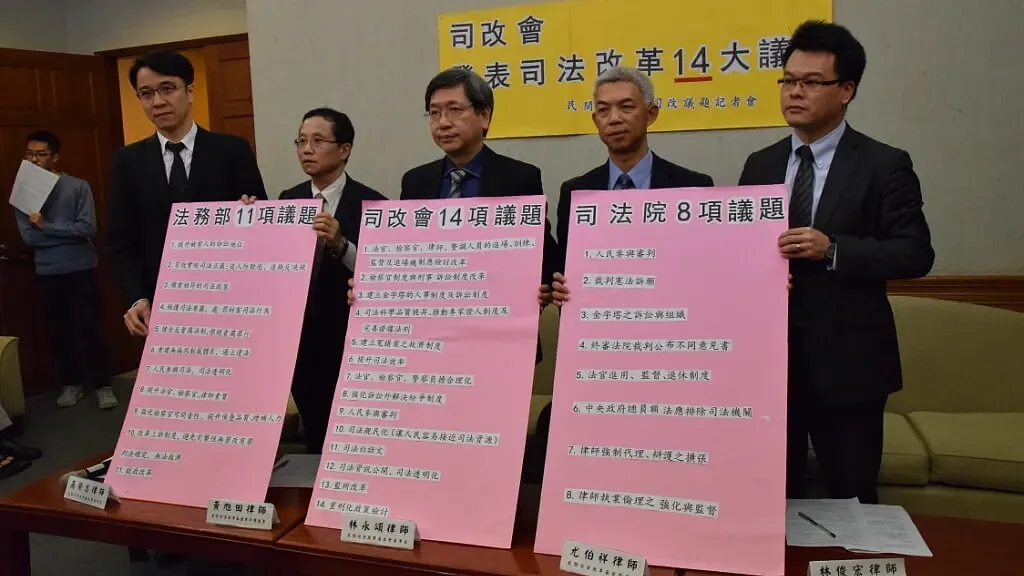
JRF Releases 14 Major Judicial Reform Issues - NGO vs. Official Judicial Reform Issues Press Conference
Last edited: 2026-07-27
In active response to the National Consultative Conference on Judicial Reform, the Judicial Reform Foundation (JRF) invited civil society organizations to separately visit the President of the Judicial Yuan on January 4 and the Minister of Justice on January 17. During these visits, they proposed procedural recommendations for the conference, various organizations shared their views on judicial reform, and the JRF officially released its core issues for judicial reform.
This press conference announced: 1. The JRF's 14 core issues for judicial reform; 2. Reform items recommended for immediate official implementation without waiting for conference meetings; 3. Procedural recommendations for the National Consultative Conference on Judicial Reform.
-
14 Core Issues for Judicial Reform
-
Review and reform the entry, training, supervision, and exit mechanisms for judges, prosecutors, attorneys, and law enforcement personnel
We must comprehensively review the examination, training, deployment, and elimination mechanisms for legal professionals. Specific issues include: making the judge selection process open and transparent, establishing a system for certifying specialized areas of practice for attorneys, reviewing police performance and reward-punishment systems, establishing a Judiciary Evaluation Foundation, and subordinating the Judges Academy to the Judicial Yuan.
-
Reform of the prosecutor system and criminal procedure system
Put forward the policy direction for "reform of the prosecutor system and criminal procedure system," re-examine prosecutorial organization, the identity and status of prosecutors, and related criminal procedure complements; strengthen the functions of prosecutors' meetings to implement internal democracy among prosecutors; and move toward implementing the system where prosecutors "attend and argue the cases they investigate."
-
Establish a pyramidal personnel and litigation system
Regardless of whether the Judicial Yuan/Supreme Court adopts a unitary or binary system, moving toward a pyramidal litigation system is currently a reform direction with a high degree of consensus. The JRF suggests that the reform of the litigation system must be paired with the personnel system to be complete.
-
Enhance the quality of forensic science, promote the expert witness system, and improve rules of evidence
Establish a national-level forensic science organization to ensure that government-affiliated forensic science units are equipped with sufficient, professional personnel and good equipment. Furthermore, complete, clear, and operational rules of evidence should be constructed to regulate judges' mental conviction and prevent the misuse or abuse of scientific evidence.
-
Establish a relief system for wrongful convictions
It is recommended to construct a review system independent of the judicial authorities to expand opportunities for retrial relief, and to establish an interdisciplinary research center for wrongful convictions to understand their causes, promote education on understanding the causes of wrongful convictions, and carry out institutional reforms based thereon.
-
Enhance judicial efficiency
In addition to implementing centralized trial systems, a review should also be conducted on how to improve trial delays caused by the reassignment of judges.
-
Rationalize the workload of judges, prosecutors, and police
The government should study plans to rationalize the workloads of judges, prosecutors, and police. Only when the workloads of judicial personnel are rationalized can judicial quality be enhanced. Specific measures include: the effective reallocation of judicial resources, the simplification and improvement of judgments and legal documents, and the review of relevant laws to avoid unnecessary judicial caseloads.
-
Strengthen alternative dispute resolution (ADR) systems
To reduce the consumption of litigation resources and pursue the maximization of mutual interests, alternative dispute resolution mechanisms should be strengthened, such as implementing the mediation system and strengthening the arbitration system.
-
Public participation in trials
To carry out institutional reform, sufficient communication is required. Empirical methods should be used to thoroughly research and evaluate the feasibility of implementing the lay judge system (lay participation) and the mixed-court system (assessor system) in Taiwan, conduct elaborate simulations, engage in dialogue, and propose complementary measures.
-
Make the judiciary approachable to the public (making judicial resources accessible to the people)
Regarding public feedback that people do not know what to do when facing a lawsuit, nor how to find a good attorney, the government should study the causes and propose solutions to facilitate public access and utilization of judicial resources.
-
Plain-language judiciary
Promote plain-language terminology in court proceedings and legal documents so that the judiciary can be understood by the general public, thereby increasing public trust in the judiciary.
-
Judicial information disclosure and judicial transparency
In addition to judgments and judicial information being made public, prosecutors' documents should also be moderately disclosed. In the event of high-profile trials, consideration can be given to the scope and manner in which court proceedings are live-streamed. Information regarding judges, prosecutors, and attorneys should be moderately disclosed by the Judicial Yuan, the Ministry of Justice, and bar associations respectively, to ensure judicial transparency and gain public trust.
-
Correctional institution reform
In addition to improving living, sanitary, and medical conditions within correctional institutions and deploying sufficient medical personnel, it is also necessary to strengthen the rehabilitative function of prisons. For example, teams consisting of psychologists, social workers, and vocational training instructors should be incorporated to plan and execute reintegration programs.
-
Review of the policy of severe punishment
Rigorous research should be conducted to understand the causes of various types of crimes, design crime prevention strategies targeting those causes, periodically review the effectiveness of these strategies and whether adjustments are needed, and establish an inter-ministerial consultation platform to coordinate the direction of criminal policy amendments. Regarding crimes related to drug or alcohol addiction, a review should be conducted on whether imprisonment helps with prevention, and research should be done on how to design programs for drug or alcohol addicts that aid in addiction recovery and harm reduction, enabling them to survive in society.
-
-
Reforms that the Judicial Yuan and the Ministry of Justice Can Implement Immediately
Our foundation and civil society organizations jointly visited the President of the Judicial Yuan and the Minister of Justice. For issues where consensus was already reached between officials and civil society during the visits, we demand that officials prioritize reform so that the public can immediately feel the impact. The agreed-upon issues are as follows:
-
Issues related to the Judicial Yuan
Issues within the remit of the Judicial Yuan do not need to be submitted to the National Consultative Conference on Judicial Reform; they can be researched and handled immediately by the Judicial Yuan's internal Judicial Reform Promotion Task Force. Examples include publishing rosters of judges and case distributions, and promoting plain legal language.
-
Issues related to the Ministry of Justice
Examples include: publishing indictments and other prosecutorial documents, requiring prosecutors to display name tags during court hearings, and displaying the names of the handling prosecutors on judgments.
-
-
Procedural Recommendations for the National Consultative Conference on Judicial Reform
- In addition to online collection, physical opinion collection should be conducted concurrently, and the process of selecting issues should be made public.
- Members of the consultative conference should introduce diverse viewpoints, and qualification standards should be published.
- Preparatory meeting and sub-committee meeting procedures must be open and transparent.
- Standing committees should hold regular meetings and incorporate the views of stakeholders.
Attending Representatives
Lin Yung-sung, Chairperson, Judicial Reform Foundation
Huang Hsu-tian, Standing Board Director, Judicial Reform Foundation
Yu Po-hsiang, Board Director, Judicial Reform Foundation
Lin Chun-hung, Standing Executive Committee Member, Judicial Reform Foundation
Kao Jung-chih, CEO, Judicial Reform Foundation
Press Contact
Kao Jung-chih, CEO, Judicial Reform Foundation 02-2523-1178
This article is an AI-generated translation of the original Chinese text. In the event of any discrepancy, the Chinese version shall prevail.