
[Tone-Switching Lecture] You Are a Human Being First, and a Attorney Second: Attorney Lo Wan-ting
Last edited: 2026-07-27
Attorney Lo Wan-ting began by sharing her experience of finding a law firm. Unlike most lawyers who look for openings on job banks or rely on word-of-mouth recommendations from teachers and classmates, she started by searching online for the specialized fields of various law firms. She selected the ones that interested her and sent self-recommendation letters hoping to learn at those firms. Through this serendipitous path, she began apprenticing under Attorney Yu Po-hsiang, a mentorship that continues to this day.
For junior attorneys, choosing their first law firm with care is crucial. Unless facing financial difficulties, salary should not be prioritized too heavily. What matters most is to follow a boss who is willing to invest time and effort in guiding junior practitioners, much like how an advisor has a profound impact on graduate students. The kind of lawyer a boss is determines the kind of lawyer a junior attorney will eventually become. Whether to call it fortune or misfortune, Attorney Lo met a boss willing to guide her growth, yet because of Attorney Yu's steadfast commitment to social justice, she was also exposed to a large number of public-interest cases.
"Actually, I have never dared to call myself a public-interest lawyer, because to me, that is an extremely noble profession. Yet because it is thankless and unrewarding, I always consider myself a foolish lawyer," Attorney Lo laughed. Speaking about her reflections on handling public-interest cases over the years, she noted that a quote by the Japanese writer Haruki Murakami perhaps best captures it: "Between a high, solid wall and an egg that breaks against it, no matter how right the wall may be and how wrong the egg, I will always stand with the egg."
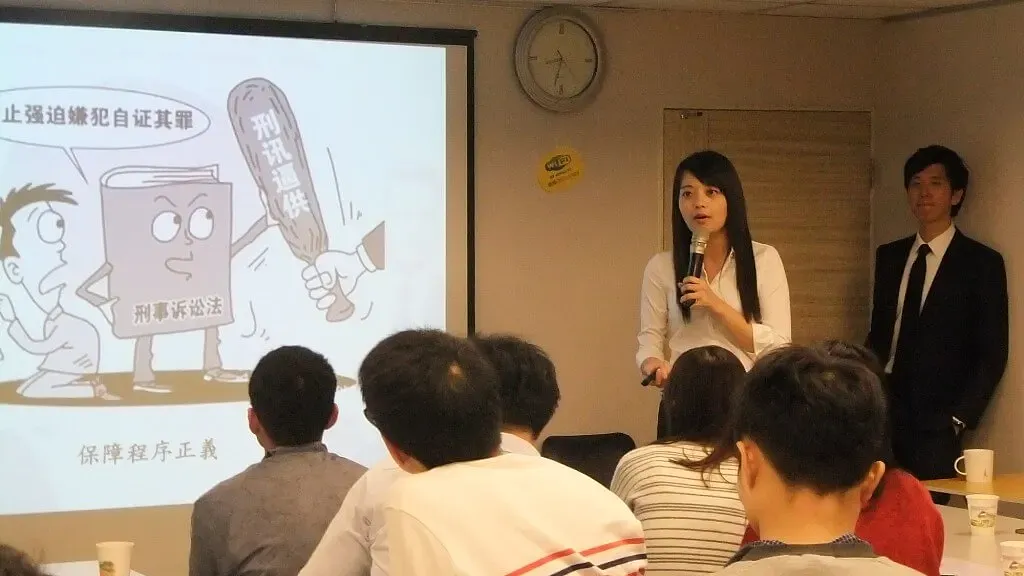
The hardships of handling public-interest cases go without saying, and a recurring dilemma faced by lawyers undertaking such cases is: What should be done if the client actually committed the crime? To the general public, the evidence against Cheng Chieh, who committed the MRT stabbing attack, was conclusive. Why would a lawyer abandon their conscience to defend such a person? Attorney Lo also fell into this dilemma when she first began practicing, and only found her answer after working in the field for some time. She believes that the notion of "defending bad people" is open to debate. A lawyer's enduring conviction should be to safeguard procedural justice; anyone and everyone has the right to a fair and just trial. If the presumption of innocence cannot be upheld, and a person is deemed guilty from the outset, they are inevitably degraded to a non-human existence, reduced to a depersonalized procedural label. Naturally, one could no longer expect the defendant to receive a fair trial.
"Enabling a defendant to be treated as a 'human being'" is what Attorney Lo regards as the greatest value of a criminal defense lawyer. The judges presiding over a trial only have the opportunity to meet defendants inside the courtroom; they do not understand the defendants' upbringing, nor do they know why such personalities were shaped. Relying solely on cold case files to determine a defendant's life—once the judgment is rendered, it may look like a perfect conclusion to the matter, but who can convey the defendant's voice, and who can hear their inner cries from the heart? Only the defendant's retained counsel can, because in the courtroom, only the defense lawyer spends the most time with the client. The only person who has the chance to understand the client, and the only one who can add a touch of human warmth to the judge's detached stroke of the pen when writing a judgment, is the lawyer defending the defendant.
Finally, Attorney Lo shared advice once given to her by Attorney Yu Po-hsiang with the junior attorneys: "You are a human being first, and a attorney second." She hopes that every junior attorney will uphold empathy when handling cases in their future work.
This article is an AI-generated translation of the original Chinese text. In the event of any discrepancy, the Chinese version shall prevail.