
Who Turned Judicial Reform into Political Maneuvering?
Last edited: 2026-07-27
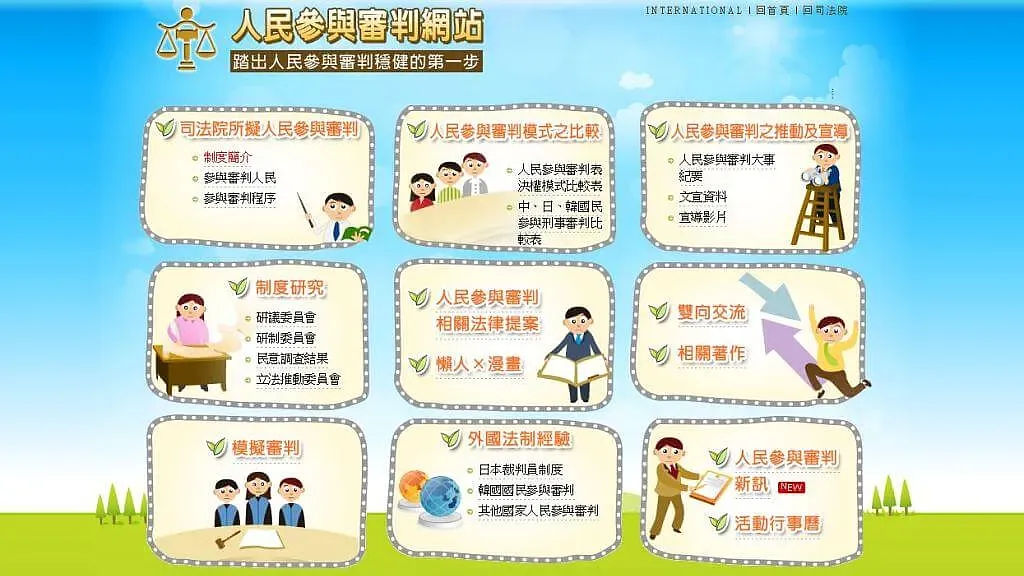
Three days before the 2012 presidential election, the Judicial Yuan officially announced the Draft Trial Regulations for Citizen Guanshen (Lay Observation), under which five citizen observers—randomly selected from citizens aged 23 and above—would participate alongside three judges in the district court's first-instance proceedings for serious criminal cases carrying a maximum sentence of death or life imprisonment. Although citizen observers could express their opinions, they had no power to participate in the decision-making process, and the final judgment was still rendered by the judges themselves. The Judicial Yuan declared at the time that, once the bill passed the Legislative Yuan, the "Guanshen system" would be adopted in the Chiayi and Shihlin District Courts starting January 1, 2013.
Two years have passed, and the Legislative Yuan has not even substantively deliberated the Draft Trial Regulations for Citizen Guanshen. Naturally, the "Guanshen system" has not been implemented in the Shihlin and Chiayi District Courts either. At the time, the Judicial Yuan's hasty and eager rollout of the Guanshen draft served no positive purpose whatsoever, other than adding a so-called "achievement" of promoting judicial reform to bolster Ma Ying-jeou's campaign for re-election. Instead, it triggered severe negative repercussions—arguably the most deplorable cautionary tale of politicians trampling on procedural justice and damaging the opportunities for judicial reform for the sake of personal gain.
Specifically, the outcry from civil society in the summer of 2010 against "dinosaur judges" and "corrupt judges" led to the resignation of the President and Vice President of the Judicial Yuan, and prompted Ma Ying-jeou to appoint Lai Hao-min and Su Yung-chin to lead the Judicial Yuan at the highest level. The so-called "Guanshen system" was proposed by Lai and Su when they assumed office in November 2010. In fact, grounded in the ideal of "judicial democratization," many civic groups and scholars not only favored the reform direction of "introducing public participation in trials," but had long advocated making judicial rulings closer to the life experiences of ordinary people—and thereby rectifying the malaise of judicial decisions being disconnected from social justice—through "group discussion and joint decision-making by cross-disciplinary representatives." However, civic groups harbored deep skepticism regarding the Judicial Yuan's planned trajectory for the "Guanshen system." Whether looking at the "jury system" adopted in Anglo-American jurisdictions or the "lay assessor system" adopted in continental Europe, citizens in both systems possess the actual power to participate in decision-making. In contrast, under the Guanshen system promoted by the Judicial Yuan, the opinions of citizen observers served merely as reference for the judges—completely violating the institutional spirit of public participation in trials and reducing the citizenry to mere window-dressing rubber stamps for judicial verdicts.
Faced with backlash from civil society, the Judicial Yuan established the "Advisory Committee on the Citizen Guanshen System" in early 2011. Although several academic members, including the author, initially doubted whether the Judicial Yuan had a predetermined stance and whether the advisory committee was merely a tool to whitewash the Judicial Yuan's established policy, we nevertheless agreed to participate in the committee's operations upon receiving the Judicial Yuan's guarantee that "there is absolutely no predetermined stance." However, throughout the subsequent deliberation process, what we witnessed was the Judicial Yuan continuously engaging in media public relations maneuvers, violating its commitments by disseminating manipulated polls "supporting the Guanshen system," and deliberately dodging the most crucial core issue: whether citizens should be granted the power to jointly render judgments with judges. Consequently, before the committee could conduct substantive discussions and make a decision, the media disclosed in June the specific details of the "Guanshen system" the Judicial Yuan intended to adopt, explicitly pointing out that the Judicial Yuan would conduct a pilot program in the Chiayi and Shihlin District Courts.
Subsequently, the author, along with fellow committee member Wang Chao-p'eng (Professor at National Taiwan University College of Law) and Lin Yü-shun (Professor at Central Police University Department of Law), co-authored an op-ed criticizing the Judicial Yuan for making decisions on major judicial reform issues through an arbitrary and crude process, declaring that the establishment of the "Advisory Committee on Public Participation in Trials" was fundamentally a scam. As a result, perhaps realizing that the negative evaluations of the "Guanshen system" by academic and civil society representatives on the committee could not align with the Judicial Yuan's "established policy direction" and "special schedule requirements," the Judicial Yuan abruptly decided to hastily dissolve the committee in July 2011, which was originally scheduled to operate until January 2012. Afterward, Shen Yü-mei, a retired teacher from Taipei First Girls' High School and a civil society representative, pointedly remarked: "One could hear the Chairman's [referring to Su Yung-chin] impatience with our clear support for voting rights . . . I worry that the new system produced will likely run counter to public expectations, or, as friends predicted, simply serve to rubber-stamp the ruling party's election gimmicks."
The greatest malignant fruit of judicial reform driven by electoral maneuvering is not that Teacher Shen Yü-mei's words proved prophetic, but rather that after undergoing such a crude and arbitrary process, the masterminds could no longer swallow their pride to admit their mistakes. Despite wave after wave of protests from civil associations, legal professional groups, and scholars, they arrogantly pressed forward. Consequently, even though the Legislative Yuan had long ago passed a resolution demanding that the Judicial Yuan impartially conduct empirical research and comparative evaluations on different systems—such as the jury system, the lay assessor system, and the Guanshen system—the Judicial Yuan treated congressional resolutions as a dead letter. Over the past two years, it has squandered a massive budget buying advertisements to promote its exclusively self-created "Guanshen system," while persistently refusing to earnestly carry out the most vital foundational work.
If the Judicial Yuan had been able to genuinely keep judicial reform in mind starting in 2011, adopted an open attitude, listened to the voices of the people, and joined hands with civic groups to jointly promote the construction of a public participation system in trials, it would not have ended up wasting three full years. Not only would society still harbor strong opposition to the Guanshen system, but even ruling-party legislators would have bluntly stated that a system where you are "only allowed to watch, not allowed to judge" is a complete sham.
Now, hearing Ma Ying-jeou—who just last September joined hands with Huang Shih-ming to completely trash the credibility of the entire prosecutorial system in one fell swoop—suddenly step forward to vigorously promote the "Guanshen system," claiming that Taiwan's current judicial problem lies in the public's lack of trust in the judiciary, and stating that promoting judicial reform should not involve political considerations, I feel only a profound sense of sorrow.
※ This article was published on February 24, 2014 by Apple Daily
This article is an AI-generated translation of the original Chinese text. In the event of any discrepancy, the Chinese version shall prevail.